

Engineering Guide: How to Select High Pressure, High Speed & High Airflow DC Blowers for Industrial Cooling
Modern industrial thermal management systems—ranging from high-density server racks and automotive LiDAR cleaning systems to medical diagnostic hardware and automated pneumatic lines—face a severe physical constraint: massive internal system impedance. When airflow passes through densely packed heat sink fins, HEPA dust filters, narrow ductwork, sealed enclosures, or multi-layer PCB stacks, standard axial fans stall. Their low static pressure capability leads to a drastic drop in actual airflow CFM, causing thermal throttling, component overheating, premature hardware failure, and costly operational downtime.
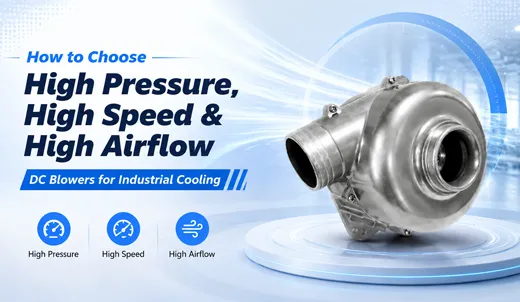
To overcome high system resistance, engineering teams require industrial-grade high pressure DC blowers that deliver three essential metrics simultaneously: extreme static pressure to push through obstruction, high rotational speed (RPM) to maintain head pressure, and high airflow (CFM) to dissipate accumulated thermal loads rapidly. Unlike standard cooling fans, high-performance DC centrifugal blowers leverage specialized scroll housings and backward-curved impellers. This structural architecture ensures a stable pressure-airflow curve even under steep backpressure, allowing 24/7 continuous duty in harsh industrial environments.
For OEM design engineers, procurement specialists, and thermal system integrators, selecting the incorrect blower introduces severe risks: power semiconductor overheating, manufacturing process temperature fluctuations, reduced bearing L10 lifespan, excessive acoustic noise, and failure to comply with international aerodynamic testing standards like ISO 5801 and AMCA 210. This comprehensive guide provides actionable selection frameworks, technical comparisons, and engineering formulas to help you specify the exact high-pressure, high-speed, high-airflow DC blower required for your application. Discover TKFAN’s certified lineup by visiting our high pressure DC blower product catalogue.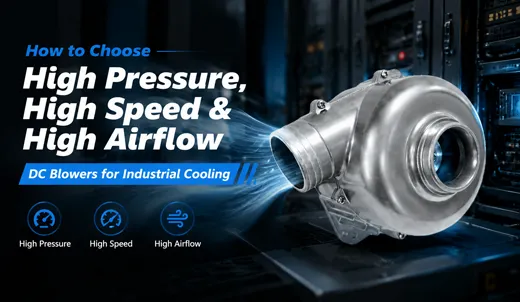
2. Key Technical Parameters: Static Pressure, Rotational Speed, and Airflow Dynamics
Precise selection requires a thorough understanding of the three core metrics defining high-performance DC centrifugal blowers and how they interact within an enclosure.
2.1 High Static Pressure (kPa / Pa / mmH₂O)
Static pressure represents the maximum force a blower exerts to overcome resistance along an airflow path. High-pressure blowers force air through dense air filters, tight bend radius ducting, micro-channel heat sinks, and sealed chassis restrictions. While conventional axial fans generate less than 1 kPa of static pressure, TKFAN industrial DC blowers span a range of 2.9 kPa up to 24 kPa, specifically built for heavy-duty thermal management.
2.2 High Speed (RPM) and BLDC Motor Architecture
Speed measures the revolutions per minute (RPM) of the internal brushless DC (BLDC) motor. Higher rotational speeds directly drive pressure generation and air volume output. Driven by advanced internal or external BLDC controllers, TKFAN high-speed blowers operate between 28,000 RPM and 48,000 RPM. This ultra-high rotational capability allows compact frame sizes (e.g., 50x25mm, 70x50mm, 80x60mm) to achieve extreme static head pressure without increasing physical equipment footprints.
2.3 High Airflow Volume (CFM / m³/h)
Airflow volume (CFM) dictates the total volumetric rate of air moved by the blower per minute, determining how quickly thermal energy is transferred out of the system. While many low-cost fans advertise high free-air delivery, their airflow collapses when faced with real-world impedance. Industrial high-pressure blowers preserve over 80% of their rated airflow even when operating near maximum design backpressure.
2.4 Axial Cooling Fans vs. High Pressure DC Blowers
| Parameter | Standard Axial Fan | Industrial High-Pressure DC Blower |
|---|---|---|
| Max Static Pressure | < 1.0 kPa | 2.9 kPa to 24.0 kPa |
| Rotational Speed Range | 1,000 – 8,000 RPM | 28,000 – 48,000 RPM |
| Performance Under High Resistance | Airflow drops drastically; prone to stall | Maintains stable operating airflow curve |
| Housing & Airflow Path | Open frame, axial straight-through | Centrifugal scroll housing (90° intake-to-discharge) |
| Primary Industrial Applications | Unobstructed enclosure ventilation | Densely packed cabinets, HEPA filtration, targeted cooling |
3. The Affinity Laws: Balancing Speed, Static Pressure, and Power Consumption
The operational behavior of every high-speed DC centrifugal blower is governed by Fan Affinity Laws. Understanding these mathematical relationships allows thermal engineers to predict performance shifts when altering motor RPM:
- Airflow (CFM) is directly proportional to Speed (RPM): $CFM_2 = CFM_1 \times \left(\frac{RPM_2}{RPM_1}\right)$
- Static Pressure (kPa) scales with the square of Speed (RPM): $P_2 = P_1 \times \left(\frac{RPM_2}{RPM_1}\right)^2$
- Power Consumption (Watts) scales with the cube of Speed (RPM): $W_2 = W_1 \times \left(\frac{RPM_2}{RPM_1}\right)^3$
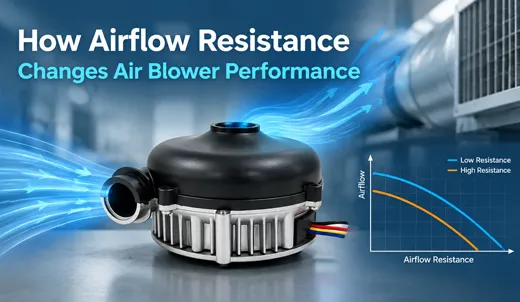
Engineering Note on System Impedance: The intersection of your system’s resistance curve and the blower’s P-Q (Pressure vs. Airflow) curve determines the actual operating point. Operating to the left of the peak pressure point can trigger aerodynamic stall, resulting in severe turbulence, elevated acoustic noise, and thermal runaway. TKFAN provides fully verified P-Q curves tested in accordance with AMCA 210 standards to guarantee precise operating point matching.
4. Step-by-Step Engineering Selection Framework for Industrial DC Blowers
To eliminate selection errors and prevent over- or under-specifying thermal components, follow this 7-step engineering checklist:
- Calculate Total Thermal Load (Heat Dissipation Rate): Determine the heat generation in Watts ($Q$) of all active electronics. Calculate required airflow using the heat transfer equation: $$CFM = \frac{3.16 \times Q_{Watts}}{\Delta T_{°C}}$$ where $\Delta T$ represents the maximum allowable internal temperature rise above ambient.
- Calculate Total System Pressure Loss: Sum all static pressure drops caused by dust filters, internal duct turns, component packing density, and chassis grilles. Add a minimum 20% safety margin to account for particulate buildup over time.
- Evaluate Envelope Dimensions: Measure available spatial boundaries within the equipment. TKFAN manufactures units ranging from compact 50x25mm blowers to robust 103x86x76mm heavy-duty models.
- Select Voltage Architecture (12V vs. 24V DC):
- 12V DC Blowers: Preferred for mobile automation, portable diagnostic gear, and battery-powered systems.
- 24V DC Blowers: Standard for industrial control cabinets, server racks, automotive OEMs, and heavy manufacturing machinery.
- Choose Motor Driver Configuration (Internal vs. External BLDC Driver):
- Internal Driver (Integrated): Plug-and-play design with built-in PWM speed control and FG tachometer signals (e.g., Model BA5025H24B-A).
- External Driver: Allows higher peak power throughput, custom commutation algorithms, and extreme static pressure capabilities up to 24 kPa (e.g., Model BA8060H24B-E).
- Verify P-Q Curve Operating Point: Cross-reference your required CFM at the calculated total pressure drop on the official TKFAN P-Q graph. Ensure the operating point stays within the stable airflow region.
- Confirm Environmental Protection & Bearing Life Requirements: For continuous industrial duty, specify dual precision ball bearings offering an L10 life expectancy $\ge 40,000$ hours at elevated temperatures, alongside IP54 to IP68 ingress protection ratings where moisture or dust is present.
5. Advanced Structural Features of Premium Industrial Blowers
High-speed operations demand superior structural engineering to resist mechanical wear and aerodynamic degradation. TKFAN industrial blowers incorporate specific design features to guarantee long-term stability:
- Precision-Engineered Backward-Curved Impellers: Molded or CNC-machined from reinforced engineering plastics or aluminum alloys, optimized to prevent airflow separation at speeds exceeding 40,000 RPM.
- Reinforced Scroll Housings: Thick-walled PBT/PC housings engineered to contain high static pressures without mechanical flexing or vibration leakage. Transparent housing options are available for visual flow validation in research labs.
- Dynamic Balancing to ISO 21940 G6.3: Every rotor undergoes multi-plane dynamic balancing to minimize operational vibration, reduce bearing stress, and lower acoustic emission.
- Encapsulated BLDC Stator Winding: Thermally conductive epoxy resin potting protects motor windings against environmental humidity, chemical vapors, and thermal shock.
6. Industrial Application Mapping: Recommended Blower Models
6.1 Autonomous Vehicle LiDAR and Sensor Cleaning
Requirements: Ultra-high instantaneous static pressure to clear debris, mud, and water droplets from optical sensors; compact footprint; 12V/24V compatibility.
Recommended Model: BA5030H12B-A (12V, 39,000 RPM, 6.15 kPa Max Pressure, 8.6 CFM Airflow).
6.2 High-Density Server Racks and Control Enclosures
Requirements: High airflow combined with high pressure to drive air through dense PCB arrays and dust filters continuously.
Recommended Model: BA8050H24B-A (24V, 45,000 RPM, 13.3 kPa Max Pressure, 25.9 CFM Airflow, Integrated PWM).
6.3 Medical Diagnostics & Laboratory Equipment
Requirements: Smooth, non-pulsating airflow through HEPA filters, low electromagnetic interference (EMI), and highly stable speed control.
Recommended Model: BA7060H24B (24V, 36,000 RPM, 7.4 kPa Max Pressure, 16.2 CFM Airflow).
6.4 Heavy-Duty Industrial Process Air & Pneumatics
Requirements: Extreme static head pressure, rugged casing, external PLC control compatibility.
Recommended Model: BA8060H24B-E-25KPA (24V, 24.0 kPa Max Pressure, 28.0 CFM Airflow, 280.8W Peak Power).
7. Industrial DC Blower Specification Matrix
The following performance matrix lists standard industrial models from the TKFAN high-pressure product line. Detailed engineering datasheets and CAD drawings can be accessed via our industrial blower product hub.
| Model Number | Dimensions (mm) | Voltage | Speed (RPM) | Max Pressure (kPa) | Max Airflow (CFM) | Driver Type | Primary Application |
|---|---|---|---|---|---|---|---|
| BA5025H24B-A | 50 x 50 x 25 | 24V DC | 38,000 | 4.81 | 11.1 | Internal | Medical & Compact Automation |
| BA5030H12B-A | 58 x 50 x 28 | 12V DC | 39,100 | 6.15 | 8.6 | Internal | Automotive LiDAR Cleaning |
| BA7050H24B | 70 x 66 x 45 | 24V DC | 37,000 | 7.89 | 17.8 | Internal | Industrial Cabinet Thermal Control |
| BA7060H24B | 70 x 70 x 60 | 24V DC | 36,000 | 7.40 | 16.2 | Internal | Medical HEPA Ventilation |
| BA8050H24B-A | 80 x 80 x 50 | 24V DC | 45,000 | 13.30 | 25.9 | Internal | High-Density Telecom & Servers |
| BA8060H24B-E | 86 x 82 x 60 | 24V DC | 48,000 | 18.20 | 25.1 | External | Industrial Process Blowing |
| BA8060H24B-E-25KPA | 86 x 82 x 60 | 24V DC | Ultra High | 24.00 | 28.0 | External | High-Resistance Pneumatic Systems |
8. Frequently Asked Questions (Technical FAQ)
Static pressure (measured in kPa, Pa, or mmH₂O) represents the blower's capability to push air through physical resistance like HEPA filters, dense heat sinks, and restrictive ducting. High static pressure ensures that airflow does not collapse when encountering system backpressure, guaranteeing consistent heat removal from enclosed industrial electronics.
According to the Fan Affinity Laws, airflow (CFM) increases linearly with motor RPM, while static pressure increases quadratically (with the square of the RPM). Doubling the speed quadruples the static pressure output, allowing high-speed blowers to achieve extreme pressure performance within small frame footprints.
Yes, specialized centrifugal blowers designed with high-speed BLDC motors and optimized backward-curved impellers—such as the TKFAN BA8060H24B-E series—deliver up to 24 kPa of static pressure alongside 28 CFM of airflow, spanning a wide operational envelope across challenging backpressure conditions.
All TKFAN industrial blowers are rigorously tested in compliance with ISO 5801, AMCA 210, and GB/T 1236 laboratory standards. Performance curves are measured using automated wind tunnel chambers to record precise P-Q points, acoustic levels (dBA), and motor winding thermal rise.
Yes. TKFAN provides full OEM/ODM engineering services, including custom winding voltages, modified mounting flanges, specialized harness/connector assemblies, custom PWM speed control curves, and enhanced IP68 water/dust proofing. Learn more on our custom blower manufacturing page.
Aerodynamic stall occurs when a blower operates to the left of its peak static pressure point on the P-Q curve. To prevent stall, calculate total system impedance accurately, include a 20% pressure safety margin, and ensure the operating point remains within the wide, stable airflow section of the published P-Q curve.
Integrated drivers place the control electronics inside the blower hub, streamlining wiring for standard 12V/24V applications. External drivers isolate the electronics from motor heat and mechanical vibration, allowing higher current throughput, advanced PLC communication, and extreme power outputs up to 280W+.
Industrial applications operate continuously at speeds reaching 48,000 RPM and ambient temperatures up to 70°C. Dual precision ball bearings prevent lubricant breakdown, maintain precise rotor alignment under vibration, and provide an L10 life rating exceeding 40,000 to 70,000 hours.
Pulse Width Modulation (PWM) allows the system controller to dynamically adjust blower RPM based on real-time temperature sensors. This optimizes cooling performance, reduces power consumption during low-load periods, and minimizes overall system acoustic noise.
Common errors include selecting blowers based solely on free-air CFM (ignoring system impedance), failing to account for filter dust clogging over time, using under-rated power supplies, and attempting to use low-pressure consumer axial fans in restricted airflow environments.