
How Does the Air Blower Intake Filter Direct Impact Maintenance Cycles and Total Operating Costs?
In continuous heavy-duty industrial processing—including municipal wastewater aeration, pneumatic conveying, aquaculture aeration, dust extraction, and printing—an industrial Air Blower serves as the indispensable heart of pneumatic operations. Maintenance teams traditionally base overall equipment overhaul routines on rigid calendar schedules or fixed operating hours. However, real-world data demonstrates that neglecting a relatively low-cost component—the air intake filtration system—can prematurely destroy bearings, erode impellers, degrade synthetic lubricants, and dramatically contract maintenance intervals.
When selecting a high-efficiency TKFAN Air Blower, engineers and plant managers frequently focus on nominal volumetric flow rate, discharge pressure , and motor shaft power. Yet, combining a premium performance Air Blower with inadequate, poor-quality, or clogged air intake filters introduces high differential pressure drops and abrasive particulate ingestion. This comprehensive technical guide analyzes the underlying physics, fluid dynamics, thermodynamic mechanics, and real-world failure modes governing how intake filters dictate maintenance frequency. You can explore standard engineering configurations and system reliability metrics directly on the official TKFAN Air Blower Product Hub.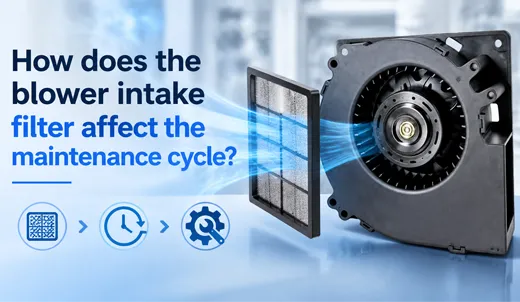
Executive Summary & Fundamental Takeaway: Intake filtration is not an optional accessory; it is the first defense line in rotating machinery reliability. A properly selected intake filter maintains design differential pressure drops below 250 Pa, prevents micro-particle impingement erosion on impellers, and extends bearing replacement intervals from under 2,800 hours to over 7,600 operating hours.
1. The Working Physics of Air Filtration: The Dual-Track Mechanics
An intake filter does far more than simply intercept visible dust. It directly modulates intake differential pressure drop, establishing a balance between two competing operating tracks:
- The Particulate Interception Track: High-efficiency media traps solid airborne particulates (salts, silica, metallic dust, fibers), mitigating surface erosion on rotors/impellers and keeping contaminants out of lubricant chambers. This extends overhaul intervals.
- The Aerodynamic Resistance Track: As particulate loading accumulates, intake vacuum resistance rises. Higher pressure drop alters operating point dynamics, driving thermal buildup and motor overload, which accelerates lubricant oxidation and reduces maintenance intervals.
Quantifying this effect, research published by the Pacific Northwest National Laboratory (PNNL, 2023, Building America Fact Sheet: Fan System Pressure Loss Impacts) demonstrates that every 1 kPa (100 mmH2O) of uncompensated intake pressure drop increases fan/blower shaft power requirements by 1.5% to 1.8%. This excess energy manifests as heat, driving up bearing thermal levels and accelerating lubricant breakdown.
Furthermore, practical test data from the Gardner Denver Positive Displacement Blower Operation & Maintenance Manual (2024) highlights the dramatic impact of filter selection on rotor clearances and maintenance cycles:
| Filter System Configuration | Impeller Erosion Rate | First Rotor Clearance Inspection | Average Bearing Replacement Interval |
|---|---|---|---|
| No Intake Filter (Unfiltered Air) | Baseline (100% Extreme Wear) | 2,000 Operating Hours | < 2,500 Operating Hours |
| MERV 8 Standard Media Filter | Reduced by 42% | 4,000 Operating Hours | 4,500 Operating Hours |
| MERV 13 Premium Industrial Filter | Reduced by 67% | 6,000+ Operating Hours | 7,600+ Operating Hours |
For every TKFAN Air Blower, operational curves and bearing L10h life metrics assume initial intake differential pressure remains below 250 Pa (with an upper alarm limit at 800 Pa). Operating above vendor differential pressure limits invalidates standard factory maintenance schedules.
2. Micro-Particulate Ingestion Paths and Mechanical Failure Modes
While coarse particles cause visible damage, fine sub-micron particulates present the greatest long-term operational threat. Technical studies from the Donaldson Filtration Institute (2022, Industrial Dust and Fan Component Wear Whitepaper) indicate that hard mineral particulates ranging from 1 to 10 μm cause the most destructive erosion on high-speed blowers.
In high-speed positive displacement and centrifugal equipment, impellers operate at tip velocities from 25 m/s to over 150 m/s. Micro-fine silica particles continuously striking rotor surfaces cause severe impingement erosion. As rotor profiles wear down, internal clearances expand, increasing internal air slippage and degrading volumetric efficiency. Plant operators often mistake this output loss for mechanical failure, performing premature and costly overhauls when an intake filter upgrade was all that was needed.
Secondarily, fine dust can breach labyrinth or lip seals, contaminating bearing oil reservoirs. Mixed with oil, microscopic particles form an abrasive slurry that rapidly scores rolling elements and raceways, generating elevated vibration levels. According to the international vibration monitoring standard ISO 10816-3:2009 (Evaluation of Machine Vibration by Measurements on Non-Rotating Parts), when overall vibration velocity exceeds 4.5 mm/s RMS, industrial equipment must undergo immediate inspection to avoid catastrophic failure.
Field data collected in the Blower Hub Field Reliability Survey for PD Blowers (2024) across 217 positive displacement units confirms that units operating with damaged or absent filters experienced average bearing failure at 2,800 hours. Conversely, units with properly specified MERV 10+ filtration systems maintained stable performance beyond 7,600 hours.
In coastal installations, marine mists introduce salt crystals that accelerate galvanic corrosion on internal cast iron or aluminum surfaces. Using water-repellent, anti-salt filter media can reduce marine corrosion incidents by up to 72% (SYKING Filtration, 2023, Coastal Air Intake Filtration for Rotary Blowers).
3. Filter Clogging Dynamics: The Three Operational Phases
As dust accumulates, an intake filter progresses through three distinct operational phases:
- Phase 1: Initial Clean State: Airflow matches baseline design performance. Thermal output, current draw, and bearing stress remain at optimal nominal levels. Regular maintenance schedules apply.
- Phase 2: Linear Dust Accumulation : Dust builds up on the media surface, gradually elevating intake restriction. Motor current rises slightly to maintain system pressure, and internal operating temperatures creep upward. Without differential pressure monitoring, this stage often goes unnoticed while compounding micro-wear.
- Phase 3: Critical Restriction & Alarm State: Air intake is severely choked, causing surge vulnerability in centrifugal units or dramatic volumetric efficiency loss in positive displacement blowers. Motors overheat, and lubricant thermal degradation accelerates exponentially.
A real-world engineering evaluation published by Endustra (2023, Case Study: Clogged Intake Filter Energy and Equipment Cost Analysis) evaluated a 20 HP Air Blower operating with a clogged intake filter. Delivered airflow dropped from 3,806 CFM down to 1,831 CFM—a 51.8% loss in output—while annual energy consumption increased by 8,818 kWh. This resulted in an extra $1,058 in electrical costs alongside severe thermal stress on motor windings and bearings.
4. MERV Selection Matrix for Air Blower Protection
Selecting the correct Minimum Efficiency Reporting Value (MERV) rating depends on operating environment dust levels, as outlined in the Carrier MERV Filter Selection Guide for Industrial Air Systems (2022):
| MERV Rating | Particle Size Efficiency | Ideal Operational Environment | Maintenance Impact on Blowers |
|---|---|---|---|
| MERV 4 – MERV 6 | < 20% for 3.0–10.0 μm | Clean indoor plant environment | High particle bypass; accelerates wear in dusty environments. Requires 50% shorter inspection intervals. |
| MERV 8 – MERV 10 | 50%–85% for 3.0–10.0 μm | Standard industrial & wastewater plants | Optimal balance of protection and restriction. Recommended baseline for standard TKFAN Air Blower installations. |
| MERV 11 – MERV 13 | 85%+ for 1.0–3.0 μm | Cement, mining, dusty outdoor environments | Prevents micro-particle erosion. Extends internal clearance life, but requires differential pressure monitoring due to faster dust loading. |
| MERV 14 – HEPA | 95%+ for 0.3–1.0 μm | Cleanrooms & specialized gas conveying | High initial restriction. Not recommended for standard industrial units without oversized filter housings. |
According to the HQFiltration Blower Intake Filter Sizing Handbook (2023), increasing filter surface area rather than simply raising the MERV rating allows higher particle capture efficiency without causing excessive pressure drop spikes.
5. Condition-Based Maintenance via Differential Pressure Monitoring
Relying solely on fixed calendar intervals (e.g., replacing media every 30 days) is inefficient. Seasonal humidity changes, sandstorms, and varying process dust concentrations can alter filter loading rates by up to 500%.
While polyester filter cartridges can be pulse-cleaned or blown off using compressed air during emergencies, repeated cleaning degrades fiber structure. Testing by Donaldson (2022) indicates that after three cleaning cycles, filtration efficiency drops by roughly 18%, while baseline pressure drop remains elevated. Compressed air cleaning should be treated as a temporary measure, not a replacement for fresh filter elements.
6. Standardized Maintenance Framework for Industrial Air Blowers
To maximize equipment service life and maintain optimal efficiency, plant engineering teams should incorporate these structured practices into their preventive maintenance programs for every TKFAN Air Blower:
- Engineering Selection: Match MERV rating and filter surface area to site dust conditions. Verify initial pressure drop stays below 250 Pa.
- Differential Pressure Instrumentation: Install analog differential pressure gauges or digital pressure transmitters tied to plant PLC systems for automated alarm triggers.
- Daily Logging: Log intake vacuum pressure drop, operating current, oil temperature, and housing vibration levels daily to spot early filter loading or bypass leaks.
- Interface & Seal Audits: Inspect rubber gaskets, mounting flanges, and filter housings during routine checks. Degraded housing gaskets can allow unfiltered air to bypass the filter element entirely.
- Oil Analysis Cross-Referencing: If routine oil analysis detects elevated silicon levels, inspect intake filters and ducting seals for leaks before changing oil.
7. Frequently Asked Questions (Technical FAQ)
Q1: How does intake filter pressure drop directly reduce total air blower volumetric output?
Intake restriction lowers inlet air density. Because an industrial Air Blower is a constant-displacement device by volume, reduced intake density lowers total mass airflow delivered to the process, decreasing effective system efficiency.
Q2: Can I use standard HVAC MERV 4 filters on a heavy-duty TKFAN Air Blower?
MERV 4 filters only capture large particles (>10 μm). Fine silica particles will pass through, eroding impellers and contaminating bearing grease. Standard installations should use MERV 8 to MERV 10 media at minimum.
Q3: Why does a clogged intake filter cause blower motor overheating?
A clogged filter creates a high vacuum on the intake side, forcing the motor to work harder against the increased pressure differential. This extra work raises current draw and operating temperatures across motor windings and bearing assemblies.
Q4: How often can a pulse-jet cleanable intake filter cartridge be reused?
Pulse cleaning or compressed air blow-downs are useful for short-term maintenance, but media fibers gradually degrade over time. We recommend replacing elements after 2 to 3 cleaning cycles to preserve capture efficiency.
Q5: What differential pressure reading indicates an intake filter needs replacement?
For most industrial units, initial clean pressure drop is under 250 Pa. Plan element replacement when differential pressure reaches 600 Pa, and perform mandatory replacement before reaching 800 Pa.
Q6: What is the primary cause of sudden bearing failure despite clean oil sight glasses?
Microscopic mineral dust entering through poor intake filtration can mix with bearing grease, creating an abrasive paste. This causes rapid surface wear on rolling elements even while oil appears clean in sight glasses.
Q7: How does intake air temperature impact filter differential pressure?
Higher ambient temperatures reduce air density and increase volumetric flow velocity across the filter media, slightly elevating pressure drop. High humidity can also cause hygroscopic dust to swell, accelerating filter blinding.
Q8: Why does high intake filter restriction increase surge risk in centrifugal blowers?
Centrifugal blowers require adequate intake mass flow to maintain stable pressure ratios. Excessive intake restriction starves the impeller, causing flow separation and high-vibration surge events.
Q9: How do coastal environments affect filter element performance?
Salt spray forms damp crystalline deposits on filter media, causing rapid pressure spikes. Coastal applications should use hydrophobic, synthetic filter elements to prevent moisture absorption.
Q10: Where can I find original engineering specifications for TKFAN Air Blower units?
You can access detailed performance curves, dimensional drawings, and filtration sizing specs on the official TKFAN Air Blower Product Page.
GET A QUOTE