


Cabinet Cooling Fans | Industrial Enclosure & Server Rack Fans
Introducing TKFAN’s innovative reversible DC brushless cabinet cooling fan series, engineered for adaptive bi-directional thermal management and multi-mode enclosure ventilation. Designed to seamlessly switch rotation directions via software control or hardware signals, these intelligent cabinet fans excel at both air supply and heat exhaust. They eliminate the need for dual-fan configurations and effectively lower overall system hardware complexity, making them the ideal choice for server racks, telecom cabinets, and industrial control enclosures.
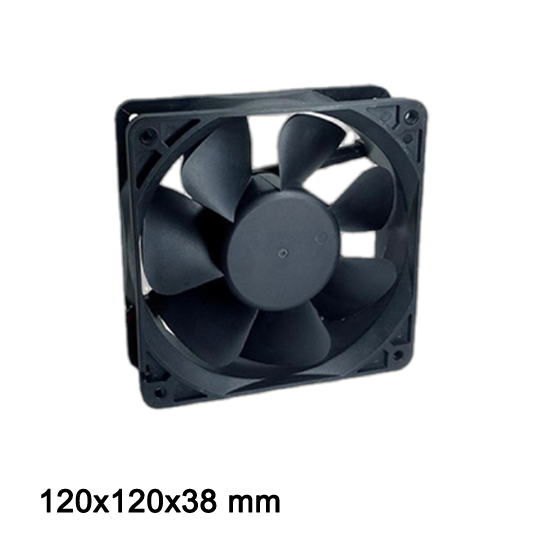
High-Performance Cabinet Cooling Fan Engineering: Overcoming Thermal Hotspots and Backpressure Bottlenecks in Industrial Enclosures
In modern industrial automation, telecommunications infrastructure, outdoor power distribution units, and server room deployments, electronic density continues to increase exponentially. As sensitive components such as VFDs, power supplies, switchgears, and server blades generate immense thermal energy within confined spaces, installing an efficient, high-reliability cabinet cooling fan becomes a fundamental requirement for system longevity and continuous operation.
Without adequate forced-air convective heat transfer, internal enclosure temperatures rapidly spike, triggering thermal throttling, component degradation, and catastrophic equipment shutdowns. To maintain optimal operating temperatures and safeguard mission-critical hardware, engineering teams require a ruggedized cabinet cooling fan engineered specifically to defeat extreme static backpressure, dusty air filters, and continuous thermal stress.
Critical Thermal & Mechanical Bottlenecks in Cabinet Ventilation
Selecting an off-the-shelf ventilation fan without considering actual cabinet thermodynamics frequently leads to system instability. Engineers face three major technical friction points:
- Severe Static Resistance from Dense Cabling and Filters: Dust-proof filter mats, rain hoods, and densely packed wiring looms create immense airflow restriction. A conventional low-pressure fan suffers aerodynamic stall, drastically reducing actual volumetric airflow delivery.
- Thermal Hotspots & Inefficient Air Distribution: Uneven airflow velocity leads to localized heat buildup around heat-sensitive microprocessors and power transistors, causing premature component failure despite nominal ambient cabinet temperatures.
- Continuous Thermal Strain & High Operational Costs: Inefficient motors running continuously under high backpressure draw excessive wattage, radiate internal motor heat, and suffer accelerated bearing wear, driving up total cost of ownership (TCO).
Cabinet Cooling Fan Specifications & Selection Guide
Select the optimal cooling fan series engineered to overcome specific thermal resistance and spatial constraints within industrial control enclosures:
| Type | Model | Dimensions | Voltage | Power | Airflow |
|---|---|---|---|---|---|
| Axial cooling fan | DCH12038VH48B-C | 120 x 120 x 38 mm | 48V DC | 24.0 W | 183.8 CFM |
Engineering Advantages of Advanced Cabinet Cooling Fan Solutions
1. High-Static Pressure Aerodynamic Impeller Design
An optimized cabinet cooling fan features specialized blade geometry and dynamic inlet shrouds designed to maintain steep pressure-airflow (P-Q) curves. This enables maximum CFM delivery even when discharging air through high-density dust filters, ensuring constant positive or negative pressure ventilation.
2. High-Efficiency Motors & Extended Operating Lifespan
Equipped with precision dual ball bearings and advanced brushless DC motor technology, modern cabinet cooling fan systems deliver up to 50,000+ hours of continuous, maintenance-free operation. Reduced electrical loss directly translates to cooler motor operation and lower power consumption.
3. Dynamic Rotor Balancing & Minimal Acoustic Footprint
To prevent structural vibration resonance within thin-sheet metal enclosures, each cabinet cooling fan undergoes rigorous two-plane dynamic balancing. This minimizes mechanical noise and vibration, ensuring quiet, reliable performance in noise-sensitive indoor and telecom environments.
Cabinet Cooling Fan - Technical FAQ
Q1: What is a cabinet cooling fan and why is forced-air ventilation vital for electrical enclosures?
A cabinet cooling fan is a specialized forced-air thermal management device installed on industrial control panels, telecom enclosures, or server racks. It actively exhausts trapped heat or draws in ambient cool air to prevent thermal accumulation, component overheating, and catastrophic system failures.
Q2: How does static backpressure affect cabinet cooling fan performance?
Dense cabling, filter mats, and louvers restrict airflow, creating static pressure resistance. If a cabinet cooling fan has insufficient static pressure capability, its actual delivered airflow drops drastically. High-pressure models (like the DCH12038-C series) maintain stable CFM even under severe restriction.
Q3: Should a cabinet cooling fan be installed for positive or negative pressure ventilation?
Positive pressure (blowing cool air into the cabinet through a filter) prevents unfiltered dust from entering through unsealed panel seams. Negative pressure (exhausting hot air out from the top) is preferred when rapid extraction of intense localized hotspots is required.
Q4: What are the advantages of 24V and 48V DC cabinet cooling fans over AC fans?
DC cabinet cooling fan models offer significantly higher energy efficiency, lower electromagnetic interference (EMI), extended operating lifespans, and direct compatibility with industrial DC power supplies and battery backup systems during power outages.
Q5: How do IP ratings and dust filters impact cabinet cooling fan longevity?
Dust and moisture ingress cause premature bearing seizure and electrical short circuits. Choosing a cabinet cooling fan with IP54 or IP68 environmental protection and regularly replacing air filter mats ensures continuous operation in outdoor or harsh factory environments.
Q6: How can I minimize acoustic noise from a high-speed cabinet cooling fan?
Noise can be mitigated by using dynamic PWM speed control to throttle fan RPM when heat loads are low, installing rubber anti-vibration gaskets, optimizing shroud inlet geometry, and choosing fans with dynamically balanced rotors.
Q7: What speed control and monitoring signals are available for smart cabinet cooling fans?
Modern DC cabinet cooling fan units support 4-wire configurations featuring PWM (Pulse Width Modulation) input for automated speed adjustment and FG (Tachometer/Frequency Generator) pulse outputs to detect fan stall or failure in real-time.
Q8: What routine maintenance is required for industrial cabinet cooling fans?
High-quality fans with dual ball bearings are permanently lubricated and virtually maintenance-free. Primary maintenance consists of periodically inspecting and washing or replacing dust filter mats to maintain uninhibited airflow into the enclosure.
Q9: Can I request custom cabinet cooling fan configurations for specialized OEM/ODM projects?
Yes! We offer full OEM/ODM customization for cabinet cooling fan products, including custom wire harness lengths, specialized connector terminations, custom operating voltages, and IP68 conformal motor coating. Contact our engineering team below for custom projects.
GET A QUOTE

Can't Find the Perfect Fan?
We offer customization services from wire length to full mold design. Get a prototype in 48 hours.
Request Custom Solution