How High-Static Pressure AC Centrifugal Fan Solutions Eliminate Thermal Bottlenecks in Heavy-Duty Infrastructure
In modern electronic engineering and industrial plant layouts, high-voltage system stability directly dictates overall equipment lifespans. As telecommunication base stations, enterprise data centers, renewable energy inverters, and automated control cabinets migrate to more compact and power-dense architectures, mitigating localized heat build-up has become a paramount design obstacle. Standard axial fans routinely fail under these severe operational setups because they lack the force required to drive vital cold air across densely populated component matrices, resulting in system-wide thermal throttling and catastrophic grid downtime.
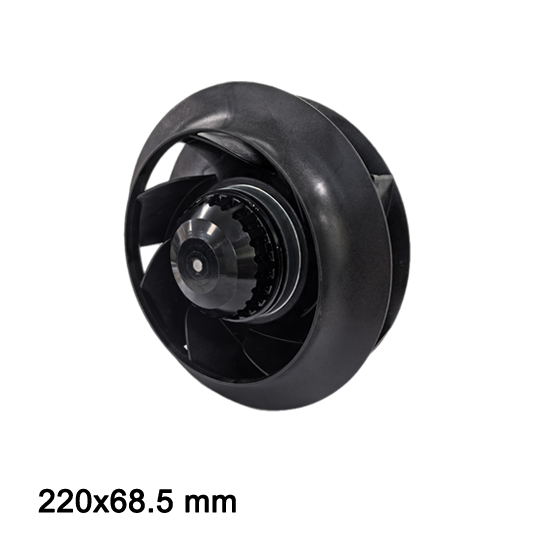
To prevent severe airflow impedance and hardware failures, integrating an industrial-grade AC centrifugal fan (commonly classified as an AC centrifugal blower fan) is essential. Unlike conventional linear cooling layouts, an AC centrifugal fan draws incoming air in axially and forces it out at a sharp 90-degree vector. This aerodynamically optimized radial scroll housing design effectively compresses fluid flow and converts rotational kinetic energy into commanding static pressure, delivering strong, directed ventilation exactly where backpressure is most intense.
The Core Industrial Pain Points in High-Impedance AC Systems
When deploying heavy-duty equipment in restricted pathways, hardware developers routinely encounter three severe thermal engineering bottlenecks:
- Aerodynamic Stall Blocker: Conventional fans face sudden stall and backflow when fighting dense component placement or micro-machined internal heatsinks, allowing localized thermal pockets to quickly degrade surrounding circuits.
- Premature Bearing Desiccation: Lower-grade cooling fans operating continuously in high-temperature cabinets experience rapid oil breakdown, causing mechanical friction spikes, high operational vibration, and sudden rotor locking.
- Electrical Noise & Speed Inaccuracy: Grid power rails often suffer from voltage fluctuations and electromagnetic interference (EMI). Unprotected blower motors frequently translate these irregularities into acoustic humming and unstable RPM output.
A premium AC centrifugal fan from TKFAN comprehensively neutralizes these critical pain points. By combining optimized impeller configurations with robust, stable AC motor architectures, our blower fan series handles dense system backpressure with excellent stability and an extended operational lifetime.
Engineering Innovations Behind TKFAN AC Centrifugal Fans
1. Heavy-Duty AC Motors for Grid Stability
Every TKFAN AC centrifugal fan is engineered around a high-efficiency AC motor equipped with specialized electrical safeguard circuitry. This robust configuration guarantees seamless operation across a flexible commercial voltage spectrum (110V/220V), ensuring that temporary grid variations will not destabilize your critical cooling performance.
2. Dual Precision Ball Bearings for Heavy-Duty 24/7 Duty Cycles
Industrial deployments demand robust parts capable of continuous service over multiple years. We implement pre-lubricated dual precision ball bearing assemblies across our industrial AC blower units. This mechanical framework substantially lowers operational friction and allows our fans to perform reliably for more than 50,000+ continuous hours under high ambient temperatures, supporting multi-axis mounting orientations without degrading structural lifespan.
3. Reliable Speed Performance and Continuous Airflow Output
To minimize acoustic energy waste and system wear, modern smart infrastructure demands consistent aerodynamic control. Our AC centrifugal fan designs feature optimized scroll housing geometry and stable rotational dynamics. This advanced engineering enables your central cabinet controller to maintain steady, high-volume pressure performance dynamically based on active system thermal loads.
AC Centrifugal Fan - Technical FAQ
Need professional clarity on selecting or integrating high-voltage, high-pressure AC blowers into your engineering layout? Explore our technical FAQ section compiled by TKFAN's thermal experts to find answers regarding performance customization, lifespans, and system optimizations for AC centrifugal fans.
Q1: When should I choose an AC centrifugal fan instead of an axial cooling fan for industrial cabinets?
You should integrate an AC centrifugal fan when your enclosure has high air impedance, dense hardware layout, or restricted ducting channels. While axial fans provide massive airflow volume in completely open air, centrifugal blowers use their compressed scroll housing to generate the high static pressure required to force air through tightly packed internal component pathways.
Q2: Why is AC voltage preferred in large-scale fixed industrial infrastructure?
An AC centrifugal fan connects directly to standard commercial grid power (110V/220V), making it highly convenient and efficient for large-scale fixed machinery, HVAC ventilation units, and electrical control rooms without requiring external DC power conversion rectifiers.
Q3: Can TKFAN customize wire harness lengths and specific electrical connectors for B2B AC blower orders?
Yes, TKFAN specializes in full B2B OEM/ODM mechanical and electrical customization. We can adjust lead wire lengths, apply flame-retardant heat-shrink insulation tubing, and terminate assemblies with specified heavy-duty industrial connectors to integrate seamlessly with your custom electrical layout.
Q4: What is the expected operational lifespan of a dual ball bearing AC centrifugal fan under harsh field environments?
By implementing premium, pre-lubricated dual precision ball bearings, our industrial-grade AC blower fans exhibit an extended operational lifetime of over 50,000 to 70,000 hours in continuous 24/7 service. This robust internal architecture easily outperforms commercial sleeve bearings, resisting grease breakdown under high heat conditions.
Q5: What is the safe operational input voltage range for a TKFAN heavy-duty AC blower?
Our heavy-duty AC blowers feature advanced integrated voltage-safeguard winding designs, allowing stable continuous operation across standard grid tolerances (such as 100V-120V or 200V-240V AC). This engineering choice safeguards performance against temporary grid voltage fluctuations encountered in industrial facilities.
Q6: How does your production process mitigate micro-vibration and acoustic noise in high-performance AC centrifugal fans?
Every individual blower rotor impeller undergoes an automated, dual-plane dynamic balance calibration process during assembly. This precise manufacturing step eliminates structural micro-vibrations, protects internal bearing surfaces from uneven off-axis wear, and ensures our fans maintain a low acoustic footprint during operation.
Q7: Do you provide advanced environmental ingress protections like IP55 or IP68 for outdoor AC hardware deployments?
Absolutely. For outdoor installations exposed to heavy dust, ambient moisture, or direct water spray, TKFAN can engineer your AC centrifugal fan batches with specialized conformal coatings or complete vacuum epoxy encapsulation to confidently meet IP55, IP68, or higher protection grades.
Q8: Can we request custom sample quantities of a specific AC centrifugal fan for engineering prototype evaluation?
We strongly welcome engineering prototyping and verification cycles. Simply click our contact button below or email our support team with your target body dimensions, static pressure requirements, and airflow CFM, and our thermal engineering group will promptly coordinate custom sample configurations for review.