
Automotive Sensor Cleaning Air Blower: How TKFAN Automotive Camera Anti-Fog Blowers Improve ADAS Visibility
Modern vehicles increasingly depend on cameras, LiDAR, and other optical sensors to support Advanced Driver Assistance Systems (ADAS), autonomous driving, parking assistance, and surround-view monitoring. However, rainwater, road dust, mud, snow, and condensation can reduce optical visibility and affect the reliability of vehicle perception systems.
An Automotive Sensor Cleaning air blower provides a compact, non-contact airflow solution for removing loose contaminants and water droplets from sensitive optical surfaces. Unlike conventional cooling fans, automotive cleaning blowers are designed to generate concentrated airflow and sufficient static pressure to deliver air through narrow ducts and precision nozzles.
For automotive engineers, selecting the correct automotive camera anti fog blower involves more than comparing airflow values. Static pressure, nozzle geometry, operating voltage, environmental resistance, noise, electrical control, and long-term reliability all influence actual system performance.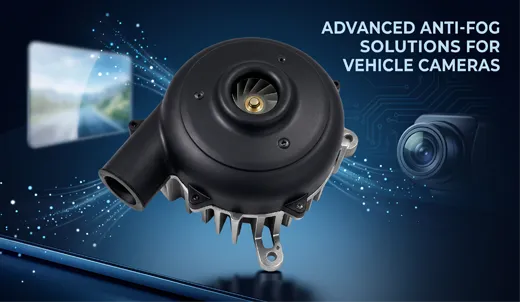
TKFAN develops compact high-pressure DC blowers for automotive sensor cleaning applications. The TKFAN Automotive Sensor Cleaning air blower product series provides different airflow and pressure configurations for camera modules, LiDAR housings, and integrated vehicle sensor cleaning systems.
Quick Engineering Answer
An automotive sensor cleaning air blower uses a high-speed centrifugal impeller to generate concentrated airflow. The air passes through a duct or nozzle and reaches the camera window or sensor cover, helping remove loose dust, water droplets, and surface contaminants. For condensation control, the system may additionally require heating, humidity management, or appropriate optical enclosure design.
Explore the TKFAN Automotive Sensor Cleaning Air Blower Product Series.
1. Why Automotive Cameras Need Dedicated Cleaning and Anti-Fog Systems
Automotive cameras are installed in locations that expose them to continuously changing environmental conditions. Front-facing ADAS cameras may be positioned behind the windshield, while surround-view cameras, rear-view cameras, and side-view cameras are frequently installed in exterior vehicle components.
These positions expose optical surfaces to several types of contamination:
- Rainwater and water droplets: Water can accumulate on camera windows and distort the optical image.
- Road dust and fine particles: Dust reduces contrast and creates unwanted scattering or image obstruction.
- Mud and road spray: Wet road contaminants can form a film over the optical surface.
- Snow and frost: Low temperatures can produce ice accumulation and reduce camera visibility.
- Condensation and fogging: Temperature and humidity changes can create microscopic water droplets on optical surfaces.
- Insects and organic debris: Insects and other contaminants can obstruct the camera field of view.
A contaminated camera may produce unclear images, unreliable object detection, or reduced visual information for the vehicle's perception algorithms. This is particularly important for systems supporting lane detection, automatic emergency braking, pedestrian recognition, and parking assistance.
The automotive camera anti fog blower is therefore an important component in the development of reliable optical cleaning architectures. Its purpose is to provide controlled airflow close to the optical window without requiring direct mechanical contact with the camera lens.
Automotive camera cleaning technology is also attracting increasing commercial attention. According to The Business Research Company, its Car Camera Cleaning Systems market report estimates a global market value of approximately USD 0.84 billion in 2026 and projects USD 1.86 billion by 2030, representing a forecast CAGR of approximately 21.9% for 2026–2030.
These figures are market research estimates rather than guaranteed outcomes. They nevertheless illustrate the growing commercial importance of camera cleaning technologies as vehicle camera installations and ADAS applications expand.
Reference: The Business Research Company – Car Camera Cleaning Systems Global Market Report.
2. How Does an Automotive Camera Anti-Fog Blower Work?
To understand the working principle of an automotive camera anti-fog blower, engineers should first distinguish between surface contamination and condensation.
2.1 Surface Water and Dust Removal
When rainwater, loose dust, or small particles accumulate on a camera cover, a directed airflow jet can apply aerodynamic force to the contaminated surface. The airflow helps move water droplets away from the optical field and dislodge loose particles.
A high-pressure blower draws air through its inlet, accelerates the air using a rotating centrifugal impeller, and discharges it through an outlet. The outlet connects to a duct or nozzle designed to direct airflow toward the camera window.
The nozzle geometry is particularly important. A poorly designed outlet may produce excessive airflow dispersion, reducing the effective cleaning force at the target surface. A properly designed duct can concentrate the air stream and improve cleaning efficiency.
2.2 Condensation and Lens Fogging
Fogging occurs when water vapor condenses on a surface whose temperature is below the surrounding air's dew point. The resulting microscopic droplets scatter light and reduce image clarity.
For example, a vehicle exposed to cold outdoor temperatures may enter a warmer, humid environment. If the camera cover remains cold, moisture in the surrounding air can condense on its surface.
An automotive camera anti fog blower can help remove surface moisture by moving air across the optical window. However, ordinary airflow does not automatically remove moisture from a sealed camera enclosure or lower the absolute humidity of incoming air.
For demanding condensation conditions, engineers may combine the blower with:
- PTC heating elements or other controlled heating solutions.
- Humidity management and enclosure ventilation.
- Hydrophobic or anti-fog optical surface coatings.
- Improved sealing and condensation-resistant housing structures.
- Temperature and humidity sensors for intelligent activation.
3. Why Choose a Centrifugal Blower Instead of a Standard Axial Fan?
One of the most important decisions when developing an automotive sensor cleaning system is selecting the correct airflow technology.
A conventional axial fan moves air mainly along its rotational axis. It is suitable for general ventilation and cooling applications, where relatively unrestricted airflow is available.
An automotive sensor cleaning system, however, frequently requires air to pass through small tubes, narrow passages, bends, and precision nozzles. These components introduce airflow resistance.
A centrifugal blower is generally more suitable for this type of application because its impeller accelerates air radially outward, helping generate higher static pressure in a compact package.
| Comparison | Axial Cooling Fan | Centrifugal Cleaning Blower |
|---|---|---|
| Airflow direction | Mainly axial | Axial intake, radial discharge |
| Static pressure capability | Generally lower | Generally higher |
| Small nozzle applications | Limited suitability | Better suitability |
| Long air ducts | More sensitive to resistance | Better suited to pressure-demanding ducts |
| Targeted cleaning | Requires additional duct design | Suitable for concentrated air delivery |
| Typical application | Electronics cooling and ventilation | Camera cleaning, sensor blowing, air drying |
For these reasons, a compact BLDC centrifugal blower is a practical choice for many automotive sensor cleaning designs.
The TKFAN automotive camera anti fog blower series is designed around high-speed DC blower technology, providing different pressure and airflow options for engineers developing compact sensor cleaning assemblies.
4. Main Applications of Automotive Sensor Cleaning Air Blowers
An Automotive Sensor Cleaning air blower can support different vehicle sensing architectures. The required airflow, pressure, nozzle arrangement, and activation strategy depend on the sensor location and contamination conditions.
4.1 Front-Facing ADAS Cameras
Front-facing cameras support functions such as lane departure warning, traffic sign recognition, forward collision warning, and automatic emergency braking. Their optical windows must remain sufficiently clear for the perception system to obtain usable visual information.
A dedicated blower can direct air toward the camera cover to remove loose dust and water droplets. In windshield-mounted designs, the cleaning architecture must also consider windshield geometry, optical distortion, heating, and the surrounding enclosure.
4.2 Rear-View and Parking Cameras
Rear-view cameras are frequently exposed to road spray, mud, and rainwater. These contaminants can accumulate quickly during driving, particularly in wet or dusty conditions.
A compact automotive camera anti fog blower can be integrated into the camera housing or connected to a dedicated cleaning nozzle. The objective is to restore a clear optical surface without physically touching the lens.
4.3 Surround-View and Side Cameras
Vehicles equipped with 360-degree surround-view systems use several cameras positioned around the body. Each camera may experience different contamination conditions depending on its mounting location.
Engineers can consider either individual small blowers or a centralized air distribution system. Individual units offer localized control, while centralized systems can reduce the number of motors but require careful duct pressure balancing.
4.4 LiDAR and Autonomous Driving Sensors
LiDAR systems use optical windows to transmit and receive laser signals. Dust, water droplets, and surface contamination may interfere with optical transmission and reduce sensing quality.
High-pressure cleaning blowers can provide directed airflow around the sensor window. The design must consider the sensor's optical field, nozzle position, air consumption, and the possibility of introducing turbulence or recirculating contaminants.
4.5 Integrated Multi-Sensor Cleaning Systems
Advanced vehicle platforms may combine front cameras, side cameras, rear cameras, and LiDAR within a centralized cleaning architecture.
In these applications, engineers should calculate the pressure loss of every branch, evaluate simultaneous cleaning demand, and determine whether the blower can maintain sufficient airflow at the most restrictive outlet.
5. TKFAN Automotive Sensor Cleaning Air Blower Product Solutions
TKFAN provides compact high-pressure DC blowers for automotive cleaning and optical sensor applications. The product range includes multiple sizes and performance configurations to support different integration requirements.
The following examples are based on published TKFAN product information. Maximum airflow and maximum static pressure are separate operating-point specifications and should not be assumed to occur simultaneously.
| Model | Voltage | Maximum Speed | Maximum Airflow | Maximum Static Pressure |
|---|---|---|---|---|
| BA5025H12B-A | 12V DC | 37,000 RPM | 10.5 CFM | 4.9 kPa |
| BA7050H12B-C | 12V DC | 40,000 RPM | 15.49 CFM | 7.9 kPa |
| BA8060H12B-E | 12V DC | 38,000 RPM | 19.3 CFM | 12 kPa |
These models illustrate the different airflow and pressure options available within the TKFAN automotive cleaning blower family.
5.1 Compact Blower for Localized Cleaning
The BA5025H12B-A is a compact 12V DC blower with a published maximum airflow of 10.5 CFM and maximum static pressure of 4.9 kPa.
Its compact dimensions make it worth evaluating for localized camera cleaning applications where installation space is limited. Engineers should check the actual operating point after connecting the selected duct and nozzle.
5.2 Medium-Size Blower for Higher Airflow Demand
The BA7050H12B-C provides a published maximum airflow of 15.49 CFM and maximum static pressure of 7.9 kPa at 12V DC.
This configuration can be considered for applications requiring stronger airflow delivery or additional pressure margin to overcome duct resistance.
5.3 High-Pressure Blower for Demanding Cleaning Architectures
The BA8060H12B-E offers a published maximum static pressure of 12 kPa and maximum airflow of 19.3 CFM. Its 12V DC design and 38,000 RPM rated speed make it a candidate for higher-demand automotive cleaning system development.
Final model selection should always be based on the blower's P-Q performance curve, system resistance, electrical power budget, thermal conditions, and required cleaning time.
View complete specifications and additional configurations:TKFAN Automotive Sensor Cleaning Air Blower Product Catalog.
6. Five Critical Parameters When Selecting an Automotive Camera Anti-Fog Blower
Selecting an automotive camera anti fog blower requires a system-level engineering evaluation. A blower with the highest advertised airflow is not necessarily the best choice for a particular vehicle platform.
6.1 Static Pressure and Airflow
Static pressure determines how effectively the blower can overcome resistance in ducts, filters, connectors, and nozzles. Airflow determines the volume of air delivered under a particular operating condition.
Engineers should evaluate the blower's pressure-flow curve rather than selecting a product using maximum airflow alone.
6.2 Voltage and Electrical Compatibility
Many automotive cleaning applications use a 12V DC electrical architecture. The blower driver must be evaluated against actual vehicle supply variations, transient conditions, startup current, and protection requirements.
PWM speed control can provide adjustable cleaning intensity, while tachometer or other speed feedback can help the vehicle controller detect abnormal operation when these functions are supported by the selected blower.
6.3 Environmental Resistance
Automotive components may experience humidity, temperature cycling, vibration, dust, salt spray, and water exposure.
ISO 16750-4:2023, titled Road Vehicles – Environmental Conditions and Testing for Electrical and Electronic Equipment – Part 4: Climatic Loads, describes climatic environmental stresses and recommended testing considerations for vehicle electrical and electronic components according to their installation locations.
Engineers should use the applicable environmental test requirements when evaluating the blower, connectors, wiring, sealing, and surrounding assembly.
Reference: ISO 16750-4:2023 – Official ISO Standard.
6.4 Noise and Vibration
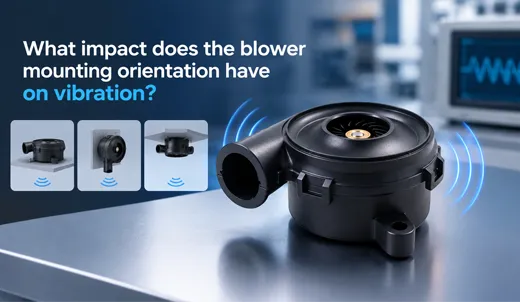
High-speed blowers can generate aerodynamic noise and mechanical vibration. These effects may become more noticeable when the blower is mounted near the passenger compartment or sensitive optical equipment.
Proper balancing, mounting isolation, duct design, and motor control can help reduce unwanted noise and vibration. Testing should be conducted in the final mounting configuration rather than on the blower alone.
6.5 Size and Installation Flexibility
Modern camera housings and vehicle body structures have limited installation space. Engineers should evaluate blower dimensions, inlet clearance, outlet direction, connector orientation, wire length, and service accessibility.
For OEM and Tier 1 projects, customization may also be required for mounting brackets, electrical connectors, cables, and airflow outlet configurations.
7. Engineering Integration: How to Build an Effective Air Cleaning System
The performance of an automotive sensor cleaning air blower depends on the complete airflow path, not just the motor and impeller.
A practical development process can be divided into six stages.
- Define the contamination problem. Identify whether the target is loose dust, rainwater, mud, condensation, or a combination of contaminants.
- Identify the optical target. Determine camera or LiDAR window dimensions, surface orientation, mounting position, and cleaning area.
- Select the blower operating point. Calculate the required airflow and pressure after considering duct length, bends, outlet restrictions, and simultaneous cleaning demand.
- Optimize the nozzle. Adjust nozzle diameter, distance, angle, and outlet geometry to create an effective air stream across the optical surface.
- Integrate the control system. Define activation conditions using humidity sensors, temperature sensors, camera contamination detection, or ECU commands where appropriate.
- Validate the complete assembly. Perform environmental, vibration, water exposure, dust, thermal cycling, acoustic, and cleaning performance tests according to the vehicle program's requirements.
Understanding the P-Q Curve
The pressure-flow curve, commonly called the P-Q curve, is one of the most useful engineering references when selecting a blower.
As airflow resistance increases, the actual airflow delivered by the blower generally decreases. The system operating point is determined by the intersection of the blower performance curve and the system resistance curve.
This explains why a blower that performs well in an open-air test may deliver insufficient airflow after installation in a long, narrow duct.
Practical recommendation:
Always request the complete P-Q curve and evaluate the blower under the actual duct and nozzle configuration. Measure airflow at the final outlet whenever possible. This approach provides a more reliable basis for choosing an automotive camera anti fog blower than comparing free-air airflow values.
8. Automotive Reliability, Environmental Testing, and Industry Standards
Automotive cleaning components must be evaluated as part of the complete vehicle system. A blower may operate normally in a laboratory but experience different conditions after installation in a bumper, mirror housing, grille, or sensor enclosure.
The following references provide useful engineering guidance:
- ISO 16750-4:2023: Covers climatic loads and environmental testing considerations for automotive electrical and electronic equipment.
- SAE J1455: Provides recommended environmental practices for electronic equipment design in heavy-duty vehicle applications, including temperature, humidity, vibration, and other environmental factors.
- Euro NCAP Crash Avoidance Protocols: Provide assessment procedures and technical criteria for vehicle safety and crash avoidance systems.
Euro NCAP's 2026 Safe Driving and Crash Avoidance technical documentation includes data acquisition and assessment criteria under Technical Bulletin CA 004. However, this should not be interpreted as a universal regulation requiring every vehicle to install a specific camera cleaning blower.
For automotive suppliers, the important engineering objective is to demonstrate that the complete sensing system performs reliably under the relevant conditions defined by the vehicle manufacturer and applicable assessment program.
Official references:
- ISO – ISO 16750-4:2023 Road Vehicle Environmental Testing
- SAE International – J1455 Environmental Practices
- Euro NCAP – Crash Avoidance Protocols and Technical Bulletins
9. Why Choose TKFAN for Automotive Sensor Cleaning Air Blower Solutions?
Choosing an automotive blower supplier involves more than comparing catalog specifications. Product consistency, engineering communication, customization capabilities, and application support are equally important during OEM development.
TKFAN provides a range of DC centrifugal blowers for automotive sensor cleaning and other high-pressure airflow applications.
Key considerations when evaluating TKFAN solutions include:
- Multiple performance options: Different blower sizes and pressure-flow configurations allow engineers to match different sensor cleaning requirements.
- 12V DC product options: Suitable models are available for evaluation in 12V vehicle electrical architectures.
- Compact integration: Different housing sizes help address restricted installation space.
- OEM customization: Custom voltage, cable length, connectors, and mechanical configurations can be discussed according to project requirements.
- Application-oriented engineering: Blower selection can be based on airflow, static pressure, duct resistance, and the actual sensor cleaning configuration.
For projects requiring additional environmental or automotive qualification, customers should confirm the relevant model's test reports, ingress protection rating, operating temperature range, component qualification, and control interface with TKFAN before final design approval.
The TKFAN Automotive Sensor Cleaning air blower range is intended to support engineers developing practical, compact, and high-pressure airflow solutions for automotive optical systems.
For product specifications, model selection, and OEM customization, visit:TKFAN Automotive Sensor Cleaning Air Blower.
10. Technical FAQ: Automotive Sensor Cleaning Air Blower
Q1. What is an Automotive Sensor Cleaning air blower?
An Automotive Sensor Cleaning air blower is a compact high-pressure air-moving device used to remove loose dust, water droplets, and other surface contaminants from automotive cameras, LiDAR windows, and optical sensor covers. It typically uses a centrifugal impeller to generate concentrated airflow through a dedicated outlet or nozzle.
Q2. How does an automotive camera anti fog blower prevent camera fogging?
It directs airflow across the camera window to help remove surface moisture and reduce water accumulation. However, airflow alone does not necessarily eliminate condensation inside a sealed enclosure. For demanding anti-fog applications, engineers may combine the blower with PTC heating, humidity management, appropriate sealing, or anti-fog coatings.
Q3. Why is a centrifugal blower better than an axial fan for sensor cleaning?
A centrifugal blower generally provides higher static pressure, making it more suitable for applications involving narrow ducts, small nozzles, and restricted airflow paths. An axial fan is typically better suited to general ventilation and cooling where airflow resistance is relatively low.
Q4. What voltage is commonly used for automotive sensor cleaning blowers?
12V DC is a common configuration for passenger vehicle cleaning systems. The actual electrical design must account for vehicle supply variation, startup current, transient protection, driver requirements, and the operating conditions specified by the vehicle manufacturer.
Q5. What airflow and static pressure are required for a camera cleaning blower?
There is no universal airflow or pressure requirement for every camera. The required values depend on camera window size, nozzle geometry, duct length, outlet distance, contamination type, and cleaning time. Engineers should select the blower using its P-Q curve and verify performance at the final nozzle.
Q6. Can a TKFAN automotive camera anti fog blower clean LiDAR sensors?
TKFAN's automotive cleaning blower series is intended for automotive optical sensor cleaning applications, including LiDAR-related systems. The selected model must be evaluated against the LiDAR window dimensions, airflow direction, pressure requirements, optical field of view, and contamination conditions.
Q7. Can an automotive sensor cleaning air blower remove mud and oil?
Airflow can remove loose dust and some light surface contamination, but dried mud, oily films, and strongly adhered debris may require liquid washing or another cleaning method. Hybrid systems combining liquid spray and air drying may be more appropriate for demanding contamination conditions.
Q8. Can the blower work with a PTC heating element?
Yes, a blower can be integrated with a properly designed PTC heating module to deliver warmed airflow. The design must consider heater power, airflow rate, outlet temperature, material temperature limits, electrical protection, and thermal safety. The combined assembly requires validation under the intended operating conditions.
Q9. What environmental tests should an automotive cleaning blower undergo?
Depending on its mounting location and vehicle program, evaluation may include high- and low-temperature operation, thermal cycling, humidity exposure, vibration, mechanical shock, dust, water ingress, salt spray, electrical transient, and electromagnetic compatibility testing. ISO 16750 and applicable SAE or OEM requirements can provide relevant test guidance.
Q10. How can engineers select the right TKFAN Automotive Sensor Cleaning air blower?
Start by defining the required cleaning area, contamination type, cleaning time, nozzle configuration, and installation constraints. Then calculate the required airflow and static pressure, evaluate the blower P-Q curve, confirm electrical compatibility, and validate the complete assembly. TKFAN can be contacted to discuss model selection and customization based on the project specifications.
11. Conclusion: Build More Reliable Automotive Camera Cleaning Systems
As ADAS and autonomous driving technologies continue to develop, automotive cameras and LiDAR sensors are becoming increasingly important components of vehicle perception systems. Keeping their optical surfaces clean is essential for maintaining reliable image acquisition under changing environmental conditions.
A properly selected Automotive Sensor Cleaning air blower can provide concentrated airflow to remove loose dust, water droplets, and surface contaminants without direct mechanical contact. For applications involving condensation, an integrated solution combining airflow, heating, humidity control, and optical surface treatment may provide more comprehensive protection.
The TKFAN automotive camera anti fog blower product range offers multiple 12V DC blower configurations with different airflow and static pressure capabilities. By considering the actual P-Q operating point, nozzle design, installation space, electrical requirements, and environmental testing conditions, engineers can develop a more reliable automotive sensor cleaning system.
Whether you are developing a front camera cleaning module, a rear-view camera anti-fog system, a 360-degree surround-view solution, or a LiDAR cleaning assembly, TKFAN can help evaluate suitable high-pressure blower configurations for your project.
Looking for a Reliable Automotive Sensor Cleaning Air Blower?
Contact TKFAN for technical specifications, product recommendations, OEM customization, and automotive camera anti-fog blower solutions.
Share your required voltage, airflow, static pressure, installation dimensions, and application details to help identify a suitable blower.