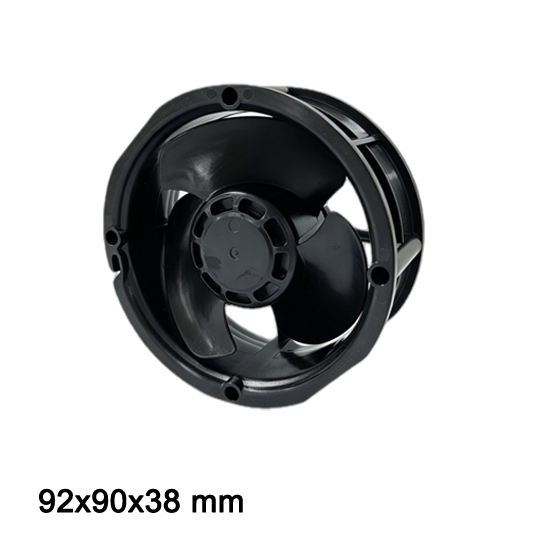
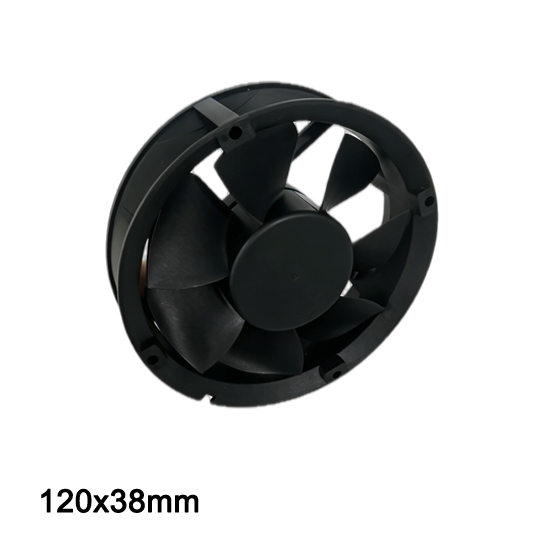
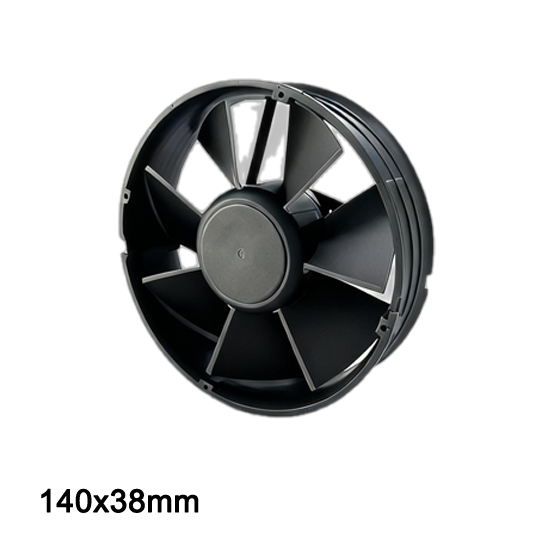
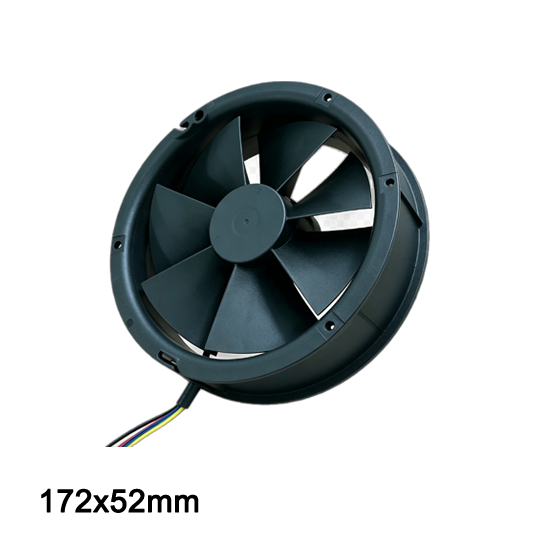
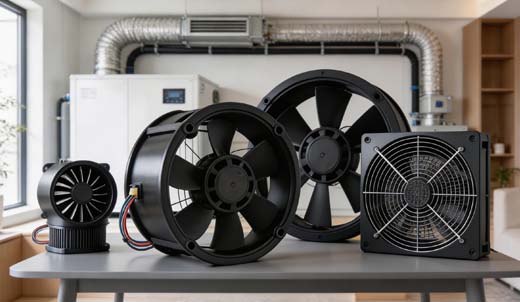
High-Performance Round Fan Selection Guide
Compare voltage parameters, rotational speed, volumetric airflow, and static pressure to identify the ideal round fan for your circular duct systems, equipment enclosures, and industrial cooling needs.
Precision Round Fan Technology: Optimizing Aerodynamic Efficiency and Noise Reduction in Cylindrical Air Cooling Systems
In modern industrial equipment, circular duct networks, compact server cabinets, and specialized medical hardware, space constraints and air flow path continuity are vital factors for thermal management. Square-frame fans often suffer from dead zones at the corners, creating internal turbulence and flow separation. Deploying a specialized round fan solves these spatial and aerodynamic limitations by providing a seamless, circular housing profile that matches cylindrical ducting and round mounting ports perfectly.
When standard square fans are retrofitted into circular ports, air leakage, pressure loss, and extra acoustic resonance frequently occur. To maintain precise temperature thresholds and ensure uninterrupted operation, engineering teams rely on a rugged round fan optimized for high airflow uniformity, minimal vortex generation, and maximum mechanical durability.
Major Thermal & Aerodynamic Challenges in Circular Systems
Cooling and ventilating circular architectures present unique mechanical and fluid dynamic challenges. Key engineering friction points include:
- Corner Stall & Air Recirculation: In circular duct adapters or round chassis cutouts, square fan corners block fluid movement, leading to static turbulence, pressure drops, and airflow dead zones.
- Vibration and Housing Resonance: Mismatched fan housings mounted into round ductwork generate mechanical friction and low-frequency resonance, causing unwanted acoustic disturbance.
- Thermal Stress Under Continuous Backpressure: Operating under tight space restrictions causes traditional motors to draw higher currents, resulting in thermal strain that shortens the operating life of the fan.
An advanced round fan mitigates these engineering bottlenecks by featuring a specialized circular frame, dynamically balanced impellers, and brushless DC/EC motor drivers designed for continuous heavy-duty ventilation.
Key Advantages of Industrial-Grade Round Fan Systems
1. Optimized Circular Frame Profile for Seamless Integration
The round housing design eliminates unused frame corners, allowing the round fan to fit directly into circular ducts, round tube heat exchangers, or cylindrical enclosures without requiring heavy adapter flanges. This streamlines airflow vectors, minimizes drag, and boosts total CFM output.
2. High Energy Efficiency with EC/DC Brushless Motors
Utilizing advanced brushless EC/DC technology, a high-efficiency round fan consumes significantly less energy while producing lower operational heat. These motors offer precise PWM or 0-10V speed regulation, enabling real-time airflow adaptation to meet changing thermal demands.
3. Dynamic Balancing for Quiet, Vibration-Free Operation
Equipped with dual ball bearings and precision two-plane balancing, a modern round fan delivers smooth rotation even at high RPMs. Optimized stator vanes direct air smoothly downstream, reducing turbulent air chatter and ensuring long service life under continuous 24/7 operation.
Round Fan - Technical FAQ
Q1: What is a round fan and when should it be used instead of a square fan?
A round fan features a circular frame designed specifically to match round ventilation openings, cylindrical equipment enclosures, and round duct systems. It should be used when mounting into circular spaces to prevent corner airflow turbulence, air leaks, and mounting flange mismatches common with square fans.
Q2: What are the main aerodynamic advantages of a round fan?
A round fan provides a more uniform velocity profile across the entire intake and exhaust surface. By eliminating the dead corners of square frames, it reduces air turbulence, minimizes backpressure loss, and achieves higher aerodynamic efficiency in circular ductwork.
Q3: Can a round fan be controlled via PWM or 0-10V speed control signals?
Yes. Modern DC/EC round fan models support 4-wire configurations incorporating Tachometer output and PWM or 0-10V speed control inputs, enabling smart thermal control based on temperature sensor feedback.
Q4: Is a round fan suitable for both blowing and exhausting applications?
Yes. Depending on the airflow orientation during installation, a round fan can act as a fresh air intake fan or an exhaust fan to pull out hot air and contaminants from enclosures or duct channels.
Q5: How do I choose the correct size round fan for my enclosure or duct?
Measure the inner and outer diameter of your circular mounting port or duct fitting. Select a round fan whose outer frame diameter matches your mounting footprint, and ensure its CFM and static pressure rating meet your system’s heat dissipation requirements.
Q6: What bearing options are available for industrial round fans?
For long-term reliability and high-temperature environments, high-grade dual ball bearings are recommended. They offer an operational lifespan of up to 50,000–70,000 hours and allow the round fan to be mounted in any orientation (vertical or horizontal).
Q7: Can round fans be used in harsh or humid outdoor environments?
Yes, provided you select a round fan with IP55, IP68, or conformal coating protection for the motor and PCB assembly, protecting the unit against water ingress, dust, and humidity.
Q8: Does a round fan generate less noise than a square fan of similar size?
In circular duct installations, yes. Because a round fan matches the fluid channel geometry, it eliminates corner air turbulence and vortex shredding, resulting in noticeably lower noise levels and reduced mechanical vibration.
Q9: Are custom voltage options available for OEM round fan projects?
Yes, our round fan product lines can be customized for various voltage inputs, including 12V, 24V, 48V DC, or wide-range EC AC inputs, depending on your project specifications.
Q10: How can I request customized round fan engineering samples or quotes?
We offer complete OEM/ODM customization for round fans, including custom wiring harnesses, connectors, speed profiles, and IP protection levels. Click the quote button below to submit your project requirements to our technical support team.