| Model / Series | Voltage (V) | Speed (RPM) | Airflow (CFM) |
|---|
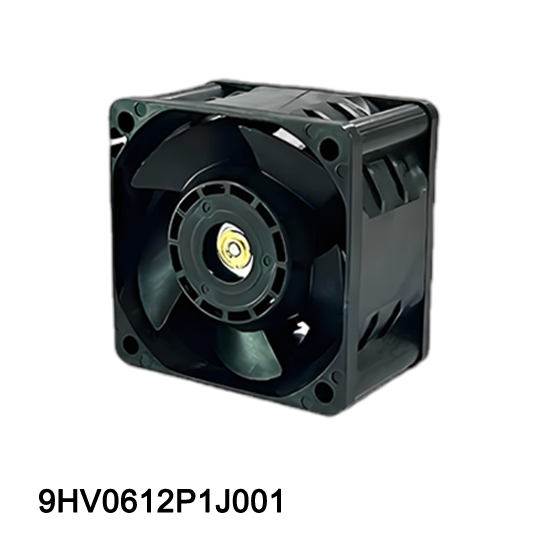
| 9HV0612P1J001 | 12V | 21,700 | 66.4 |
How the 9HV DC FAN Series Conquers Extreme Backpressure and Severe Thermal Obstacles in Next-Gen Industrial Enclosures
In today's fast-evolving landscapes of hyper-scale computational hardware, telecommunication nodes, and automated factory floor control grids, mechanical thermal design engineers consistently battle a relentless threat: severe localized heat congestion trapped inside densely compacted electronic housings. As components like high-density processing matrices, AI server clusters, high-power photovoltaic inverters, and multi-channel telecom transceivers grow more powerful, their physical enclosure footprints are simultaneously shrinking. This introduces immense fluid resistance or system impedance inside the chassis. When standard axial cooling configurations stall under these heavy environments, incorporating a premium, high-performance 9HV DC FAN becomes the mandatory industry-wide standard to protect mission-critical electronics and eliminate catastrophic hardware failure.
Operating on optimized direct-current power architectures, the specialized 9HV DC FAN framework is precision-engineered to bridge the gap between high volumetric airflow rates and small physical profiles. Conventional cooling units often experience aerodynamic "stall" when confronted with high system backpressure, which sharply decreases their cooling efficiency and drives up core operating temperatures. Conversely, the advanced motor aerodynamics and specialized rotor dynamics of a professional-grade 9HV DC FAN aggressively slice through dense fluid blockages. By generating industry-leading static pressure, these advanced cooling fans push cooling air directly through deep heatsink channels, dense electronic components, and fine particulate filters, effectively carrying away waste heat before it causes thermal throttling.
Breaking Boundaries: Advanced Thermal Management Schemes Powered by 9HV DC FAN Technology
1. Overcoming Severe System Resistance
Equipped with custom aerodynamic impeller curves, a premium 9HV DC FAN effortlessly overcomes extreme backpressure inside narrow, crowded casings. It prevents the aerodynamic stalling common to low-pressure components, maintaining continuous heat transfer even when positioned behind tightly grouped PCBs, complex internal routing paths, or high-efficiency air filters.
2. Targeted High-Velocity Impingement Cooling
By delivering a concentrated, high-velocity stream of fresh air, the 9HV DC FAN series enables design engineers to deploy highly targeted spot cooling. This direct airflow targets critical high-heat components—such as power MOSFETs, central processors, or high-capacity battery cells—keeping system temperatures uniform without requiring oversized cooling layouts.
Critical Industrial Design Features and Structural Highlights of the 9HV Cooling Fan
TKFAN designs, builds, and optimizes a comprehensive catalog of industrial-grade 9HV DC FAN architectures engineered to perform reliably under demanding environmental conditions. Our high-pressure fan designs solve tough aerodynamic limitations across major global industries:
- High-RPM Brushless Motor Topology: Engineered with premium, high-efficiency brushless DC motors that handle continuous high-speed rotation (up to 21,700 RPM on model 9HV0612P1J001). This configuration ensures consistent performance even during minor industrial input voltage fluctuations.
- Optimized High-Static Impeller Engineering: The complex 3D curvature of our composite impellers is precisely modeled using advanced computational fluid dynamics (CFD). This design yields high static force and stable airflow velocity profiles under backpressure.
- Low Noise, Vibration, and Harshness (NVH) Profiling: Built with high-precision dynamic balancing and industrial-grade dual shielded ball bearings. These features allow the 9HV DC FAN to maintain stable operation at extreme speeds while keeping vibration and acoustic profiles minimal.
- Tough Environmental Safeguards: Fully customizable with specialized conformal coatings ranging from IP55 up to true IP68 dust and water resistance. This ingress protection isolates critical motor assemblies from airborne pollutants, moisture, and chemical exposure.
- Intelligent Variable Speed Regulation: Features integrated pulse-width modulation (PWM) speed input terminals and frequency-based tachometer sensor wires. This enables host monitoring systems to dynamically scale fan speeds to match actual real-time heat loads, reducing overall energy usage.
9HV DC FAN — Technical Deep-Dive FAQ
Explore comprehensive engineering insights, installation criteria, and performance parameters for the 9HV DC FAN series. Learn how these high-static-pressure fans solve tough thermal challenges in automated industrial machinery, server enclosures, and rugged environments.
Q1: What defines the 9HV DC FAN series, and how does it differ from standard cooling fans?
A 9HV DC FAN is an industrial-grade, high-velocity, ultra-high-static-pressure cooling fan designed specifically to handle high backpressure and severe air resistance. Unlike standard DC cooling fans that prioritize open-air volume, the 9HV series uses high-RPM motor topologies, reinforced structural blades, and advanced housing dimensions. This structural layout enables it to deliver high pressure profiles that force air through dense electronic components and restricted paths where conventional fans would stall.
Q2: What are the key performance specs of the flagship 9HV0612P1J001 model?
The 9HV0612P1J001 model operates on a standard 12V DC input, delivering an ultra-high speed of 21,700 RPM and generating an impressive maximum airflow of 66.4 CFM. It is engineered to maintain high static airflow throughput inside high-density chassis where standard fans suffer from severe thermal degradation.
Q3: How does the 9HV DC FAN series eliminate aerodynamic stall under high system impedance?
Aerodynamic stall happens when backpressure forces air to slip backward over the tips of fan blades, destroying forward airflow. A professional 9HV DC FAN prevents this issue through optimized impeller designs, tight tolerances between blade tips and the outer frame, and high motor torque. This combination maintains a stable forward air vector even under extreme system resistance, ensuring consistent heat dissipation.
Q4: What are the primary B2B application scenarios for integrating a 9HV DC cooling fan?
The 9HV DC FAN is widely deployed across high-density industries, including AI data center server racks, 5G telecommunication enclosures, industrial power inverters, high-capacity lithium battery charging systems, medical imaging hardware, and automated factory control cabinets. Any system with tightly packed internal PCBs or restrictive dust filters can benefit from the high static pressure of the 9HV series.
Q5: Can the 9HV DC FAN series handle continuous operations in high-humidity or dust-heavy factory settings?
Yes, provided the unit is built with appropriate environmental safeguards. TKFAN provides optional custom ingress protection coatings ranging from IP55 up to IP68 for our 9HV DC FAN models. This vacuum-pressurized polymer encapsulation isolates the internal stator windings, driving circuitry, and electrical nodes from dust accumulation, moisture ingress, and corrosive chemicals, ensuring long-term reliability.
Q6: What bearing options are utilized in TKFAN's 9HV fan series to ensure long service lifespans?
For our high-performance 9HV DC FAN models, TKFAN uses heavy-duty, premium dual-ball bearing assemblies. Compared to standard sleeve bearings, dual-ball bearing setups handle high-speed rotation and structural vibrations reliably. They also allow the fan to be mounted in any physical orientation without impacting its operational life, delivering an expected lifespan of up to 70,000 hours under standard industrial temperatures.
Q7: How do integrated PWM inputs improve the efficiency of a 9HV DC FAN?
Integrated pulse-width modulation (PWM) control lines allow the host system's MCU or thermostat to dynamically scale the 9HV DC FAN's RPM to match the actual real-time heat load. This variable speed control reduces overall power consumption during low-demand periods, minimizes acoustic output, and extends the operational life of the internal bearings.
Q8: Does TKFAN provide custom engineering modifications for the 9HV DC FAN product line?
Yes. Through our specialized OEM/ODM engineering division at
www.tkfan.com, B2B procurement teams can specify custom operating voltages (including standard 12V, 24V, or 48V DC inputs), target volumetric flow rates (CFM), custom mounting configurations, lead-wire terminal connectors, and integrated tachometer output signals to match specific hardware requirements.
Q9: What safety protections are engineered into the 9HV DC FAN motor controller?
All 9HV DC Fans come standard with Locked-Rotor Auto-Restart Protection, Reverse Polarity Protection, and Over-Current Protection. If a physical blockage stops the impeller, power supply to the motor coils is automatically limited to prevent coil burnout and circuit board damage.
Q10: How do international procurement managers request customized prototypes and validation units?
Procurement offices and engineering teams can access factory-direct accounts via the global B2B portal at
www.tkfan.com. Sourcing direct from our manufacturing facility provides access to complete 2D/3D CAD models, detailed aerodynamic performance data, and direct technical consultations with our fluid design engineers to shorten product development timelines.
Securing Global Supply Chain Excellence with Factory-Direct 9HV Aerodynamic Solutions
Choosing the right cooling components for high-density hardware requires careful balancing of volumetric airflow, static pressure, and long-term mechanical reliability. For engineering teams developing advanced industrial electronics, relying on generic cooling fans can lead to system overheating, unexpected downtime, and premature field failures. Sourcing direct from an established, vertically integrated manufacturing partner like TKFAN (www.tkfan.com) gives procurement managers direct access to high-performance 9HV DC FAN architectures built to rigorous international safety standards. With complete in-house control over tooling, automated motor windings, and quality verification, TKFAN delivers reliable performance, full regulatory compliance, and predictable delivery schedules to optimize your global hardware supply chain.