


Case Study | Mining Safety & Respiratory PPE
The Breathing Heart of a PAPR Mining Helmet: How the TKfan CA7020H12B DC Centrifugal Blower Powers Advanced Mining Respiratory Protection
1. Introduction: Combatting Silicosis with Next-Generation PAPR Helmets
Silicosis remains one of the most hazardous, irreversible occupational health risks in the global mining sector. Frequently referred to by miners as the "silent killer," fine respirable crystalline silica (RCS) particles are generated whenever workers drill, blast, cut, or crush rock underground. Once these microscopic particles enter human lungs, they induce severe pulmonary fibrosis. Because silicosis has no known cure, absolute prevention through continuous respiratory protection is the only viable solution.
The urgency for high-efficiency respiratory protective equipment (RPE) escalated sharply following Australia’s decision to tighten exposure limits for workplace air contaminants. Australian workplace regulators dramatically reduced the Workplace Exposure Standard (WES) for respirable crystalline silica to an eight-hour time-weighted average (TWA) of 0.05 mg/m³. This regulatory mandate forced Australian mining original equipment manufacturers (OEMs) and Personal Protective Equipment (PPE) innovators to redesign safety gear from the ground up.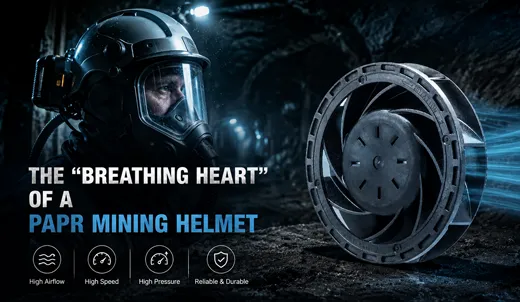
In response, a prominent Australian leader in mine safety engineering developed an all-in-one smart mining helmet featuring an integrated Powered Air-Purifying Respirator (PAPR). At the core of this respiratory system lies the TKfan CA7020H12B DC Centrifugal Blower—a compact, ultra-reliable Ø70×20mm high-pressure miniature blower custom-engineered by Shenzhen TKfan Precision Electromechanical Co., Ltd. to power real-time underground respiratory protection.
2. The Partner: Australian Pioneer in Underground Mine Safety
Established in 1999, the Australian partner is an international pioneer in subterranean life-support systems and mine refuge chambers. Their life-saving technologies are trusted across deep-seam operations managed by global mining operators such as Rio Tinto, BHP, and Newcrest across more than 50 countries.
Their smart PAPR mining helmet converges head, eye, hearing, and lung safety into a single ergonomic system. Integrating a high-performance powered air-purifying respirator directly into the helmet shell eliminates external waist-mounted hoses that pose snagging hazards in tight underground spaces. To select the ideal PAPR blower, the customer's engineering group established rigorous qualifying criteria:
- Regulatory & Safety Compliance: Absolute adherence to AS/NZS 1716 respiratory protection standards and AS/NZS 1801 structural helmet standards.
- Harsh Environment Durability: Capability to operate continuously despite extreme underground humidity, particulate load, and mechanical vibration over 12-hour continuous shifts.
- Acoustic & Aerodynamic Efficiency: High static pressure capacity in a micro-footprint while maintaining low acoustic emission (< 61 dBA) to protect helmet-integrated wireless communication clarity.
- Intelligent Closed-Loop Interface: Pulse Width Modulation (PWM) speed adjustment, Frequency Generator (FG) tachometer output, soft-start circuitry, and rotor lock protection.
Following comprehensive testing against global competitor blowers, the TKfan CA7020H12B DC Centrifugal Blower achieved top performance metrics across static pressure delivery, power efficiency, and long-term operating stability, securing its position as the baseline PAPR fan for the product line.
3. Architecture & Airflow Dynamics of the Integrated PAPR Helmet
Unlike conventional passive respirators that depend on the wearer’s inhalation effort—inducing fatigue and leakage risks—this smart PAPR helmet maintains a continuous positive-pressure air barrier across the wearer’s facepiece zone.
Step-by-Step PAPR Airflow Sequence:
- Intake Filtration: Contaminated ambient air is drawn in through a rear-mounted high-efficiency particulate air (HEPA/P3) filter cartridge.
- Particulate Elimination: The high-capacity filter media captures hazardous respirable dust, silica particles, and airborne contaminants down to sub-micron dimensions.
- Blower Pressurization: The TKfan CA7020H12B centrifugal blower draws air through the filter media, pressurizes it, and directs it through internalized helmet air channels.
- Positive-Pressure Clean Zone: Clean air streams over the miner's breathing zone, maintaining a positive pressure differential relative to external ambient air. This positive pressure prevents dirty air from entering through seal gaps.
- Exhalation Clearance: Expired breath and excess air vent out smoothly via low-resistance one-way exhalation valves.
The smart helmet features an integrated telemetry array that drives visual LED warnings and audible status alerts for three critical failure modes: Filter Clogging Alert (measured via differential static pressure), Low Battery Warning, and Facepiece Seal Failure / Open Status. Powered by a shared modular lithium-ion battery system, the LED headlamp and PAPR blower run efficiently together for full-shift reliability.
4. Blower Engineering Breakdown: The Four-Stage Operation of CA7020H12B
The TKfan CA7020H12B DC centrifugal blower functions as the electromechanical heart of the respiratory system. Its high performance relies on a optimized four-stage fluid dynamics process:
Stage 1: Brushless DC Motor Drive
Utilizes a 4-pole brushless DC (BLDC) inner rotor design. Electronic commutation replaces mechanical carbon brushes, eliminating electrical arcing and friction degradation—a critical safety parameter for underground explosive dust environments.
Stage 2: High-Speed Centrifugal Impeller
The motor drives the precision-balanced impeller at speeds up to 9,200 RPM. Air enters axially at the hub and is accelerated radially outward by high-velocity blades, transferring kinetic energy to the fluid column.
Stage 3: Volute Conversion & Static Pressure
High-velocity airflow enters the volute chamber. The expanding geometry converts kinetic energy into static pressure, generating up to 48.1 mmH₂O static pressure to overcome heavy filter resistance.
Stage 4: Closed-Loop Control
The driver IC processes 25 kHz PWM speed inputs and transmits real-time FG tachometer pulse signals. As particulate load builds up, the system automatically adjusts motor torque to maintain steady airflow.
5. Complete Technical Specifications & Engineering Advantages
Below are the engineering parameters for the TKfan CA7020H12B high-pressure DC centrifugal blower: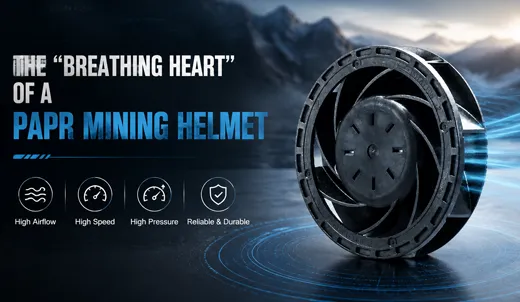
| Parameter Item | Technical Value | Engineering Application Context |
|---|---|---|
| Dimensions | Ø70 × 20 mm | Ultra-compact form factor suitable for helmet integration without adding excessive head bulk. |
| Bearing System | Dual Precision Ball Bearings | Provides long operational life (>50,000 hrs), high shock protection, and multi-axis mounting capability. |
| Rated Voltage | 12 VDC | Optimized for standard multi-cell lithium rechargeable battery systems. |
| Operating Voltage Range | 7.5 to 13.5 VDC | Ensures stable airflow delivery as battery discharge curves drop over long shifts. |
| Rated Speed | 9,200 ±10% RPM | Generates high static pressure while maintaining dynamic rotational balance. |
| Max Airflow Rate | 42.8 CFM (1.21 m³/min) | Delivers high volumetric air supply under free-flow conditions. |
| Max Static Pressure | 48.1 mmH₂O (471.7 Pa) | Penetrates high-resistance HEPA particulate filters without air stalls. |
| Power Consumption | 12 W (12 VDC / 1.0 A) | Low power draw maximizes overall battery runtime per shift. |
| Acoustic Noise Level | 60.8 dBA @ 1 meter | Evaluated in a 16 dBA semi-anechoic room to reduce hearing fatigue. |
| Control Interface | PWM Control + FG Signal Wire | Enables real-time speed adaptation and central controller fault reporting. |
| Total Net Weight | 97 grams | Ultra-lightweight design minimizes neck fatigue for miners during extended shifts. |
Key Engineering Advantages for Industrial Safety OEMs
- High Power-to-Weight Ratio: Delivering 48.1 mmH₂O static pressure at a weight of only 97 grams, the CA7020H12B provides industry-leading pressure density in a compact size.
- Dual Ball Bearing Durability: Engineered with NMB precision dual ball bearings, this blower outlasts standard sleeve bearings by 3 to 5 times under continuous thermal, shock, and dust stresses.
- Closed-Loop Thermal & Stall Protections: Onboard smart driver circuitry features auto-restart protection against rotor lock scenarios and reverse polarity wiring safeguards.
6. Why Global Safety Equipment Manufacturers Choose TKfan
Founded in 2009, Shenzhen TKfan Precision Electromechanical Co., Ltd. is a leading manufacturer specializing in the research, design, and production of high-pressure DC brushless cooling fans and centrifugal blowers. Spanning sizes from Ø50mm up to Ø180mm, TKfan maintains an annual production capacity exceeding 5 million units from its state-of-the-art manufacturing center.
TKfan’s OEM/ODM capabilities include:
- Full In-House R&D Integration: Complete control over motor winding design, aerodynamic blade profiling, and custom PCB driver development.
- 100% Quality Assurance & Testing: Every production blower undergoes automated AMCA-210 wind tunnel airflow testing, acoustic chamber sound level verification, and environmental temperature/humidity stress testing.
- Customization Options: Engineering customization for input voltage targets, unique PWM frequency bands, customized IP55/IP68 dust/waterproof coatings, custom lead wiring harnesses, and custom housing mounts.
- Global Supply Chain Reach: High-performance blowers exported across North America, Europe, Australia, and Asia-Pacific, supporting critical applications in medical PAPR units, mining PPE, fuel cell cooling, and industrial air purification.
Whether you are designing next-generation PAPR mining helmets, wearable medical respirators, or high-resistance particulate filtration equipment, TKfan provides custom-engineered centrifugal blowers designed to meet your specific application requirements.