


Medical-Grade CPAP Blower & Ventilator Systems: Real-World OEM Success Cases & Engineering Solutions
The medical-grade CPAP blower represents one of the most critical core subsystems inside homecare and portable medical ventilator devices. Unlike standard industrial centrifugal fans, a specialized CPAP blower must conform to stringent clinical performance criteria: ultra-low operational noise, rapid dynamic pressure response, strict airpath biocompatibility, elevated static pressure reserves, and long-term reliability over tens of thousands of continuous operational hours. Original Equipment Manufacturers (OEMs) attempting to integrate generic commercial blowers frequently encounter severe engineering bottlenecks. These issues include excessive structural vibration causing sensor drift, intrusive acoustic noise ruining patient compliance, insufficient pressure reserves under humidifier and filter backpressure, and poor unit-to-unit consistency during mass production.
This article details multiple real-world OEM success cases, demonstrating how high-performance medical-grade CPAP micro blowers solve complex hardware development challenges for global medical device manufacturers. Explore full product specifications on the official TKFAN CPAP Air Blower Product Catalog.
Understanding Medical CPAP Blower Core Requirements vs. Industrial Fans
Medical ventilation requires precise pneumatic delivery. When a patient suffers from Obstructive Sleep Apnea (OSA) or respiratory insufficiency, the therapy device must supply continuous positive airway pressure or dual-level pressure synchronized with human inhalation and exhalation cycles. Consequently, a medical ventilator blower operates under constraints vastly different from traditional cooling fans.
| Performance Metric | Standard Industrial Fan | TKFAN Medical CPAP Blower |
|---|---|---|
| Dynamic Pressure Response | Slow / Steady-state speed focused | Milliseconds-level rapid speed/pressure adjustments |
| Acoustic Performance | 35 dB(A) to 50+ dB(A) typical | Sub-28 dB(A) quiet operation at clinical therapy pressures |
| Dynamic Balancing | Single-plane impeller balancing | Coaxial dual-plane dynamic balancing for rotor assemblies |
| Airpath Biocompatibility | Standard industrial plastics (Non-certified) | ISO 10993 certified biocompatible engineering materials |
| Lifespan Expectancy (L10) | 10,000 – 30,000 hours | 50,000 – 70,000+ hours continuous operation |
Case Study 1: Household Compact Sleep CPAP Ventilator Project
Project Background & Technical Challenges
A leading North American medical device OEM set out to develop a next-generation household CPAP ventilator tailored for Obstructive Sleep Apnea (OSA) physical therapy. Designed for bedside bedroom operation, the target engineering specifications mandated an ultra-quiet operating sound level below 28 dB(A) at a continuous 10 cmH₂O treatment pressure, a wide output pressure range of 4 to 30 cmH₂O, a 24V DC power supply, dual therapy modes (Fixed CPAP and Auto-adjusting APAP), and an L10 minimum lifespan requirement exceeding 50,000 hours.
During early prototype evaluation using competitor blowers, the client hit two major technical roadblocks:
- Residual Vibration & Noise Leakage: Competitor blowers relied only on single-plane dynamic balancing, leaving unaddressed rotational imbalances within the rotor assembly. Despite implementing external rubber dampening mounts, micro-vibrations propagated into the device chassis, resulting in total system acoustic noise exceeding 33 dB(A). Test users reported low-frequency humming that disturbed night sleep.
- Pressure Lag Under High Backpressure: When subjected to heavy system impedance from combined heated humidifiers and bacterial/viral filters, the competitor blowers demonstrated slow dynamic acceleration and deceleration. This lag created significant pressure deviations during patient inhalation-exhalation transitions.
TKFAN OEM Solution & Realized Outcomes
The OEM integrated the TKFAN BA7060H24B-K CPAP blower for comprehensive prototype re-validation. The decisive engineering advantage lay in TKFAN's proprietary coaxial dual-plane dynamic balancing technology. By precisely removing mass imbalances across two separate axial planes of the rotor assembly, structural micro-vibrations were minimized at the source. Furthermore, the blower incorporated a low-inertia fluid-optimized impeller paired with ultra-precision dual ball bearings.
Laboratory Validation Results in Assembled System:
• Acoustic Noise Reduction: Achieved 26.5 dB(A) at 10 cmH₂O operating pressure, beating the project specification.
• Dynamic Control: Millisecond-level acceleration enabled tight closed-loop pressure control, keeping full-cycle pressure fluctuations within ±2%.
• Clinical Compliance: All air-contact plastic components passed ISO 10993 biocompatibility standards, eliminating volatile organic compound (VOC) risks along the patient breathing circuit.
Following comprehensive stress, thermal cycling, and accelerated life testing, the OEM successfully launched their homecare CPAP device globally. Field feedback confirmed minimal noise complaints and an equipment field-failure rate far below the risk threshold.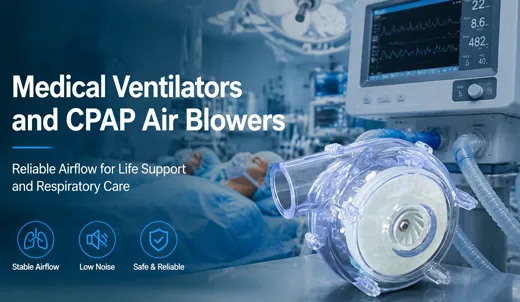
Case Study 2: Portable Travel CPAP Device for Mobile Clinical Scenarios
Project Background & Technical Challenges
A European medical technology firm aimed to build a lightweight, portable travel CPAP device tailored for frequent travelers and field emergency medical setups. Internal mechanical space inside compact travel units is exceptionally tight. The project required a micro CPAP blower with an outer diameter restricted to around 40mm, running on 24V DC, capable of generating sufficient therapy static pressure inside a minimal enclosure, and delivering high electrical efficiency to maximize battery runtime.
Testing off-the-shelf mini blowers revealed unacceptable trade-offs. Most 40mm industrial blowers required maximum rotational speeds to hit peak static pressures, creating high-pitched acoustic whine. Moreover, large unit-to-unit consistency variations and high current draw under pressure quickly drained battery life. Because compact devices leave virtually no space for multi-stage sound baffles or shock mounts, inherent low noise and high efficiency were non-negotiable.
TKFAN OEM Solution & Realized Outcomes
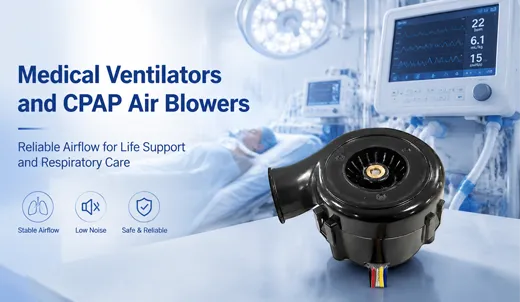
The client selected the TKFAN BA4028H24B mini CPAP blower. Measuring just 40×28 mm, this ultra-compact medical blower generates a maximum static pressure of 5.9 kPa and a maximum airflow rate of 12 CFM. Despite its ultra-small footprint, TKFAN applied dual-plane balancing to suppress high-speed rotational vibrations. The optimized brushless DC motor winding reduced power consumption under nominal therapeutic pressures.
- Optimal Pressure Output: Delivered required treatment pressures without continuously running at 100% duty cycle, preventing acoustic whine.
- Extended Battery Life: Lower power consumption in typical operating conditions prolonged unplugged battery operational hours.
- Space Efficiency: Eliminated the need for heavy multi-layer dampening structures, saving precious internal volume.
Turnkey Harness Customization: Utilizing TKFAN’s custom OEM/ODM services, custom wire harness lengths and connector pinout configurations were pre-fitted to match the customer's PCB layouts, eliminating manual rework during mass assembly.
Case Study 3: Bi-Level BiPAP Homecare Respirator Project
Project Background & Technical Challenges
An Asian respiratory medical device manufacturer developed a modern BiPAP (Bi-level Positive Airway Pressure) ventilator system. Bi-level therapy places extreme dynamic demands on the underlying motor driver and blower assembly. The blower must rapidly cycle between Inspiratory Positive Airway Pressure (IPAP) and Expiratory Positive Airway Pressure (EPAP) in synchronization with the patient's spontaneous breathing effort. Dynamic response delays cause pressure phase lag, leading to patient-ventilator dyssynchrony and severe discomfort.
Standard medical blowers designed for constant pressure CPAP mode struggle during high-frequency speed cycling. Rapid acceleration and deceleration impart severe mechanical strain on bearing assemblies and rotor components, raising the risk of premature fatigue failure. The manufacturer required a specialized CPAP micro blower supporting PWM speed control inputs, possessing a low-inertia rotor structure, and backed by verified cyclic endurance testing.
TKFAN OEM Solution & Realized Outcomes
The manufacturer adopted the TKFAN BA5060H24B-A CPAP blower. Featuring a maximum static pressure rating of 8.4 kPa and maximum airflow of 14 CFM, this model integrates an ultra-low inertia impeller structure designed specifically for high-speed dynamic response. A 4-wire electrical interface supports standard PWM speed adjustment while returning an FG tachometer signal for real-time closed-loop speed monitoring.
Rigorous laboratory life testing simulated millions of IPAP-to-EPAP pressure transition cycles. The TKFAN blower maintained stable aerodynamic pressure curves with zero performance drift in vibration or noise levels over time. The client successfully transitioned the BiPAP device to mass production, validating that the blower system seamlessly matched complex bi-level respiratory timing requirements.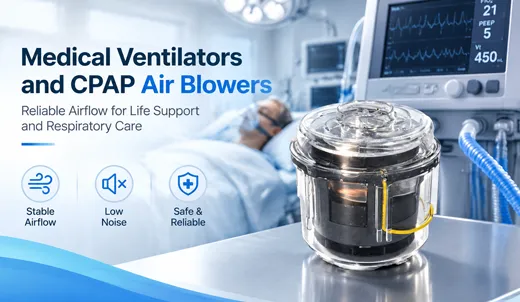
Core Technical Capabilities Driving TKFAN CPAP Blower OEM Success
Analyzing these successful implementations highlights several critical engineering boundaries separating true medical-grade CPAP blowers from generic industrial blowers:
- Coaxial Dual-Plane Dynamic Balancing: While standard micro fans use single-plane balancing, TKFAN performs dual-plane material removal calibration on both rotor ends. This eliminates internal dynamic coupling moments, laying the foundation for whisper-quiet performance inside tight ventilator casings.
- Comprehensive 40mm to 70mm Product Portfolio: From ultra-small travel CPAP units to high-pressure homecare and emergency hospital devices, TKFAN provides off-the-shelf standard models to accelerate client prototyping. Discover full specifications at the TKFAN CPAP Air Blower Product Catalog.
- Strict Medical Material Compliance: Every component within the therapeutic gas path uses ISO 10993 certified biocompatible engineering polymers, eliminating off-gassing and toxic volatile chemical risks for respiratory patients.
- High-Speed Brushless DC Motors & Dynamic Response: Low-inertia impeller designs coupled with advanced BLDC motor drives enable millisecond-level dynamic response essential for APAP, BiPAP, and complex ventilation modes.
- Scalable Automated Manufacturing & Full Traceability: Automated motor winding, precise automated assembly, inline vision inspection, and integrated MES quality tracking guarantee lot-to-lot consistency. Every individual blower leaves the production line with logged dynamic balance and vibration serial data.
Frequently Asked Questions by Medical Device Engineers (FAQ)
Q1: Are TKFAN CPAP blowers suitable for both homecare and portable travel ventilators?
Yes. The TKFAN CPAP blower product family ranges from 40mm micro blowers tailored for ultra-compact travel units to high-pressure 70mm versions designed for premium homecare and clinical systems. All models adhere to the same medical-grade dynamic balancing, biocompatibility, and dynamic response standards.
Q2: What electrical control interfaces do TKFAN medical blowers support?
TKFAN CPAP blowers support industry-standard Pulse Width Modulation (PWM) speed control input along with FG (Frequency Generator) tachometer speed feedback. Customized 0–5V analog voltage control setups are also available through OEM customization.
Q3: Can TKFAN customize blower designs for specific medical device projects?
Absolutely. TKFAN provides complete OEM/ODM engineering services, including custom wiring harnesses, specialized connectors, tailored mounting frames, and custom aerodynamic impeller adjustments to align with unique mechanical and pneumatic requirements.
Q4: What is the typical operating lifespan (L10) of a TKFAN medical CPAP blower?
Equipped with premium precision dual ball bearing systems and low-vibration rotor assemblies, TKFAN medical CPAP blowers deliver an L10 lifespan rating between 50,000 and 70,000 operational hours under nominal operating conditions.
Conclusion: Partnering with TKFAN for Next-Generation Medical Ventilation
Engineering stable, compliant, and quiet homecare or travel medical ventilators hinges on choosing the right specialized CPAP blower component. Noise levels, structural vibration, dynamic pressure response, material safety, and mass-production consistency directly determine clinical success and end-user satisfaction. As demonstrated in these real-world OEM implementations, engineering-focused blower solutions effectively eliminate core hardware design obstacles.
If your engineering team is currently evaluating blowers for sleep apnea therapy, non-invasive ventilation, or portable emergency medical equipment, explore complete product specifications on our official CPAP Air Blower Product Page. Contact our technical sales team today to request engineering samples, test reports, or custom OEM consultations for your next-generation medical device project.
GET A QUOTE