Automotive Sensor Cleaning Air Blower Selection Guide
Explore our premium 12V automotive sensor cleaning air blower series, engineered with IP68 waterproof ratings and AEC-Q100 certified components for advanced ADAS systems.
Air Blower for Automotive Sensor Cleaning Systems Overview: Resolving ADAS Vulnerabilities
Modern autonomous vehicles and high-level L2-L5 driving platforms typically use nearly 30 sensors, including LiDAR, CMOS cameras, ultrasonic devices, and high-frequency radars, to maintain spatial orientation. However, real-world deployment reveals a severe critical bottleneck: environmental debris and road dust easily accumulate on delicate sensor surfaces, and rainwater further contaminates them during storms. This contamination severely impacts sensing results, blinding the perception layers and compromising active safety protocols. Therefore, integrating a robust, reliable automotive sensor cleaning air blower system is absolutely essential to ensure uninterrupted autonomous safety in any weather condition.
Cleaning Solutions: Fluid Controls vs. Aerodynamic Thrust
To tackle optical lens obscuration, Tier 1 suppliers and automotive developers currently utilize two main cleaning solutions depending on the vehicle integration framework and spatial allocation. For a rigorous engineering evaluation of these architectures, including airflow thresholds and efficiency benchmarks, please refer to our comprehensive technical guide on ADAS & LiDAR sensor cleaning hardware systems .
Airflow Cleaning via High-Pressure Blower
This specialized approach relies on a high-pressure automotive sensor cleaning air blower to generate concentrated, high-velocity airflow jets. The massive static kinetic force directly sweeps across the sensor surface, instantly removing dry dust, loose sand, and ambient rainwater droplets without physical contact or consumption of liquids.
Fluid Washing via High-Pressure Pump
Alternatively, some systems deploy a high-pressure water pump to wash away dried mud or sticky bugs. This pump generates high-pressure water, sometimes reaching up to 1 MPa, forcefully rinsing the sensor lens before utilizing secondary air streams to quickly dry the residual water traces.
Relevant Products & Flexible Scaling Strategies
As a leading developer in vehicle thermal and fluid dynamics, our company manufactures both types of high-pressure blowers and offers blowers in different sizes to meet the complex integration needs of different vehicle models and varying sensor clusters:
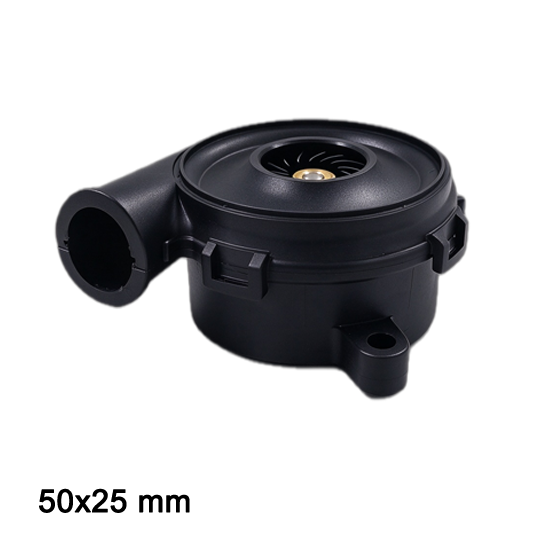
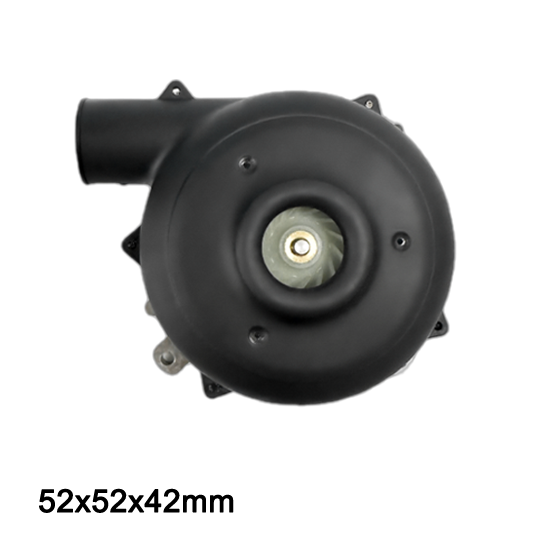
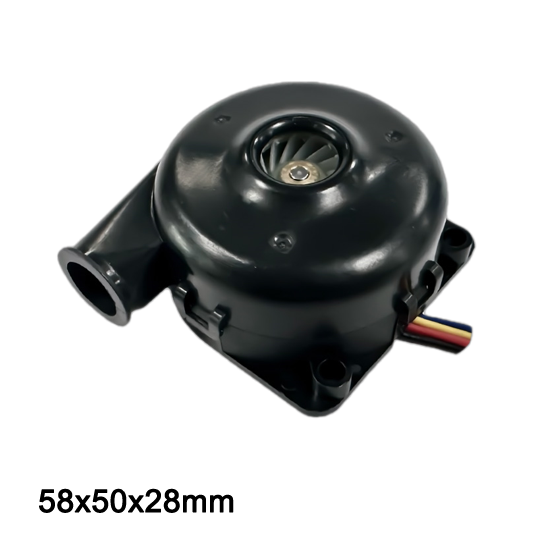
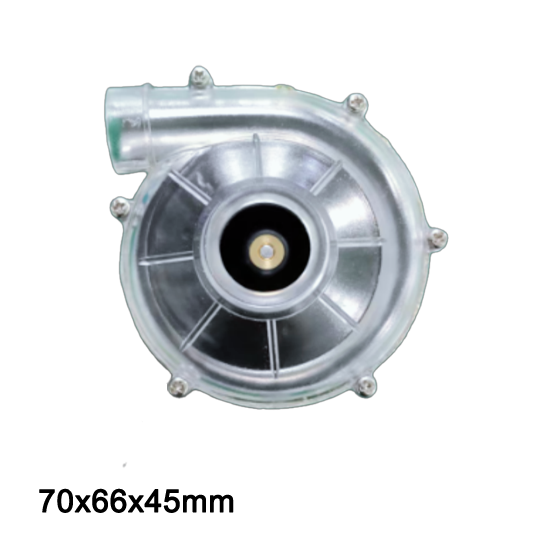
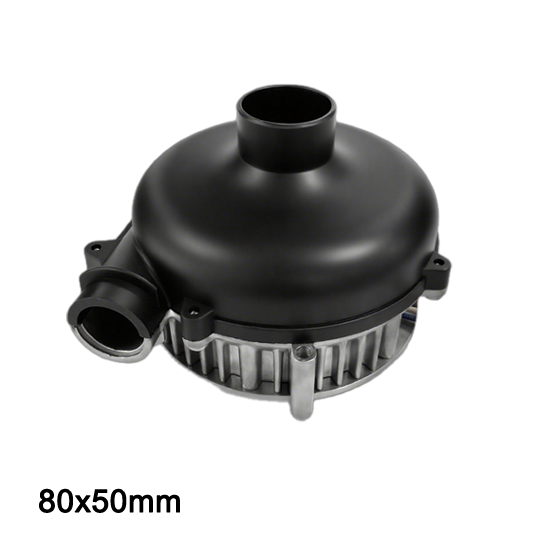
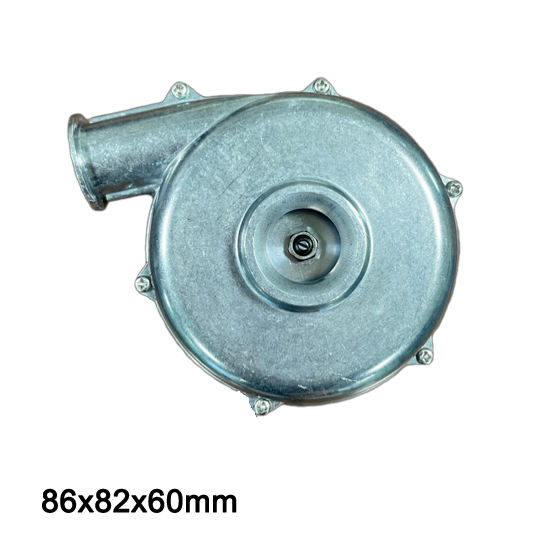
Our **small high-pressure blower** is 50mm in size (such as the BA5025 series) and can provide sufficient cleaning airflow for 2-6 centralized sensors, making it optimal for local camera housings or rearview mirror pods. For full-vehicle redundancy, our **large blower** is 80mm in size (such as the BA8050/BA8060 series) and can deliver immense pneumatic output through centralized manifolds to provide sufficient cleaning airflow for all sensors onboard simultaneously.
Strict Vehicle Integration & Hardware Mandates
To qualify for commercial automotive front-installation, every single automotive sensor cleaning air blower we supply is engineered to meet five unwavering vehicle-grade development benchmarks:
- Maximum Ingress Protection: The blower must be fully waterproof and dustproof, engineered with a certified protection rating of IP68 to survive continuous underside mud splashes, high-pressure car washes, and submersion.
- Wide Voltage Adaptability: The rated operating voltage must be 12V DC, with a preferred flexible operational window of 9-16V to absorb voltage surges or sudden cranking drops on the vehicle's electrical rail.
- Extreme Thermal Survival: Components must operate normally in an unforgiving ambient environment ranging from extreme arctic sub-zeros of -40°C up to blistering engine bay heat of 85°C without structural deformation.
- Integrated Brushless Drivers: Internal smart integrated drivers are ideal, streamlining direct PWM speed communication with the central vehicle ECU while saving critical physical envelope room within tight housings.
- Rigorous Car-Grade Compliance: Critical silicon, embedded microcontrollers, and electrical components should be fully AEC-Q100 certified, assuring ultra-low PPM defect rates and an extended operational lifetime.
Automotive Sensor Cleaning Air Blower - FAQ
Get professional answers about selecting, implementing, and optimizing high-pressure blowers for autonomous vehicle ADAS sensor washing structures.
Q1: How does an automotive sensor cleaning air blower handle both dry dust and wet rainwater during operation?
Our automotive sensor cleaning air blower series utilizes a high-efficiency centrifugal impeller configuration. This geometry converts high-speed rotational energy into massive static pressure (up to several Kilopascals). When channeled through micro-nozzles, it forms a sheer pulse-air knife that detaches dry dust particles via structural kinetic force and shears rain droplets away from hydrophobic lenses, preventing blind spots.
Q2: Why is the 9-16V voltage range and AEC-Q100 certification so critical for ADAS cleaning blowers?
Automotive electrical networks are notorious for transient spikes, cranking dips, and heavy alternator noise. A preferred 9-16V range ensures the 12V blower operates continuously without resetting. Furthermore, AEC-Q100 certification guarantees that the integrated driver components have been rigorously stressed against thermal cycling and electronic shock, a crucial prerequisite for safety-critical autonomous systems.
Q3: Between your 50mm small blower and 80mm large blower, how should a Tier 1 engineer choose?
Selection depends heavily on the sensor layout architecture. If your ADAS design uses localized, independent cleaning zones, our 50mm small blower can seamlessly integrate near the sensor pod to service 2 to 6 nearby lenses. If the vehicle utilizes a centralized air wash network, our larger 80mm blower provides the volumetric airflow necessary to overcome complex ducting resistance and clear all sensors across the chassis.
Q4: Does the IP68 waterproof rating protect the blower from high-pressure cleaning liquids or road chemicals?
Yes. Our IP68 certified automotive sensor cleaning air blower devices feature complete environmental sealing. The internal brushless DC motor and driver circuitry are entirely encapsulated using specialized high-thermal-conductivity resins. This isolates the internal electronics from road salt, winter de-icing chemicals, water submersion, and aggressive vehicle underbody pressure washes.