

×
News – PC Banner Image


Air Blower Noise Reduction for High-Speed Applications
4 September, 2026

Air Blower Noise Reduction for High-Speed Applications

Blower noise is an unavoidable engineering trade-off in modern high-speed, high-pressure blower equipment. To address blower noise reduction, it is recommended to follow this logical process: First, identify the four main sources of noise (aerodynamic noise, mechanical vibration noise, electromagnetic noise, and system resonance noise), prioritize the selection and hardware optimization of source components, and then implement system-level noise reduction measures (vibration isolation, airflow optimization, and silencing treatment). Adding silencers or sound-absorbing cotton only late in the development process is a stopgap measure and often damages the core static pressure performance of the TKFAN high-pressure blower.

Check more
How Back Pressure Affects Air Blower Performance
3 September, 2026

How Back Pressure Affects Air Blower Performance

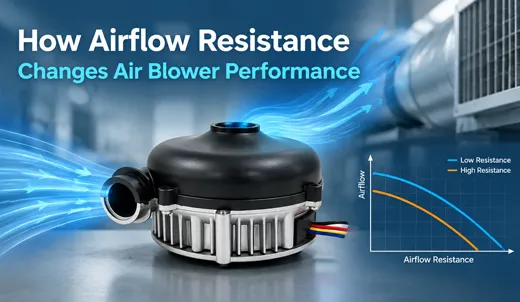
In virtually all real-world blower installations, back pressure is an inherent factor. It impacts blower performance across the board—reducing airflow output, altering motor power consumption, increasing noise and vibration, and even triggering aerodynamic stall or shortening equipment lifespan. The discrepancy between laboratory specifications and the performance of the finished unit often stems from a failure to fully account for system back pressure during the initial design phase.

Check more
Air Blower Speed Control for Precise Airflow Adjustment
2 September, 2026

Air Blower Speed Control for Precise Airflow Adjustment

From life-saving and sleep-therapy ventilators to cleaning systems for automotive ADAS sensors, high-precision particle counters, air-cushion packaging machinery, and all-weather industrial equipment, the TKFAN blower series features proven, mass-production-validated speed control technology. The product lineup encompasses micro blowers, low-pressure blowers, and models ranging from 12V to 220V, including waterproof, high-pressure, and specialized variants. Engineers can visit https://www.tkfan.com/products/air‑blower.html to view the complete blower series, access specifications, and explore OEM customization options.

Check more
How Air Blower Pressure Affects Airflow in Compact Systems
1 September, 2026

How Air Blower Pressure Affects Airflow in Compact Systems

Consumer and industrial hardware continues to shrink in size every year, but processing power and component heat density continue to rise. Portable medical analyzers, VR headsets, mini projectors, wearable cooling devices, and small fuel cell systems all face the same thorny problem: limited internal space coupled with enormous heat generation. Many hardware designers make a common mistake: selecting heat dissipation devices solely based on maximum free airflow parameters, only to find that the actual cooling effect falls short of expectations after the fan is fitted into the cramped device casing.

Check more
AC 220V vs DC 24V Blower: What Are The Real Differences?
31 August, 2026

AC 220V vs DC 24V Blower: What Are The Real Differences?

The differences between a 220V AC blower and a 24V DC blower go far beyond the input voltage label. When engineers are selecting a blower, they cannot simply compare the unit price; they must comprehensively evaluate the power supply conditions, static pressure requirements, automation control, safety regulations, and the overall system cost.

Check more
What Is a 220V Blower? Working Principle & Main Applications
28 August, 2026

What Is a 220V Blower? Working Principle & Main Applications

Choosing a suitable 220V blower, especially the high-performance TKFAN 220V air blower series, fills the market gap between ordinary low-pressure fans and large high-pressure air compressors. The equipment directly uses 220V industrial and commercial mains power, relying on centrifugal principle to output sufficient static pressure, overcoming air resistance caused by filters, complex pipelines, and sealed enclosures. It is widely used in scenarios such as exhaust gas extraction, rack cooling, server thermal management, and automated drying.

Check more