


Accessories – PWM Generator
Our PWM Generators are widely applied in medical respiratory equipment, powered air‑purifying respirators(PAPR), HVAC ventilation, industrial air blowers and automation air‑handling devices. We work closely with equipment manufacturers to deliver PWM generators matching custom speed control, signal pulse and communication requirements.
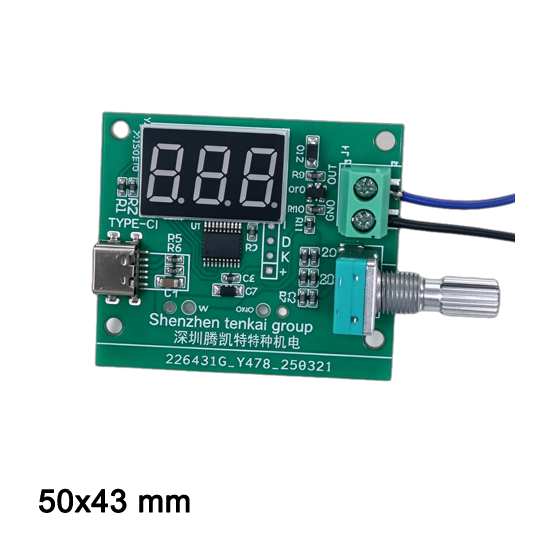
How Precision PWM Signal Generators Optimize Speed Control in Modern Automation Systems
In modern industrial automation, HVAC ventilation, and precision medical equipment, stable motor speed regulation depends heavily on clean, reliable control signals. Operating BLDC motors or electronic cooling fans without a dedicated signal controller often leads to operational bottlenecks: unstable RPM modulation, signal distortion over long cables, improper duty cycle scaling, and noisy speed regulation. Implementing a high-precision PWM Signal Generator Module resolves these issues by delivering flexible pulse-width frequency control and clean digital signal output.
Engineered for demanding industrial and testing environments, TKFAN’s specialized PWM generators feature intuitive digital controls, clear display interfaces, and high signal stability. By providing programmable frequency adjustment and precise duty cycle tuning from 0% to 100%, the PWM generator allows technicians and system engineers to seamlessly test, calibrate, and drive BLDC fan controllers, motor drivers, and industrial actuators. Whether used for benchtop testing or permanent integration into control cabinets, our PWM generators deliver repeatable performance while isolating sensitive control loops from electrical noise.
Advanced Signal Control & System Integration
1. High-Precision Frequency & Duty Cycle Tuning
Featuring fine step adjustment across broad frequency ranges, the PWM generator enables ultra-smooth RPM ramping and exact duty cycle positioning. This ensures highly accurate airflow calibration for medical blowers, laboratory equipment, and automated climate systems.
2. Dual-Mode Operation & Signal Isolation
Equipped with dual PWM output channels and configurable pulse output modes, the module supports both standard speed control and multi-device drive setups. Onboard buffering protects connected host controllers against signal reflection and voltage spikes.
Key PWM Generator Features & Technical Specifications
TKFAN PWM generators are designed and manufactured to meet high industrial signal accuracy standards. Every module incorporates robust components to support continuous testing and control applications:
- Wide Frequency Adjustment Range: Supports signal outputs from low Hz up to several hundred kHz, covering all standard BLDC motor drive and fan control input frequencies.
- 0%–100% Duty Cycle Resolution: High-resolution digital tuning allows step adjustments down to 0.1% or 1%, enabling micro-level speed regulation.
- Clear Digital LCD / LED Display: Displays real-time frequency, duty cycle, and signal status simultaneously for intuitive monitoring during setup and testing.
- Wide Operating Voltage Compatibility: Operates across standard DC voltage inputs (e.g., 3.3V to 30V), generating standard 5V or VCC PWM pulse amplitudes compatible with standard driver boards.
- Power-Down Parameter Memory & Enclosure Options: Automatically saves preset parameters upon shutdown; available in compact panel-mount housings for direct integration into control panels.
PWM Generator Accessories - FAQ
Find technical answers about TKFAN PWM generators, covering signal amplitude, frequency ranges, wiring methods, fan speed testing, and customization options.
Q1: What is a PWM generator used for in BLDC fan and motor control?
A PWM (Pulse Width Modulation) generator outputs a digital square-wave signal with adjustable frequency and duty cycle. It is primarily used as an external control signal source to test, calibrate, or manually regulate the speed of 4-wire DC fans, BLDC motor drivers, and industrial actuators without needing a micro-controller or PLC setup.
Q2: How does duty cycle affect motor and fan speed?
Duty cycle represents the percentage of time the pulse signal stays in the logic HIGH state within one period. On most standard PWM-controlled fans and drivers, a higher duty cycle (e.g., 80%–100%) commands maximum RPM, while a lower duty cycle (e.g., 10%–20%) slows down the fan or triggers a complete shutdown depending on the driver's firmware logic.
Q3: Can TKFAN customize PWM generators for panel mounting or OEM equipment integration?
Yes. TKFAN provides OEM/ODM customization for PWM generator modules, including customized PCB layouts, panel-mount bezels, knob/button controls, specific terminal block connectors, custom output voltage levels, and pre-configured default frequencies for factory assembly lines.
Q4: What frequency setting should I select for testing 4-wire PWM cooling fans?
Standard 4-wire DC fans follow Intel PWM specification requirements, which typically call for a control signal frequency of 25 kHz (acceptable range: 21 kHz to 28 kHz). Setting your PWM generator to 25 kHz ensures smooth speed response and eliminates audible coil noise from switching.
Q5: Can a single PWM generator control multiple fans or motor drivers at the same time?
Yes. Since the PWM output is a low-power digital control signal (not the main power source), one PWM signal output can be wired in parallel to the PWM input pins of multiple fans or drivers, provided the total signal current does not exceed the maximum current driving capacity of the generator channel (typically 30mA).
Q6: What signal output amplitude does the PWM generator supply?
Depending on the module model, the PWM signal output amplitude is either fixed at 5V TTL level or equal to the DC supply voltage (VCC) powering the module. Most standard BLDC motor driver boards and 4-wire fans accept 3.3V–5V logic PWM inputs.
Q7: What is the difference between frequency (Hz) and duty cycle (%) on a PWM generator?
Frequency (Hz/kHz) defines how many square-wave pulses are output per second, determining the switching speed. Duty cycle (%) defines the ratio of "ON" time versus "OFF" time within each pulse period, which acts as the speed control command value for the motor driver or fan controller.
Q8: Does the PWM generator require an external DC power supply to operate?
Yes. The PWM generator module requires a stable DC power input (typically DC 3.3V–30V, depending on the model) to power its internal microcontroller, display, and output buffer circuitry.
Q9: Can the PWM generator save setting parameters after power is turned off?
Yes. TKFAN PWM signal generators feature non-volatile EEPROM memory. Once you set your desired frequency and duty cycle, the parameters are saved automatically and restored instantly the next time the module is powered on.
Q10: How do I wire a 4-wire fan to the PWM generator?
Connect the fan’s Power (+V) and Ground (GND) wires directly to the main power supply. Connect the fan’s PWM control signal wire to the PWM Output pin of the generator, and ensure the Ground (GND) wire of the PWM generator is connected to the same Ground (GND) of the power supply to establish a common ground reference.
PWM Generator Video
Watch our video demonstration to see how our 5V 25kHz standard PWM generator accurately controls fan speed, providing reliable performance for testing and calibration setups.
GET A QUOTE

Can't Find the Perfect Fan?
We offer customization services from wire length to full mold design. Get a prototype in 48 hours.
Request Custom Solution