

High-Performance CPAP Blower Solutions for Vehicle-Mounted Respiratory Equipment
With more than one billion adults worldwide suffering from mild to severe Obstructive Sleep Apnea (OSA), the necessity for reliable continuous positive airway pressure (CPAP) therapy has long transcended the boundaries of traditional home environments. Standard CPAP therapy remains the recognized gold standard for maintaining upper airway patency, eliminating snoring, overcoming nocturnal hypoxia, and mitigating long-term cardiovascular risks. However, modern lifestyles and logistical advancements have triggered an unprecedented boom in mobile healthcare, overland self-driving road trips, recreational vehicle (RV) exploration, long-haul freight logistics, and emergency transport medicine. This shift has driven a massive surge in demand for mobile respiratory support setups. To address this evolving market, device manufacturers require specialized, high-performance CPAP blower solutions for vehicle-mounted respiratory equipment that ensure therapeutic precision across fluctuating operating environments.
Strategic SEO Focus Note: Standard residential CPAP blowers are designed exclusively for stable AC municipal power grids, climate-controlled rooms, and static positioning. When placed in moving vehicles, these consumer-grade devices often fail due to sudden voltage drops, constant vibration, thermal extremes, and severe electromagnetic interference (EMI). Implementing a dedicated medical-grade, vehicle-optimized blower platform is essential to safeguard patients from pressure delivery failures and preserve device longevity.
Critical Engineering Shortcomings of Standard CPAP Blowers in Mobile and Automotive Environments
To construct a highly competitive vehicle-mounted sleep apnea machine or emergency transport ventilator, engineers must first isolate and address the typical failure modes associated with standard domestic blowers. Using non-modified, standard blowers inside commercial trucks, SUVs, or RVs exposes four core vulnerabilities:
1. Automotive Voltage Fluctuations Destabilize Therapy Pressure
A standard 12V passenger vehicle power system fluctuates wildly between 10.8V and 14.8V during engine ignition, idling, and high-speed acceleration. Heavy-duty commercial trucks, overland vehicles, and high-capacity RVs operate on 24V architectures that spike or sag from 21V up to 28.8V. Standard CPAP blowers lacking wide-voltage adaptive driver circuits suffer from fluctuating motor RPMs. This creates static pressure variances that exceed ±1 cm H₂O, disrupting breath-triggering algorithms and potentially cutting off night therapy. Furthermore, unprotected microcontrollers risk immediate thermal destruction when subjected to voltage surges above 27V from vehicle alternators.
2. Single-Plane Dynamic Balancing Causes High Structural Noise and Cabin Resonance
The vast majority of mass-produced, standard miniature blowers feature low-cost impellers balanced on a single plane. While sufficient for static bedroom environments, the residual eccentric mass of the rotor is rapidly amplified by continuous structural road vibrations. Inside the tight confines of a truck cabin or an RV sleeper berth, structural resonance can push operational noise past 35 dBA. Combined with road noise and engine rumble, this completely disrupts restorative sleep for OSA patients. To overcome this, advanced dual-plane dynamic balancing is required to lower the noise, vibration, and harshness (NVH) profile of mobile respiratory gear.
3. Low Ingress Protection Accelerates Component Wear
Vehicles operating in the field encounter high dust loads, shifting humidity, splash hazards, and aggressive thermal cycles (ranging from arctic sub-zero storage at -40°C up to scorching vehicle cabin storage at +70°C). Standard commercial blower housings lack robust ingress sealing, which causes rapid dust accumulation on high-speed impellers, premature bearing degradation, and moisture condensation on critical PCBA traces. Non-automotive fans often show airflow blockages or circuit shorts within 3 to 6 months of active mobile operation.
4. Poor Electromagnetic Compatibility (EMC) Disrupts Dashboard Electronics
Standard brushless DC (BLDC) motor drivers running at high RPMs without dedicated electromagnetic shielding emit substantial radiated and conducted electrical noise. This interference can disrupt sensitive vehicle communications, including GPS navigation tracking, Bluetooth infotainment systems, tire pressure monitoring sensors (TPMS), and local electronic control units (ECUs). Adding external, bulky filters post-production increases material costs and expands the physical footprint of compact portable respiratory enclosures.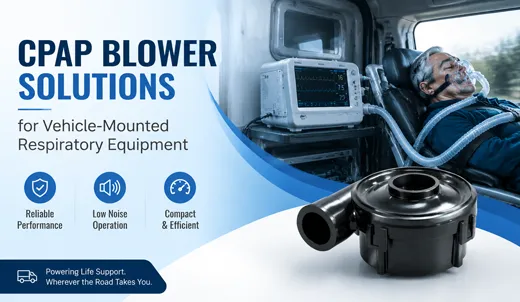
The Dual Framework Compliance: Medical Certification Meets Automotive Rigor
An effective, high-tier vehicle-mounted CPAP blower solution must bridge two separate regulatory frameworks: global medical device compliance protocols (for patient safety) and strict automotive component standards (for vehicular resilience). By adopting a pre-engineered platform that addresses both frameworks simultaneously, medical device OEMs can substantially compress their time-to-market.
Medical Performance Metrics for CPAP Therapy Integration
- Dynamic Pressure Modulation: Seamlessly adjustable static pressure between 4 and 40 cm H₂O with an accuracy tolerance under ±0.2 cm H₂O, making it fully compatible with Fixed CPAP, Auto-adjusting APAP, and Bi-level BiPAP modalities.
- Highly Linear Airflow Delivery: Delivers a consistent supply from 0 up to 440 L/min, ensuring less than a 3.2% performance drop after 5,000 hours of continuous high-load operation.
- Rapid Pressure Rise Times: Achieving targeted pressure changes in under 180 milliseconds to sync perfectly with human inspiratory and expiratory patterns.
- Biocompatibility Compliance: Utilizing medical-grade, burr-free PA66 engineering polymers that comply fully with ISO 10993 standards. This guarantees zero toxic outgassing or volatile organic compound (VOC) emissions, even under intense cabin heat.
- Acoustic Emission Boundaries: Emits less than 30 dBA at a standard 10 cm H₂O pressure baseline, verified with clinical 4mm airflow restrictors.
Automotive Adaptability and Environmental Standards
- Wide-Input DC Voltage Range: Continuous, seamless operation across 10.8V to 26.4V DC, automatically adapting to both 12V cars and 24V logistics vehicles.
- Extended Operational Temperature Envelope: Flawless performance from a minimum of -20°C to a maximum of +70°C, with non-operational storage survivability between -40°C and +85°C.
- Random Vibration Verification: Withstands rigorous three-axis (X/Y/Z) random vibration sweeps from 10Hz to 2000Hz, ensuring zero impeller displacement or solder joint fatigue.
- Robust Ingress Protection Ratings: Standard IP54 dust and splash protection, with optional IP65 fully encapsulated options for off-road RV setups and expedition vehicles.
- Automotive Level EMC Shielding: Integrated Transient Voltage Suppressors (TVS) and magnetic ring shielding designed to prevent interference with critical vehicle electronics.
Architecture Analysis of TKFAN Integrated Vehicle-Mounted CPAP Blower Platforms
The TKFAN integrated vehicle-mounted CPAP blower solution addresses demanding operational profiles through five modular, highly optimized sub-systems. This ensures clinical precision is maintained even under harsh road conditions.
1. Wide-Voltage Sensorless Sine-Wave BLDC Driver Circuitry
The core of the TKFAN platform features a sensorless sine-wave brushless DC motor driver that incorporates dynamic wide-voltage stabilization. A built-in voltage sensing microchip instantly identifies the vehicle's electrical architecture (12V or 24V) and dynamically adjusts the Pulse Width Modulation (PWM) duty cycle. This keeps motor speed and output pressure perfectly stable regardless of sudden battery drops or alternator spikes.
The system features a 40V onboard TVS diode array to clamp high-voltage spikes during ignition, preventing driver chip failures. It supports dual control inputs (0-5V analog voltage and 0-100% PWM feedback signals) for plug-and-play integration with standard CPAP microcontrollers. This driver achieves an impressive 92% to 95% power conversion efficiency, lowering power draw by over 30% compared to standard residential blowers. This power efficiency helps maximize battery life when sleeping off-grid or resting in a truck cabin with the engine turned off.
2. Coaxial Dual-Plane Dynamic Balancing Technology
Standard consumer blowers rely on single-plane balancing, which can lead to high noise and accelerated bearing wear under continuous road vibration. To solve this, TKFAN utilizes a proprietary coaxial dual-plane dynamic balancing process on all its vehicle-mounted blower lines. The high-speed motor shaft extends through the entire rotor assembly: the aerodynamic impeller mounts to the front end, while a precision brass counterweight node anchors the rear end.
Automotive balancing machinery analyzes both planes under rotation, executing microscopic material milling to eliminate residual structural eccentricity. This specialized process reduces combined aerodynamic and mechanical noise by 6 to 11 dBA compared to single-plane alternatives. For compact, enclosed vehicle cabins, this technology is essential to maintain a quiet, restful environment for night therapy.
3. CFD-Optimized Medical Fluid Turbines for Multi-Stage Backpressure
Stable therapy delivery depends heavily on the blower's centrifugal turbine design. Using extensive Computational Fluid Dynamics (CFD) simulation, TKFAN has optimized its internal airflow channels to prevent turbulence and pressure loss when the blower is paired with inline humidifiers, extended hoses, or heavy HEPA filters.
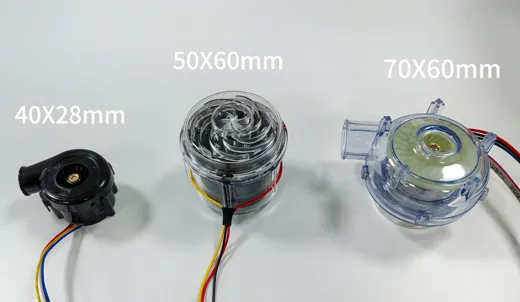
TKFAN's automotive blower impellers range from ultra-compact 40mm versions to high-volume 70mm platforms, operating at speeds between 30,500 RPM and 48,000 RPM to meet varied clinical needs:
- Ultra-Compact BA4028H24B (40×28mm): Spins at 48,000 RPM, delivering a maximum static pressure of 5.9 kPa. Ideal for ultra-portable, pocket-sized travel CPAP machines.
- Mid-Size BA5060H24B-A (58.7×59mm): Operates at 31,000 RPM, providing an impressive 8.4 kPa of static pressure. Optimized for dual-level high-pressure BiPAP devices.
High-Capacity BA7060H24B-K (76×65×54mm): Runs at 34,000 RPM, generating 5.4 kPa of static pressure and 15.7 CFM of free-flow volume. Tailored for heavy-duty built-in RV installations.
4. Full-Suspension Isolation and Environmental IP Sealing
Continuous vibration can quickly degrade unsecured blower housings. To counter this, TKFAN employs a multi-tiered isolation system: the internal motor core is secured within the outer housing by four high-damping silicone isolation mounts that absorb low-frequency engine rumbles and harsh road shocks. A six-directional mechanical stop prevents any impeller-to-housing contact during sudden vehicle braking or rough off-road travel.
The housing seams feature high-temperature EPDM rubber seals to provide standard IP54 protection. For rugged expedition vehicles, an optional IP65 upgrade adds waterproof wire harnesses and splash-resistant intake baffles. To prevent moisture damage, a built-in condensation drainage channel diverts any humidifier backflow away from the motor coils, addressing a common failure point in mobile respiratory modifications.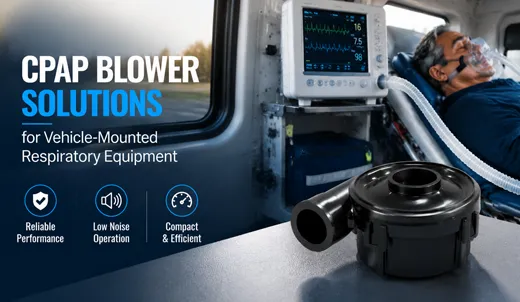
5. Six-Tier Integrated Electronic Fault Protection Logic
Because automotive electrical grids carry higher risks than home power lines, the TKFAN blower driver includes six built-in safety protection algorithms:
- Reverse Polarity Protection: Instantly cuts off current if battery leads are reversed, preventing component damage.
- Under-Voltage Lockout (UVLO): Gradually reduces speed and triggers a low-voltage alert if a 12V battery drops below 10.8V or a 24V system falls below 21V, helping to maintain basic therapy without sudden shutdowns.
- Over-Voltage Surge Suppression: Automatically halts operation if input voltage exceeds 27V, isolating components from high alternator spikes.
- Rotor Lock Protection: Shuts off motor power within 200 milliseconds if a kinked hose or blocked filter stops the impeller, preventing coil burnout.
- NTC Thermal Overload Throttling: Automatically lowers motor speed to cool components if internal temperatures exceed 85°C.
- Over-Current Monitoring: Instantly isolates the circuit during a short circuit to protect the broader device ecosystem.
The Global Product Matrix: 40mm to 70mm Specialized CPAP Blowers
The following product selector matrix displays TKFAN's standardized, high-performance CPAP blower solutions designed for mobile and automotive integration:
| Model Identifier | Dimensions (mm) | Rated Voltage | Max Speed (RPM) | Max Airflow (CFM) | Max Pressure (kPa) | Primary Automotive Use Cases |
|---|---|---|---|---|---|---|
| BA4028H24B | 40 × 28 | 24V Wide-Range | 48,000 | 12.0 | 5.9 | Pocket-sized travel CPAP machines, FAA-compliant airline sleep gear. |
| BA5025H24B | 50 × 25 | 24V DC | 37,000 | 9.5 | 4.05 | Ultra-low profile vehicle CPAP, low-power portable power station operations. |
| BA5060H24B-A | 58.7 × 59 | 12V/24V Auto | 31,000 | 14.0 | 8.4 | Long-haul freight truck BiPAP devices, mid-sized SUV mobile therapy. |
| BA7060H24B-C | 77 × 67 × 57 | 24V Wide-Range | 30,600 | 18.8 | 4.8 | Integrated class-A RV installations with multi-stage heated humidifiers. |
| BA7060H24B-D2311 | 79 × 69 × 56 | 24V DC | 30,600 | 15.9 | 4.9 | Standard motorhome treatment units requiring balanced flow over long hoses. |
| BA7060H24B-D2303 | 79 × 69 × 56 | 24V DC | 30,500 | 15.9 | 4.7 | Entry-level automotive CPAP configurations focusing on cost optimization. |
| BA7060H24B-K | 76 × 65 × 54 | 12/24V Dual | 34,000 | 15.7 | 5.4 | Premium off-road expedition RVs, ultra-quiet medical transport vans. |
Application Blueprint: Matching Blower Platforms to Vehicle Configurations
Selecting the appropriate blower architecture directly affects device power runtime, noise control, and treatment consistency. Review these configuration recommendations based on vehicle type:
Passenger Sedans and Compact SUVs (Ultra-Portable Travel CPAP)
Recommended Blower: BA4028H24B
Engineering Rationale: Measuring just 40mm, this ultra-compact blower integrates easily into slim, handheld enclosures. With a low 18W power draw, it can run for over 8 hours off a compact auxiliary power bank without needing to start the vehicle's engine. Its high-RPM design delivers sufficient static pressure over short hoses, while dual-plane balancing keeps cabin noise down to a quiet 27 dBA—ideal for road trips, flights, and lightweight travel needs.
Commercial Freight Trucks and Mid-Sized RVs (Long-Haul Logistics Support)
Recommended Blower: BA5060H24B-A
Engineering Rationale: This model features automatic 12V/24V voltage recognition, making it a drop-in match for a commercial truck's 24V electrical system. Its high 8.4 kPa static pressure easily overcomes the resistance of long 3-to-5 meter hoses and integrated humidifiers without dropping airflow. Optimized power consumption ensures it won't drain truck batteries during overnight rest stops, making it a reliable choice for long-haul transport operators.
Overland Expedition RVs and All-Terrain Motorhomes (Off-Grid Independence)
Recommended Blower: BA7060H24B-K or BA7060H24B-C
Engineering Rationale: Delivering a high 18.8 CFM free-flow rate, these 70mm blowers maintain stable pressure through multi-stage HEPA filtration and large-capacity humidifier chambers. Available with an optional IP65 fully sealed housing, they are built to withstand dusty trails, sea breezes, and high-humidity camping sites. Their long-life bearings support multi-day off-grid therapy powered by solar arrays, while advanced dual-plane balancing ensures a quiet cabin environment.
System Integration Specifications for Device Manufacturers
To preserve the performance of your chosen TKFAN CPAP blower, your engineering team should follow these verified vehicle integration guidelines:
- Component Placement: Maintain a minimum 2cm clearance between the blower housing and neighboring heat sources like engine firewalls or climate control lines. Position the device low in the cabin or in rear storage compartments to maximize distance from the patient's head and reduce perceived noise.
- Wiring and Filter Management: Use 18AWG stranded copper wiring for power delivery. Install inline ferrite cores to reduce EMI noise, and add a 5A fast-acting inline fuse for primary overcurrent protection.
- Airway Path Optimization: Keep air path bends to a minimum to reduce internal backpressure. Ensure the intake features an easily replaceable HEPA filter to keep out fine road dust and extend turbine life, recommending monthly filter changes for active travelers.
- Humidifier Isolation: Utilize the integrated moisture baffles on the blower's output port to block any fluid feedback, protecting the motor core from short circuits caused by vehicle motion or condensation.
- Smart Vehicle Connectivity: Use the PWM speed feedback signal from the driver board to connect with vehicle control displays or mobile apps, allowing users to monitor therapy pressure, device runtime, and diagnostic codes directly from their vehicle's central screen.
10 Essential Technical FAQs: Vehicle-Mounted CPAP Blower Solutions
What is the core difference between an automotive CPAP blower and a standard residential CPAP blower?
Automotive CPAP blowers feature wide-voltage stabilization circuits (10.8V–26.4V) to handle vehicle power fluctuations, dual-plane dynamic balancing to counter road vibration, and IP54/IP65 ingress sealing against dust and moisture. Standard residential blowers lack these ruggedized protections, which can lead to unstable therapy pressure and premature component failure when used in moving vehicles.
Can TKFAN vehicle-mounted blowers support advanced Bi-level (BiPAP) and Auto-CPAP (APAP) algorithms?
Yes. TKFAN's automotive blower platforms utilize low-inertia impellers powered by highly responsive brushless DC motors. The driver circuitry can ramp speeds up or down within 180 milliseconds, allowing it to sync with complex pressure changes required by BiPAP, APAP, and conventional fixed-pressure CPAP systems.
How does dual-plane dynamic balancing lower noise inside a quiet vehicle cabin?
Standard blowers are typically balanced on a single plane, which allows microscopic balance errors to expand into loud vibrations under rough road conditions. TKFAN uses automated machinery to balance the rotor assembly on two separate planes (the impeller face and a rear brass counterweight). This process minimizes structural vibrations and reduces overall operating noise by 6 to 11 dBA.
What is the exact input voltage range for these vehicle-mounted blowers?
The standard mobile series supports a continuous input range from 10.8V to 26.4V DC. The smart driver board automatically detects whether it is plugged into a 12V car battery or a 24V truck power source, adjusting performance without requiring manual user configuration. Custom fixed-voltage variants (12V or 24V only) are also available for specific product designs.
What is the expected operating life of a TKFAN blower under mobile conditions?
Equipped with premium Japanese NMB dual ball bearings and optimized internal cooling paths, TKFAN automotive blowers achieve an L10 operating life of 50,000 to 70,000 hours under typical mobile conditions. This is a substantial improvement over standard modified fans, which often fail after 15,000 to 25,000 hours due to road shocks.
Are the blower's plastic housings safe from outgassing when a vehicle is parked in hot weather?
Absolutely. All TKFAN blower housings and impellers are manufactured from medical-grade, modified PA66 polymers that are fully compliant with ISO 10993 biocompatibility standards. The materials prevent any toxic outgassing or volatile organic compound (VOC) emissions, even if the vehicle cabin reaches extreme temperatures up to +70°C.
How does the blower platform prevent water backflow from integrated humidifiers?
The blower casing includes an integrated mechanical drainage path and moisture baffles at the outlet port. If vehicle movement or deceleration causes water to back up from the humidifier chamber, these features divert fluid away from the internal motor windings, protecting the electronics from short circuits.
Can these blowers be integrated into aircraft-compliant or FAA-approved travel CPAP designs?
Yes. Models like the compact BA4028H24B are specifically engineered for small, lightweight, and power-efficient configurations. Their low power draw and excellent electromagnetic shielding profiles make it easier for manufacturers to secure FAA compliance for in-flight medical equipment use.
Do these high-speed blowers create electromagnetic interference with vehicle dashboard electronics?
No. Every TKFAN vehicle-class driver board includes integrated TVS diodes, onboard filtering capacitors, and magnetic ring shielding. These components clamp voltage spikes and contain electrical noise, ensuring full compliance with automotive EMC standards without disrupting GPS navigation, Bluetooth systems, or local vehicle ECUs.
What customization options are available for OEM and ODM contract manufacturing?
TKFAN provides comprehensive design flexibility for medical device manufacturers. Customization options include tailoring input voltage ranges, rewriting PWM communication protocols, modifying mounting brackets, altering port dimensions, upgrading to IP65 ingress sealing, and adjusting blade pitches to meet specific pressure and flow requirements.
Strategic Value for Medical Device OEMs and Global Procurement
As overland travel, commercial logistics, and mobile emergency medicine continue to expand worldwide, the demand for ruggedized, high-performance portable respiratory equipment is set for strong growth. The core blower engine remains the single most critical component determining therapy precision and equipment longevity in these demanding settings.
By leveraging the TKFAN automotive-grade blower platform, engineering teams can bypass common design challenges associated with voltage fluctuations, vibration noise, and environmental wear. Our comprehensive product matrix, spanning 40mm to 70mm configurations, allows device manufacturers to streamline development by utilizing a single supplier that meets both medical and automotive standards. Partnering with TKFAN helps lower product failure rates, reduces warranty overhead, and ensures stable, quiet sleep therapy for patients on the move.