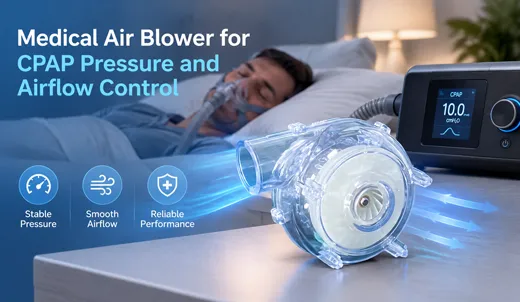


CPAP Blower Selection for Home Ventilators: The Definitive Engineering & Design Integration Guide
In modern sleep medicine and subacute homecare environments, the mechanical reliability, aerodynamic efficiency, and acoustic signature of non-invasive respiratory hardware hinge entirely upon a single critical subsystem: the high-pressure miniature blower. As global Original Equipment Manufacturers (OEMs) and research institutions advance toward hyper-compact, intelligent, and whisper-quiet home sleep apnea hardware, understanding the sophisticated criteria governing CPAP blower selection has transformed from standard parts sourcing into a strict fluid dynamics and biomechanical engineering discipline.
This technical guide details the pneumatic architectures, mechanical balance requirements, and electrical controls necessary to specify a medical-grade, high-pressure 24V Brushless DC (BLDC) centrifugal blower. By bridging the gap between aerodynamic performance data sheets and clinical compliance, this paper provides design engineers with a rigorous baseline for specifying components that ensure stable therapeutic pressures, low noise levels, and long service lifespans. Integrating a high-efficiency medical CPAP blower ensures precise pressure control, which is indispensable for modern smart respiratory medical workstations.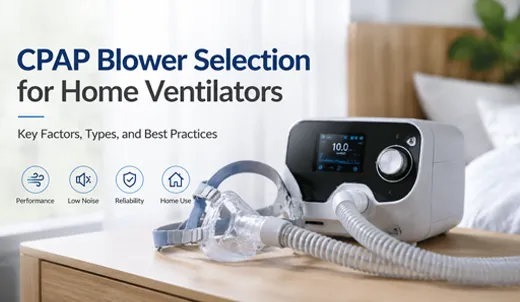
1. Classification of Home Respiratory Devices and System Constraints
Developing a residential non-invasive ventilator requires balancing spatial footprint against thermodynamic capability. Personal sleep therapy equipment is generally split into two main structural designs: travel-friendly portable hardware and full-featured standard homecare medical platforms. Each layout presents distinct operational limits for the internal blower core.
1.1 Travel CPAP Systems vs. Standard Homecare Medical Workstations
Travel CPAP configurations prioritize small footprints and battery efficiency. However, these compact constraints limit the integration of complex internal baffle networks, multi-stage acoustic silencers, and built-in active humidification systems. Consequently, portable units often run at higher internal noise levels and require micro-blowers with low-inertia impellers capable of quick velocity changes to offset system leaks.
In contrast, standard homecare ventilators are not constrained by strict spatial limits. This architectural flexibility allows fluid engineers to integrate larger, highly efficient centrifugal volutes and thick vibration-isolation mounts. These systems universally feature comprehensive integrated humidification. This introduces higher mechanical impedance along the airway, requiring a heavy-duty high-pressure CPAP blower with robust static pressure capabilities to overcome fluid resistance without overheating the device casing.
2. Technical Performance Parameter Matrix & Models
A systematic approach to blower integration requires measuring aerodynamic output against real-world fluid resistance. Over 80% of systemic ventilation failures stem from inaccurate parameter pairing or neglecting safety margins during the initial design phase. To provide engineers with precise engineering references, the following official product parameter matrix documents the electrical and aerodynamic profiles of TKFAN's benchmark platforms:
| Model/Series (型号/系列) | Dimensions (mm) (尺寸 (毫米)) | Voltage (V) (电压 (V)) | Speed (RPM) (转速 (RPM)) | Airflow (CFM) (气流 (立方英尺/分钟)) | Max Pressure (kPa) (最大压力 (千帕)) |
|---|---|---|---|---|---|
| BA4028H24B | 40*28 | 24 | 48,000 | 12 | 5.9 |
| BA5025H24B | 50*25 | 24 | 37,000 | 9.5 | 4.05 |
| BA5060H24B-A | 58.7*59 | 24 | 31,000 | 14.0 | 8.4 |
| BA7060H24B-C | 77*67*57 | 24 | 32,000 | 18.8 | 4.8 |
| BA7060H24B-D2311 | 79*69*56 | 24 | 30,600 | 15.9 | 4.9 |
| BA7060H24B-D2303 | 79*69*56 | 24 | 30,500 | 15.9 | 4.7 |
| BA7060H24B-K | 76*65*54 | 24 | 34,000 | 15.7 | 5.4 |
Engineering Core Formula for Safety Margin: To account for inevitable dust accumulation on internal HEPA filters, tight chassis bends, and component aging over extended operation, the target minimum blower selection should always integrate a mandatory safety margin:
$\text{Required System Airflow} \times 1.2 = \text{Target Minimum Blower Specification}$
2.1 Volumetric Airflow Rate (CFM & L/min)
Volumetric flow rate reflects the gross volume of breathable gas displaced by the impeller per unit of time, typically calculated in Cubic Feet per Minute (CFM) or Liters per Minute (L/min), where $1\text{ CFM} \approx 28.316\text{ L/min}$. For standard home-use sleep apnea platforms, open-flow capabilities must span up to $150\text{ L/min} - 440\text{ L/min}$ to guarantee adequate volume delivery during deep inhalation cycles and major mask alignment shifts. Sourcing a dependable CPAP blower from a professional manufacturer simplifies meeting these demanding fluid metrics.
2.2 Static Pressure Capacity (kPa)
Static pressure measures the blower's capacity to push gas through high-resistance elements like multi-stage antiviral inline filters, heated humidifiers, narrow breathing circuits, and patient interfaces. While a blower may show impressive volumetric flow numbers in open-air testing, insufficient static pressure will cause the airflow curve to drop sharply under load. As shown in our updated engineering matrix above, benchmark models like the BA5060H24B-A deliver an exceptional 8.4 kPa of wind pressure within a compact 58.7*59 mm structural configuration.
3. Advanced Mechanical & Aerodynamic Innovations
Operating speeds above 30,000 RPM place significant mechanical stress on miniature blowers. Mitigating these forces requires advanced balancing techniques and specialized internal engineering.
3.1 Coaxial Double-Sided Dynamic Balancing
Conventional miniature blowers often feature a basic internal rotor paired with a single impeller mounted inside a volute shell. At high speeds, this asymmetric layout can create severe center-of-mass offsets. This structural imbalance increases vibration, elevates low-frequency structural noise, and accelerates bearing wear.
To resolve this issue, TKFAN implemented double-sided dynamic balancing across its premium CPAP blower range. By extending both ends of the high-speed BLDC motor shaft, the main aerodynamic impeller is positioned on the front end, while a precision-machined brass counterweight is anchored to the rear. This dual-plane alignment eliminates rotational asymmetry, reduces vibration, and helps maintain noise levels well below strict clinical standards.
3.2 Dual-Impeller Serial Compression Topologies
For applications requiring high static pressure with minimal noise, such as premium Neonatal Intensive Care Unit (NICU) workstations or high-end home bi-level ventilators, single-impeller configurations must spin at extreme speeds, increasing aerodynamic noise. TKFAN's dual-impeller architecture distributes the compression load across two consecutive stages. This design generates the necessary pressure at a lower RPM, reducing the acoustic signature for a quieter patient environment.
4. Electrical Architecture, Motor Selection, and Speed Control
The reliability of a medical ventilator's pneumatic output depends directly on the configuration of its motor and control loop electronics.
4.1 24V Brushless DC (BLDC) Motive Superiority
Specifying the proper electrical platform is essential for long-term continuous operation. Compared to 12V DC variants or AC induction systems, a premium 24V BLDC motor configuration provides clear advantages:
- Reduced Current Draw: Running at higher voltages cuts current demands in half at equivalent wattages, minimizing thermal stress on the internal drive board.
- Enhanced Torque Density: Provides superior torque profiles, allowing the blower to maintain target RPMs under fluctuating backpressure.
- Extended Battery Life: High electrical efficiency maximizes runtime for backup power supplies and transport battery packs.
4.2 Motor Driver Architectures: Internal vs. External Layouts
Engineers must choose between built-in internal drive boards and independent external drivers based on space constraints and thermal requirements. TKFAN supports versatile configurations across its entire product lineup. Choosing an external driver structure isolates heat-generating commutation chips from the pure patient air path. This setup simplifies sterilization procedures and allows for customized control programming via an external microcontroller.
4.3 Closed-Loop Dynamic Speed Modulation
To accurately synchronize with a patient's breathing cycle, home ventilators require real-time speed adjustments. High-performance blowers utilize dual-signal configurations: Pulse Width Modulation (PWM) inputs for precise digital speed control, paired with a Frequency Tachometer Output (PG Signal). This enables the system controller to continuously monitor and adjust blower speed, matching pressure output to the user's real-time inspiration and expiration demands.
5. Materials Science, Biocompatibility, and Clean Air Pathways
Because the output airflow from a medical ventilator enters the patient's respiratory tract directly, component material safety is just as critical as pneumatic performance numbers.
Strict Cleanliness Standard: Industrial fans often use internal fluid lubricants that can outgas volatile organic compounds (VOCs). Medical-grade systems must feature completely oil-free designs, utilizing double-shielded, pre-lubricated high-precision ball bearings sealed away from the primary gas path to ensure absolute compliance with global inhalation safety standards.
Every plastic component, including the volute casing and structural impellers of the TKFAN CPAP blower series, is manufactured from medical-grade, non-outgassing polymers. This material selection prevents toxic outgassing even during long continuous operation at elevated internal temperatures, ensuring clean air delivery to the user.
Technical FAQ: CPAP Blower Integration & Selection
Q1: Can standard industrial brushless fans replace a medical-grade CPAP blower?
No. Industrial blowers often use internal liquid grease lubricants, operate at higher noise levels, and exhibit wider pressure fluctuations. They do not meet medical cleanliness and biocompatibility standards, making them unsuitable for direct inhalation pathways.
Q2: What is the average operational lifespan of a TKFAN medical-grade CPAP blower?
Equipped with premium dual-ball bearing structures and optimized thermal dissipation pathways, these blowers deliver an L10 bearing life expectancy of 20,000 to 50,000+ hours under nominal operating conditions.
Q3: How does double-sided dynamic balancing lower acoustic output?
By placing an adjustable counterweight on the opposite end of the extended BLDC motor shaft, single-plane rotor wobble is eliminated. This significantly reduces mechanical vibration and lowers ambient noise levels.
Q4: Why is 24V DC preferred over 12V DC for high-pressure medical ventilators?
24V architectures reduce current draw by 50% compared to 12V systems at equivalent power levels. This minimizes heat generation on the control PCB, improves motor efficiency, and extends backup battery runtime.
Q5: What control signals are required to implement automatic pressure tracking?
A standard setup requires a PWM input signal (typically 20-25 kHz) for real-time speed adjustment, combined with a FG/Tachometer output signal to provide precise rotational speed feedback to the host microcontroller.
Q6: How does active fluid humidification impact blower selection?
Humidification chambers and inline viral filters increase pneumatic resistance along the airway. Engineers should choose blowers with a robust static pressure curve to overcome this impedance without reducing targeted volumetric flow.
Q7: What advantages do dual-impeller blowers offer over single-impeller designs?
Dual-impeller systems split the pressure workload across two consecutive compression stages. This enables the blower to achieve high static pressures at lower rotational speeds, significantly reducing high-frequency noise.
Q8: Are the polymers used in TKFAN CPAP housings safe for medical applications?
Yes, all internal components along the gas pathway are manufactured from medical-grade polymers. These materials are engineered to resist outgassing under continuous operation, ensuring clean gas delivery.
Q9: What is the dynamic acceleration response time of a low-inertia micro rotor?
TKFAN's optimized low-inertia impellers can ramp from zero to peak operational speeds within milliseconds, enabling the blower to adapt to rapid changes in patient breathing patterns.
Q10: Can these medical blowers handle supplemental oxygen enrichment lines?
Yes, specified models can be configured with spark-free, oxygen-compatible brushless motor components, ensuring safe operation when integrating high-concentration supplemental oxygen lines.
GET A QUOTE