

How to Select a Reliable Replacement Blower for Medical CPAP Devices
A professional engineering analysis on sourcing high-performance, medical-grade replacement CPAP blowers to ensure clinical safety, ultra-quiet operation, and long-term device stability.
Introduction: Why the CPAP Blower is the Heart of Sleep Apnea Therapy
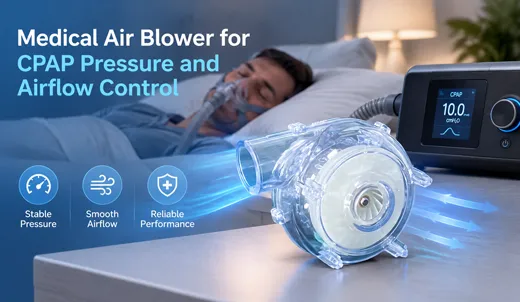
At the core of every Continuous Positive Airway Pressure (CPAP), Bi-level Positive Airway Pressure (BiPAP), and Auto-adjusting Positive Airway Pressure (APAP) machine lies a highly specialized airflow component: the CPAP blower. This high-speed, micro-medical centrifugal blower is the single most critical hardware component in determining the clinical efficacy of sleep apnea therapies. It is responsible for delivering a precise, continuous stream of pressurized air to keep the patient’s airway from collapsing during sleep, preventing obstructive episodes and eliminating snoring.
Because CPAP machines typically run for more than 8 hours every night under high rotational speeds (ranging from 30,000 to 48,000 RPM) and often operate alongside active humidifiers, the internal blower is subject to significant wear and tear over years of service. When a blower degrades or fails, medical device manufacturers, service centers, and biomedical engineers must source a premium medical-grade replacement CPAP blower. Utilizing low-quality, non-certified industrial fans can lead to unstable pressure delivery, excessive noise, toxic chemical outgassing, and early system failure.
"Sourcing an OEM-quality medical replacement blower requires a rigorous evaluation of mechanical compatibility, biological safety, dynamic balance, and acoustic dampening. Leading global medical brands trust specialized suppliers like TKFAN to provide highly reliable, 24V medical-grade CPAP blowers that meet strict international regulatory standards."
1. Key Indicators: When Your CPAP Blower Requires Immediate Replacement
Recognizing the early signs of blower degradation is vital to preventing sudden device breakdowns and maintaining therapeutic safety. Cleaning or lubricating a worn-out blower is rarely effective. When any of the following symptoms occur, a complete component replacement is required:
- Abnormal Acoustic Noise: A noticeable increase in high-frequency whining, grinding, or rattling sounds during operation. If the noise level exceeds 30 dBA under a standard clinical pressure of 10 cmH₂O, the bearings are likely failing.
- Airflow Error Codes: The ventilator's control panel displays persistent "low flow" or "pressure delivery failure" warnings despite clean air filters and a fully sealed breathing circuit.
- Unstable Pressure Outputs: Inconsistent pressure delivery during inhalation and exhalation cycles, which can disrupt the auto-adjusting algorithms of APAP and BiPAP devices.
- Chemical or Plastic Odors: A distinct plastic or metallic smell emanating from the mask, indicating that internal components are overheating or off-gassing harmful volatile compounds.
- Excessive Heat Generation: The outer casing of the CPAP machine becomes hot to the touch, driven by increased mechanical resistance and motor overload within a worn blower assembly.
Upgrading to a high-performance replacement blower from a trusted medical manufacturer like TKFAN resolves these operational issues, restoring the device to its original whisper-quiet, therapeutically stable performance.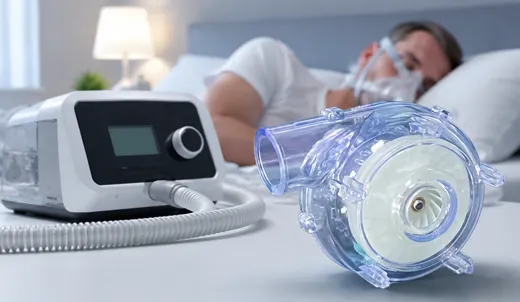
2. Strict Selection Criteria for Medical-Grade CPAP Replacement Blowers
Engineers and procurement teams must evaluate several strict parameters to ensure a replacement blower matches the technical requirements of the original medical system.
2.1 Electrical & Mechanical Compatibility
A replacement blower must fit perfectly within the device’s physical housing to avoid modifications that could alter airflow dynamics or increase noise. TKFAN provides a complete range of sizes from 40mm to 70mm to match different housing designs.
On the electrical side, 24V DC is the industry standard for medical-grade CPAP ventilators. Utilizing the correct rated voltage ensures the motor runs at optimal efficiency without overheating. Additionally, the replacement unit must support standard PWM (Pulse Width Modulation) or 0-5V analog speed control to communicate seamlessly with the system's motherboard.
2.2 Biocompatibility & Certified Safety
Because CPAP air channels deliver pressurized air directly to a patient's lungs, biocompatibility is critical. All plastic components in the airflow path (such as the scroll housing, impeller, and internal seals) must be certified under ISO 10993 and ISO 18562 standards for biocompatibility and low VOC emissions.
Standard industrial blower fans may use non-certified recycled plastics or low-grade lubricants that release toxic gases under warm, humid conditions. Premium medical replacement blowers use cleanroom-assembled, virgin engineering polymers and specialized lubricants to ensure a safe, toxin-free airflow.
2.3 Aerodynamic Performance (Static Pressure & Flow Rate)
The replacement blower must have sufficient pressure and flow reserves to overcome backpressure from fine filters, active humidifiers, and nasal masks.
For compact travel CPAP units, a blower like the 40mm BA4028H24B provides a compact footprint with a respectable static pressure of up to 5.9 kPa. For standard home-use CPAP and BiPAP devices, larger blowers like the 58mm BA5060H24B-A deliver up to 8.4 kPa of static pressure, ensuring consistent pressure delivery even under high system resistance.
3. Double-Sided Dynamic Balance: Resolving Noise at the Source
The dynamic balancing process is what primarily distinguishes high-end medical-grade CPAP blowers from standard industrial fans.
At operational speeds up to 48,000 RPM, any microscopic imbalance in the rotating assembly can generate high-frequency micro-vibrations. Standard blowers often rely on single-plane balancing, which corrects imbalance on only one end of the rotor, leaving residual forces that cause increased noise (often exceeding 32 dBA) and accelerated bearing wear.
To address this, advanced manufacturers like TKFAN employ double-sided dynamic balancing. The brushless motor shaft is designed with the main impeller on the front and a precision brass counterweight on the rear. Automatic balancing systems analyze both planes simultaneously, milling away microscopic material until the residual imbalance is virtually eliminated.
📊 Engineering Performance Advantage:
By reducing residual vibration to less than 0.4 mm/s, double-sided balancing lowers the operating noise of the TKFAN BA7060H24B-K to an ultra-quiet 26.5 dBA (at 10 cmH₂O pressure). This reduction in mechanical stress also extends the bearing’s operating life to 50,000 to 70,000 hours, compared to the 30,000-hour industry average.
4. Sizing Matrix: 40mm to 70mm Replacement CPAP Blowers
To assist engineers in selecting the correct model, the table below outlines the dimensions, speed profiles, and typical applications for TKFAN's standard 24V medical-grade replacement blowers:
| Model Number | Dimensions (mm) | Max Speed (RPM) | Max Flow (CFM) | Max Pressure (kPa) | Primary Application |
|---|---|---|---|---|---|
| BA4028H24B | 40 × 40 × 28 | 48,000 | 12.0 | 5.9 | Travel CPAPs, Portable Sleep Therapy Devices |
| BA5025H24B | 50 × 50 × 25 | 37,000 | 9.5 | 4.05 | Ultra-thin Portable Sleep Therapy Units |
| BA5060H24B-A | 58.7 × 58.7 × 59 | 31,000 | 14.0 | 8.4 | High-Pressure BiPAP, Home Auto-CPAP Systems |
| BA7060H24B-C | 77 × 67 × 57 | 32,000 | 18.8 | 4.8 | Standard Home CPAPs with Active Humidifiers |
| BA7060H24B-K | 76 × 65 × 54 | 34,000 | 15.7 | 5.4 | Universal High-Efficiency Replacement Blower |
5. The Risks of Using Standard Industrial Fans in CPAP Devices
When searching for replacement blowers, some maintenance centers or manufacturers might consider generic industrial centrifugal fans as a low-cost alternative. However, this approach carries substantial safety and compliance risks:
- No Biocompatibility Assurances: Industrial blowers are not tested for biocompatibility, posing a risk of volatile organic compound (VOC) or microplastic release directly into the patient's breathing path.
- Insufficient Backpressure Handling: Standard industrial fans lack the aerodynamic design to handle backpressure, which can cause flow stall and pressure drops when breathing resistance changes.
- Elevated Noise and Vibration: Without dual-plane dynamic balancing, industrial blowers often generate loud high-frequency noises (exceeding 32-35 dBA) and vibrations that can disrupt the user's sleep.
- Shorter Operating Lifespan: Lower-grade bearings can fail quickly under high-humidity conditions (such as those created by integrated humidifiers), leading to premature breakdown and increased warranty claims.
Choosing a dedicated medical-grade replacement blower, such as those from TKFAN, protects device longevity and ensures complete compliance with global health standards.
Technical Q&A: Deep-Dive Into CPAP Blower Engineering
Q1: Why is dual-plane dynamic balancing critical for CPAP blowers but less important for standard industrial fans?
Industrial blowers run at lower speeds, making single-plane balancing sufficient. CPAP blowers operate at ultra-high speeds up to 48,000 RPM. At these velocities, even tiny imbalances generate significant vibrational forces, leading to noise levels over 32 dBA and accelerated bearing wear. Dual-plane balancing corrects mass distribution on both ends of the rotating shaft to keep vibration levels under 0.4 mm/s, ensuring quiet sleep environments and long lifespans.
Q2: What bearing types are used in medical-grade CPAP blowers and why?
High-end CPAP blowers utilize miniature ball bearings, specifically customized Japanese NMB ball bearings. Standard sleeve bearings wear out quickly at high RPMs, causing noise and performance degradation within months. Ball bearings handle high rotational speeds, maintain low friction, and resist wear, helping the blower reach a lifetime of 50,000 to 70,000 operating hours.
Q3: How do manufacturers prevent biological contamination of the therapeutic airflow?
First, all airway components are made of ISO 10993 biocompatible polymers with low VOC outgassing. Second, the blowers are assembled in separate cleanrooms to prevent dust, grease, or industrial residues from settling in the air channels. No industrial adhesives or recycled plastics are used in the process.
Q4: What is the significance of the ISO 13485 certification for a component manufacturer?
ISO 13485 is the international quality standard for medical device manufacturing. It requires strict design control, vendor qualification, complete material traceability (via an MES system), and robust corrective/preventive action (CAPA) systems, ensuring that every production run meets medical standards.
Q5: How do CFD simulations improve CPAP blower performance?
CFD allows engineers to model aerodynamic flow, turbulence, and velocity vectors within the scroll housing before building physical prototypes. This optimization maximizes pressure and airflow while preventing stall and backpressure instabilities, ensuring stable therapeutic pressure profiles.
Q6: Why is the choice of motor rotor magnets critical for BiPAP devices?
BiPAP machines must switch pressure levels rapidly with the patient's natural breathing cycle (Inspiratory vs. Expiratory). High-performance neodymium (NdFeB) magnets provide the high magnetic flux and low rotational inertia needed for the motor to accelerate and decelerate instantly without slipping or overheating.
Q7: How does an MES system assist in product quality tracing?
An MES (Manufacturing Execution System) tracks and records every stage of production for each individual unit via its laser-etched serial code. If a blower encounters an issue, the manufacturer can trace its exact assembly time, raw material batch, operator, and dynamic balancing metrics to identify and isolate potential issues.
Q8: What noise parameters are checked during outgoing quality control?
Each finished blower is tested under load in an acoustic chamber with a 22 dBA ambient background. The blower is evaluated at 10 cmH₂O static pressure; only units emitting under 26.5 dBA of overall sound pressure (and displaying no unusual frequency spikes) are approved for delivery.
Q9: What is the L10 operating lifetime of a medical CPAP blower?
The L10 lifetime is the point at which 10% of a tested population is expected to fail. While cheap blowers average around 30,000 hours, premium-grade Chinese CPAP blowers achieve L10 lifetimes of 50,000 to 70,000 hours (translating to over 15 years of nightly use) thanks to precision balancing and premium Japanese NMB bearings.
Q10: How do Chinese medical blowers prevent electromagnetic interference (EMI)?
CPAP blowers are tested to meet IEC 60601-1-2 EMC standards. The brushless motor, internal wiring, and drive boards are designed to prevent electromagnetic interference, protecting the sensitive flow and pressure sensors inside the ventilator.