

Medical Air Blower for Ventilator Airflow Control Systems: High-Performance Air Blowers Designed for Home Sleep Therapy Equipment
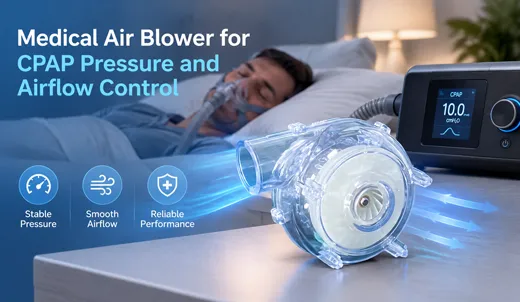
Sleep-disordered breathing—most prominently Obstructive Sleep Apnea (OSA)—affects hundreds of millions of individuals worldwide. This widespread chronic condition drives an expanding global demand for premium, highly dependable home respiratory therapy hardware. At the structural core of every modern Continuous Positive Airway Pressure (CPAP), Automatic Positive Airway Pressure (APAP), and Bilevel Positive Airway Pressure (BiPAP) system lies a specialized miniature turbomachinery core: a precision-engineered air blower. More specifically, a ultra-responsive ventilator blower is tasked with delivering stable, highly dynamic pressurized airflow continuously across every phase of a patient's nocturnal sleep cycle.
The operational capability of this miniature electromechanical driver directly governs patient comfort, clinical compliance, physical device longevity, and the overarching reliability of the medical device. Choosing the ideal thermal, fluid-dynamic, and acoustic configuration for a ventilator blower is therefore one of the most critical decisions faced by medical design engineers.
Key Engineering Takeaway: A medical-grade air blower is fundamentally distinct from standard commercial blowers. It requires strict ISO 10993 biocompatibility compliance, low-inertia dynamic response, sub-30 dB(A) acoustic profiles, and resilience against high static backpressure created by humidification chambers and bacterial filters.
For OEM and ODM engineering teams developing next-generation sleep apnea devices, evaluating the internal architecture and performance trade-offs of the core air delivery system is paramount. This technical guide explores the engineering requirements of medical fluid delivery, examines the breakthrough architectural features of the TKFAN air blower product lineup, breaks down dual-plane dynamic balancing, offers product comparisons, and answers pressing engineering FAQs.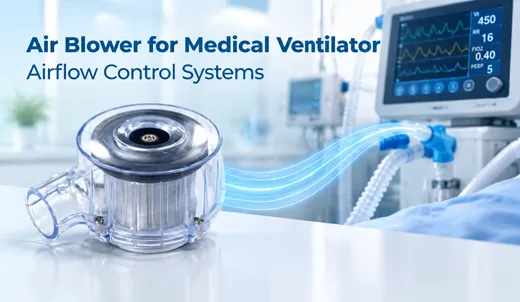
1. What is a Medical-Grade Ventilator Blower & Why Standard Blowers Fail
A medical-grade ventilator blower is a high-speed, brushless DC (BLDC) miniature centrifugal air pump specifically designed to generate dynamically controlled positive airway pressure for respiratory therapy. In home sleep therapy equipment, the air blower draws ambient air through a intake filter, accelerates it through a high-precision impeller and volute housing, and outputs pressurized air via flexible tubing and a patient mask to maintain upper airway patency throughout sleep.
While novice system designers occasionally consider low-cost industrial fans to reduce bill-of-materials (BOM) costs, general-purpose commercial blowers systematically fail during medical validation testing due to five key engineering factors:
A. Strict Biocompatibility & Gas-Path Safety Standards
Medical air delivery systems must strictly satisfy ISO 10993 and ISO 18562 standards regarding biocompatibility and respiratory gas pathway safety. Every internal material coming into contact with the patient air stream must be free from toxic off-gassing, volatile organic compounds (VOCs), and hazardous particulate leaching during continuous high-temperature operation. Standard industrial blowers utilize non-medical plastics, unvetted glues, and industrial lubricants that release harmful chemical fumes as the motor heats up during high-speed rotation—rendering them unsafe for human inhalation.
B. Sub-Millisecond Dynamic Pressure Response
Advanced CPAP and BiPAP therapy requires near-instantaneous pressure transitions. When a patient alters their breathing pattern, exhibits mask leakage, or undergoes an apnea event, an APAP algorithm demands rapid pressure adjustments. Industrial fans are engineered for steady-state fixed-speed operation with high rotational inertia. In contrast, a specialized medical ventilator blower—such as the TKFAN ventilator blower series—incorporates ultra-low-inertia impellers paired with sensorless BLDC motor control to execute millisecond-level acceleration and deceleration curves.
C. Superior Acoustic and Vibration Mitigation (NVH)
Patients rely on home CPAP machines continuously for 7 to 8 hours per night. Acoustic noise and micro-vibrations generated by an internal air blower severely disrupt sleep architecture, leading patients to discontinue treatment. While industrial fans rely on single-plane static balancing that leaves residual rotational imbalances, specialized medical blowers must control both airborne noise and structural vibration transmitted into the device chassis.
D. High Static Pressure Performance Under Backpressure
In a real-world sleep therapy system, the airflow generated by a ventilator blower encounters significant fluid resistance from heat-moisture exchangers, fine-particle air filters, humidification chambers, compliance tubing, and patient masks. Low-cost fans stall easily under high static head pressures. A medical TKFAN ventilator blower utilizes CFD-optimized impeller geometries to sustain stable volumetric flow even under severe backpressure loads up to 8.4 kPa.
E. Extended L10 Bearing Life and Continuous Reliability
Medical sleep devices must operate flawlessly for years without maintenance. The TKFAN air blower architecture features premium Japanese NMB dual ball bearings, achieving an L10 operational lifespan rating of 50,000 to 70,000 hours of continuous high-speed rotation.
2. Dual Categories of Home Sleep Therapy Equipment & Their Blower Selection Criteria
The global home sleep care market is broadly categorized into two primary equipment architectures: ultra-portable travel CPAP systems and standard home-station CPAP/BiPAP platforms. Each device category imposes distinct fluid-dynamic, spatial, and mechanical constraints on the internal ventilator blower.
A. Ultra-Portable Travel CPAP Systems
Travel CPAP units prioritize extreme miniaturization, targeting physical footprints small enough to fit inside a pocket or travel bag. However, extreme size reduction introduces tough thermal and acoustic compromises. The lack of internal physical space prevents the inclusion of large damping chambers or thick acoustic foam linings. Consequently, OEM engineers designing travel units require an exceptionally compact air blower with a high power-to-size ratio.
For travel applications, designers specify compact models such as the TKFAN BA4028H24B, which measures just 40×28 mm. Despite its small size, this TKFAN ventilator blower reaches rotational speeds up to 48,000 RPM, delivering up to 12 CFM airflow and 5.9 kPa maximum static pressure to handle sleep apnea therapy in travel-friendly footprints.
B. Standard Home-Station CPAP/BiPAP Platforms
Standard home-station medical devices offer a larger internal envelope. Engineers can integrate multi-stage vibration dampers, optimized acoustic volute designs, and built-in heated humidifiers. Because integrated humidification chambers introduce high pneumatic backpressure, the selected ventilator blower must excel at maintaining high static pressure without overheating or increasing noise output.
For these demanding systems, high-pressure solutions such as the TKFAN BA5060H24B-A deliver up to 8.4 kPa of static head pressure, making it an ideal choice for full-featured, humidified home-station therapy platforms.
3. Engineering Performance Metrics of the TKFAN Air Blower Series
When selecting a ventilator blower for medical airflow systems, hardware teams conduct rigorous empirical tests to benchmark pressure-flow curves, power consumption across pressure states, acoustic emissions, and dynamic response latency. The TKFAN ventilator blower line is engineered around these exacting testing protocols.
Key Performance Benchmarks (24V DC Nominal Supply):
- Maximum Static Pressure: Up to 8.4 kPa (depending on model architecture).
- Maximum Volumetric Flow: Up to 440 L/min (18.8 CFM).
- Current Draw Dynamics: Highly optimized power draw curves. For example, at a typical 4 cmH₂O CPAP pressure setting, current draw is only 0.105A. At 10 cmH₂O, current rises moderately to 0.175A; at 20 cmH₂O, it draws 0.30A; and under maximum therapy loads of 40 cmH₂O with a 4mm restriction, current consumption stabilizes at 0.56A.
- No-Load Power Profile: Low-flow standby (10 L/min) consumes just 0.05A, while high-flow open outlet delivery (200 L/min) draws 1.1A. This predictability simplifies power delivery network (PDN) design for battery-powered medical equipment.
- Acoustic Emission Threshold: In a test setup of 10 cmH₂O therapy pressure with a 4mm orifice and a ambient background noise floor of 22 dB, the latest TKFAN air blower generates an acoustic signature as low as 26.5 dB(A)—well beneath the strict clinical target threshold of 30 dB(A).
- Speed Control Interfacing: Supports high-frequency Pulse-Width Modulation (PWM) or 0–5V analog voltage signals for precise, smooth speed variations.
4. Core Technical Innovation: Coaxial Dual-Plane Dynamic Balancing
A major technical hurdle in miniature medical blowers stems from single-ended rotor designs. In typical low-cost blowers, the impeller is mounted on one end of the motor shaft, and balancing material is removed only from the exposed face of the impeller (single-plane balancing). While simple to manufacture, this leaves uncorrected rotational mass imbalances within the internal motor core. When rotated at 30,000 to 48,000 RPM, this residual offset creates high-frequency micro-vibrations, generating noise and accelerating bearing fatigue.
To overcome this limitation, TKFAN introduced its proprietary coaxial dual-plane dynamic balancing architecture across its premium TKFAN ventilator blower platforms.
In this architecture, the motor shaft extends from both ends of the BLDC motor core. The primary aerodynamic impeller is installed on the front end, while a custom-machined brass counterweight is attached to the rear shaft extension. The entire rotor assembly is placed on automated dynamic balancing equipment that simultaneously measures and mills away micro-scale material from two distinct axial planes (Plane A at the impeller, Plane B at the rear brass weight).
By balancing across two separated planes, rotational mass asymmetry across the entire rotor axis is virtually eliminated. This engineering process dramatically reduces Noise, Vibration, and Harshness (NVH), minimizes structural vibration transferred into the respiratory chassis, and significantly extends the operational lifespan of the Japanese NMB ball bearings.
5. Product Portfolio Matrix: TKFAN Ventilator Blower Series (40mm–70mm)
To support diverse medical device requirements, TKFAN manufactures a comprehensive family of 24V DC medical blowers ranging from 40mm micro-units up to 70mm high-flow models. The complete specifications for all models are available on the official TKFAN CPAP Air Blower product page.
| Model | Dimensions | Voltage | Max Speed | Max Airflow | Max Pressure | Primary Application |
|---|---|---|---|---|---|---|
| BA4028H24B | 40×28 mm | 24V DC | 48,000 RPM | 12.0 CFM | 5.9 kPa | Ultra-portable Travel CPAP |
| BA5025H24B | 50×25 mm | 24V DC | 37,000 RPM | 9.5 CFM | 4.05 kPa | Lightweight Portable Devices |
| BA5060H24B-A | 58.7×59 mm | 24V DC | 31,000 RPM | 14.0 CFM | 8.4 kPa | Home CPAP/BiPAP with Humidifiers |
| BA7060H24B-C | 77×67×57 mm | 24V DC | 30,600 RPM | 18.8 CFM | 4.8 kPa | High-Flow Home Platforms |
| BA7060H24B-D2311 | 79×69×56 mm | 24V DC | 30,600 RPM | 15.9 CFM | 4.9 kPa | Universal Home Sleep Therapy Units |
| BA7060H24B-D2303 | 79×69×56 mm | 24V DC | 30,500 RPM | 15.9 CFM | 4.7 kPa | Cost-Optimized CPAP Reference Designs |
| BA7060H24B-K | 76×65×54 mm | 24V DC | 34,000 RPM | 15.7 CFM | 5.4 kPa | Versatile Pressure/Flow Sleep Ventilators |
6. Comparative Analysis: TKFAN Air Blower vs. Global Competitor Solutions
Medical procurement and engineering teams routinely evaluate competitive options when selecting a ventilator blower. Popular market models include solutions from Boreasa, Delta, Ebmpapst, and Constart.
When side-by-side bench testing is conducted—such as comparing the TKFAN air blower model BA7060H24B-K against the Boreasa C68SS1, Delta BFN0724SS-01, Ebmpapst 9393020003, or Constart B202005/7054ZWF—the TKFAN unit delivers matching or superior acoustic and pneumatic results at a highly competitive price point.
By leveraging fully automated production lines equipped with robotic winding, automated SMT insertion, automated dual-plane balancing stations, and MES-tracked quality inspection, TKFAN provides stable global supply chains and competitive lead times without compromising medical quality assurance standards.
7. Quality Management, Automated Manufacturing & Supply Chain Resilience
Scaling up the manufacture of medical components requires absolute consistency across batch runs. The automated facilities producing every TKFAN ventilator blower enforce stringent quality controls at every step:
- Automated Balancing and Logging: Every individual air blower undergoes dual-plane balancing, with data logged and linked to a laser-etched serial number on the housing.
- In-Line Optical Inspection: Automated vision systems inspect housing moldings, solder joints, and wire routing to catch micro-defects before assembly.
- Full MES Traceability: Complete Manufacturing Execution System (MES) tracking supports regulatory submission compliance for FDA, CE, and NMPA medical device filings.
Beyond sleep therapy equipment, the high-pressure, low-vibration performance of the TKFAN air blower has led to its adoption in high-end additive manufacturing (such as Voron 3D printers) for printhead cooling. However, TKFAN's primary R&D focus remains firmly rooted in meeting strict medical-grade OEM requirements.
8. Practical Practical Selection Guide for OEM Design Engineers
When selecting a ventilator blower for a new sleep therapy project, hardware development teams should evaluate four primary criteria:
- Pneumatic Matching Under Resistance: Calculate system pressure drops across filter media, humidifiers, and delivery tubes. Ensure the selected air blower delivers required therapy pressure (typically 4–20 cmH₂O) comfortably within its efficiency envelope.
- System-Level Acoustic Verification: Always test blower samples inside the fully assembled device chassis. Bench top measurements alone do not account for enclosure resonance or internal acoustic reflection.
- Transient Response Capability: For BiPAP and auto-titrating algorithms, verify that the motor and drive controller support rapid acceleration rates via high-frequency PWM input.
- Regulatory & Material Documentation: Ensure the manufacturer provides complete ISO 10993 material safety declarations to streamline regulatory approval processes.