

How to Choose a Suitable CPAP Blower for a Sleep Apnea Machine
B2B Procurement Guide & Technical Selection Manual | Sourced by TKFAN Medical Air Solutions
Introduction: Why the CPAP Blower Dictates the Success of Sleep Ventilator Engineering
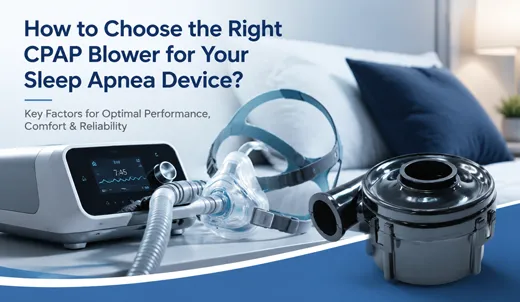
At the true electromechanical center of any Continuous Positive Airway Pressure (CPAP) device designed for Obstructive Sleep Apnea (OSA) therapy lies the CPAP blower. In the highly specialized respiratory medical equipment industry, this specific medical blower acts as the literal heart of the machine. Without a high-performance, medical-grade CPAP air blower, even the most advanced computerized housing designs or proprietary sleep algorithms become useless. Inferior blowers inevitably introduce severe mechanical failure patterns, including volatile nocturnal pressure drops, high-frequency acoustic screaming, and rapid structural wear within only a fraction of their expected operational life.
For medical device Original Equipment Manufacturers (OEMs), healthcare product factories, and proprietary respiratory ventilation brands, choosing a premium CPAP blower motor is the single most critical procurement decision. End-user patients place their physiological safety entirely on steady airflow tracking, whisper-quiet motor operation, and multi-year hardware reliability. Sourcing teams who compromise technical performance for low upfront costs face high product return rates, poor patient treatment compliance, and failure to pass rigorous international regulations such as FDA clearance or European CE marking. This engineering manual outlines the essential technical parameters, dimensional design trade-offs, aerodynamic processing innovations, and bio-safety compliance frameworks required to choose the optimal brushless DC blower for any sleep apnea therapy platform.
1. Core Technical Parameters to Audit in a Premium CPAP Blower
When technical directors and sourcing executives evaluate a new respiratory blower, standard commercial marketing language must be ignored in favor of quantifiable engineering metrics. All standard evaluation parameters should align directly with ISO 17510 regulatory testing frameworks to guarantee clinical efficacy and patient sleeping comfort.
1.1 Maximum Static Pressure Capabilities (kPa / cmH2O)
Static pressure threshold performance dictates whether a mini blower can effectively overcome standard pneumatic resistance loops. This includes internal humidification water columns, inline bacterial filters, extended smoothbore breathing tubes, and transient mask leaks, while accurately sustaining targeted treatment pressures all night. Standard therapeutic scales range from 4 cmH2O to 40 cmH2O (roughly equivalent to 0.4 kPa to 4.0 kPa). Heavy-duty BiPAP (Bilevel) applications or deep therapeutic systems require high-pressure configurations supporting 5.0 kPa up to 8.4 kPa of peak static pressure without encountering motor aerodynamic stall.
- Standard APAP/CPAP Systems (Mild to Moderate OSA): Typically demand an optimized CPAP blower capable of producing a stable 4.0 to 6.0 kPa of maximum static pressure (e.g., TKFAN models BA4028H24B delivering 5.9 kPa or BA7060H24B-K at 5.4 kPa).
- Advanced High-Pressure BiPAP Systems: Require heavy-duty brushless blowers offering peak static pressure metrics ≥ 8.0 kPa. The premium TKFAN BA5060H24B-A establishes an industry benchmark at 8.4 kPa of maximum static pressure output.
- Pocket Travel CPAP Ventilators: Require specialized ultra-compact micro blowers engineered to provide a stable 4.0 kPa minimum baseline, exemplified by the TKFAN BA5025H24B reaching 4.05 kPa.
1.2 Dynamic Airflow Volume Output (CFM / L/min)
Airflow volume capacity—measured in Cubic Feet per Minute (CFM) or Liters per Minute (L/min)—must align with the internal space of the ventilator and its integrated humidification setup. Premium brushless DC blowers stand out due to their fast dynamic response times. Unlike older brushed setups, a sensorless brushless CPAP blower adjusts its RPM almost instantly. This rapid response allows the motor to match the patient's natural breathing rhythm, which is an essential requirement for auto-adjusting APAP and dual-pressure BiPAP devices that switch pressures between inhalation and exhalation.
1.3 Acoustic Sound Signatures & Noise Dampening (dB(A))
High noise levels are the primary reason patients stop using CPAP therapy. Medical regulations state that at a standard pressure of 10 cmH2O, the internal blower's noise must remain below 30 dB(A) inside a testing room with a 22 dB(A) background noise floor. Traditional single-plane balanced motors create micro-vibrations that pass through the outer casing. Advanced dual-plane dynamic balancing allows high-quality micro blowers to lower operational noise to a quiet 26.5 dB(A) under load.
1.4 Voltage Configurations & Power Optimization
Modern medical sleep ventilators rely primarily on a 24V DC power architecture. Optimizing for low current draw extends battery runtime for portable devices and limits internal thermal generation. Keeping power consumption low prevents component overheating, helping engineers design smaller power bricks or smaller battery packs for travel-friendly systems.
1.5 Expected Equipment Lifespan (L10 Bearing Reliability Standards)
Blower longevity directly determines warranty overhead costs and brand reputation. Cheap, unbranded blowers using single-ball bearings and simple balancing often fail within 10,000 to 20,000 hours. Premium medical-grade CPAP blowers utilize genuine Japanese NMB dual ball bearings paired with precise balancing, extending the L10 operational lifespan to 50,000–70,000 continuous hours. This translates to 5 to 8 years of dependable nocturnal operation without requiring internal motor replacement.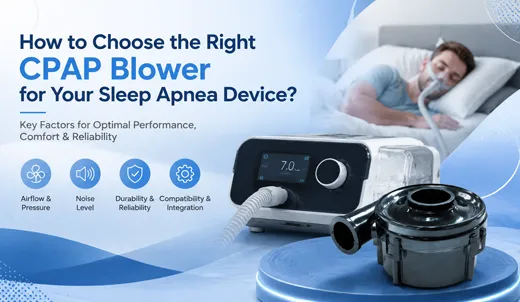
2. Desktop vs. Portable Configurations: Dimensional Size Trade-offs
Before selecting a specific blower model, structural design engineers must determine the exact target market of the ventilator line. Systems generally split into two main formats, each requiring distinct blower configurations:
Portable/Travel Ventilator Demands
Travel units focus on compact size and minimal weight for transit, restricting the blower to a 40mm–50mm footprint. Technical considerations include:
- Compact internal impeller space caps maximum air volume output.
- Limited room for bulky dampening foam or acoustic decoupling mounts.
- The blower must be efficient enough to offset pressure drops across travel circuits.
Standard Home Desktop Demands
Home systems do not face strict dimensional limits, allowing engineers to prioritize performance and quiet operation by selecting 60mm–70mm blowers:
- High peak static pressures easily overcome large, integrated humidification chambers.
- Generous scroll volute geometries lower rotational noise speeds.
- Slower relative RPM targets reduce mechanical vibration, extending bearing life.
3. Advanced Engineering: Dual-Plane Dynamic Balancing Mechanics
The primary engineering differentiator between basic commercial fans and medical-grade CPAP blowers lies in their structural balancing. This engineering detail separates high-end sleep apnea equipment from loud, failure-prone alternatives.
Standard miniature centrifugal fans feature a single impeller mounted on one side of the motor shaft. Manufacturers typically perform balancing adjustments only on the impeller face, leaving the internal motor rotor uncorrected. At high speeds, this asymmetric mass distribution creates rotational eccentricities, causing micro-vibrations that increase noise, accelerate bearing wear, and cause pressure fluctuations during breath transitions.
Advanced medical-grade CPAP blowers resolve these issues with an engineered dual-plane dynamic balancing configuration:
- The central motor shaft extends on both ends: the front plane holds the main air impeller, while the rear plane receives a dedicated brass counterweight.
- Automated, high-precision milling machinery calibrates both planes simultaneously, correcting mass distribution across both the impeller (Plane A) and the brass counterweight (Plane B).
- This dual-plane correction removes rotational eccentricities, lowering mechanical vibration and reducing acoustic noise levels. It also helps preserve long-term bearing integrity.
4. Material Safety, Outgassing Mitigation, and Biocompatibility
Because the air moving through a respiratory blower travels directly into a patient's lungs, its internal construction must meet strict biocompatibility standards. Repurposing general industrial fans for medical applications creates regulatory and health risks due to material outgassing.
- ISO 10993 Biocompatibility: All internal components within the airflow pathway—including the volute scroll, impeller blades, and air channel—must be molded from medical-grade engineering polymers. These materials ensure zero volatile organic compound (VOC) outgassing, protect against toxic particulate shedding, and remain free of harmful chemical additives.
- Global Medical Certifications: Sourced equipment must hold authenticated documentation demonstrating strict alignment with FDA guidelines, CE medical directives, and standard international regulatory audits.
Fast Dynamic Response for BiLevel Configurations: Advanced sleep ventilators require rapid pressure adjustments. Combining lightweight impellers with sensorless brushless motor control allows premium CPAP blowers to adjust quickly between inhalation and exhalation pressures, supporting CPAP, APAP, and BiPAP configurations.
5. Professional B2B Selection Matrix for CPAP Blowers
This technical cross-reference matrix details 24V DC medical-grade brushless blowers tailored for sleep apnea applications, assisting engineering and procurement teams with product selection:
| Model | Size (mm) | Speed (RPM) | Airflow (CFM) | Pressure (kPa) | Target Integration Environment |
|---|---|---|---|---|---|
| BA4028H24B | 40 * 28 | 48,000 | 12.0 | 5.9 | Ultra-portable travel units, battery-powered pocket ventilators. |
| BA5025H24B | 50 * 25 | 37,000 | 9.5 | 4.05 | Slim profile travel devices, low-clearance portable housings. |
| BA5060H24B-A | 58.7 * 59 | 31,000 | 14.0 | 8.4 | High-pressure BiPAP devices, severe OSA therapeutic equipment. |
| BA7060H24B-C | 76*75*73 | 32,000 | 18.8 | 4.8 | Premium desktop home units, setups with high-capacity humidifiers. |
| BA7060H24B-D2311 | 79 * 69 * 56 | 30,600 | 15.9 | 4.9 | Standard home CPAP lines balancing airflow and pressure. |
| BA7060H24B-D2303 | 79 * 69 * 56 | 30,500 | 15.9 | 4.7 | Cost-optimized desktop configurations for high-volume production. |
| BA7060H24B-K | 76 * 65 * 54 | 34,000 | 15.7 | 5.4 | Universal home ventilating systems with heated breathing tubes. |
6. Final Procurement Inspection Checklist
Before selecting a blower supplier for mass production, procurement teams should verify the following technical points:
- Confirm complete pneumatic data charts covering 4–40 cmH2O operation are available.
- Review certified acoustic testing reports generated under operational loads rather than empty open-air spins.
- Verify the supplier utilizes automated dual-plane dynamic balancing production equipment.
- Confirm all materials within the air pathways hold valid ISO 10993 compliance testing certificates.
- Ensure the blower control system interfaces correctly with your master control board (via PWM or 0-5V analog inputs).
Comprehensive Technical FAQ (Sourcing & Engineering Focus)
Q1: What separates a medical-grade CPAP blower from a high-speed industrial centrifugal fan?
Medical-grade blowers must meet strict criteria: ISO 10993 certified biocompatible materials, dual-plane dynamic balancing to minimize noise and micro-vibration, and low-inertia rotor assemblies for rapid pressure changes during breathing. Industrial alternatives lack these design considerations, presenting outgassing risks and loud operation.
Q2: Can a single brushless CPAP blower support both standard CPAP and BiLevel therapy modes?
Yes. Advanced brushless configurations feature low-inertia impellers that respond quickly to PWM or 0-5V control signals, allowing the blower to transition efficiently between high inhalation pressures and low exhalation pressures via firmware adjustments.
Q3: How do manufacturers measure noise specifications under loaded conditions?
Acoustic verification occurs within specialized sound-dampening chambers with low background noise floors. The blower operates under a standard 10 cmH2O backpressure load with downstream flow restrictions, providing an accurate reflection of real-world use.
Q4: What custom OEM options are typically available for specialized ventilator integrations?
Engineering customization options include custom wiring harnesses, modified mounting holes, altered volute exhaust angles, and specialized motor parameter tuning for alternative 12V DC power inputs.
Q5: How does dual-plane balancing extend the operational lifespan of the blower?
Correcting mass distribution on both sides of the motor shaft eliminates rotational eccentricities. This reduction in structural vibration protects the internal ball bearings, extending operational life to 50,000–70,000 hours.
Q6: Why is a 24V DC power input standard across medical respiratory equipment?
24V architectures provide an optimal balance of electrical efficiency, lower current draw, and reduced thermal generation compared to 12V alternatives, easing integration with external medical power bricks and internal battery systems.
Q7: Does integrated humidification require specialized blower performance consideration?
Yes. Humidification chambers create additional pneumatic resistance. Sourcing teams must select a blower with sufficient static pressure headroom to overcome this impedance while maintaining stable target therapy pressures.
Q8: What are the risks of using out-of-warranty or non-compliant blower replacements?
Non-compliant blowers introduce structural vibration, higher noise levels, and pressure tracking errors, which can affect patient compliance and invalidate institutional medical device insurance coverages.
Q9: What types of bearings are used in premium medical blowers?
High-performance blowers utilize dual, preloaded miniature ball bearings sourced from specialist manufacturers like NMB Japan, ensuring smooth high-RPM rotation and long-term reliability.
Q10: How does a sensorless control drive model handle motor commutation?
The control system monitors Back Electromotive Force (Back-EMF) voltages across unenergized motor coils to determine rotor position. This eliminates the need for internal Hall-effect sensors, simplifying wiring and improving reliability in high-speed applications.
GET A QUOTE