

Mini Air Blower for Humanoid Robot Thermal Management: Why TKFAN Micro Blower is the Game-Changing Compact Cooling Solution
Humanoid robotics is rapidly transitioning from experimental research prototypes to mass commercialization across personal home assistance, automated industrial manufacturing, medical caregiving, and interactive embodied AI applications. However, an often-underestimated engineering bottleneck continues to constrain their full operational potential: thermal management. Inside a human-esque robotic body, up to 90% of electrical energy converts directly into waste heat. This thermal load originates from high-density joint servo motors, high-speed AI computing chips, motor drivers, power conversion modules, and lithium-ion battery packs. Trapped within tightly sealed joint housings, dexterous hand cavities, torso computing bays, and head sensor suites, heat rapidly accumulates.
Unlike stationary server racks or industrial automation cabinets, humanoid robot hardware operates under extreme multi-variable physical constraints. Every additional gram of weight degrades payload capacity and agility. Every cubic millimeter of internal volume triggers intense spatial competition between actuators, wire harnesses, structural linkages, and sensor arrays. Powered by internal DC batteries and subjected to continuous rotational dynamic shocks, these machines require silent, vibration-free, and highly efficient heat dissipation. Passive cooling components like heatsinks, heat pipes, or vapor chambers hit thermal saturation within minutes of dynamic peak workloads, such as heavy-load lifting, rapid walking, or high-speed dexterous manipulation. On the other hand, liquid cooling adds complex pumps, fluid lines, and leakage risks, rendering it impractical for compact robotic limbs.
Definition & Core Function: A micro blower (or mini air blower) is an ultra-compact centrifugal air-moving device that draws air axially and expels it radially at 90 degrees. It is specifically engineered to generate high static pressure within constrained, high-resistance enclosures where traditional miniature axial fans stall due to backpressure.
To overcome these obstacles, robot hardware engineering teams are turning to the TKFAN Micro blower and TKFAN mini air blower product lines. By delivering forced-air centrifugal cooling, low-voltage DC compatibility, PWM dynamic speed regulation, and ultra-compact footprints, TKFAN provides the definitive active cooling architecture for commercial-grade humanoid robotics.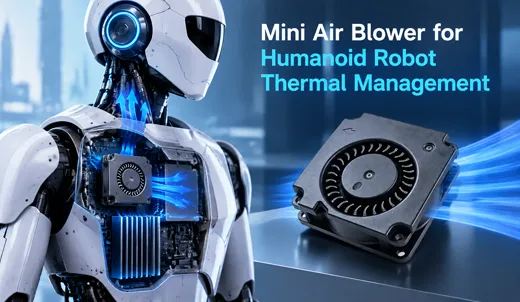
1. The Unique Thermal Engineering Challenges of Humanoid Robots
Managing heat in a humanoid robot involves a complex combination of mechanical design, fluid dynamics, power electronics, and battery chemistry. Before selecting a specialized mini air blower or micro blower, thermal architects must evaluate five core physical constraints:
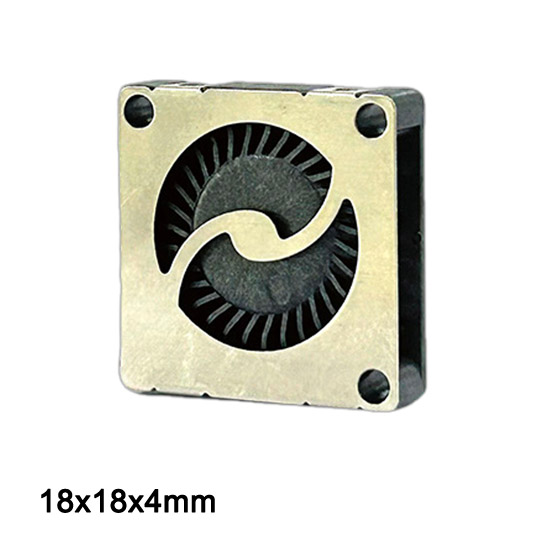
- Extreme Spatial Constraints in Joints & Dexterous Hands: Robotic wrist actuators, finger flexors, and ankle joints feature internal clearances measured in millimeters. Some multi-fingered hands have internal gaps under 2mm. Conventional axial fans cannot fit into these tiny mechanical channels, requiring ultra-thin cooling modules like the 18×18×4mm TKFAN Micro blower.
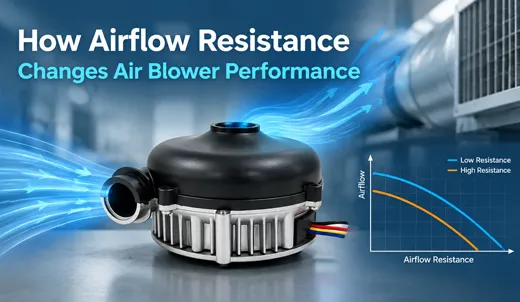
- Severe Internal Backpressure: Tight mechanical packaging, dense wiring looms, stacked PCBs, and gearboxes obstruct airflow. Standard axial fans experience severe aerodynamic stall under high impedance, spinning without moving air. A high static pressure mini air blower is necessary to force air through obstructed fluid pathways.
- Dynamic Pulse-Width Thermal Loads: Heat generation fluctuates dramatically. While idle, heat output is negligible; during peak dynamic movements, joint actuators generate instantaneous thermal spikes. Fixed-speed fans waste power or fail to cool during these spikes. Active thermal systems require PWM speed control to dynamically ramp up cooling output instantly.
- Strict Battery Power Budgets: Every watt consumed by active cooling reduces overall battery run-time. High-voltage or power-hungry blowers drain system batteries rapidly. Low-voltage BLDC motors operating at 2V, 3.3V, 5V, or 12V DC are essential to maintain efficiency.
- Vibration Stability, Silent Operation & Lifespan: Cooling devices mounted on moving limbs endure continuous mechanical shocks. Poorly balanced impellers cause vibration, distorting sensitive haptic and force sensor data. Furthermore, indoor human-robot interaction demands low acoustic signatures alongside 30,000+ hours of operational lifespan.
2. Micro Blower vs. Axial Fan: Aerodynamic Superiority in Robotics
When selecting active air cooling, engineers often evaluate traditional axial fans against centrifugal mini air blowers. Aerodynamic physics explains why the centrifugal design of the TKFAN mini air blower is significantly better suited for enclosed robotic architectures.
| Aerodynamic & Technical Parameter | Micro Axial Fan | Centrifugal Micro Blower (TKFAN Mini Air Blower) |
|---|---|---|
| Airflow & Discharge Direction | Parallel to motor axis (Axial in / Axial out) | 90° Perpendicular discharge (Axial in / Radial out) |
| Static Pressure Capability | Low static pressure; highly prone to airflow stall | Extremely high static pressure; overcomes heavy airflow resistance |
| Performance in Obstructed Enclosures | Airflow collapses rapidly when facing impedance | Maintains stable forced airflow through tight wind tunnels |
| Ultra-Thin Form Factors | Limited performance below 8mm thickness | Highly optimized form factors starting at 18×18×4mm |
| Speed Control & Feedback | Basic ON/OFF or limited PWM on standard models | Full PWM speed control + FG tachometer feedback available |
| Primary Robotic Applications | Open, unsealed electronics bays with low backpressure | Densely packed joints, dexterous fingers, closed torsos, sensor heads |
Axial fans rely on unrestricted airflow paths. Inside a tightly packaged robotic limb filled with harmonic drives, planetary gears, and rigid flex circuits, an axial fan suffers from flow separation and zero effective cooling output. Conversely, the centrifugal impeller inside a TKFAN Micro blower compresses incoming air and redirects it radially, generating the static pressure needed to flush heat out of dense robotic enclosures.
3. Key Engineering Advantages of TKFAN Micro Blowers
Engineered specifically for space-constrained, battery-powered electronics, the TKFAN Micro blower and TKFAN mini air blower lines offer technical capabilities tailored for robotic OEM hardware integration:
BA1804L05X Ultra-Thin Series
- Dimensions: 18 × 18 × 4 mm
- Voltage: 5V DC (2V custom available)
- Speed & Airflow: 13,000 RPM | 0.20 CFM
- Static Pressure: 0.06 kPa
- Target Use: Micro dexterous fingers, miniature sensor pods
BA2008L05X-A Compact Series
- Dimensions: 20 × 26 × 8 mm
- Voltage: 5V DC
- Speed & Airflow: 9,000 RPM | 0.57 CFM
- Static Pressure: High-impedance optimized
- Target Use: Wrist, elbow, and ankle joint actuators
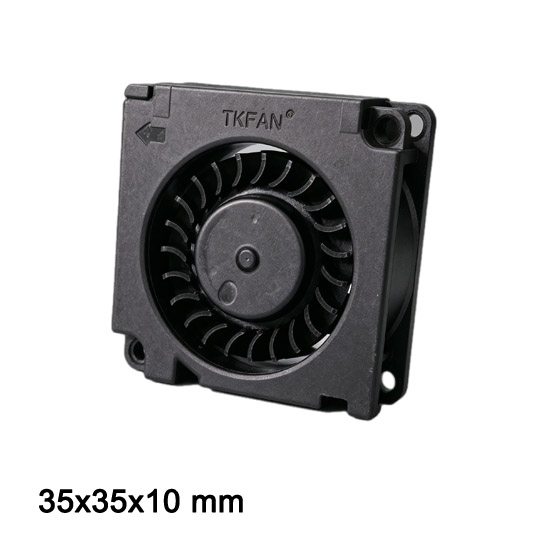
BA3510VH05X High-Pressure Series
- Dimensions: 35 × 35 × 10 mm
- Voltage: 5V / 12V DC options
- Speed & Airflow: High RPM | 2.38 CFM
- Static Pressure: 0.11 kPa
- Target Use: Torso AI processing boards, power distribution
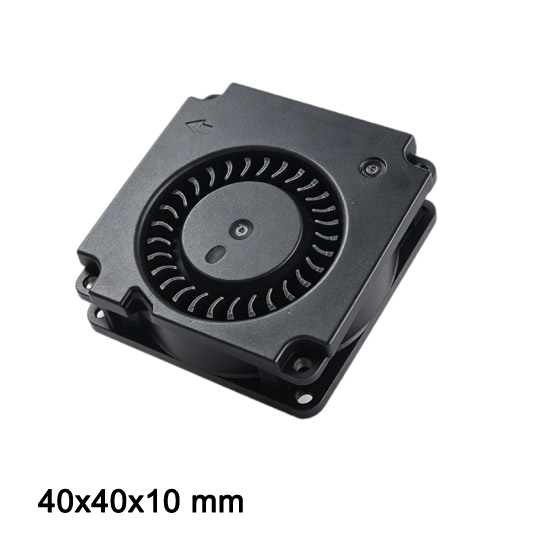
BA4010HHV05X Power Series
- Dimensions: 40 × 40 × 10 mm
- Voltage: 5V / 12V / 24V DC
- Speed & Airflow: 13,500 RPM | 3.70 CFM
- Static Pressure: 0.23 kPa
- Target Use: High-load leg servos, main power converters
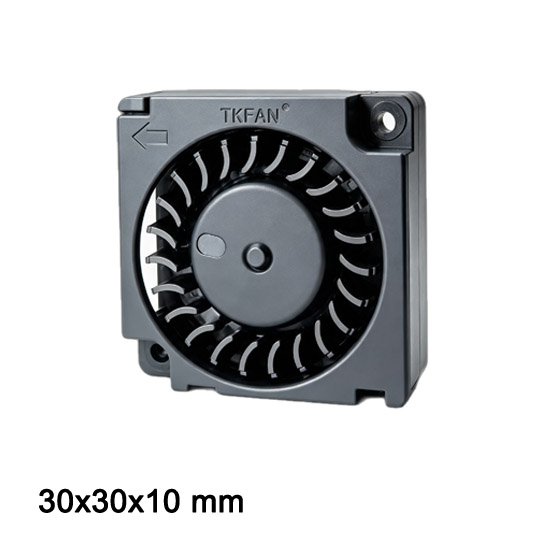
Micro Blower Product Image
Advanced Electrical & Mechanical Feature Set:
- Low-Power Brushless DC (BLDC) Motors: Equipped with multi-phase micro BLDC motors, these blowers deliver smooth torque, low power draw, and minimal electromagnetic interference (EMI)—preventing signal corruption across delicate IMU and tactile sensor circuits.
- Dynamic PWM Closed-Loop Temperature Control: 4-wire configurations support standard Pulse-Width Modulation (PWM) input. This allows robot main controllers to continuously scale blower speeds in real time based on thermistor readings, conserving battery power and lowering acoustic levels during ambient idle periods.
- FG Frequency Generator Feedback: Tachometer signal output (FG) feeds real-time rotational speed data back to system firmware, enabling predictive fault detection and automatic safety throttling if air intakes become obstructed.
- Precision Impeller Dynamic Balancing: Advanced dynamic balancing prevents mechanical vibration from transferring into moving joints, protecting sensitive force-torque sensor calibration.
- High-Reliability Bearings & Flame Retardant Plastics: Fluid Dynamic Bearings (FDB) or dual-ball bearing options deliver continuous service lives between 30,000 and 50,000+ hours. Housings use UL94 V-0 flame-retardant engineering plastics to meet global robotics safety standards.
4. Deployment Locations for TKFAN Mini Air Blowers in Humanoid Robotics
Integrating a specialized mini air blower at critical thermal nodes ensures consistent performance across the robot's entire physical frame:
- 1. Servo Actuators in Arms, Legs, and Torso: High-torque brushless motors and planetary gearheads generate considerable heat during dynamic walking or heavy lifting. Integrating a compact TKFAN Micro blower directly inside or adjacent to the joint housing directs pressurized air across stator windings and heat-sinks, preventing thermal demagnetization and torque output loss.
- 2. Multi-Fingered Dexterous Hands: With tight mechanical assemblies, dexterous hand flexors overheat quickly during continuous grasping operations. The ultra-thin 18×18×4mm TKFAN mini air blower fits into tiny palm or wrist cavities, supplying targeted forced-air cooling without adding excessive weight to the end-effector.
- 3. Main Torso AI Computing & Power Conversion Modules: Humanoid torsos house high-performance AI inference processors, motor drive boards, and DC-DC converters. Mid-sized blowers (such as the BA3510 and BA4010 series) generate strong, high-pressure airflow that routes heat through narrow internal exhaust ducts.
- 4. Head Sensor Modules & Vision Processing Units: Stereo cameras, LiDAR processing chips, and TOF depth sensors mounted in the robot's head generate heat within sealed enclosures. Micro blowers maintain stable operating temperatures, preventing thermal drift in optical sensors and image processing chips.
5. Selection Checklist for Humanoid Robot Thermal Engineers
When selecting a micro blower or mini air blower for humanoid robot integration, engineering teams should follow this systematic parameter verification process:
- Volumetric Footprint & Clearances: Measure maximum allowable length, width, and Z-height. For space-critical limbs or dexterous fingers, prioritize the 4mm ultra-thin TKFAN Micro blower.
- System DC Voltage Alignment: Match blower operating voltages with internal power buses (e.g., 3.3V, 5V logic rails or 12V, 24V motor power buses). Custom low-voltage configurations down to 2V are available upon request.
- Required Static Pressure (kPa or mmH2O): Evaluate internal airflow impedance. Prioritize static pressure metrics over open-air CFM ratings to ensure airflow successfully penetrates densely packed internal channels.
- Power Consumption & Electrical Budget: Ensure peak blower current draw fits within local motor driver or power distribution budgets without draining main battery packs excessively.
- Control Signal Requirements: Determine if your control architecture requires 3-wire (FG tachometer output) or 4-wire (PWM input + FG output) capability for closed-loop thermal control.
- Bearing Architecture Selection: Choose Fluid Dynamic Bearings (FDB) for ultra-quiet indoor operation, or dual-ball bearings for high-vibration limbs subjected to continuous dynamic impacts.
- Custom OEM Options: Review harness lengths, connector types, custom mounting flanges, and special environmental coatings with the TKFAN engineering team prior to tooling lock.
6. Top 10 Technical FAQs: Micro Blowers in Robotics
7. Conclusion: Compact Active Air Cooling for Next-Generation Robotics
Solving thermal bottlenecks is critical for advancing humanoid robots from lab prototypes to high-reliability commercial systems. As servo actuators, power electronics, and onboard AI computing chips become denser, passive cooling alone is no longer sufficient. High-weight liquid cooling systems add unwanted structural complexity and leakage risks.
The TKFAN Micro blower and TKFAN mini air blower product families provide a lightweight, high-pressure forced-air cooling solution designed specifically for space-constrained robotic architectures. Featuring high static pressure output, low-voltage BLDC motor drives, PWM closed-loop control, ultra-thin profiles, and OEM customization, TKFAN empowers robotics hardware teams to unlock peak performance across all dynamic operating conditions.