

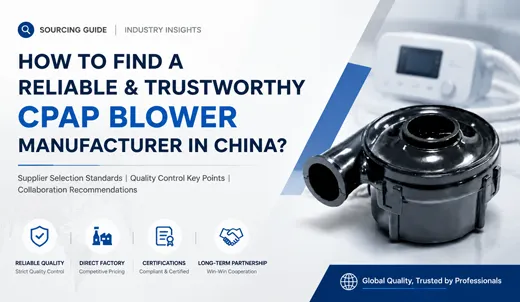
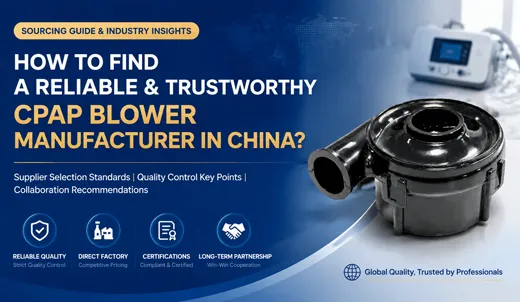
How to Find a Reliable and Trustworthy CPAP Blower Manufacturer in China?
The ultimate guide for sleep apnea device OEMs and medical procurement specialists to source top-tier, medical-grade CPAP air blowers from verified Chinese factories.
If you are an OEM/ODM brand developing CPAP, BiPAP, APAP, or portable sleep apnea ventilators, sourcing a stable, high-performance, and compliant CPAP blower is the most critical decision in your supply chain. The running performance, acoustic noise level, dynamic balancing, lifespan, and material biocompatibility of the medical air blower directly dictate patient comfort, therapeutic compliance, and your product's regulatory approval path globally.
Over the past decade, China has evolved into a global manufacturing hub for advanced micro high-speed brushless DC (BLDC) CPAP blowers. Leading Chinese manufacturers now deliver performance matching top-tier European brands at a significant cost advantage. However, the market is also flooded with low-end traders and general industrial fan workshops claiming to be "medical-grade." Without a systematic vetting process, buyers risk facing unstable airflow pressure, excessive noise, premature bearing failures, and regulatory compliance issues.
Why You Must Choose a Specialized CPAP Blower Factory vs. General Fan Suppliers
Before initiating your vendor search, it is imperative to understand that general industrial cooling fans and medical-grade CPAP blowers operate on entirely different technical thresholds. A dedicated CPAP blower manufacturer in China designs products around stringent clinical benchmarks:
1. Ultra-Low Noise & Dynamic Coaxial Balancing
Sleep therapy devices operate in quiet bedrooms overnight. Any noise level exceeding 30 dB(A) can severely disrupt patient sleep. While standard fan manufacturers only perform single-plane balancing on the impeller, professional medical blowers like TKFAN utilize a proprietary coaxial dual-plane dynamic balancing process. By precisely milling both the impeller and the rear counterweight, vibration is mitigated to near-zero, bringing operational noise down to an ultra-quiet 26.5 dB(A) under standard clinical settings (10 cmH₂O with a 4mm restriction).
2. ISO 10993 Biocompatibility Compliance
The internal air path of a CPAP blower directly channels the air inhaled by patients. Low-cost industrial fans use standard plastics that can release volatile organic compounds (VOCs) under high-speed operation. A reliable medical blower factory uses certified non-toxic engineering plastics for both the scroll housing and impeller, backed by full ISO 10993 biocompatibility testing reports to clear FDA, EU MDR, and NMPA audits.
3. Rapid Pressure Response for Advanced Ventilation
Modern BiPAP and APAP systems require the blower to adjust airflow in milliseconds according to the patient’s inhalation and exhalation cycles. High-grade CPAP blowers feature low-inertia BLDC motors that support rapid acceleration and deceleration, compatible with PWM pulse or 0-5V analog voltage control. Industrial alternatives suffer from pressure lag, causing patient discomfort or choking sensations.
4. Premium Bearings for 24/7 Continuous Operation
Medical ventilators run continuously for 8+ hours every single day. Top-tier China CPAP blower manufacturers strictly deploy genuine Japanese NMB dual-ball bearings, achieving an L10 operating lifespan of 50,000 to 70,000 hours. Counterfeit or low-grade single-bearing alternatives typically fail or generate loud friction noise within 6 to 12 months.
5. High Static Pressure to Overcome Backpressure
Humidifiers, bacterial filters, and narrow-diameter breathing tubes create severe systemic backpressure. Premium medical micro blowers maintain flat flow curves under pressure, with maximum static pressures covering 4.05kPa to 8.4kPa to fit everything from travel CPAP units to heavy-duty clinical ventilators.
4 Verified Channels to Reach Original CPAP Blower Factories (Avoiding Brokers)
To filter out intermediate trading companies that lack manufacturing capabilities, procurement teams should leverage these four professional sourcing routes:
- Industrial B2B Platforms with Advanced Filtering: When utilizing platforms like Made-in-China or Alibaba, actively filter by tags such as "Verified Source Factory," "ISO 13485 Certified," and "Medical Device Component Support." Always request real-time video verification of automated dynamic balancing lines.
- Global Medical Device Trade Exhibitions: International expos like Medtec China (Shanghai), CMEF, and Global Sources Medical Shows provide direct access to engineering teams. Reputable manufacturers such as TKFAN exhibit annually, displaying full sizing line-ups from 40mm to 70mm, including specialized models like the ultra-compact BA4028H24B and high-pressure BA5060H24B-A.
- Industry Supply Chain Referrals: Leading domestic sleep apnea device brands (such as Yuwell, BMC, and CoFoe) maintain rigid supplier tracking. Sourcing from proven suppliers who manage high-volume medical-grade shipments drastically minimizes supply risks.
- Geographic Industrial Clusters in China: High-speed medical micro blowers are densely clustered in high-precision manufacturing zones:
- Guangdong (Shenzhen/Dongguan): Dominates in 24V micro portable blowers, featuring mature automation, robust export compliance, and fast global shipping.
- Zhejiang (Ningbo/Yuyao): Strong injection molding ecosystem and medium-sized medical blower capacity.
- Jiangsu (Suzhou): Focuses heavily on heavy-duty clinical high-flow ICU blower systems.
Mandatory Credential Checklist for Regulatory Compliance
Regulatory alignment is a non-negotiable threshold for medical electronics. Never compromise on the following third-party certifications:
ISO 13485 Quality System
The foundational standard for medical device components. Without an audited ISO 13485 system, the blower cannot be designed into ventilation equipment aiming for FDA 510(k) or EU MDR registrations.
ISO 10993 Biocompatibility
The factory must provide authentic laboratory reports for cytotoxicity, sensitization, and intracutaneous irritation tests. Generic RoHS sheets are completely insufficient for gas-path compliance.
EU CE MDR & EMC Reports
To clear EU customs post-2024, components must comply with up-to-date MDR frameworks, alongside complete Electromagnetic Compatibility (EMC) reports preventing driver circuit interference.
Technical Performance Benchmarks for Prototype Testing
Before proceeding to mass orders, evaluation samples must undergo extensive cross-checking. The standard product line of TKFAN serves as an ideal baseline benchmark for medical engineers:
| Blower Model | Dimensions | Max Airflow | Peak Static Pressure | Rated Speed | Target Application |
|---|---|---|---|---|---|
| BA4028H24B | 40×40×28 mm | 12 CFM (340 L/min) | 5.9 kPa | 48,000 RPM | Ultra-compact / Travel CPAP |
| BA5025H24B | 50×50×25 mm | 9.5 CFM (269 L/min) | 4.05 kPa | 37,000 RPM | Ultra-thin Pocket Ventilators |
| BA5060H24B-A | 58.7×59 mm | 14 CFM (396 L/min) | 8.4 kPa | 31,000 RPM | High-pressure Household BiPAP |
| BA7060H24B | 76×79×60 mm | 15.7-18.8 CFM | 4.7-5.4 kPa | 24,000 RPM | High-flow Stationary Oxygen/CPAP |
On-Site Factory Auditing: Evaluating Scalability and Quality Control
An unannounced or comprehensive physical factory audit is the ultimate step to safeguard your supply chain against subcontracting and erratic batch quality. Focus heavily on these segments:
Isolated Medical Manufacturing Cleanrooms: True medical component vendors run isolated assembly lines separate from general industrial production to avoid airborne particulate cross-contamination. Furthermore, audit their 100% End-of-Line testing setup. A reliable factory maintains a complete 5-year archival history of every single unit shipped—tracking precise acoustic signatures, dynamic unbalance parameters, and power load variations via tracking frameworks like an integrated Manufacturing Execution System (MES).
Technical FAQ: Sourcing Medical CPAP Blowers in China
Q1: What is the standard operational lifespan for a premium CPAP blower?
A1: Premium CPAP blowers equipped with Japanese NMB dual-ball bearings offer an L10 lifespan of 50,000 to 70,000 hours under continuous duty cycles, allowing years of flawless nightly home therapy.
Q2: Why is dual-plane dynamic balancing crucial for medical ventilators?
A2: Single-plane balancing only corrects the face of the impeller. Dual-plane dynamic balancing corrects imbalances across both axes of the motor assembly, eliminating high-frequency micro-vibrations and lowering acoustic noise below 27 dB(A).
Q3: Can standard industrial plastic cooling fans be used in CPAP devices?
A3: Absolutely not. Industrial fans release harmful VOC plastic gases under heat. Medical CPAP air blowers must use certified medical-grade engineering plastics that conform to strict ISO 10993 biocompatibility testing.
Q4: What voltage options do Chinese CPAP blower manufacturers typically offer?
A4: While 24V DC is the absolute gold standard for stable pressure and power efficiency in clinical and home environments, 12V DC options are available for highly integrated travel-size or battery-operated portable CPAP units.
Q5: How do I verify if a factory is an original manufacturer or a trader?
A5: Request real-time factory videos of their dual-plane dynamic balancing calibration machinery or audit their ISO 13485 medical tracking directory. Trading companies cannot provide individual unit trace certificates or serialized MES metrics.
Q6: Do Chinese medical blower suppliers support custom OEM/ODM requests?
A6: True original factories like TKFAN house dedicated R&D engineering teams capable of modifying structural housing sizes, impeller geometries, wire harnesses, or tailoring motor driver firmware control loops.
Q7: What is the typical lead time for custom and standard CPAP blower orders?
A7: Standard models typically ship within 15 to 30 days. Complex custom mold or electronics firmware development (ODM projects) generally runs on a 35 to 45-day structural timeline.
Q8: How does a CPAP blower handle high system backpressure?
A8: Through specialized aerodynamic impeller configurations, premium medical blowers can overcome system resistance from integrated humidifiers and anti-bacterial filters, delivering up to 8.4 kPa of uncompromised static pressure.
Q9: What motor speed regulation signal types are supported?
A9: They seamlessly accept standard Pulse Width Modulation (PWM) duty cycle signals or 0-5V analog voltage control inputs, allowing effortless integration into a wide variety of ventilator mainboards.
Q10: Are old CE MDD certificates still acceptable for CPAP blower components?
A10: No, legacy CE MDD structures are obsolete. To guarantee smooth entry into European markets, components must strictly feature compliant documentation matching the latest European Medical Device Regulation (EU MDR 2017/745) requirements.