

What is a CPAP Blower? The Ultimate Technical Guide for Medical-Grade CPAP Blowers
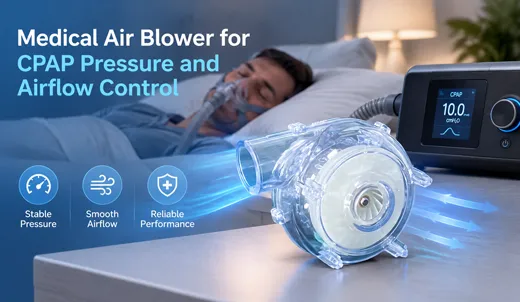
If you are a medical device OEM engineer, a respiratory equipment procurement manager, a sleep apnea ventilator maintenance technician, or an R&D expert designing portable home-use ventilators, the CPAP blower is undoubtedly the most critical component you must evaluate. A medical-grade CPAP blower is a highly specialized miniature brushless DC (BLDC) centrifugal fan. It is engineered specifically for Continuous Positive Airway Pressure (CPAP) devices, Auto-CPAP (APAP), Bi-level Positive Airway Pressure (BiPAP) machines, and High-Flow Nasal Cannula (HFNC) oxygen therapy systems to deliver stable, precise, and adjustable airway positive pressure.
Without a qualified medical-grade CPAP blower, a sleep apnea ventilator cannot generate the stable therapeutic airflow required to splint open collapsed upper airway tissues during sleep. This means it fails to eliminate snoring or prevent Obstructive Sleep Apnea (OSA) episodes. Global health data indicates that over 1 billion adults worldwide suffer from mild to severe OSA. This massive patient base continuously drives procurement demands from ventilator factories, home medical equipment distributors, hospital respiratory departments, and ambulance emergency equipment suppliers for high-performance CPAP blowers.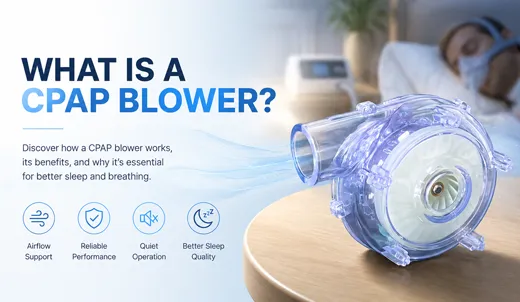
1. Core Definition: Medical CPAP Blower vs. Standard Industrial Fans
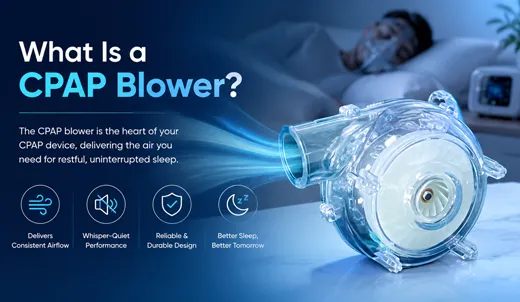
A CPAP blower, also known as a medical CPAP turbine fan, 24V brushless CPAP blower, or portable travel CPAP blower, is a compact centrifugal air supply unit. It integrates a high-speed brushless DC motor, a precision curved impeller, a sealed acoustic volute casing, an embedded PWM speed control PCB, and a pressure feedback sampling port. It is strictly manufactured to meet the rigorous positive pressure ventilation demands of respiratory medical devices.
Standard industrial cooling fans, axial fans, small air pumps, or consumer-grade inflator pumps absolutely cannot replace a dedicated medical blower. Conventional air supply devices fail to meet strict medical regulatory standards, which require ultra-low noise, pinpoint pressure accuracy, rapid dynamic response, biocompatible air pathways, and an ultra-long continuous running lifespan. Every compliant CPAP blower must satisfy three non-negotiable medical design objectives:
Precise Pressure Range: Output adjustable, stable static pressure ranging from 4 cmH₂O to 40 cmH₂O, perfectly matching the clinical pressure standards for OSA, bi-level ventilation, and high-flow oxygen therapy. The pressure deviation under full breathing load must be controlled within ±2%.
Ultra-Silent Operation: The operating noise must remain below 30 dB(A) under rated therapeutic pressure. Noise disturbance is the primary reason patients abandon long-term CPAP therapy, making premium acoustic performance a core metric.
Millisecond Dynamic Response: It must support closed-loop instantaneous speed adjustment based on pressure sensor signals from the mainboard. This allows the blower to compensate for mask leaks, breathing airflow fluctuations, and tube pressure loss within milliseconds, maintaining a constant airway pressure for the user.
2. Internal Structure and Step-by-Step Working Principle
2.1 Five Core Integrated Components of a Medical CPAP Blower
Every mass-produced industrial CPAP blower assembly consists of five inseparable functional modules:
High-Speed Brushless DC Motor: The power core of the CPAP blower, operating at speeds of 30,000–48,000 RPM, equipped with imported NMB dual ball bearings. The brushless structure eliminates carbon brush friction noise and carbon dust contamination, which is a mandatory biocompatibility requirement. High-end models achieve an L10 lifespan of 50,000–70,000 hours of continuous operation.
Centrifugal Curved Turbo Impeller: A lightweight, medical-grade plastic multi-blade component mounted on the motor shaft. Its high-speed rotation generates centrifugal force to accelerate air molecules and build the target static backpressure.
Sealed Vibration-Damping Volute Casing: A fluid-dynamics-optimized plastic outer shell with built-in noise-reduction structures that minimize airflow turbulence and prevent internal pressure leakage during operation.
PWM Driver Control PCB: An embedded speed regulation module that receives real-time pressure feedback signals from the ventilator's CPU, adjusting the motor speed within 180 milliseconds to match the user's inhalation and exhalation cycles.
Standardized Outlets & Sampling Ports: Universal circular connectors that interface seamlessly with mainstream ventilator filter chambers and humidification tubes, plus an integrated port for factory calibration and clinical monitoring.
2.2 Step-by-Step Airflow and Therapy Workflow
Step 1: Air Intake & Filtration: When powered on, the ventilator sends a start signal to the CPAP blower's brushless motor. The high-speed rotation of the impeller creates negative pressure at the intake, drawing in ambient air through composite HEPA filters to block dust, pollen, and microscopic particulates before it enters the volute chamber.
Step 2: Air Compression & Static Pressure Generation: The rotating impeller flings air outward against the inner wall of the volute casing, converting kinetic energy into stable static positive pressure. The higher the motor speed, the greater the cmH₂O therapeutic pressure generated, catering to severe sleep apnea patients.
Step 3: Closed-Loop Dynamic Pressure Compensation: The pressure sensor near the patient mask continuously transmits real-time airway pressure data to the ventilator's microcontroller. If a mask leak causes a pressure drop, the main controller instantly boosts the CPAP blower's speed to restore the prescribed level. During exhalation, the blower slightly slows down to reduce expiratory resistance, maximizing night-long patient comfort.
Step 4: Humidified Airflow Output: The stabilized high-pressure airflow exits the CPAP blower, flows through an integrated heated humidifier to regulate moisture (preventing airway dryness), and is delivered through a flexible breathing tube directly into the patient's airway. The continuous air cushion prevents pharyngeal tissue collapse, stopping sleep apnea and snoring completely.
3. High-End CPAP Blower Technical Specifications and Parameters
During ventilator OEM manufacturing or replacement parts procurement, standardized technical indicators dictate clinical suitability. Below is the verification baseline data for next-generation TKFAN CPAP blowers. For more models, please visit our official CPAP Air Blower Product Page.
| Model | Size (mm) | Voltage | Speed (RPM) | Max Airflow (CFM) | Max Pressure (kPa) |
|---|---|---|---|---|---|
| BA4028H24B | 40 * 28 | 24V | 48,000 | 12.0 | 5.9 |
| BA5025H24B | 50 * 25 | 24V | 37,000 | 9.5 | 4.05 |
| BA5060H24B-A | 58.7 * 59 | 24V | 31,000 | 14.0 | 8.4 |
| BA7060H24B-C | 77 * 67 * 57 | 24V | 32,000 | 18.8 | 4.8 |
| BA7060H24B-D2311 | 79 * 69 * 56 | 24V | 30,600 | 15.9 | 4.9 |
| BA7060H24B-D2303 | 79 * 69 * 56 | 24V | 30,500 | 15.9 | 4.7 |
| BA7060H24B-K | 76 * 65 * 54 | 24V | 34,000 | 15.7 | 5.4 |
4. Low-Vibration Innovation: Coaxial Dual-Side Dynamic Balancing Technology
Vibration and acoustic noise are the primary bottlenecks of traditional miniature high-speed blowers. Most general-purpose fans adopt single-side dynamic balancing, which only calibrates the impeller surface after assembly, leaving internal rotor eccentric imbalances uncorrected. This design flaw induces high-frequency micro-vibrations during long-term high-speed operation, escalating noise levels and accelerating bearing wear.
To overcome this industry challenge, TKFAN developed its proprietary Coaxial Dual-Side Dynamic Balancing Technology. This engineering design extends both ends of the high-speed brushless motor shaft: the front carries the main aerodynamic impeller, while the rear features a custom brass counterweight component, establishing a dual-sided correction framework. Every finished CPAP blower rotor assembly is calibrated on high-precision automatic balancing equipment by milling microscopic amounts of material from both planes. This full-spectrum calibration completely eliminates rotational asymmetry, achieving near-zero structural vibration and an NVH index far superior to standard clinical requirements. Compared to single-balanced competitor fans, dual-side balanced CPAP blowers reduce vibration amplitude by over 60% and drop operational noise by 3–5 dB(A).
5. Mainstream Clinical Application Scenarios for Medical Blowers
Premium CPAP blowers are vital across a multitude of medical sub-sectors, catering to all forms of non-invasive positive pressure ventilation (NPPV) devices:
Home CPAP & APAP Systems: This represents the largest market segment. A quiet and stable blower directly determines patient compliance; loud, vibrating fans cause treatment abandonment. Auto-CPAP machines leverage rapid dynamic acceleration to scale pressure dynamically based on upper airway collapse indicators.
BiPAP Machines: Bi-level devices require distinct, independently adjustable Inspiratory Positive Airway Pressure (IPAP) and Expiratory Positive Airway Pressure (EPAP). The blower must rapidly switch speeds seamlessly, making airflow stability critical for Central Sleep Apnea and COPD patients.
High-Flow Nasal Cannula (HFNC) Therapy: Used heavily in ICUs and respiratory clinics, these devices require larger 70mm blowers capable of delivering airflows exceeding 60-100 L/min. The blower uniformly mixes ambient air and oxygen, delivering heated and humidified gas to expand alveoli and improve oxygen saturation in ARDS patients.
Ambulance Emergency Ventilators: Highly customized 12V low-power compact blowers power battery-operated transport ventilators. In pre-hospital emergency situations, the micro blower delivers instantaneous positive pressure, avoiding traumatic intubations.
6. Essential Medical Regulatory Compliances and Certifications
As core components of Class II medical devices, export-grade CPAP blowers must pass stringent global regulatory verifications. These certifications serve as critical E-E-A-T trustworthiness pillars:
ISO 13485 Medical Devices Quality Management: The baseline standard proving a manufacturer's standardized medical production line—a mandatory threshold for supplying OEM factories.
CE MDR Compliance: Mandatory for the EU market, validating electrical safety, electromagnetic compatibility (EMC), and long-term continuous runtime stability.
ISO 10993 Biocompatibility Testing: Verifies that all materials within the blower's gas pathway emit no hazardous chemical outgassings or volatile organic compounds (VOCs), ensuring zero irritation to the patient's respiratory tract.
RoHS & REACH Hazardous Substance Compliance: Confirms the complete absence of heavy metals or toxin emissions from the fan housings, impellers, and motor windings.
IP54 Dust & Moisture Protection: Shields the interior from humidifier water vapor backflow and environment dust accumulation, extending the blower's service life in humid clinical environments.
7. Technical FAQ: Top 10 Questions About CPAP Blowers Answered
Q1: Can an end-user replace the internal CPAP blower inside a home ventilator by themselves?
A: While replacement blowers are readily available, self-replacement is highly discouraged. After installing a new CPAP blower, the machine must undergo professional pressure calibration. DIY installation risks incorrect therapeutic pressure output, housing air leaks, and sensor calibration errors.
Q2: What causes a CPAP blower to suddenly develop loud rattling or harsh vibrations?
A: There are three main reasons: First, neglected air filters cause dust accumulation on the impeller blades, ruining rotational balance. Second, the dual ball bearings have reached their maximum L10 service lifespan and are mechanically worn. Third, the internal silicone dampening pads separating the blower from the ventilator housing have degraded.
Q3: What is the standard lifespan of a premium medical-grade CPAP blower?
A: High-end CPAP blowers equipped with premium imported dual ball bearings achieve an L10 lifespan of 50,000 to 70,000 hours. Assuming 8 hours of use per night, this equates to over 17 years of stable performance. Budget single-ball models typically last around 20,000 hours.
Q4: Are 12V and 24V CPAP blowers interchangeable within the same device?
A: No, they are not interchangeable. 24V blowers provide higher torque, faster dynamic response, and higher static pressures suitable for home medical and BiPAP devices. 12V blowers are engineered for battery-powered, compact travel ventilators with limited power capacities. Mismatched voltages can fry the mainboard control circuit.
Q5: Can a CPAP blower function properly without an integrated humidifier module?
A: Mechanically, yes, the blower can independently deliver high-pressure airflow. However, clinically, unhumidified therapy is strongly discouraged. Continuous dry airflow directly irritates nasal mucosa, triggering severe nasal congestion, dry coughing, and potential airway bleeding.
Q6: Does TKFAN offer fully customized OEM/ODM services for medical blowers?
A: Yes. We provide extensive customizations including tailored input voltages, custom housing designs, modified impeller aerodynamic pitches, custom wire harnesses, and corporate logo printing to fulfill unique ventilator R&D specifications.
Q7: Why can't standard industrial cooling fans or mini air pumps be used in CPAP machines?
A: Standard industrial fans cannot build the required static backpressure (up to 40 cmH₂O) and lack millisecond-level speed adjustment circuits. Meanwhile, mini industrial air pumps are excessively loud (over 50 dB) and lack the required ISO 10993 biocompatibility certification for human breathing paths.
Q8: How does a brushless motor improve the biosafety of a CPAP blower?
A: Brushed motors shed microscopic carbon dust particles over time due to mechanical wear. If used in medical ventilators, patients would inhale these hazardous particles into their lungs. Brushless DC (BLDC) motors operate via electromagnetic induction, generating zero physical friction dust, ensuring absolute purity of the therapeutic gas.
Q9: What is the optimal acoustic testing condition for verifying CPAP blower noise levels?
A: Credible medical blower manufacturers test noise under loaded conditions (e.g., at a constant backpressure of 10 cmH₂O or 20 cmH₂O) inside a specialized anechoic chamber. Beware of suppliers who only publish open-flow/unloaded noise data, as acoustic decibels multiply significantly once backpressure resistance is applied.
Q10: How does a factory ensure product consistency across large-scale wholesale CPAP blower shipments?
A: Top-tier factories deploy automated MES smart production lines. Every single CPAP blower undergoes automated balancing, automated pressure-flow profiling, and computerized acoustic screening. Each unit is laser-engraved with a unique tracking serial number to achieve 100% full-process quality traceability.