

Key Benefits of High Pressure High Airflow High Speed Centrifugal Blowers
Introduction: Transforming Modern Aerodynamic Systems
In modern mechanical engineering, thermal management, medical device manufacturing, and high-density hardware development, systems designers constantly encounter a fundamental trade-off: delivering maximum static pressure and large airflow volume within severe spatial constraints. Furthermore, contemporary electronics and life-support hardware require ultra-fast dynamic response, whispers-quiet acoustics, and uninterrupted long-term operational reliability. Traditional axial fans fail to build sufficient static pressure against systemic resistance, whereas conventional low-speed centrifugal fans suffer from bulky footprints and high rotational inertia that severely impede dynamic responsiveness.
Modern high pressure high airflow high speed centrifugal blowers overcome these limitations. Driven by advanced brushless DC (BLDC) motors, utilizing ultra-lightweight low-inertia impellers, and housed within precision-balanced volutes, these micro-turbines achieve rotational speeds ranging from 30,000 RPM up to 100,000 RPM. They convert electrical energy into concentrated, highly efficient kinetic airflow engineered specifically to overcome severe system impedance.
Unlike standard cooling fans designed for open-air convection, high-speed centrifugal blowers push air through high-density HEPA filters, narrow medical breathing circuits, tight server chassis, and intricate optical projection assemblies. For hardware developers, mechanical engineers, and procurement specialists, understanding these core technical advantages is critical during early-stage component selection to prevent thermal throttling, excessive noise generation, acoustic resonance, bearing degradation, or regulatory failure.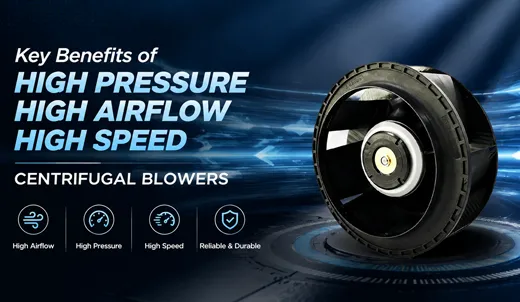
Defining High Speed Centrifugal Blowers vs. Conventional Fans
To accurately evaluate performance capabilities, engineers must distinguish high-speed centrifugal blowers from standard axial cooling fans and traditional low-speed industrial blowers. High-speed centrifugal units integrate specialized BLDC drives, high-frequency electronic commutation, low-density composite impellers, and aerodynamic radial volutes.
| Parameter | Standard Axial Fan | Traditional Centrifugal Blower | High Speed Centrifugal Blower |
|---|---|---|---|
| Rotational Speed | 2,000 – 6,000 RPM | 1,500 – 5,000 RPM | 30,000 – 100,000 RPM |
| Static Pressure | Very Low (< 0.1 kPa) | Moderate (0.1 – 0.3 kPa) | High to Extreme (0.4 – 12+ kPa) |
| Airflow Under Load | Drops drastically | Moderate drop | Maintains high CFM flow |
| Transient Response | Slow | Very Slow (High Inertia) | Milliseconds (Low Inertia) |
| Physical Size | Medium to Large | Bulky & Heavy | Ultra-compact (e.g., 70x70x25mm) |
Traditional axial fans move substantial air volumes in open environments, but their pressure curves stall when encountering system impedance like micro-channel heat sinks or dense particulate filters. Low-speed centrifugal blowers generate moderate static head, but their heavy metal or thick plastic impellers possess high rotational inertia. This mass prevents rapid acceleration and deceleration, leading to severe latency when system conditions demand immediate airflow adjustments. High-speed centrifugal blowers eliminate these compromises by spinning low-mass impellers at ultra-high velocities, accelerating air radially, and converting dynamic velocity into stable static pressure within a compact housing.
7 Core Engineering Advantages of High Speed Centrifugal Blowers
1. Ultra-Low Impeller Inertia for Millisecond Transient Response
The primary advantage of high-speed centrifugal blowers lies in their ability to adjust pressure and airflow almost instantaneously. Utilizing lightweight high-polymer or carbon-reinforced impellers, these blowers minimize rotational inertia. Coupled with high-torque coreless BLDC motors, they accelerate from zero to tens of thousands of RPM within milliseconds.
In medical ventilation, such as CPAP, BiPAP, and ICU ventilators, this speed is vital. The blower matches human inhalation and exhalation profiles without delay, preventing patient-ventilator dyssynchrony. In industrial applications like high-speed 3D printing, rapid pressure adjustments allow instant changes in cooling airflow as print heads traverse complex geometries.
2. High Static Pressure & Airflow in Ultra-Compact Footprints
Spatial efficiency is a major priority for modern hardware design. High-speed centrifugal blowers deliver high CFM air delivery alongside kilopascal-level static pressure within small form factors. For instance, compact blowers measuring only 70×70×25 mm can reach speeds above 11,000 RPM, producing airflow exceeding 32 CFM and static pressures over 0.44 kPa. Higher-voltage variants can deliver over 42 CFM and 0.47 kPa within a 20 mm thickness.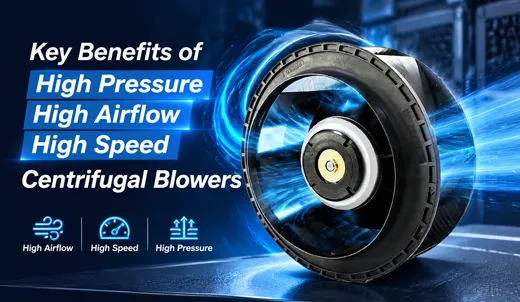
3. High-Efficiency Brushless Motors for Reduced Thermal Output
Quality high-speed centrifugal blowers utilize three-phase brushless DC or coreless motors with electronic commutation rather than mechanical carbon brushes. Eliminating mechanical contact removes friction losses, electrical arcing, and carbon dust contamination while significantly increasing motor efficiency.
Lower thermal dissipation protects internal motor windings and prevents premature degradation of bearing grease. Reduced power draw also makes these units ideal for battery-powered applications such as Powered Air-Purifying Respirators (PAPRs) and portable medical equipment, extending battery operating times.
4. Precision Dynamic Balancing for Low Vibration and Noise
High rotational speeds naturally amplify mechanical imbalance. A fraction of a milligram of uneven mass on an impeller spinning at 50,000 RPM creates significant centrifugal forces, resulting in structural vibration, acoustic noise, and rapid bearing failure. Premium high-speed centrifugal blowers undergo dual-plane automated dynamic balancing during manufacturing, reducing residual imbalance to microgram levels.
By eliminating vibration at the rotor source, these blowers achieve quiet operation—often under 20 dB(A) in medical modes—without relying solely on external dampening materials. This is critical for sleep-therapy devices, hospital environments, and quiet laboratory spaces.
5. Extended Operating Lifespan under Continuous Harsh Workloads
System reliability is measured by Mean Time Between Failures (MTBF). Medical and industrial applications demand continuous duty cycles under high operational stress. High-speed centrifugal blowers use high-precision dual ball bearings lubricated with synthetic, temperature-resistant greases. For extreme performance demands, hybrid ceramic ball bearings are utilized.
Furthermore, medical-grade blowers are manufactured using medical-grade PBT or polycarbonate materials compliant with RoHS, REACH, and ISO 10993 biocompatibility guidelines. These polymers resist deformation at high temperatures and prevent off-gassing, ensuring clean airflow output.
6. Advanced Closed-Loop Electronic Control Interfaces
Modern high-speed centrifugal blowers integrate seamlessly with microcontrollers and digital control systems. Standard features include Pulse Width Modulation (PWM) or analog voltage control inputs alongside Tachometer Frequency Generator (FG) feedback signals.
The FG signal allows real-time speed monitoring, enabling closed-loop control algorithms. If a HEPA filter becomes clogged or system resistance changes, the main control unit adjusts the PWM duty cycle to maintain the required target pressure or airflow rate automatically.
7. Extensive Customization Options for Specialized OEM Systems
Off-the-shelf fan geometries may not always fit complex custom enclosures. Leading manufacturers offer comprehensive OEM and ODM engineering capabilities, including custom volute molds, specialized mounting brackets, custom motor winding configurations, and integrated anti-vibration isolation mounts.
| Customization Area | Engineering Options Available | Primary Application Benefit |
|---|---|---|
| Volute Housing | Custom outlet shapes, duct angles, injection materials | Fits tight spatial limits without flow restriction |
| Motor Windings | Voltage mapping (12V, 24V, 48V), custom KV ratings | Optimizes electrical efficiency for battery power |
| Vibration Dampening | Over-molded silicone boots, isolated mounting flanges | Isolates structural noise in sensitive devices |
| Connector / Cable | Molex, JST, custom wiring harness lengths, IP ratings | Plug-and-play assembly in OEM production lines |
Solving Common Failure Points of Legacy Micro-Blowers
Upgrading to high-speed centrifugal blowers resolves several systemic issues inherent to older fan designs:
- Acoustic Resonance and High-Frequency Whine: Solved via dual-plane dynamic rotor balancing and optimized blade pitch angles, eliminating harmonic vibration at the source.
- Bearing Burnout and Thermal Runaway: Resolved by switching to BLDC drives, high-temperature synthetic lubricants, and hybrid ceramic bearings that manage heat at elevated speeds.
- Pressure Lag During Dynamic Load Shifts: Overcome by reducing impeller mass and increasing motor torque density, enabling millisecond response times during pressure changes.
Key Application Scenarios Across Modern Industries
Medical Ventilation and Respiratory Therapy
In CPAP machines, BiPAP devices, transport ventilators, and ICU life-support hardware, high-speed centrifugal blowers provide precise pressure generation. Their rapid response aligns with patient breathing patterns, while low noise levels ensure comfortable sleep and clinical compliance.
Powered Air-Purifying Respirators (PAPR)
For industrial safety and healthcare PPE, PAPR systems rely on compact blowers to pull air through dense HEPA and chemical filters, delivering clean positive-pressure air to the user's hood. High efficiency maximizes battery life, while a lightweight design minimizes wear fatigue.
High-Density Electronics & Optics Thermal Management
Modern blade servers, optical projectors, automotive ECU modules, and telecom infrastructure generate high heat within compact enclosures. High-speed centrifugal blowers create the static pressure required to force cooling air through densely packed circuit boards and micro-pin heat sinks.
Additive Manufacturing & High-Speed 3D Printing
Industrial 3D printers operating at high print speeds require precise layer cooling. High-speed blowers supply directed, controllable air streams to solidify extruded polymers instantly without causing thermal warping.
Engineering Checklist: How to Select the Right High-Speed Blower
When specifying a high-speed centrifugal blower for new hardware development, evaluate these parameters during the initial design phase:
- Operating Voltage: Match system power buses (typically 12V, 24V, or 48V DC).
- Target Working Point: Calculate required airflow (CFM) at the specific system static pressure (kPa), rather than relying solely on free-air rating curves.
- System Impedance Curve: Account for pressure drops caused by filters, duct bends, and internal components.
- Spatial Dimensions: Verify maximum height, width, and outlet duct geometry within the chassis.
- Control Protocol: Ensure compatibility with PWM speed control frequency and FG tachometer feedback.
- Environmental & Material Compliance: Confirm requirements for RoHS, REACH, UL, or medical-grade biocompatibility standards.