

Why Static Pressure Matters in Air Blower Selection: A Comprehensive Engineering Guide
Introduction: The Hidden Metric Defining Thermal & Aerodynamic Success
When design engineers, procurement professionals, and thermal management specialists evaluate thermal dissipation and pneumatic supply solutions, their eyes naturally gravitate toward the headline volumetric figure on a datasheet: free air delivery measured in Cubic Feet per Minute (CFM) or cubic meters per hour (m³/h). It is a widespread assumption that choosing an air blower with the highest possible airflow rating will guarantee optimal cooling or air transport inside a device. However, real-world failure analyses, field recalls, and prototype thermal throttles tell a completely different story.
Selecting hardware purely on maximum free airflow is an incomplete methodology carrying substantial engineering risk. The single most vital, yet frequently overlooked parameter dictates actual field performance: air blower static pressure. Without adequate static pressure capacity, even an air blower boasting impressive open-air flow specs will experience a severe collapse in actual output once installed inside a dense enclosure containing HEPA filters, narrow ductwork, heat sink fins, sharp pipe turns, or packed circuit boards.
The premium TKFAN air blower lineup is engineered around the core physics of static pressure. From high-pressure Brushless DC (BLDC) units to miniature centrifugal fans, waterproof modules, and specialized medical CPAP blowers, the TKFAN air blower portfolio is tailored to thrive in high-impedance environments. Understanding how TKFAN air blower static pressure interacts with total system impedance empowers engineering teams to eliminate prototype redesigns, avoid catastrophic component overheating, lower acoustic emissions, extend operational lifespan, and prevent expensive product recalls across medical devices, automotive electronics, smart appliances, and industrial automation systems.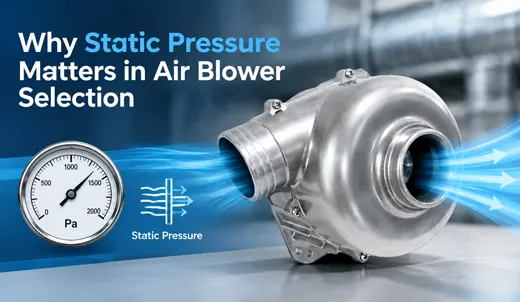
What is Air Blower Static Pressure?
In fluid dynamics, static pressure represents the potential energy exerted equally in all directions by a fluid at rest or moving parallel to a surface. In forced-air thermal management, air blower static pressure measures the blower's capability to overcome system impedance (flow resistance) to push air through a confined pathway. It is conventionally measured in Pascals (Pa), millimeters of water gauge (mmH₂O), or inches of water gauge (in H₂O).
To put it simply: open-air volume answers "How much air can be moved when nothing stands in the way?" while static pressure answers "How effectively can the blower push air through structural obstacles, micro-channels, and restrictive media inside an enclosed chassis?"
System impedance stems from every single element placed along the airflow path:
- Particulate air filters (HEPA, ULPA, or coarse dust screens)
- Small-diameter flexible or rigid tubing
- Convoluted, narrow, or 90-degree bend air ducts
- High-density aluminum or copper heat sinks
- Closely stacked printed circuit board assemblies (PCBAs)
- Constricted exhaust grilles and louvered vents
- Accumulated dust and debris settling on surfaces over months of operation
Every structural hindrance creates a localized pressure drop ($\Delta P$) that drains kinetic energy from the airflow. If the static pressure generated by an air blower fails to meet or exceed the aggregate pressure loss of the system, the actual delivered airflow drops precipitously—frequently to a fraction of the datasheet's nominal CFM rating.
The Reality of Datasheet Extremes: Free Flow vs. Max Static Pressure
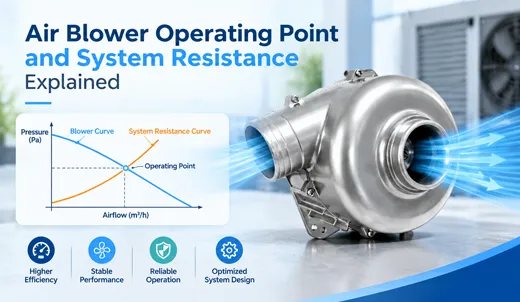
Datasheets publish two ideal extremes: Maximum Airflow (measured at zero static pressure in open air) and Maximum Static Pressure (measured at zero airflow with a fully sealed discharge outlet). Neither condition exists during normal device operation! The true operational state sits at the intersection of the blower's Pressure-Flow ($P-Q$) curve and your enclosure's system impedance curve.
Every model in the TKFAN air blower family undergoes precise dynamic balancing, computational fluid dynamics (CFD) simulation, and acoustic/aerodynamic chamber calibration. Whether you are validating a 12V/24V/48V BLDC unit, a miniature cooling fan, or a high-pressure medical grade blower, TKFAN provides complete, verified $P-Q$ performance curves so engineers can design around real-world working points rather than marketing headlines.
Static Pressure vs. Airflow: The Core Engineering Trade-Off
For any air blower governed by a fixed envelope size, motor wattage, and input voltage, air blower static pressure and volumetric airflow share an inverse trade-off. When an impeller is designed to build higher static pressure to push past restriction, its maximum free-air delivery decreases. Conversely, impellers optimized strictly for maximum open-air CFM produce lower peak static pressure.
This aerodynamic trade-off manifests distinctly when plotting the $P-Q$ curve of centrifugal blowers:
| Blower Category | Aerodynamic Profile | Behavior Under Impedance | Primary Target Applications |
|---|---|---|---|
| High Airflow / Low Static Pressure | Wide blade angles, large inlet area, lower internal compression ratio. | Airflow drops sharply at the slightest restriction; prone to aerodynamic stall under backpressure. | Open chassis, un-ducted enclosures, large cabinet ventilation without filters. |
| High Static Pressure / Balanced Flow | Optimized forward or backward curved blades, tight scroll housing clearance, high RPM BLDC motor. | Maintains stable airflow even when backpressure rises steeply; resists aerodynamic stall. | Medical CPAP/ventilators, automotive ADAS cleaning, HEPA-filtered air purifiers, dense servers. |
A classic purchasing trap is comparing two competing blowers with identical free-air CFM ratings while ignoring their static pressure profiles. When placed inside a restrictive enclosure, Blower A (high static pressure capability) might deliver 80% of its rated airflow, whereas Blower B (low static pressure design) collapses to less than 20% output. This discrepancy leads directly to field overheating, elevated noise, and premature component failure.
Engineers specifying a TKFAN air blower benefit from tailored aerodynamic geometries. TKFAN modifies housing scroll curves, impeller blade angles, and BLDC motor torque characteristics to match distinct impedance profiles—ensuring high static pressure where restrictions are severe or balanced characteristics where low acoustic signatures are mandatory.
Centrifugal Air Blowers vs. Axial Cooling Fans: Why Static Pressure Dictates Selection
A frequent technical inquiry during component selection is: "When should I choose a centrifugal air blower over a standard axial cooling fan?" The definitive answer hinges on system resistance and required static pressure performance.
Axial fans move air parallel to the motor shaft, drawing air in directly from one side and exhausting it out the other. While axial fans excel at pushing large volumes of air in open or minimal-resistance environments, their static pressure ceiling is exceptionally low. When forced to push air against medium-to-high backpressure, axial fan blades stall, resulting in severe turbulence, elevated acoustic noise, and an immediate drop in airflow.
Centrifugal blowers take in air axially through the impeller center and redirect it 90 degrees out through a specialized scroll housing. This scroll converts high-velocity kinetic energy into usable static pressure energy. Consequently, centrifugal blowers generate significantly higher static pressure than same-sized axial fans, keeping airflow stable under heavy backpressure.
| Performance Parameter | Standard Axial Cooling Fan | Centrifugal Air Blower (TKFAN) |
|---|---|---|
| Airflow Discharge Direction | Parallel to fan shaft (Straight through) | 90° Radial redirection out housing scroll |
| Static Pressure Range | Low to Moderate | High to Extreme (Multi-stage capability) |
| High-Backpressure Resistance | Poor (Prone to stall & severe noise increase) | Excellent (Stable airflow delivery) |
| Ideal System Resistance Profile | Unrestricted, open-cavity cooling | Ducts, HEPA filters, micro-channels, narrow vents |
| Noise Profile Under Resistance | High pitch stall noise when choked | Controlled, smooth acoustic curve across duty cycle |
If your end product features tight interior spaces, complex air routing, fine mesh filters, or narrow nozzles, an axial fan will rarely meet performance targets. Integrating an optimized TKFAN air blower ensures reliable air delivery without risking aerodynamic stall or thermal throttling.
The Real-World Pitfalls of Mismatched Static Pressure
Failing to conduct a thorough evaluation of air blower static pressure during early prototyping introduces a domino effect of technical and commercial failures:
1. Insufficient Actual Air Delivered
The most immediate failure mode is severe airflow deficit. A blower that runs perfectly on an open workbench can fail entirely inside an enclosed housing. In medical CPAP devices or ventilators, inadequate pressure capacity translates directly to insufficient therapeutic airway pressure, risking patient safety. In particle counters, low pressure prevents accurate air sampling through micro-filtration membranes, invalidating test data. In automotive ADAS sensor cleaning systems, low static pressure results in weak air jets that fail to clear rainwater, mud, or snow from camera lenses and LiDAR windows.
2. Excessive Noise and Mechanical Vibration
Operating an air blower near its aerodynamic stall zone due to excessive backpressure creates extreme air turbulence inside the scroll. This turbulence generates unpleasant low-frequency hums and elevated decibel levels. For quiet-dependent environments like medical wards, bedrooms, or luxury vehicle cabins, this acoustic spike is unacceptable. While the low-noise TKFAN air blower series features optimized aerodynamic housings, achieving ultra-quiet operation requires matching the unit's static pressure curve accurately to your system impedance point.
3. Thermal Overheating and Accelerated Motor Aging
When system airflow drops below thermal design specifications, critical internal electronics (such as power MOSFETs, CPUs, or optical sensors) run hot. Prolonged high temperatures degrade bearing lubricants and stress the insulation windings of BLDC motors. Although TKFAN air blower models use durable, high-efficiency brushless motors, running continuously under mismatched backpressure conditions compromises operational longevity.
4. Costly Redesigns and Extended Time-to-Market
Discovering static pressure deficits during final validation forces expensive tooling modifications, PCB layout changes, or emergency component swapping. Evaluating TKFAN air blower static pressure curves early in the design cycle avoids these costly late-stage revisions.
Critical Applications Requiring High-Pressure Air Blowers
Medical Devices: ICU Ventilators, CPAP, & Respiratory Care
Medical respiratory systems push air through multi-stage anti-bacterial filters, long flexible tubing, humidification chambers, and patient masks. These elements generate significant pressure drops. High-pressure TKFAN air blower units use lightweight, high-rpm impellers paired with 24V BLDC motors to deliver rapid pressure response times, high static pressure output, and whisper-quiet sound profiles required for hospital and homecare environments.
Particle Counters & Cleanroom Environmental Monitoring
Airborne particle counters draw air samples through fine-pore analytical filters at precise, steady flow rates. Variations in static pressure ruin sampling accuracy. High-stability TKFAN air blower static pressure performance guarantees steady sample draw regardless of filter loading over time.
Automotive Electronics: ADAS Sensor Cleaning Systems
Autonomous vehicles rely on optical cameras, LiDAR, and radar units that must remain clean in rain, snow, and mud. Specialized automotive-grade TKFAN air blower units provide the high static pressure required to blast high-velocity air pulses through narrow cleaning nozzles, clearing optical surfaces instantly across wide operating temperatures.
Industrial & Appliance Solutions: Cushion Packaging, Soldering Stations, & Servers
In air cushion packaging equipment, blowers must inflate plastic void-fill pillows rapidly under resistance. In hot air rework stations, air is forced through tight heating elements. In high-density 48V telecom racks, blowers push air through densely packed blade servers. In all these demanding applications, robust static pressure capability is essential for system operation.
Step-by-Step Practical Guide: Selecting the Right Air Blower
Follow this engineering methodology to evaluate and select the ideal TKFAN air blower for your application:
Step 1: Calculate Aggregate System Pressure Losses ($\Delta P$)
Sum the pressure drops caused by every component in your airflow pathway: filters, ducts, bends, heat sink matrix, and exhaust grilles. Utilize Computational Fluid Dynamics (CFD) modeling or pressure-drop tables supplied by component vendors. Always apply a 10%–15% safety margin to account for manufacturing tolerances and real-world dust accumulation over time.
Step 2: Determine Required Operating Airflow Under Resistance
Establish the required volumetric airflow (CFM or m³/h) needed to achieve your thermal dissipation or fluid delivery targets at the elevated system pressure calculated in Step 1. Do not use the open-air free delivery figure as your target.
Step 3: Analyze the Air Blower $P-Q$ Performance Curve
Plot your calculated system operating point (Static Pressure vs. Target Airflow) onto the $P-Q$ performance curve provided in the TKFAN air blower datasheet. Ensure your operating point falls cleanly below the blower curve—preferably within the middle 30%–70% efficiency zone, far away from both the zero-flow max static pressure point and the zero-pressure max flow point.
Step 4: Verify Mechanical, Electrical, and Environmental Constraints
Once pneumatic compatibility is confirmed, verify secondary engineering specs:
- Operating Voltage: 2V low voltage, 12V, 24V, 48V DC, or 220V AC options.
- Control Protocols: PWM speed control, FG tachometer signal, RD lock alarm.
- Physical Envelope: Housing dimensions, mounting hole locations, outlet flange style.
- Environmental Protection: IP55, IP67, or IP68 waterproof/dustproof ratings for harsh conditions.
- Acoustic Ceiling: Maximum acceptable decibel level at designated RPM.
Step 5: Prototype Validation in Real Enclosures
Install physical samples inside functional prototype enclosures. Measure real-world static pressure using differential pressure gauges and verify internal temperature profiles under full load.
Step 6: Leverage TKFAN Custom OEM/ODM Engineering Services
If standard commercial blowers cannot meet your exact static pressure, footprint, or noise targets, TKFAN provides full OEM customization. Engineers can customize impeller blade profiles, scroll housings, BLDC motor windings, wire harness lengths, and connector types—with rapid prototyping turnaround times as fast as 48 hours.
Technical FAQ: Air Blower Static Pressure
Conclusion: Optimize Your Thermal & Pneumatic Design Today
Static pressure is the true benchmark of how an air blower performs inside real-world equipment. Open-air flow figures do not reflect performance inside tight enclosures fitted with HEPA filters, intricate air channels, or high-density cooling fins. Selecting a blower without matching its $P-Q$ curve to your system resistance leads to thermal throttling, excessive noise, and premature component failure.
The TKFAN air blower catalog offers a complete array of centrifugal solutions: miniature units, 12V/24V/48V BLDC models, high-pressure medical respiratory blowers, automotive sensor cleaning systems, and IP68 waterproof configurations. Every unit includes full static pressure test curves to streamline your engineering selection process.
Before finalizing your system design, calculate total system pressure loss, define your required operating airflow under resistance, review verified $P-Q$ performance curves, and validate performance with real samples. Explore the complete product lineup or request custom OEM engineering support at https://www.tkfan.com/products/air-blower.html.