

Why Industrial Cooling Requires High-Pressure, High-Airflow, High-Speed Blowers
As modern manufacturing equipment, edge AI servers, high-density power electronics, medical equipment, and automated machinery achieve unprecedented power densities, industrial thermal management has reached a critical inflection point. Engineering design teams face a stubborn physical challenge: traditional axial cooling fans frequently fail when installed inside real-world industrial enclosures. While a standard axial fan may boast impressive free-air CFM (Cubic Feet per Minute) ratings in a laboratory setting, its actual delivered airflow plummets to near zero when confronted with internal component layout density, multi-stage HEPA air filtration systems, convoluted ductwork, and severe static pressure resistance.
This discrepancy between open-air performance specs and real-world system behavior is why high-pressure high-airflow high-speed blowers—frequently referred to as industrial blowers or centrifugal blowers—have become indispensable for industrial thermal management. Unlike standard ventilation fans engineered for open-space circulation, specialized industrial blowers convert rotational kinetic energy into static pressure capable of forcing cool air through high-resistance thermal obstacles.
In this technical guide, we break down the fluid dynamics, key parameters, failure modes, international test standards, and real-world applications of high-pressure blower technology. Referencing engineering data from the TKFAN High-Pressure Blower Technical Library, this guide outlines why high-speed blowers outperform traditional cooling options in critical industrial environments.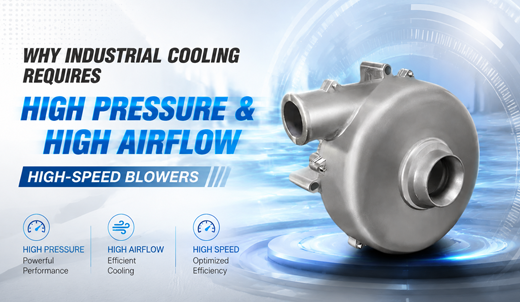
Fundamental Differences: Standard Axial Fans vs. Industrial High-Pressure Blowers
To understand why industrial thermal management requires specialized air-moving equipment, systems engineers must evaluate the relationship between static pressure and volumetric airflow rate.
Key Engineering Definitions:
- Static Pressure (Measured in inches H₂O, Pa, or mmH₂O): The potential pressure exerted by an air-moving device to overcome downstream resistance, friction, and restrictions.
- Airflow / Volumetric Flow Rate (CFM or m³/min): The total volume of air pushed through a system per unit of time.
- System Impedance Curve: The mathematical parabolic curve representing a system's total resistance to airflow as velocity increases.
Standard axial cooling fans feature blades mounted parallel to the airflow direction. They excel at moving massive volumes of air in open, unrestricted spaces. However, axial blades exhibit poor pressure generation capabilities. When forced to push air against a high system impedance—such as a dense array of heatsinks or dirty dust filters—axial fans experience aerodynamic stall, causing severe turbulence and a complete loss of airflow velocity.
Conversely, high-pressure centrifugal blowers draw air in axially through the inlet and accelerate it radially through a scroll-shaped housing via aerodynamically optimized impellers, discharging the air at a 90-degree angle. This centrifugal conversion transforms high rotational speed into static pressure. As a result, high-speed blowers can maintain constant volumetric airflow even under severe backpressure conditions that would completely disable a standard fan.
| Performance Metric | Standard Axial Cooling Fan | Industrial High-Pressure Blower |
|---|---|---|
| Primary Advantage | High volumetric airflow in open-air conditions | Exceptional static pressure capability under severe backpressure |
| Performance in Filtered/Ducted Systems | Airflow drops by 50% to 80% under backpressure | Maintains stable volumetric airflow across the impedance curve |
| Aerodynamic Mechanism | Axial propeller pushes air inline along fan axis | Centrifugal force in scroll housing converts velocity to static head |
| Stall Susceptibility | High risk of blade stall in high-impedance enclosures | Low stall vulnerability across wide operating static pressure zones |
| Typical Application Target | Open ventilation, unsealed rack enclosures | Dense server chassis, HEPA filtered medical units, long duct runs |
Core Industrial Challenges Solved by High-Pressure Centrifugal Blowers
Industrial deployment environments subject air-moving components to multiple overlapping flow resistances. Below are the primary structural and operational challenges that strictly necessitate high-pressure blowers.
1. Ultra-Dense Component Placement & Compact Enclosures
Modern industrial controllers, high-speed variable frequency drives (VFDs), power distribution cabinets, and edge compute servers compress high-wattage components into tightly sealed housings. The resulting narrow gaps between printed circuit board (PCB) traces, wire harnesses, mounting brackets, and tall pin-fin heatsinks act as air-choking bottlenecks. High-pressure blowers generate the static pressure required to force cooling air into microscopic thermal gaps, sweeping away boundary layers of trapped hot air and eliminating localized hot spots that lead to premature silicon degradation.
2. HEPA and Multi-Stage Air Filtration Impedance
Industrial electronics often operate in environments filled with conductive dust, airborne oil mists, metal shavings, or chemical vapors. To prevent electrical short circuits, cooling intake air must pass through dense washable dust filters or multi-stage HEPA filters. Each filter layer imposes significant static pressure load on the air delivery system. Furthermore, as dust accumulates over operating cycles, the filter's static resistance escalates dynamically. High-speed blowers possess the pressure reserve required to drive nominal airflow through loaded, particulate-heavy filter media without dropping thermal performance.
3. Long Air Ducting, Multiple Elbows, and Complex Manifolds
In distributed thermal systems, centralized equipment cabinets or cleanroom instruments cannot vent hot exhaust air directly into the immediate room. Cooling air must be routed through long ductwork, 90-degree elbows, flow splitters, and narrow exhaust nozzles. Every bend, transition, and duct wall contact creates friction head loss. High-speed blowers provide the static head needed to overcome cumulative pressure drops over extended duct lengths, ensuring cool air arrives at remote internal heat exchangers.
4. 24/7 Uninterrupted Continuous Duty Under Heavy Thermal Loads
Industrial manufacturing, power grids, and telecommunication networks run 24/7/365. Fan failure translates directly into costly facility downtime. Standard commercial-grade fans subjected to continuous high backpressure experience mechanical stress, shaft misalignment, motor coil overheating, and rapid bearing wear. Industrial-grade blowers—such as those engineered in the TKFAN High-Pressure Blower Line—utilize reinforced impellers, dual-ball precision bearings, and high-efficiency Brushless DC (BLDC) motors built for continuous duty under severe thermodynamic strain.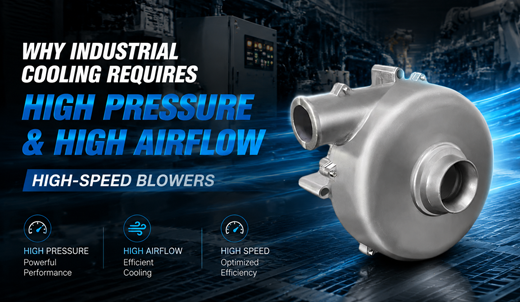
Critical Technical Parameters for Evaluating High-Speed Blowers
Selecting an optimal blower requires a detailed calculation of system impedance rather than relying on basic datasheet max ratings. Systems engineers must analyze five core parameters during thermal evaluation:
Static Pressure vs. Airflow (P-Q) Performance Curves
Single-value metrics like "Maximum Airflow (CFM)" or "Maximum Static Pressure (mmH₂O)" are measured at extreme opposite ends of the operating envelope (free air vs. complete shutoff). Neither reflects actual operational performance. Engineers must plot the enclosure's unique system resistance curve against the candidate blower's complete P-Q curve. The actual operating point is the intersection of these two curves. The selected blower must place this operating point well within its high-efficiency, non-stall zone.
Rotational Speed (RPM), Motor Topology, and Control Interfaces
High static pressure is directly proportional to impeller tip speed. Modern high-pressure blowers rely on BLDC motor technologies reaching speeds from 25,000 RPM up to over 50,000 RPM. Drives generally fall into integrated internal motor drivers or external controller modules. Advanced industrial blowers support PWM (Pulse Width Modulation) speed control input along with FG (Tachometer) pulse signal outputs, enabling automated closed-loop thermal control based on real-time temperature sensor feedback.
Thermal Equilibrium Under Continuous Operational Pressure
When operating against high backpressure, electric motors draw higher current to sustain rotational speed, generating internal electromagnetic and resistive heat. Quality industrial blowers incorporate dedicated internal heat dissipation channels to protect motor windings and bearing lubricants. Thermal equilibrium tests must confirm that under maximum rated static head, motor winding temperatures stabilize below insulation class limits.
Acoustic Noise Characteristics Under Load Conditions
A blower's acoustic output changes drastically when transitioning from open-air testing to high backpressure operating points. Operating near aerodynamic stall triggers blade pass frequency spikes, structural vibration, and high-pitched noise. Reliable blower technical documentation provides acoustic pressure spectra measured across various points on the P-Q curve per international acoustic standards.
International Performance Testing & Quality Standards
To avoid thermal discrepancies between lab prototypes and production units, blowers should be verified using standardized aerodynamic test setups:
- ISO 5801: Industrial fans — Performance testing using standardized airways.
- AMCA 210 / ASHRAE 51: Laboratory Methods of Testing Fans for Aerodynamic Performance Rating (utilizing multi-nozzle plenum chambers).
- GB/T 1236: Aerodynamic performance test for industrial fans.
Standardized testing adjusts raw data to standard air density parameters (1.204 kg/m³ at 20°C and 101.325 kPa). This allows engineers to accurately account for environmental variables like altitude and ambient temperature shifts, which reduce air density and static pressure output.
Primary Real-World Applications for High-Pressure Blowers
1. Industrial Automation & Robotics
Articulated robotic arms, automated optical inspection (AOI) machines, and LiDAR-guided autonomous mobile robots (AMRs) integrate high-speed blowers into compact, sealed housing units. Blowers perform dual roles: extracting heat from high-density onboard compute chips while providing positive air pressure to blow dust and debris off optical sensors and lenses.
2. Energy Storage Systems (ESS) & Power Conversion Electronics
Solar inverters, battery management systems (BMS), and industrial uninterruptible power supplies (UPS) process high currents that generate substantial internal heat. High-pressure blowers push cool air through tightly packed liquid-to-air heat exchangers and dense IGBT inverter assemblies, ensuring continuous power output without thermal throttling.
3. Medical & Diagnostic Laboratory Instruments
Medical ventilators, DNA sequencers, blood analyzers, and imaging equipment require ultra-clean airflow passed through ultra-fine HEPA filters. High-pressure blowers overcome filter impedance while delivering whisper-quiet, low-vibration airflow necessary for sensitive optical sensors and precise fluidic sampling.
4. Commercial Appliances & Specialized Ventilation
Modern high-efficiency commercial ovens, 3D printers, laser engravers, and specialized air purification devices leverage compact BLDC high-pressure blowers to force hot gases through exhaust scrubbers, charcoal filters, and tight internal ductwork.
Common Engineering Pitfalls in Industrial Blower Selection
- Pitfall 1: Selecting based solely on free-air CFM ratings. Ignoring system impedance leads to severe under-cooling when installed in a sealed enclosure.
- Pitfall 2: Neglecting long-term filter loading. Calculating pressure requirements based only on a clean filter leads to thermal shutdown as dust accumulates over time.
- Pitfall 3: Operating within the aerodynamic stall zone. Placing the system operating point near the P-Q curve knee causes severe vibration, increased acoustic noise, and premature bearing failure.
- Pitfall 4: Ignoring derating for high altitude. Reduced ambient air density at high elevations decreases static pressure generation, requiring higher rotational speeds to achieve equivalent cooling capacity.
Technical FAQ: High-Pressure Industrial Blowers
Q1: Can parallel axial fans achieve the same performance as a high-pressure blower?
No. Placing axial fans in parallel increases maximum volumetric airflow in open-air conditions, but does not increase total static pressure capability. If your thermal system is blocked by high backpressure, parallel axial fans will simply stall. Only a centrifugal high-pressure blower can overcome severe static resistance.
Q2: Does higher RPM always yield better industrial cooling?
Higher RPM increases both static pressure and airflow, but it also increases acoustic noise, power consumption, and mechanical wear. Optimal thermal design focuses on matching the precise P-Q operating point rather than maximizing raw speed.
Q3: How do I estimate the static pressure resistance of my enclosure?
Calculate the pressure drop across individual components (filters, heatsink spacing, duct bends, grills) using fluid dynamics formulas or Computational Fluid Dynamics (CFD) simulation software. Alternatively, measure static pressure directly on a physical prototype using a differential pressure manometer inside a sealed test chamber.
Q4: What is the difference between an integrated BLDC blower and an externally driven blower?
Integrated blowers house control electronics directly within the motor housing, simplifying wiring and reducing component count. Externally driven blowers place control boards in a remote location, protecting driving electronics from extreme environmental heat or heavy vibration.
Q5: How does altitude affect high-pressure blower selection?
Air density decreases with altitude, lowering air mass flow and static pressure generation. Blower speed or physical size must be increased using air density correction factors to maintain effective thermal performance at higher elevations.
Q6: What motor protection features are essential for industrial blowers?
Industrial blowers should include Locked-Rotor Protection, Reverse Polarity Protection, Over-Current Protection, and Thermal Auto-Restart to prevent motor burnout during mechanical jams or power surges.
Q7: Why do centrifugal blowers discharge air at a 90-degree angle?
Air enters the center of the rotating impeller and is accelerated outward by centrifugal force into the scroll housing. The scroll directs the pressurized air outward at a 90-degree angle, efficiently converting kinetic velocity into static head pressure.
Q8: How does PWM speed control improve thermal efficiency in industrial blowers?
PWM speed control adjusts blower RPM based on live temperature inputs. During low-load conditions, the system lowers blower speed to reduce power consumption and acoustic noise, ramping up to full speed only when thermal demand peaks.
Q9: What bearing type is best for continuous 24/7 industrial blower operation?
Precision dual-ball bearings are recommended for continuous industrial deployment. They offer longer MTBF (Mean Time Between Failures), operate reliably across wide temperature ranges, and support mounting in any physical orientation compared to sleeve bearings.
Q10: Where can I access official test data and engineering drawings for high-pressure blowers?
Detailed technical datasheets, CAD models, and ISO/AMCA performance curves can be reviewed directly in the TKFAN High-Pressure Blower Documentation Center.
Conclusion: Reliable Industrial Cooling Demands Static Pressure Management
Solving complex thermal challenges in modern industrial hardware requires looking beyond open-air airflow metrics. When cooling air must navigate high-density component layouts, HEPA filters, tight ducting, and sealed chassis, static pressure delivery becomes the determining factor in system reliability. By incorporating high-pressure, high-speed centrifugal blowers tested to ISO 5801 and AMCA 210 standards, system architects can prevent thermal throttling, extend component lifespans, and safeguard continuous operational uptime.