

What Is a 220V Blower? Working Principle & Main Applications
In modern industrial automation, high-density computing, thermal management, and precision airflow delivery, choosing the right air-moving equipment is critical. Engineers and system integrators frequently encounter thermal bottlenecks or static pressure deficits when relying on traditional axial fans. When air must be forced through dense HEPA filters, intricate ducting networks, or tightly packed electronic enclosures, axial fans often stall and lose performance. This is precisely where a high-performance 220V Blower excels.
A standard 220V Air Blower is an advanced centrifugal air-moving machine powered directly by a standard 220V AC mains supply. Designed to generate concentrated static pressure and controlled volumetric airflow, these units are indispensable for commercial and industrial setups. Premium solutions like the TKFAN 220V Air Blower line leverage state-of-the-art brushless DC (BLDC) technology coupled with integrated or external AC-to-DC driver modules. This eliminates the need for external power transformers while maximizing energy efficiency and pressure capability.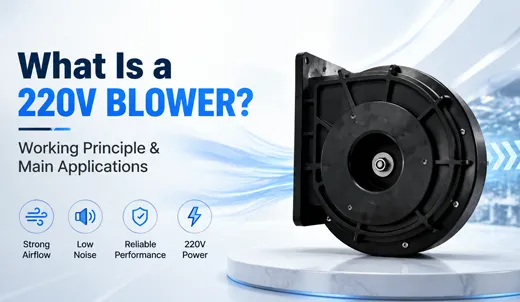
Understanding the Core Definition of a 220V Blower
At its fundamental level, a 220V Blower is defined by its operational voltage supply—utilizing 220V AC (single-phase or three-phase line power) as its primary energy input. However, the technology underlying these units has evolved significantly over the past decade. Historically, market options were dominated by traditional AC induction blowers. Today, the industry has shifted dramatically toward modern AC-input brushless blowers, exemplified by the flagship TKFAN 220V Blower series.
To fully appreciate the distinction, it is essential to analyze the two main motor architectures present in the market:
- Traditional AC Induction Blowers: These legacy devices connect directly to AC lines without electronic conversion. While straightforward, they suffer from significant drawbacks: low electrical efficiency (often below 40%), excessive thermal loss, heavy cast-iron housing, fixed operational speeds, and an inability to interface with modern digital control protocols.
- Brushless AC-Input Blowers (BLDC / EC): Modern solutions like the TKFAN 220V Air Blower integrate internal or external driver circuitry. The driver rectifies the 220V AC line voltage into high-voltage DC to power a permanent-magnet brushless motor. This design provides exceptional energy efficiency (up to 85%), minimal motor heat generation, compact sizing, and precise speed control via Pulse Width Modulation (PWM) or 0–10V analog signals.
A high-performance 220V Air Blower consists of five critical structural components engineered for harsh industrial demands:
- Precision Centrifugal Impeller: Featuring backward-curved or forward-curved blades engineered with dynamic balance. The impeller transfers mechanical rotation into kinetic air energy.
- Volute Housing (Scroll Case): A specialized aerodynamic spiral chamber that decelerates high-velocity air, transforming kinetic energy into usable static pressure.
- High-Efficiency Motor Assembly: Powered by dual-ball bearings rated for 70,000+ hours of continuous duty, ensuring longevity under high ambient temperatures.
- Integrated / External Drive Module: Handles AC-to-DC conversion, motor commutation, electronic protection (over-current, over-voltage, thermal cutout), and control signal processing.
- Inlet and Outlet Ports: Precision-machined connection points engineered to mate seamlessly with industrial ducts, filters, and equipment shrouds.
Engineering Note: Unlike low-voltage DC blowers (e.g., 12V or 24V) that require bulky external power supply units (PSUs), a native 220V Blower connects directly to standard utility grids. This drastically simplifies electrical cabinet layout and reduces overall system integration costs for OEMs.
How a 220V Blower Works: The Physics of Centrifugal Air Processing
The operational mechanics of a 220V Air Blower rely on centrifugal energy transformation. Understanding this process highlights why blowers are vastly superior to standard axial fans when facing high system impedance.
An axial fan moves air parallel to its rotational shaft, acting primarily as a volume displacement device. In contrast, a TKFAN 220V Blower draws air in axially through its center inlet and redirects it radially outward at a 90-degree angle. This process unfolds across four distinct physical stages:
Stage 1: Axial Air Intake & Suction Creation
When 220V AC power is supplied to the driver, the brushless motor accelerates the dynamically balanced impeller to high rotational speeds (ranging up to 52,000 RPM in specialized TKFAN 220V Blower models). As the blades rotate, air in the center of the wheel is flung outward, creating a localized low-pressure zone (vacuum) at the intake. Atmospheric pressure continuously forces ambient air into the center of the impeller.
Stage 2: Centrifugal Air Acceleration
As air enters the spinning impeller, it enters the channels between the blades. Centrifugal acceleration forces the air mass outward toward the blade tips. The mechanical energy from the motor is transferred directly into the fluid, rapidly increasing the air’s velocity and kinetic energy profile. In advanced TKFAN 220V Air Blower units, optimized blade curvature minimizes turbulence, vibration, and aerodynamic noise.
Stage 3: Kinetic Energy Transformation into Static Pressure
The high-velocity air exits the tip of the impeller blades and enters the expanding spiral volute casing. Due to Bernoulli's principle and the gradually expanding cross-sectional area of the volute, the air velocity decreases. As speed drops, the dynamic pressure converts into concentrated static pressure. This generated static head gives the 220V Blower the capability to push air through dense air filters, tight heat exchangers, and extensive ducting networks without stalling.
Stage 4: Directional High-Pressure Discharge
Finally, the pressurized air exits through the rectangular or circular outlet flange. In a closed-loop system, the motor driver can output Frequency Generator (FG) tachometer signals, enabling the central master controller (PLC or computer) to monitor rotational RPM continuously and adjust performance dynamically.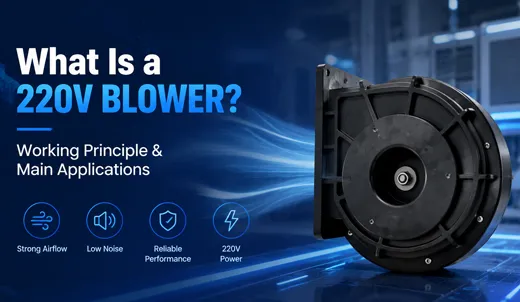
Legacy AC Induction vs. TKFAN Brushless 220V Air Blower
When selecting a 220V Blower for engineering projects, evaluating motor topology is paramount. The table below details the performance comparison between traditional single-phase AC induction blowers and the modern brushless TKFAN 220V Air Blower platform.
| Performance Feature | Traditional 220V AC Induction Blower | TKFAN Brushless 220V Air Blower |
|---|---|---|
| Electrical Efficiency | Low (approx. 30% – 45%) | Ultra-High (Up to 85%, energy saving up to 60%) |
| Speed Control & Monitoring | Single speed; requires external voltage transformers | Integrated PWM & 0–10V speed control + FG RPM signal |
| Thermal Output & Lifespan | High motor heat generation; 20,000–30,000 hrs | Low thermal rise; dual ball bearings; 70,000+ hrs |
| Power Grid Interface | Direct 220V AC line input | Direct 220V AC line input (internal/external driver) |
| High-Impedance Performance | Prone to airflow stall and severe acoustic noise | Optimized aerodynamic housing; stable high-pressure air delivery |
| Form Factor & Weight | Heavy cast iron or stamped steel housing | Lightweight, high-strength PBT / Aluminum alloy design |
Key Industrial & Commercial Applications of 220V Blowers
Thanks to their high static pressure, direct AC utility integration, and smart speed controllability, the TKFAN 220V Blower lineup serves a vast range of critical industrial sectors. Below are the primary deployment scenarios where a 220V Air Blower is essential.
1. Industrial Dust Collection, Fume & Exhaust Extraction
In CNC machining centers, laser cutting equipment, electronics soldering lines, and woodworking workshops, airborne particulates, oil mists, and toxic fumes present health and operational hazards. Filtration systems use multi-stage HEPA filters and carbon beds, which create substantial resistance.
An axial fan cannot push air through dirty filters. A properly sized 220V Blower maintains strong suction at the intake hood, pulling polluted air through dense filter media and expelling clean air continuously, even as filter resistance increases over time.
2. Commercial HVAC, Cabinet Ventilation & Long-Duct Exhaust
In building automation systems, commercial kitchen exhausts, telecommunication shelters, and outdoor power distribution cabinets, air must travel through tens of meters of ducting containing sharp 90-degree elbows. Each elbow introduces severe static head losses.
The high static pressure profile of a TKFAN 220V Air Blower overrides pipe friction losses seamlessly. Connected directly to 220V building power lines, these blowers run continuously to keep critical infrastructure cool and ventilated.
3. High-Density Computing & AI Server Rack Thermal Management
Modern enterprise servers and artificial intelligence (AI) compute clusters generate intense localized heat. Packed tightly into 19-inch rack enclosures, dense PCB layouts and large copper heat sinks restrict airflow paths significantly.
Using a high-rpm 220V Blower guarantees that cooling air penetrates deep into server chasses, directly eliminating thermal hotspots around CPUs, GPUs, and power supply units (PSUs). System controllers use PWM speed management to regulate blower RPM in response to real-time temperature fluctuations, saving energy during idle states.
4. Automated Air Knife Drying & Surface Processing Lines
Manufacturing lines for beverage bottling, PCB washing, glass fabrication, and automotive parts coating rely on air knives to strip surface moisture rapidly following fluid processing stages.
An air knife requires a continuous, high-velocity sheet of pressurized air. Deploying a TKFAN 220V Blower supplies the necessary static head and volumetric throughput required to strip moisture instantly without physically contacting delicate product surfaces.
Engineering Selection Guide: How to Choose the Right 220V Blower
Selecting the optimal 220V Blower requires precise technical evaluation of system requirements rather than relying solely on free-air CFM ratings. Follow these five core engineering criteria when selecting a model:
- 1. Calculate Total System Static Pressure (Impedance): Add up all internal pressure drops including filters, duct turns, grilles, and chassis obstruction. Match this figure against the blower's P-Q curve. Models like the TKFAN BA8060H02B-B deliver maximum static pressures up to 18 kPa.
- 2. Verify Required Volumetric Airflow (CFM / m³/h): Ensure the selected 220V Air Blower supplies sufficient air volume at your calculated operating static pressure point, not just at zero pressure (free air).
- 3. Match Control Protocols & Monitoring Needs: Determine whether your host system requires fixed-speed operation or dynamic feedback. Modern TKFAN 220V Blower units offer PWM speed adjustment and FG speed signal outputs for automated monitoring.
- 4. Evaluate Environmental & Ingress Protection (IP) Requirements: For outdoor, humid, or dust-laden environments, specify IP55 to IP68 water/dust protection ratings alongside anti-corrosion conformal coatings.
- 5. Consider Form Factor & Mounting Orientation: Review physical dimensions, outlet flange geometry, and mounting hole positions to streamline integration into tight equipment enclosures.
Representative Model Benchmark: The TKFAN BA8060H02B-B features ultra-compact footprint dimensions (79×77×60mm), rotational speeds up to 52,000 RPM, airflow reaching 33 CFM, and exceptional peak static pressure up to 18 kPa—making it an ideal candidate for space-constrained, high-resistance cooling tasks.
Frequently Asked Questions (Technical FAQ)
Summary & Engineering Recommendations
In conclusion, choosing a high-efficiency 220V Blower—specifically modern brushless solutions like the TKFAN 220V Air Blower—bridges the gap between low-pressure axial fans and costly heavy industrial air compressors. Operating directly on 220V AC mains, these blowers output impressive static head, superior energy efficiency, and low acoustic noise while supporting intelligent control interfaces.
Whether you are designing advanced fume extraction systems, upgrading commercial HVAC cabinets, optimizing AI compute cluster thermal envelopes, or building continuous industrial drying lines, evaluating both static pressure requirements and airflow volume is essential. Explore full model specifications and request expert OEM engineering assistance by visiting the TKFAN 220V Air Blower Product Center today.