

The Engineering Guide: How to Select the Right 220V Blower Based on Application Scenarios
Whether you are an Original Equipment Manufacturer (OEM) design engineer, a system integrator, or a senior procurement manager, selecting the appropriate 220V Blower directly dictates your equipment's operational stability, thermal management efficiency, energy consumption, and overall lifespan. An incorrectly specified 220V Air Blower can lead to catastrophic system failures: severe airflow reduction under load, premature motor overheating, excessive acoustic noise, or immediate motor stalling when overcoming aerodynamic impedance from filters, long ducting, or sealed enclosures.
While low-voltage Direct Current (DC) fans frequently demand bulky, external AC-to-DC power supplies that consume precious enclosure space, an industrial-grade TKFAN 220V Blower connects directly to standard commercial AC mains electricity available worldwide. It bridges the performance gap between low-pressure axial cooling fans and heavy-duty industrial air compressors, delivering concentrated static pressure engineered for ducted ventilation, fume extraction, chassis cooling, automated air-knife drying systems, and high-resistance industrial workflows. However, many engineers make the mistake of selecting blowers solely based on maximum free-air CFM (Cubic Feet per Minute) while ignoring system backpressure. This definitive selection guide breaks down every technical parameter required to match a high-performance 220V Air Blower to your exact application constraints.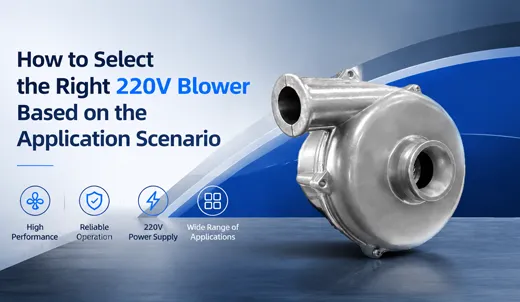
1. Defining Your Application Requirements Before Specification
Before reviewing technical datasheets or comparing 220V Blower price points, you must systematically map out your application’s operational environment. Skipping this preliminary audit is the leading cause of post-procurement performance failure. Define the following core operational criteria first:
- Primary Application Function: Is the 220V Air Blower intended for forced-air heat dissipation, toxic dust/fume extraction, air-knife moisture removal, positive pressure cleanroom supply, or high-density cabinet exhaust? Each process demands a drastically different pressure-to-volume ratio.
- Duty Cycle Requirements: Will the unit operate continuously (24/7/365) in mission-critical hardware, or will it run periodically on an intermittent schedule? Continuous-duty industrial applications demand premium dual-ball bearing structures and low thermal-rise motor architectures.
- System Aerodynamic Impedance: Does your mechanical assembly feature HEPA filters, dense dust collectors, long corrugated ductwork, right-angle elbows, or tightly packed PCB racks? These components generate static backpressure that rapidly diminishes nominal airflow.
- Envelope & Spatial Constraints: What are the maximum length, width, and height dimensions permitted inside your enclosure? High-RPM compact centrifugal blowers yield radically different pressure profiles compared to large-frame, high-volume models.
- Environmental Operating Conditions: Is the blower installed in a cleanroom, a dusty factory floor, a high-humidity environment, or a corrosive chemical atmosphere? Operating environments determine the required Ingress Protection (IP) rating and anti-corrosion surface treatments.
- Control & Monitoring Architecture: Does your system require fixed-speed operation, or dynamic speed regulation via Pulse Width Modulation (PWM) or 0–10V analog signals? Is a Frequency Generator (FG) tachometer signal required for system health monitoring?
Establishing these parameters upfront enables precise candidate filtering, ensuring that the selected TKFAN 220V Air Blower performs flawlessly under real-world operating stress.
2. Critical Performance Metrics: CFM, Static Pressure, and P-Q Curves
Evaluating a 220V Blower requires understanding two fundamental aerodynamic metrics: volumetric airflow measured in Cubic Feet per Minute (CFM) or Cubic Meters per Hour (m³/h), and static pressure measured in Pascals (Pa) or inches of water column (in. H₂O).
A frequent procurement pitfall is selecting a blower based exclusively on its advertised "Free-Air Flow" rating. Free-air flow represents performance in a complete vacuum of resistance. In actual industrial machinery, air filters, heat exchangers, and turns in ducting introduce significant backpressure. Under these conditions, standard axial fans stall, causing airflow to drop near zero. A purpose-engineered centrifugal 220V Air Blower utilizes specialized impellers to generate high static pressure, maintaining air velocity even under high systemic resistance.
Golden Rule of Blower Selection: Always Consult the P-Q Curve
Never rely on single-point max CFM ratings. Always analyze the performance P-Q (Pressure vs. Quantity) curve. Identify your calculated system operating point where static pressure intersects required CFM. Always incorporate a 15% to 20% static pressure safety margin to account for filter dust loading, duct fouling, and long-term component aging.
- Volumetric Airflow (CFM): Measures the volume of air moved per unit of time. Critical for macro-environment heat removal and high-volume cabinet purging where static resistance is minimal.
- Static Pressure (Pa / in. H₂O): Measures the blower's capability to push air through restrictive media. Necessary for dense electronics, HEPA filtration units, and long duct runs.
- Rotational Speed (RPM): Higher RPM compact blowers generate high pressure within small physical footprints but produce higher acoustic output. Larger frame blowers deliver equivalent CFM at lower RPMs, drastically reducing operational noise.
- Electrical Power & Efficiency: Traditional AC motors lose substantial energy as waste heat. Advanced AC-input brushless DC (BLDC) blowers achieve thermal efficiency up to 85%, reducing electrical power draw by up to 60%.
3. Motor Technology Comparison: Traditional AC Induction vs. High-Efficiency 220V BLDC
The internal motor architecture represents the most critical differentiator between market-available blowers. The total cost of ownership (TCO) over a blower’s service life far outweighs its initial purchase price.
Traditional 220V AC induction blowers connect directly to AC mains without external drivers. However, they suffer from fixed operational speeds, low energy efficiency (30%–45%), high internal heat generation, heavy frame weight, and limited bearing longevity. Speed regulation requires bulky voltage transformers, lacks precision, and provides no tachometer output for system monitoring.
Conversely, a modern 220V AC-input Brushless DC (BLDC) TKFAN 220V Blower accepts standard 220V AC utility power directly while leveraging an integrated high-voltage drive circuit to power a permanent-magnet brushless motor. This design provides significant industrial advantages:
- Up to 85% Motor Efficiency: Substantially cuts electricity costs for 24/7 continuous industrial operations.
- Precision Speed Control: Seamlessly integrates with system microcontrollers via PWM or 0–10V signals for variable speed thermal management.
- FG Signal Output: Integrated tachometer feedback enables real-time speed monitoring and immediate system failure alerts if obstruction occurs.
- Extended Service Life: Low thermal rise combined with premium dual-ball bearings extends maintenance-free lifespan up to 70,000 hours.
| Performance Parameter | Traditional 220V AC Induction Blower | Advanced 220V AC-Input BLDC Blower |
|---|---|---|
| Energy Efficiency | 30% – 45% (High Energy Waste) | Up to 85% (High Savings) |
| Speed Control Capabilities | Fixed speed or crude voltage regulation | Precision PWM / 0–10V continuous control + FG Feedback |
| Motor Heat Generation | High thermal rise (shortens insulation life) | Ultra-low motor heat dissipation |
| Typical Service Lifespan | 15,000 – 30,000 Hours | Up to 70,000 Hours (Dual Ball Bearings) |
| Mains Power Compatibility | Direct 220V AC Input | Direct 220V AC Input (Integrated/External Driver) |
| Real-Time System Monitoring | Not available | Supported via FG Speed Output / Alarm Output |
4. Environmental, Mechanical, and Control Features Checklist
Once performance curves and motor architectures are finalized, review this mechanical and environmental verification checklist before placing an order:
Bearing Systems: Ball Bearings vs. Sleeve Bearings
For industrial applications, specify dual-ball bearing construction. While sleeve bearings offer lower initial costs, they suffer from rapid lubricant evaporation under elevated temperatures, continuous vertical mounting, or vibration, leading to premature failure. Dual-ball bearing systems maintain rotational stability across wide operating temperature ranges (-20°C to +70°C).
Ingress Protection (IP Ratings) and Anti-Corrosion
Industrial environments containing airborne dust, humidity, or corrosive vapors require sealed motor housings. Standard indoor applications accept IP44, whereas harsh industrial environments require IP55 or IP68 potted motor designs to protect stator electronics against moisture and conductive particulates.
Acoustic Noise and Structural Vibration
High-RPM compact blowers can generate significant acoustic noise. In noise-sensitive commercial or medical environments, evaluate dBA ratings measured at 1-meter distances. Ensure your chosen TKFAN 220V Air Blower features dynamically balanced impellers to prevent structural vibration transmission into the host chassis.
International Safety & Electromagnetic Compliance
Exporting equipment globally requires safety compliance. Ensure your 220V Blower carries valid international certifications such as CE, UL, RoHS, and REACH. Installing non-compliant blowers risks customs holds, insurance invalidation, and regulatory fines.
5. Top 6 Common Procurement Mistakes to Avoid
- Selecting Solely Based on Free-Air CFM: Ignoring static pressure leads to systemic under-airflow once ducting or filters are attached.
- Using AC Induction Motors for 24/7 Operations: Low upfront cost is quickly offset by excessive power draw, motor heat, and frequent replacement downtime.
- Overlooking Enclosure Mounting Envelope: Failing to verify physical dimensions, mounting hole centers, and flange alignments causes costly retrofits during assembly.
- Ignoring Environmental Protection Standards: Installing standard blowers in humid or dusty settings results in electrical shorting and rapid bearing failure.
- Neglecting Variable Speed Requirements: Buying fixed-speed units for thermal systems that require dynamic cooling wastes power and increases acoustic noise.
- Purchasing Non-Certified Components: Using uncertified blowers exposes OEM equipment to international compliance and safety risks.
6. Application Scenario Analysis: Matching the Right 220V Blower to Your Industry
Industrial Fume, Dust, and Smoke Extraction Systems
CNC machining centers, laser engraving units, wave soldering stations, and woodworking machinery produce hazardous particulate matter and chemical fumes. These systems pull air through high-efficiency HEPA or activated carbon filters, generating substantial static resistance. A high-pressure centrifugal 220V Air Blower with an IP55 or higher rating delivers the suction needed to maintain constant airflow as filters accumulate debris.
High-Density Server Cabinets & Telecommunication Enclosures
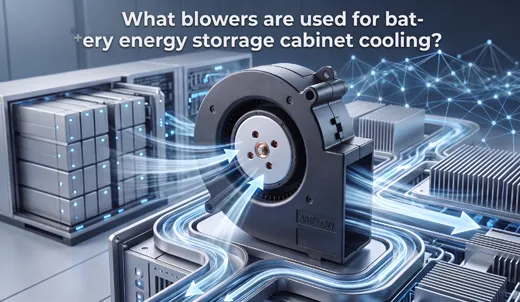
AI compute clusters, modular data centers, and high-power electrical cabinets present restricted airflow paths due to densely packed PCBs and cabling. Standard axial fans suffer from aerodynamic stall in these environments. Installing a compact, high-pressure 220V Blower provides targeted airflow through heat sinks, while PWM speed control dynamically scales fan speed to matching thermal loads.
Automated Production Line Air Knives & Drying Systems
Commercial bottling lines, PCB washing stations, and glass manufacturing processes rely on air knives to strip surface moisture rapidly. Air knives require high, pulsation-free static pressure to deliver uniform air velocity across the target area. High-RPM BLDC 220V Air Blowers maintain constant pressure output, preventing water spotting and production delays.
Commercial HVAC, Building Ventilation & Ducted Systems
Commercial kitchen exhaust, cleanroom pressurization, and multi-elbow building ventilation introduce friction losses along extended ducting runs. Integrating a heavy-duty TKFAN 220V Blower ensures consistent air exchange rates despite duct resistance.
7. Step-by-Step 220V Blower Selection Workflow for OEM Engineers
Follow this structured engineering workflow to select the optimal 220V Blower for your machine platform:
- Establish System Requirements: Document operating voltage (220V AC), target operating temperature, spatial envelope limits, and environmental exposure.
- Calculate Total System Resistance: Estimate or measure pressure losses across filters, grilles, heat exchangers, and ductwork at your target flow rate. Add a 15%–20% safety margin.
- Select Motor Architecture: Choose BLDC motor technology for continuous duty, energy savings, and smart control; select traditional AC induction only for basic, intermittent, fixed-speed retrofits.
- Plot on Manufacturer P-Q Curves: Verify that your system duty point falls within the high-efficiency operating zone of the candidate blower curve.
- Verify Mechanical & Electrical Specs: Confirm mounting dimensions, flange orientation, IP rating, wire harness length, and safety certifications (CE, RoHS).
- Prototype Testing: Request sample units from the manufacturer to validate performance, acoustic levels, and thermal rise under actual operating conditions.