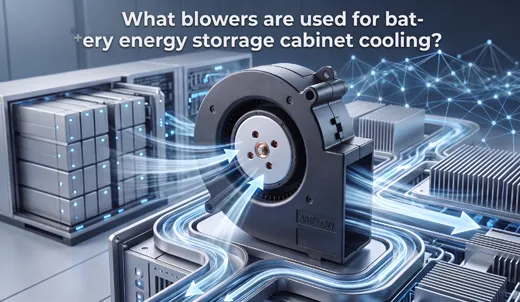


How Do DC Blowers Manage Heat Dissipation for Outdoor ESS Systems?
An expert guide on optimizing thermal management in battery energy storage systems using advanced 24V air blower and DC air blower technologies.
Introduction to Outdoor ESS Thermal Challenges
Outdoor energy storage systems (ESS), commonly referred to as battery energy storage systems (BESS), represent one of the fastest-growing segments in the global renewable energy infrastructure. Deployed across utility-scale solar farms, wind power installations, commercial rooftops, and remote industrial microgrids, these systems deliver critical grid stabilization, peak shaving, backup power, and load shifting. However, ensuring long-term operational reliability in harsh outdoor environments remains a primary engineering challenge for hardware manufacturers.
Unlike indoor electrical enclosures, outdoor energy storage units are constantly exposed to severe environmental stressors: extreme diurnal temperature swings, intense solar radiation, high humidity condensation, coastal salt spray, windblown dust, and voltage fluctuations from industrial DC buses. Lithium-ion battery modules, power conversion systems (PCS), inverters, insulated-gate bipolar transistor (IGBT) power semiconductors, and high-density printed circuit boards (PCBs) generate substantial waste heat during charge and discharge cycles. Without a precise, reliable thermal management strategy, internal hot spots develop, cell-to-cell thermal gradients widen, component derating occurs, round-trip efficiency drops, and the risk of thermal runaway increases significantly.
Passive ventilation alone can no longer satisfy the strict thermal demands of modern outdoor energy storage. Engineers increasingly rely on high-performance DC air blower units as the core active cooling components for air-cooled outdoor enclosures. Among industrial thermal components, the 24V air blower has emerged as the preferred specification for next-generation outdoor ESS designs, aligning perfectly with the standard 24V DC industrial control bus architectures used across energy storage OEMs. Premium engineering solutions like the TKFAN 24V air blower and the comprehensive TKFAN DC air blower lineup feature high static pressure output, wide-temperature brushless motor operation, customizable IP ingress protection, and PWM-FG closed-loop speed control. This article details how industrial blowers manage outdoor ESS heat dissipation, breaks down real-world site bottlenecks, compares blowers with traditional axial fans, highlights critical technical specifications, and offers actionable implementation guidelines for thermal design engineers and procurement teams.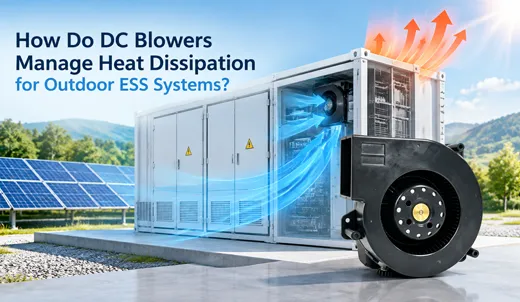
Core Heat Dissipation Bottlenecks in Outdoor Energy Storage
To understand how a DC air blower solves thermal challenges, one must first recognize the unique environmental pressures facing outdoor ESS enclosures. Many cooling system failures stem directly from deploying indoor-grade components into outdoor energy storage without adequate environmental hardening.
1. High Enclosure Airflow Resistance
Inside an ESS enclosure, cooling air must navigate dense battery racks, heavy-duty dust filters, narrow internal air ducts, heat sinks, and internal baffles. These structural obstacles generate massive static pressure resistance. Once backpressure rises, standard axial fans experience a near-total collapse in effective airflow. Even if the blades keep spinning, stagnant hot air pockets form inside the enclosure. Airflow degradation is the most common hidden root cause of premature performance deterioration in outdoor energy storage equipment.
2. Strict Cell Temperature Uniformity Requirements
Modern lithium iron phosphate (LFP) batteries utilized in energy storage require precise thermal control to maintain optimal cycle life and capacity retention. Individual cells must be maintained within a tight temperature range of 15°C to 35°C, with inter-cell temperature variances strictly controlled within ±3°C. Localized hot spots permanently accelerate battery aging. Minute thermal gradients across a battery rack gradually cause cell imbalances, leading to continuous degradation of usable system capacity over years of operation.
3. Harsh Outdoor Environmental Erosion
Alternating diurnal temperatures cause internal condensation within sealed enclosures. Dust, sand, and saline moisture continuously attack motor circuitry boards and bearings. Cooling blowers must start smoothly under sub-zero cold soaking conditions while operating at maximum load during scorching summer heatwaves. Consumer-grade fans easily succumb to circuit corrosion, bearing wear, and winding damage under these punishing conditions.
4. Parasitic Power Consumption Limits
Every watt consumed by cooling hardware directly reduces the overall round-trip efficiency of the energy storage system. Under light-load conditions with minimal heat generation, running blowers continuously at full speed wastes valuable energy. Modern efficient ESS architectures require smart speed-controllable blower solutions.
5. Long Lifespan Expectations for ESS Projects
Utility-scale and commercial outdoor ESS projects are engineered for 10 to 15-year operational lifecycles. Frequent cooling blower failures require costly on-site replacements, driving up operational expenditure (OpEx), especially in remote project locations. High Mean Time Between Failures (MTBF) is a mandatory metric for blower selection.
How DC Blowers Manage Heat Dissipation in Outdoor ESS Systems
Centrifugal DC air blower designs function fundamentally differently from standard axial cooling fans. Axial fans push air parallel to the motor shaft; centrifugal impellers draw air in axially and discharge it radially outward, converting rotational kinetic energy into powerful static pressure capable of overcoming high enclosure flow resistance. When properly selected, a 24V air blower—such as the TKFAN 24V air blower and specialized TKFAN DC air blower units—fulfills four interrelated thermal management tasks within outdoor ESS cabinets.
1. Delivering High Static Pressure to Overcome System Resistance
The primary duty of an outdoor ESS blower is to force cooling air through restrictive internal layouts. As dust accumulates on intake filters over time, system static pressure increases steadily. Premium 24V air blower models sustain effective volumetric airflow even as backpressure rises from filter clogging, preventing the thermal stagnation typical of standard axial fans.
With high-pressure variants capable of reaching significant static pressure levels, the TKFAN DC air blower series excels at pushing air through multi-stage filters, compact heat sinks, and labyrinthine ductwork inside modern outdoor storage cabinets. Stable airflow sweeps across battery module surfaces and high-heat PCS inverter components, transferring accumulated heat out of high-temperature zones. This forced convective cooling mechanism prevents dangerous localized heat accumulation.
2. Maintaining Uniform Temperature Across Battery Racks
Air naturally follows the path of least resistance. Without sufficient static pressure, cooling air bypasses densely packed battery modules and escapes through cabinet gaps, leaving the center of the battery rack trapped in hot air and creating destructive inter-cell temperature deltas. High-pressure DC air blower units pressurize internal plenums to distribute airflow evenly across every battery module. Rigorous thermal equilibrium safeguards battery pack consistency, maximizes usable capacity, and extends overall battery longevity.
In many air-cooled ESS cabinet designs, thermal engineers connect multiple 24V air blower units in parallel to guarantee balanced airflow distribution across large battery racks. TKFAN application engineers supply complete fan curve performance data, enabling clients to integrate TKFAN 24V air blower units accurately into ESS prototype CFD fluid simulations.
3. Achieving Intelligent Speed Control via PWM-FG Closed-Loop Logic
Constant-speed cooling devices waste energy during low charge-discharge loads and generate excessive pressure drops during minimal thermal loads. High-end industrial DC air blower options support 4-wire Pulse Width Modulation (PWM) speed regulation and Frequency Generator (FG) real-time tachometer feedback signals—standard features across the entire TKFAN 24V air blower portfolio.
This closed-loop control sequence operates on outdoor ESS sites as follows:
- NTC temperature sensors positioned across battery modules, PCS inverters, and internal cabinet zones transmit thermal data to the ESS Energy Management System (EMS) controller.
- The EMS calculates required cooling air volume and transmits corresponding PWM duty cycle commands to each 24V air blower.
- Blower motors dynamically adjust rotational speed: ramping up during high-current charge-discharge thermal peaks and slowing down during light nocturnal loads to minimize parasitic power draw and acoustic noise.
- The blower FG tachometer signal feeds real-time RPM data back to the EMS. The system compares target and actual speeds; if performance degrades or a blower stalls, the EMS triggers remote fault alarms early, preventing catastrophic overheating.
This smart closed-loop control represents the core advantage of professional TKFAN DC air blower solutions over ordinary consumer fans, directly boosting outdoor ESS round-trip energy efficiency.
4. Customized Ingress Protection for Harsh Outdoor Environments
Standard open-frame fans fail rapidly within the humid, condensation-prone, dusty, and salt-laden atmospheres of outdoor ESS stations. High-quality industrial DC air blower motors feature stator conformal coating and full potting treatments, achieving IP55, IP67, or even IP68 ingress protection ratings that match outdoor cabinet requirements.
The TKFAN 24V air blower series provides custom sealing protection for energy storage OEM customers. Hardened motor circuit boards resist condensation short circuits, dust abrasion, and coastal salt corrosion. Dual ball bearing designs deliver an L10 expected lifespan of 50,000 to 70,000 hours under continuous 40°C operating conditions, matching multi-year outdoor ESS project lifecycles. Standard 24V blowers support wide input voltage ranges (18V to 27.6V), easily accommodating common voltage fluctuations on storage control buses.
Why the 24V DC Architecture Dominates Outdoor ESS Blower Selection
Many design engineers wonder why the 24V air blower has become the mainstream choice for outdoor ESS cabinets over 12V blowers or AC fans. Three key engineering factors dictate industry selection preferences:
1. Native Compatibility with Global Industrial 24V DC Control Buses
Virtually all modern industrial automation hardware, including outdoor ESS EMS controllers, relays, and monitoring modules, runs on 24V DC power. Selecting a TKFAN 24V air blower eliminates the need for extra DC-DC step-down power converters. Eliminating auxiliary conversion components reduces internal electrical noise and elevates system reliability.
2. Lower Current, Reduced Line Loss, and Minimized Thermal Stress
At equivalent power outputs, a 24V air blower draws half the current of an equivalent 12V DC blower. Lower current minimizes resistive heating in wiring harnesses and connector terminals—a critical reliability boost for high-density energy storage enclosures.
3. System Fault Tolerance and Versatility
Standardized 24V components simplify material management for ESS OEM manufacturers. The versatile TKFAN DC air blower product matrix offers diverse physical dimensions, pressure-airflow specifications, and drive options (internal vs. external drivers), enabling thermal engineers to select matching 24V air blower models based on cabinet CFD simulation results across various outdoor ESS platforms.
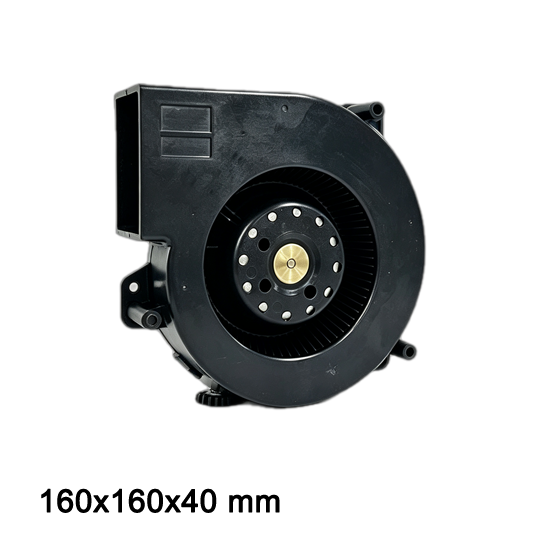
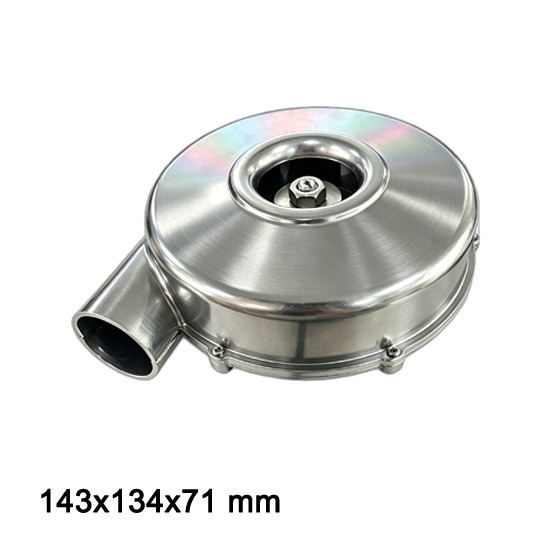
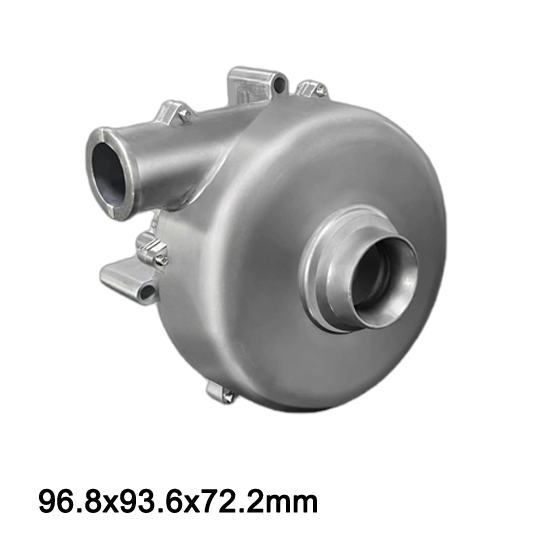
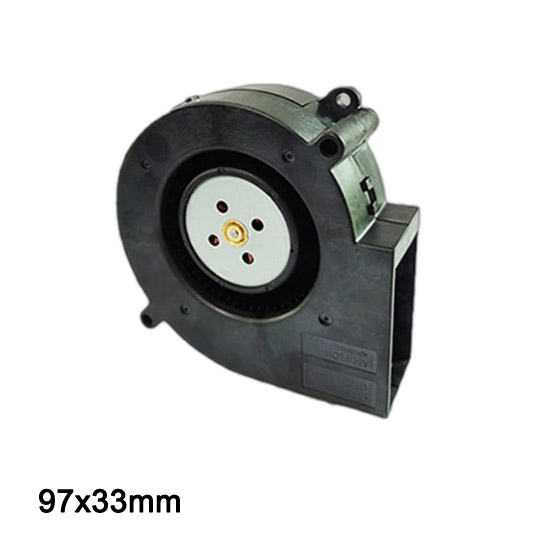
TKFAN Energy Storage Cooling Fan
Engineered for maximum reliability and structural durability, our high-performance energy storage cooling fans feature robust IP-sealed enclosures, precision ball bearings, and optimized impellers designed to withstand rigorous industrial thermal management requirements. (Click image to zoom)
Outdoor ESS Thermal Management: DC Centrifugal Blower vs. Axial Fan Comparison
Early air-cooled energy storage projects frequently relied solely on axial fans, which later revealed performance shortcomings on site. The following table outlines critical performance differences relevant to outdoor ESS thermal design:
| Performance Characteristic | DC Centrifugal Blower (TKFAN 24V Air Blower) | Standard DC Axial Fan |
|---|---|---|
| Static Pressure Capability | High; engineered to overcome filter and duct backpressure. | Low; airflow drops rapidly under moderate system resistance. |
| Airflow Maintenance with Filter Clogging | Sustains effective airflow as dust accumulates. | Airflow drops drastically once filters load up. |
| Air Delivery Method | Directional outlet; ideal for ducts and pressurized plenums. | Dispersed airflow; lacks directional output focus. |
| PWM-FG Speed Control | Fully supported as standard in industrial models. | Often unsupported or restricted in low-cost models. |
| Ingress Protection Customization | Supports IP55 to IP68 sealed customization options. | Typically weak protection on commercial axial designs. |
| Outdoor ESS Application Role | Primary forced convection cooling across filters and ducts. | Secondary internal air circulation in low-impedance zones. |
Important Note: This comparison does not dismiss axial fans from energy storage applications. Axial fans excel at internal air circulation within low-impedance cabinet spaces. However, when cooling air must force its way through filters, heat sinks, and restricted ductwork, a centrifugal DC air blower—such as the TKFAN DC air blower—is the correct choice.
Best Practices for Engineers Selecting DC Blowers for Outdoor ESS
Even with a premium 24V air blower, poor system integration will prevent optimal cooling performance. The following practical guidelines stem from years of joint fieldwork between TKFAN and energy storage OEMs:
1. Select Based on System Static Pressure, Not Just Free CFM
Free airflow CFM ratings listed on spec sheets are measured at zero backpressure—a condition that virtually never exists in real ESS cabinets. Selecting a DC air blower requires referencing operating points (CFM at target static pressure) derived from CFD simulations. Examine complete fan performance curves rather than headline metrics. The product pages on the TKFAN website provide full performance curves for every TKFAN 24V air blower to support thermal simulation work.
2. Match Ingress Protection to Site Environment
Desert projects require rigorous dust sealing; coastal installations demand salt-spray surface treatments combined with PCB conformal coating. Avoid over-specifying excessive IP ratings that drive up costs, but never deploy unprotected standard blowers in outdoor cabinets.
3. Integrate FG Speed Fault Monitoring into EMS Software Logic
Simply switching blower power on and off fails to detect gradual performance degradation caused by bearing wear or partial dust buildup. Always route FG tachometer feedback into the energy storage controller, setting alarm thresholds that compare commanded speed against actual 24V air blower speed to enable predictive maintenance for remote outdoor ESS sites.
4. Balance Thermal Uniformity Alongside Total Heat Rejection
Removing total cabinet heat alone is insufficient. Blower ducting design must ensure cooling air reaches every individual battery module, keeping cell temperature differentials within project specifications.
5. Conduct Environmental Chamber Prototype Testing
Once a TKFAN DC air blower is installed in an ESS prototype, complete thermal cycling, condensation, and dust environmental chamber testing before mass production. Laboratory testing uncovers integrated thermal design flaws prior to field shipment.
Frequently Asked Questions (FAQ)
Q1: Can a DC blower completely replace a liquid cooling system in outdoor ESS?
A: Not for all scenarios. Forced-air cooling systems powered by a DC air blower feature lower initial investment, simpler maintenance, and lower system complexity, making them ideal for medium-power outdoor ESS platforms. Ultra-high-power megawatt-scale containerized storage benefits more from liquid cooling. Many hybrid designs utilize blowers to cool liquid system heat exchangers. Thermal engineers must evaluate both approaches based on power density, budget, and site maintenance conditions.
Q2: What is the expected MTBF of an industrial 24V blower in outdoor ESS?
A: High-end industrial products like the TKFAN 24V air blower achieve an L10 lifespan of 50,000 to 70,000 hours at 40°C utilizing premium dual ball bearings. Extended high heat or heavy dust conditions will shorten actual site operational lifespans.
Q3: Is PWM speed control mandatory for outdoor ESS blowers?
A: PWM speed control is strongly recommended for modern outdoor ESS projects. Running blowers continuously at full speed increases parasitic energy consumption and acoustic noise while accelerating bearing wear during light-load operation.
Q4: Where can engineers find detailed TKFAN blower performance curves?
A: Full specifications, performance curves, and dimension drawings for the TKFAN DC air blower series are available on the dedicated product page: TKFAN 24V Air Blower Products. OEM clients can contact the TKFAN application engineering team for direct simulation technical support.
Q5: How do high static pressure blowers prevent dust accumulation on battery racks?
A: High static pressure blowers force clean filtered air through dedicated intake channels with positive pressure, preventing unfiltered ambient air and airborne dust from being drawn in through cabinet micro-gaps.
Q6: What voltage fluctuations should outdoor ESS blowers withstand?
A: Standard industrial 24V blowers typically operate reliably across an 18V to 27.6V input voltage window to handle standard DC control bus ripples and voltage dips.
Q7: Why are dual ball bearings preferred over sleeve bearings in outdoor ESS blowers?
A: Dual ball bearings offer superior resistance to high operating temperatures, mechanical vibration, and mounting orientation constraints, ensuring dependable multi-year lifespans outdoors.
Q8: How does FG tachometer feedback improve maintenance workflows?
A: FG feedback provides real-time rotational speed tracking, allowing the EMS controller to detect early signs of mechanical binding or motor fatigue before thermal shutdown occurs.
Q9: Can TKFAN customize custom mounting flanges or wire harnesses for ESS projects?
A: Yes, TKFAN provides comprehensive OEM/ODM customization services for mounting dimensions, lead wire lengths, connector types, and special IP ingress protection levels.
Q10: What IP rating is recommended for coastal marine ESS installations?
A: For coastal or offshore marine environments, IP55 or higher protection paired with specialized PCB protective coatings and salt-spray resistant hardware is recommended.
Conclusion
Outdoor energy storage systems are indispensable to the global renewable energy transition, yet reliable thermal management remains an engineering challenge during cabinet hardware design. Passive ventilation and standard axial fans struggle to overcome high system resistance, filter clogging, and severe outdoor environments.
High-performance centrifugal DC air blower technology resolves these pain points through high static pressure forced convection, PWM-FG closed-loop intelligent temperature control, customizable ingress protection, and long-life mechanical designs. Among available options, the 24V air blower has established itself as the industry-preferred component, natively compatible with global industrial 24V DC control buses. The TKFAN 24V air blower and the complete TKFAN DC air blower series deliver standardized and custom centrifugal blowers engineered specifically for outdoor ESS thermal management requirements.
Achieving stable thermal performance in outdoor ESS requires more than component selection alone; it demands thoughtful plenum layouts, sensor positioning, EMS control programming, and prototype environmental verification. When fully implemented, a blower-based cooling system protects battery consistency, boosts round-trip efficiency, extends device lifespan, and reduces thermal runaway risks for outdoor energy storage assets.