

When to Choose an IP-Rated Waterproof DC Fan: The Ultimate Guide for Harsh Environments
In modern electronics, industrial automation, outdoor renewable energy systems, and automotive engineering, thermal management directly dictates a device’s lifespan, operational stability, and safety. While standard cooling fans perform flawlessly in clean, dry indoor environments, they rapidly fail when exposed to rain, splashing water, high humidity, thick dust, or coastal salt spray. Under these harsh conditions, standard fans suffer from bearing rust, motor short circuits, coil corrosion, and blocked airflows, leading to premature system breakdown.
This is why integrating an IP-rated waterproof DC fan has shifted from being a premium optional upgrade to an absolute necessity for rugged applications. This comprehensive guide breaks down the technical meanings of IP ratings, analyzes why waterproof cooling fans are mandatory in specific industries, details precise selection criteria, and highlights the high-performance DAH8032VH12B 12V waterproof fan as an industry benchmark.
1. Understanding IP Ratings for DC Cooling Fans
The Ingress Protection (IP) rating system is an international standard defined by IEC 60529. It quantifies the sealing effectiveness of electrical enclosures against intrusion from foreign bodies (dust, dirt) and moisture (water, condensation).
An IP rating is structured as "IP" followed by two digits:
- First Digit (0–6): Indicates the level of protection against solid particles and dust ingress. (6 represents total dust-tight sealing).
- Second Digit (0–8): Indicates the level of protection against liquids and water ingress. (8 represents continuous submersion capability).
| IP Rating | Dust Protection Level | Water Protection Level | Best Application Scenarios |
|---|---|---|---|
| IP54 | Protected against limited dust | Protection from water splashes | Indoor industrial cabinets, mild environments |
| IP55 | Protected against limited dust | Resists low-pressure water jets | Outdoor telecom enclosures, heavy rain areas |
| IP65 | Total protection (Dust-tight) | Resists heavy water jets | Outdoor LED displays, EV charging piles |
| IP67 | Total protection (Dust-tight) | Withstands immersion up to 1m for 30 min | Automotive engine bays, off-road vehicles, marine gear |
| IP68 | Total protection (Dust-tight) | Continuous submersion in deep water | Submerged operations, deep-sea applications, extreme salt-spray |
2. Crucial Applications Demanding Waterproof DC Fans
A. Exposed Outdoor Infrastructure
Equipment running 24/7 outdoors faces intense climate shifts, including downpours, morning condensation, windblown sand, and scorching solar radiation. Standard fans fail instantly as rainwater breaches the motor hub, shorting out the control PCBA. Deploying an IP55 to IP67 waterproof axial fan prevents moisture ingress and ensures uncompromised airflow in 5G telecom base stations, solar PV inverters, and outdoor EV charging infrastructure.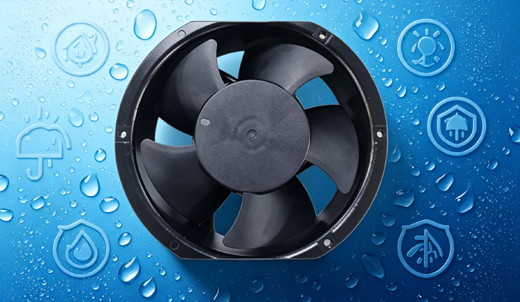
B. High-Humidity and Condensation-Prone Environments
In environments where relative humidity constantly exceeds 70%, temperature drops cause immediate internal condensation. This water buildup ruins the insulating layers of internal motor windings, causing immediate burnout. Industries such as commercial refrigeration, greenhouse climate controls, sauna equipment, and smart bathroom appliances rely heavily on fully encapsulated IP67 waterproof fans to combat moisture crystallization.
C. Washdown and Direct Liquid Spray Zones
Food and beverage processing plants, commercial kitchens, and automated car washes must be cleaned regularly using high-pressure water hoses or sanitizing agents. A standard fan cannot survive these washing cycles. Implementing an IP67 or IP68 waterproof DC fan ensures that internal components remain completely dry and functional even when blasted directly during rigorous washdown maintenance.
D. Heavy Industrial and Dust-Dense Plants
CNC machining centers, laser engraving setups, textile factories, and mining equipment generate massive quantities of airborne particulate matter, including metallic filings, wood chips, and chemical powders. When dust settles inside a fan’s bearing assembly, friction skyrockets, generating noise and locking up the impellers. A minimum of an IP54 or a fully closed IP65 dust-proof fan is critical to sustaining long-term industrial uptime.
E. Automotive, Motorcycles, and EV Thermal Management
Daily commutes subject motorcycles, E-bikes, and electric vehicles to unpredictable environments—heavy rain, muddy puddles, flying gravel, and extreme engine-bay heat. Onboard cooling fans are vital for radiator heat dissipation, lithium battery pack cooling, and ECU ventilation. For these demanding mobile applications, a heavy-duty, dual-ball bearing 12V IP67 waterproof fan like the DAH8032VH12B is highly recommended due to its exceptional shock resistance and reliable sealing.
F. Marine Electronics and Coastal Installations
Salt spray is one of the most destructive natural forces for electronics, speeding up electrochemical corrosion on metals and circuitry. Marine navigation enclosures, yacht cooling systems, and coastal security cameras require premium IP68 waterproof fans equipped with proprietary anti-salt-spray coating technologies to prevent catastrophic oxidation.
3. Technical Performance Advantages: Waterproof vs. Standard Fans
Upgrading to a verified IP-rated cooling solution delivers clear engineering and financial returns over the system's life cycle:
- Extended Lifespan (3x to 5x Longer): By utilizing eco-friendly, total vacuum-molded epoxy resin encapsulation for the PCBA and stator, the motor remains completely isolated from environmental stressors.
- Drastically Lower Maintenance Overheads: Eliminating unexpected fan failures reduces costly system downtime and avoids expensive field-service dispatchments.
- Uncompromised Operational Safety: Preventing wet short-circuits ensures zero risk of electrical leakage, safeguarding both your end users and valuable physical hardware.
4. Step-by-Step Buying Guide for Industrial Procurement
When sourcing high-volume waterproof cooling fans, engineering teams should evaluate four primary parameters:
- Match the Protection Level to the Application: Avoid paying for unnecessary protection. Use IP54/IP55 for sheltered outdoor areas, IP65/IP67 for severe outdoor environments or automotive use, and IP68 strictly for submerged or marine operations.
- Verify Electrical and Mechanical Specs: Determine the operating voltage (12V, 24V, or 48V DC) and structural dimensions (e.g., 80x80x32mm, 92x92x25mm, or 120x120x38mm). The DAH8032VH12B (80x80x32mm, 12V) is a widely adopted size for compact vehicle and charging pile retrofits.
- Prioritize Premium Component Internal Configurations: Insist on Dual Ball Bearings for extended multi-year 24/7 continuous duty cycles, integrated PWM Speed Control for smart eco-mode thermal management, and robust waterproof wire harnesses.
- Demand Certified IEC 60529 Test Reports: To combat misleadingly advertised specifications, always verify compliance certificates issued by internationally recognized laboratories, validating physical performance under intense water jet and immersion trials.
5. Technical FAQ: Waterproof DC Cooling Fans
Q1: How do manufacturers make a DC fan waterproof?
A: The most reliable method is vacuum-conformal coating or full encapsulation using specialty epoxy resins. The entire motor stator and PCBA are completely sealed inside an airtight compound block, ensuring water cannot reach the live circuitry even if the fan is fully submerged.
Q2: Can an IP67 waterproof fan run continuously underwater?
A: No, IP67 means the fan can withstand temporary immersion (up to 30 minutes at 1 meter depth). For long-term or permanent underwater operations, you must specify an IP68-rated cooling fan, which features customized high-pressure waterproofing.
Q3: Why are dual ball bearings preferred over sleeve bearings for waterproof fans?
A: Sleeve bearings rely on oil lubrication, which degrades rapidly if exposed to moisture or severe temperature swings. Dual ball bearings are structurally sealed, handle much higher temperatures, and maintain stable operation in both horizontal and vertical mounting orientations within harsh outdoor setups.
Q4: Does adding waterproofing reduce the airflow (CFM) or speed (RPM) of the fan?
A: When engineered correctly by premium manufacturers like TKFAN, the precision epoxy coating layers are incredibly thin and do not impact the aerodynamics of the impeller blades or the electrical field efficiency. Airflow and rotational velocity remain completely optimized.