

Applications of CNC Aluminum Impellers in High-Speed Blowers: Performance, Processing, and Industrial Use
In a high-speed blower assembly, the aerodynamic core component—the impeller—serves as the primary factor dictating total pneumatic performance, operational acoustics, structural integrity, and long-term operating life. As commercial sectors shift away from traditional manufacturing limits, precision 5-axis CNC aluminum impellers have emerged as the absolute gold standard for premium fluid machinery. Offering a rare combination of structural lightweight properties, micro-tier geometric tolerances, superb rotational mass distribution, and rapid thermal dissipation, precision-machined aluminum impellers outperform legacy solutions across demanding industrial and medical thermal systems.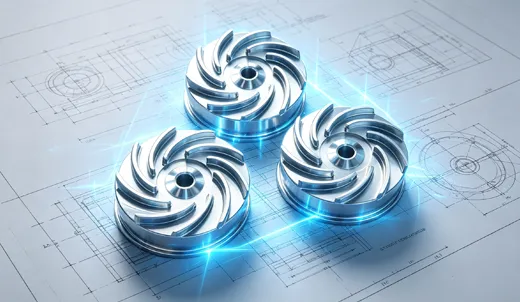
As a global pioneer in advanced fluid cooling solutions, TKFAN (under the Shenzhen Tenkai Group) continues to lead the field in high-speed, customized micro-ventilation hardware. Engineering units capable of reaching rotational velocities upwards of 200,000 RPM and generation matrices reaching up to 50kPa static pressure, TKFAN applies high-end manufacturing to solve modern aerodynamic bottlenecks. This comprehensive technical analysis explores the engineering benefits, precise manufacturing workflows, and specialized industrial sectors leveraging high-speed blower applications equipped with CNC milled aluminum impellers.
1. Technical Breakdown: Why Premium Blowers Require CNC Aluminum Impellers
Modern high-speed centrifugal fans and air compressors regularly operate within a velocity envelope of 3,000 to over 15,000 RPM. Specialized applications, like turbo-molecular devices or micro-scale ventilators, push those parameters even further. Operating at these velocities subjects the component to extreme centrifugal stress, requiring an impeller with ultra-high mechanical stability, pristine blade geometry, and flawless rotational balance. When evaluated against classic polymers, die-cast components, or fabricated steel variants, a solid-milled high-speed centrifugal blower wheel delivers unmatched mechanical advantages:
1.1 High Strength-to-Weight Optimization
Utilizing high-tensile aerospace-grade alloys such as 6061-T6 and 7075-T6 aluminum, these components feature an exceptionally low density profile (roughly 2.7g/cm³)—nearly one-third the mass of stainless steel—while maintaining ultimate tensile strengths between 310 and 400 MPa. This yields two major operational advantages:
- Reduced Rotational Inertia: Minimizing the mass moment of inertia relieves electric motor drive strain by 20% to 30%. This enables lightning-fast spin-up/spin-down response times and significantly reduces active energy consumption.
- Structural Failure Prevention: Unlike cast aluminum parts, solid-milled components are completely free of subsurface porosity, gas pockets, and structural micro-voids. This continuous grain structure improves fatigue resistance by 25% to 40%, preventing blade elongation or catastrophic deformation under high centrifugal forces.
1.2 Micro-Tier Geometric Tolerances and Aerodynamic Yield
By leveraging 5-axis CNC machining centers, specialized blade profiles (including backward-curved, radial-tipped, or complex 3D inducer configurations) can be cut with extreme precision. Machining tolerances are tightly maintained within a range of ±0.01mm to ±0.02mm.
This structural accuracy minimizes aerodynamic boundary-layer separation and boundary turbulence. Consequently, overall air-moving fluid efficiency sees a direct increase of 15% to 25% compared to molded variations. Furthermore, this automated process ensures uniform blade-to-blade consistency across massive manufacturing batches, which is vital for standardized industrial deployment.
1.3 Elite Dynamic Balance for Low Vibration and Acoustic Suppression
Excessive structural vibration is the primary cause of premature bearing wear and catastrophic motor drive failures in high-speed applications. Because of their uniform density and precise geometric symmetry, CNC machined aluminum wheels naturally excel in dynamic stability. Balanced to stringent ISO 1940 standards (achieving G2.5 down to G1.0 balancing grades), these components maintain operational vibration amplitudes below 0.1mm. This drops noise emissions to a quiet 45–55 dB range, making them perfect for medical facilities and premium laboratory equipment.
1.4 Rapid Thermal Dissipation and Corrosive Endurance
With a thermal conductivity rating between 160 and 200 W/(m·K), aluminum alloy acts as an efficient integrated heat sink, transferring heat five times faster than carbon steel. This helps rapidly dissipate thermal energy away from the central motor shaft and internal bearings. When paired with surface modification treatments such as type-III hard-anodization, these impellers achieve a service life exceeding 40,000 operational hours, even in damp, abrasive, or dust-heavy industrial environments.
2. Advanced Comprehensive Manufacturing Workflow of a CNC Aluminum Impeller
Producing a high-spec air-moving component requires strict, standardized engineering workflows. TKFAN follows a rigorous five-stage production cycle to ensure flawless performance:
2.1 Metallurgical Selection & Verification
Production begins with strict material sourcing. For standard sub-8,000 RPM setups, 6061-T6 aluminum alloy is preferred due to its balanced machinability and reliable structural integrity. For ultra-high velocity applications exceeding 10,000 RPM (such as magnetic levitation blowers), 7075-T6 aluminum alloy is specified for its exceptional tensile strength and superior fatigue life.
2.2 Multi-Axis Synchronous CNC Machining
Solid cylindrical bar stocks are sliced into raw puck blanks before entering 5-axis CNC machining complexes. The multi-axis tool path generates the hub and complex 3D aerodynamic blade curves simultaneously from a single block. This single-setup approach eliminates concentricity alignment errors and keeps dimensional variances well within the ±0.02mm limit.
2.3 Post-Milling Refinement & Deburring
Following machining, the impeller undergoes mechanical and chemical deburring processes. Micro-polishing removes tool marks and smooths surface imperfections, minimizing skin-friction aerodynamic drag during high-speed rotation.
2.4 Advanced Surface Coatings
To prepare the components for challenging operating environments, they receive specialized surface treatments. Hard-anodization creates a durable 15–25 micron protective oxide layer that resists wear and corrosion. For custom applications, electrostatic powder coatings or specialized electromagnetic shielding (EMI) layers can be applied.
2.5 Multi-Point Metrology and Validation
Before leaving the factory, every impeller must pass thorough quality inspections. This includes coordinate measuring machine (CMM) dimensional checks, dynamic balance verification on specialized balancing rigs, and live aerodynamic testing to verify volumetric flow rate, static pressure output, and acoustic levels.
3. Comprehensive Comparison Matrix: Impeller Material and Processing Types
To help engineers choose the ideal air-moving component, the table below compares standard impeller designs across key performance indicators:
| Performance Metric | TKFAN Precision CNC Aluminum | Die-Cast Aluminum Wheels | Injection-Molded Plastic | Welded Structural Steel |
|---|---|---|---|---|
| Dimensional Accuracy | ±0.01 mm – ±0.02 mm | ±0.10 mm – ±0.50 mm | ±0.20 mm – ±1.00 mm | ±0.10 mm – ±0.30 mm |
| ISO 1940 Balance Grade | G2.5 to G1.0 (Elite) | G6.3 | G16 | G6.3 |
| Component Mass Profile | Optimized / Lightweight | Medium | Ultra-lightweight | Heavily Overweight |
| Subsurface Porosity Risks | 0% (Solid Forged Bar Stock) | High (Gas pocket risks) | None (Molding stresses) | None (Weld defect risks) |
| Thermal Dissipation Rate | Excellent (160-200 W/m·K) | Good | Extremely Insulating | Poor (Approx. 45 W/m·K) |
| Acoustic Footprint (Noise) | 45 – 55 dB (Ultra-quiet) | 55 – 65 dB | 60 – 70 dB | 55 – 65 dB |
| Mean Service Lifespan | > 40,000 Hours | ~15,000 Hours | < 5,000 Hours | ~20,000 Hours |
4. Primary Use Cases Across Core Industrial Sectors
Thanks to their high precision, reliable balance, and long-term durability, CNC machined aluminum impellers are widely used across high-performance industrial sectors:
4.1 High-Speed CNC Machining Center Spindles
Modern machine-tool spindles operate at speeds between 10,000 and 30,000 RPM, generating significant thermal energy that must be quickly managed. High-speed blowers equipped with CNC machined aluminum wheels provide the steady, high-volume airflow needed to stabilize spindle temperatures and protect machining accuracy.
4.2 Wastewater Aeration & Maglev Turbo Compressors
Industrial water treatment and bulk chemical processing rely on high-capacity magnetic levitation blowers operating at speeds up to 50,000 RPM. Frictionless maglev systems require highly balanced components, making 7075-T6 aluminum impellers the standard choice to prevent system vibration and maintain continuous airflow.
4.3 Specialized Medical Systems & Ventilation Tech
Critical care medical ventilators, clinical centrifuges, and diagnostic instruments demand reliable, quiet, and non-toxic operation. CNC aluminum wheels provide smooth, pulse-free airflow with minimal noise, meeting strict clinical standards for safety and reliability.
4.4 Compact Consumer and Wearable Devices
Compact consumer electronics, like AR/VR smart glasses and portable therapy devices, use micro-fans (such as the DA1804L33X and DA1804L05X series) for active cooling. These specialized micro-blowers feature miniature CNC aluminum wheels that fit perfectly within tightly packed device layouts without adding unnecessary weight.
4.5 Automotive Fuel Cells and Aerospace Systems
In hydrogen fuel cell vehicles and aerospace climate-control systems, minimizing weight while ensuring reliability is paramount. Lightweight, high-strength aluminum impellers deliver efficient air and gas management under high pressures, helping improve vehicle range and system efficiency.
Technical FAQ: CNC Impeller Engineering
Q1: Why is an ISO 1940 G1.0 or G2.5 balancing grade essential for high-speed blower applications?
As an impeller's rotational speed increases, any residual imbalance creates centrifugal forces that scale exponentially with the square of the RPM. An impeller balanced to a precise G1.0 or G2.5 grade minimizes these micro-vibrations. This reduces mechanical fatigue on the motor bearings, cuts acoustic noise, prevents shaft deflection, and helps extend the system's operational lifespan beyond 40,000 hours.
Q2: When should an engineer choose 7075-T6 aluminum over 6061-T6 for an impeller design?
The choice depends primarily on the operational stresses caused by high speeds. While 6061-T6 aluminum offers excellent structural performance and corrosion resistance for standard speeds up to 8,000 RPM, ultra-high-speed applications exceeding 10,000 RPM require 7075-T6. Its significantly higher yield strength (up to 500 MPa) allows the impeller blades to withstand extreme centrifugal forces without structural deformation.
Q3: How do CNC machined impellers improve energy efficiency compared to standard molded variants?
CNC machined impellers are cut with tight tolerances down to ±0.01mm, allowing for optimal aerodynamic blade shapes that reduce internal air turbulence. Additionally, the lightweight properties of aerospace-grade aluminum alloys lower the overall rotational inertia by 20% to 30%. This reduces the power required to start and run the motor, leading to lower energy consumption and faster response times.
Q4: What surface treatments are recommended for impellers operating in harsh or corrosive environments?
For demanding operating conditions involving moisture, dust, or chemical exposure, Type III hard-anodization is recommended. This process creates a durable 15–25 micron aluminum oxide layer that increases surface hardness and provides excellent corrosion resistance. For added protection, specialized anti-friction or chemical-resistant topcoats can also be applied.
GET A QUOTE