

How to Select the Ideal Waterproof Cooling Fan for Rugged Industrial Equipment
An in-depth, engineer-focused guide to navigating IP55 vs. IP68 protection, vacuum encapsulation technologies, and thermodynamic selection criteria for harsh industrial environments.
1. Introduction: Why Standard Fans Fail in Harsh Industrial Environments
Industrial equipment deployed in outdoor environments, coastal facilities, marine operations, and high-humidity production halls faces constant exposure to splashing water, torrential rains, salt spray, heavy oil mist, and abrasive industrial dust. Standard non-waterproof DC cooling fans are not designed to withstand these hostile conditions. In standard fans, crucial components—such as the printed circuit board (PCB), motor stator windings, and electrical lead terminals—lack protective barriers against environmental elements, leaving them highly vulnerable to premature failure.
When moisture or corrosive vapor penetrates a standard cooling fan, it triggers two fatal failure mechanisms:
- Electrical Short Circuits: Liquid ingress causes short circuits across PCB traces, burning out sensitive power semiconductor devices and motor driver ICs.
- Bearing Corrosion and Seizure: Water dilutes essential internal bearing lubricants, leading to rust, rapid mechanical wear, increased friction, and eventual complete rotational lockup.
The Real Cost of Failure: For modern enterprises, cooling fan failures translate directly to unscheduled manufacturing line downtime, astronomical on-site maintenance costs, damage to expensive primary hardware (like IGBTs, processors, or power modules), and dangerous electrical leakage hazards.
Therefore, integrating a high-durability, industrial waterproof cooling fan is essential for robust thermal management. A correctly selected waterproof DC fan ensures continuous heat dissipation while completely isolating vulnerable electronic elements from water, saline mist, and fine dust. However, procurement specialists and project engineers often fall into selection traps: over-specifying expensive IP68 solutions for low-risk, sheltered environments, or under-specifying IP55 fans in heavy marine environments, leading to wasted budget or catastrophic equipment failure.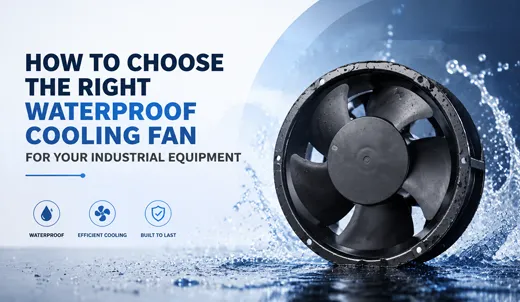
2. Understanding Waterproof Cooling Fans: Core Technology & Industry Value
A waterproof cooling fan (also referred to as a waterproof DC fan or heavy-duty brushless fan) is an axial-flow cooling device engineered with specialized sealing and protective technologies. It complies rigorously with the international IEC 60529 standard for Ingress Protection (IP). These fans are built to isolate the internal electrical motor and control circuitry from liquid, moisture, and fine-particulate contamination. At TKFAN, every waterproof fan undergoes meticulous spray, water-immersion, and salt-fog testing prior to shipment to ensure reliable performance under extreme conditions.
Three Critical Advantages of Integrating Premium Waterproof Fans
2.1 Multi-Fold Extension of Equipment Lifespan
Under humid, non-sheltered conditions, standard cooling fans generally fail within 6 to 12 months. In contrast, heavy-duty waterproof fans—especially those featuring vacuum epoxy encapsulation—can increase operational life by 3 to 5 times. This longevity significantly reduces maintenance intervals and replacement cycles in critical infrastructures, such as outdoor telecom cabinets, utility-scale energy storage systems (BESS), and railway signaling enclosures.
2.2 Minimizing Costly Downtime and Failures
In industries like solar power generation, EV charging infrastructure, and automated chemical processing, a system shutdown due to thermal overload can cost thousands of dollars per hour in lost revenue and service penalties. Utilizing a fan with an appropriate ingress protection rating completely eliminates thermal-induced shutdowns, assuring reliable, 24/7 operation.
2.3 Seamless Integration Across Diverse Voltage Systems
To accommodate varied industrial architectures, industrial waterproof fans are designed in multiple voltage configurations—including 12V DC, 24V DC, 48V DC, and 220V AC/EC. This ensures full compatibility with small surveillance nodes, mid-size off-grid controllers, and high-voltage photovoltaic inverters.
3. IEC 60529 Ingress Protection Decoded: IP55 vs. IP68 Cooling Fans
Selecting the correct waterproof fan hinges on matching the fan’s Ingress Protection (IP) rating with the equipment's real-world operational environment. Industrial waterproof fans primarily fall into two categories: IP55 rating (economic moisture/dust protection) and IP68 rating (complete immersion protection). Their materials, manufacturing processes, and target applications differ significantly.
3.1 IEC 60529 Liquid & Dust Protection Reference Table
| IP Rating | Ingress Protection Capabilities | Standard Testing Criteria | Ideal Industrial Applications |
|---|---|---|---|
| IPX4 | Protection against splashing water from any direction. | Water sprayed from any angle for 10 minutes. | Indoor humid production lines, basic industrial hoods. |
| IPX5 | Protection against low-pressure water jets. | Water projected by a 6.3mm nozzle at 12.5 L/min for 3 minutes. | Sheltered outdoor cabinets, light agricultural machinery. |
| IPX6 | Protection against high-pressure, powerful water jets. | Water projected by a 12.5mm nozzle at 100 L/min for 3 minutes. | Heavy marine deck gear, commercial car wash bays. |
| IPX7 | Protection against temporary water immersion. | Immersion in water up to 1 meter depth for 30 minutes. | Portable outdoor measurement gear, rugged field power packs. |
| IPX8 | Continuous immersion protection under specified conditions. | Deep water immersion; TKFAN IP68 models support 3m depth under live power for 72 hours. | Subsea sensors, naval systems, offshore wind turbines. |
| IPX9K | Protection against high-pressure, high-temperature steam jets. | 80–100 bar water pressure at 80°C from close range. | Food processing sanitation, heavy-duty mining machinery. |
3.2 IP55 Waterproof Fans: Parylene Nano-Coating Technology
IP55-rated waterproof fans utilize advanced chemical vapor deposition (CVD) to apply an ultra-thin, pinhole-free Parylene coating directly onto the fully assembled PCB and motor assembly. This high-performance polymer layer conforms perfectly to intricate electronic components without altering the fan’s original envelope dimensions, rotor balance, or aerodynamic performance.
- Key Benefits: Highly cost-effective; excellent defense against splashing water, ambient humidity, and dust; adds zero physical weight, maintaining maximum rotational speeds and airflow.
- Limitations: Not suitable for submersion. Continual direct exposure to pressurized water jets or heavy rainwater over time can wear down the micro-thin polymer coating.
3.3 IP68 Waterproof Fans: Vacuum Epoxy Resin Encapsulation
For systems operating under continuous exposure to liquids or highly corrosive chemicals, TKFAN's flagship IP68 waterproof fans utilize a specialized vacuum potting process. The entire motor stator, drive PCB, and winding assembly are placed in a vacuum chamber, where a high-density, thermally conductive liquid epoxy resin is injected. This vacuum process eliminates micro-bubbles, completely sealing all electrical parts in a solid, impenetrable block.
- Key Benefits: Rated for continuous live operation under up to 3 meters of water; superior resistance to high-salinity marine environments; excellent dampening against mechanical vibration; immune to fine industrial oil mists and heavy dust.
Limitations: Moderately higher initial unit cost due to advanced raw materials and specialized manufacturing steps.
4. Comparison: IP55 vs. IP68 Fan Specifications
| Technical Parameter | IP55 Waterproof Fan | IP68 Waterproof Fan |
|---|---|---|
| Primary Sealing Method | Parylene Conformal Coating | Vacuum Epoxy Potting & Encapsulation |
| Liquid Resistance | Resists splashing water, mist, and light rain | Resists heavy jets, wave wash, and deep immersion |
| Dust Protection | Prevents harmful internal dust build-up | Hermetically sealed (100% dust-tight) |
| Saline / Marine Resistance | Moderate (1–2 years service life in coastal areas) | Excellent (5+ years continuous operation in marine air) |
| Relative Unit Cost | Economic / Mid-range | Premium Industrial / Heavy-Duty |
| Benchmark Model (Example) | DDW9225HH12B (92×92×25mm 12V) | DA17251HV48X (172×150×51mm 48V) |
5. A Step-by-Step Selection Guide for Engineering Teams
Following this structured, 7-step engineering selection process prevents field failures and helps keep procurement costs aligned with real-world requirements.
Step 1: Evaluate the Operating Environment
Analyze the physical location of your equipment. For sheltered, canopy-covered, or indoor high-humidity installations, an IP55 waterproof fan offers ample protection. For outdoor equipment exposed to weather, coastal salt spray, marine washdowns, or direct water immersion, select an IP68 waterproof fan.
Step 2: Calculate Required Airflow (CFM) & Static Pressure
A fan's maximum rated airflow applies only to open, unobstructed air paths. Real-world enclosures feature filters, grilles, and dense internal electronics that restrict airflow and generate static pressure. You must consult the fan's PQ (Pressure-Volume) curve to verify that the fan can deliver the necessary volumetric flow rate under your system's estimated pressure drop.
Step 3: Specify the Physical Fan Dimensions
Match your mechanical layout with industry-standard sizes or customize as needed:
- Compact Units (e.g., 60×60×25mm): Best for outdoor cameras, sensor housings, and compact control nodes.
- Standard Units (e.g., 92×92×25mm): Ideal for public EV charging piles, small solar inverters, and outdoor telecom nodes.
- High-Capacity Units (e.g., 172×150×51mm): Built for utility-scale battery storage containers, heavy marine electronics, and large power conversion blocks.
Step 4: Select the Input Voltage
Match the fan to your system’s power bus. Industrial electronics typically utilize 12V or 24V DC. Large-scale infrastructure and industrial automation platforms often standardise on 48V DC buses to reduce distribution currents and cabling weight.
Step 5: Choose Frame and Impeller Materials
- Aluminum Alloy Frames: Offer exceptional physical strength, high thermal dissipation through the frame, and long-term resistance to intense UV radiation in hot outdoor climates.
- PBT Plastic (UL 94V-0 Rated): High-grade thermoplastic impellers are lightweight, highly resistant to chemical corrosion, and represent the ideal standard for acidic or alkaline environments.
Step 6: Integrate Control and Monitoring Features
Modern industrial controllers often require smart features for efficient system integration. TKFAN supports customized options including:
- PWM (Pulse Width Modulation): Allows real-time fan speed adjustments based on thermal sensors to minimize energy use and wear.
- Tachometer (FG) Output: Provides a frequency signal to monitor fan rotational speed and detect blockages instantly.
- Locked Rotor Alarm (RD): Sends a digital signal to the host system if the impeller stops spinning, preventing thermal runaways.
Step 7: Confirm Custom Lead-Times & Regulatory Compliance
Ensure your selected fan carries international certifications such as CE, RoHS, and UL. For specialized systems, verify that your manufacturer can deliver custom prototypes promptly (TKFAN provides tailored engineering samples within 48 hours).
6. Key Technical Parameters to Verify Before Purchasing
6.1 Rotational Speed (RPM) vs. Noise Levels
Higher impeller speeds yield greater volumetric airflow and static pressure, but increase acoustic noise. For industrial applications with human operators nearby, seek a balanced design (typically 3,000 to 5,500 RPM) to keep noise manageable while ensuring optimal thermal exchange.
6.2 Bearing Systems: Sleeve vs. Dual Ball Bearings
- Sleeve Bearings: A lower-cost option suited for intermittent duty and lighter environments, but prone to rapid wear at high temperatures.
- Precision Dual Ball Bearings: The industry standard for heavy-duty waterproof fans. They support continuous 24/7 operation for over 50,000 hours, operate reliably across a wide temperature range, and run smoothly in any physical housing orientation.
6.3 Temperature Range Limits
High-reliability industrial fans must operate flawlessly under severe temperature extremes. Premium waterproof fans are rated for operation between -20°C and +70°C, ensuring stable performance from freezing winter conditions to the intense heat of desert-based solar arrays.
7. Industry Applications: Selecting the Right Fan for Your Sector
7.1 Renewable Energy & Grid Storage
Outdoor EV charging kiosks require durable 92mm IP55 or IP68 fans to handle rain and dust. Central solar inverters and battery energy storage systems (BESS) depend on high-volume 172mm 48V IP68 fans to cool high-power electronics and protect against ambient humidity and condensation.
7.2 Marine and Offshore Engineering
Shipboard control panels, harbor automation systems, and offshore wind turbines require the highest level of protection. Only IP68 vacuum-potted fans can withstand the corrosive combination of salt air, coastal fog, and crashing waves.
7.3 Smart City Infrastructure
Outdoor 5G microcells, public LED displays, and smart street lighting rely on compact, integrated waterproof fans to maintain safe operating temperatures in year-round outdoor conditions without service interruptions.
7.4 Agriculture & Process Environments
Greenhouse ventilation, automated livestock feeding controls, and food processing lines are routinely exposed to water, fertilizers, washdowns, and sanitizing chemicals. Heavy-duty waterproof fans ensure long-term reliability in these high-humidity, washdown-heavy environments.
8. Five Common Procurement Mistakes and How to Avoid Them
- Using IP55 Fans in Marine Environments: Attempting to cut initial costs by installing IP55 fans on marine decks or coastal installations often leads to salt-spray corrosion and fan failure within 12 months. Specify IP68 vacuum-potted models for long-term marine reliability.
- Relying Solely on "Open-Air" Airflow Ratings: Designing thermal systems based only on free-air CFM values without considering internal static pressure often results in insufficient cooling. Always evaluate the fan’s performance against your system's PQ curve.
- Forcing Standard Fan Sizes into Custom Enclosures: Forcing a standard fan into an unsuitable custom enclosure can restrict air paths. Work with a manufacturer that offers rapid custom prototyping to match your specific layout.
- Choosing Sleeve Bearings for Continuous Duty: Utilizing lower-cost sleeve bearing fans for continuous, 24/7 operations often leads to premature bearing failure. For critical systems, always specify dual ball bearing assemblies.
- Over-Specifying IP68 for Protected Indoor Areas: Installing premium IP68 vacuum-potted fans in sheltered, indoor, high-humidity rooms where an IP55 Parylene-coated fan would perform perfectly increases project costs unnecessarily. Match the protection rating to the actual exposure.
9. Technical Q&A / Frequently Asked Questions
Q1: What is the main manufacturing difference between IP55 and IP68 cooling fans?
A1: IP55 fans use a chemical vapor deposition process to apply a micro-thin, conformal Parylene nano-coating onto the electronics, making them highly resistant to splashing water and dust. IP68 fans undergo complete vacuum-pressure impregnation (VPI) with a liquid epoxy resin, forming a solid, bubble-free protective block around the motor stator and PCB to allow continuous underwater operation.
Q2: Can TKFAN waterproof cooling fans be used in high-salinity coastal environments?
A2: Yes. Our IP68 vacuum-potted cooling fans are specifically engineered for marine applications. The dense epoxy potting completely encapsulates all electrical components, preventing corrosive salt ions from contacting the metal stator windings or copper PCB traces, delivering a reliable service life of over 5 years in coastal areas.
Q3: Does the vacuum encapsulation process reduce the fan's cooling performance or air volume?
A3: No. TKFAN's precision vacuum encapsulation is designed to fill only the internal motor housing cavity and stator windings. It does not alter the external dimensions of the blades or frame, nor does it impact the motor's aerodynamic design, ensuring the fan's airflow, speed, and static pressure remain fully optimized.
Q4: How do I choose between an aluminum frame and a plastic frame for a waterproof fan?
A4: Aluminum frames provide exceptional structural rigidity, resist mechanical shocks, help dissipate heat, and do not degrade under intense UV exposure, making them ideal for heavy industrial and outdoor equipment. Plastic frames (typically PBT) are lighter, highly resistant to chemical corrosion, and are cost-effective for indoor high-humidity or chemical-handling installations.
Q5: What customized options are available for industrial integrations?
A5: We provide comprehensive OEM/ODM customization services. This includes custom input voltages (such as 24V or 48V DC, or 220V AC/EC), custom lead wire lengths and connector terminals, and advanced control features such as PWM speed control, FG speed feedback, or RD rotor-lock alarms.
Q6: Are your waterproof cooling fans compliant with international environmental and safety standards?
A6: Yes, all TKFAN industrial cooling products are fully compliant with CE, RoHS, and REACH requirements. We can provide official third-party laboratory test reports for salt-spray resistance and IP68 ingress protection upon request.
Q7: What is the typical service life of an IP68-rated dual ball bearing fan?
A7: Under continuous 24/7 operating conditions at standard temperatures, our dual ball bearing IP68 fans deliver a design life (L10) of over 50,000 hours, translating to more than 5.7 years of maintenance-free operation.
Q8: Why is dual ball bearing technology preferred over sleeve bearings for waterproof industrial fans?
A8: Dual ball bearings can withstand higher operational temperatures, handle both radial and axial thrust loads, and can be mounted in any orientation without affecting lubricant distribution. Sleeve bearings rely on oil-retaining sleeves that can degrade quickly when subjected to temperature extremes or vibration.
Q9: Can IP55 fans withstand pressurized water spray or direct rainfall?
A9: IP55 fans are designed to resist low-pressure water splashes and light rain, making them ideal for sheltered outdoor enclosures. They should not, however, be exposed to high-pressure washdowns or direct, heavy torrential rain without a protective canopy. For these harsh conditions, an IP68-rated fan is required.
Q10: What is the typical turnaround time for custom prototype samples?
A10: For non-standard configurations, such as custom wiring, connectors, or specific performance modifications, TKFAN can complete and dispatch custom engineering samples within 48 hours to help keep your product development on track.