

What Is a Waterproof Cooling Fan? IP Rating, Uses & Buying Guide
Discover how waterproof cooling fans shield critical hardware from moisture, dust, and salt spray. This definitive guide breaks down IP55 vs IP68 ratings, cutting-edge manufacturing processes, key industrial applications, and engineering selection parameters.
1. Introduction: What Is a Waterproof Cooling Fan?
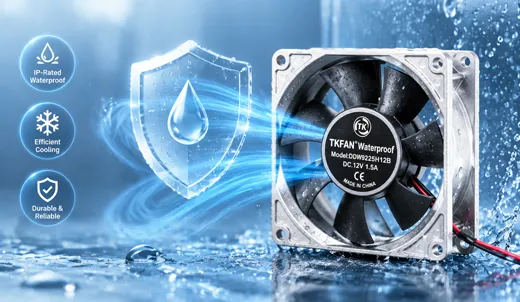
A waterproof cooling fan is a highly engineered brushless DC (BLDC) or AC axial fan equipped with specialized environmental sealing technologies. Unlike standard cooling fans, whose sensitive drive circuitry and copper motor windings are directly exposed to the ambient atmosphere, waterproof fans are purpose-built to operate reliably in highly corrosive, humid, and dirty environments. These fans resist water ingress, dust penetration, salt spray, oil mist, and condensation.
By utilizing advanced sealing methods, such as parylene conformal coatings or total vacuum-chamber epoxy encapsulation, waterproof fans physically isolate their delicate electrical components from environmental hazards. These cooling units are typically available in common system voltages—including 12V DC, 24V DC, 48V DC, and 220V AC/EC—and conform strictly to international ingress protection standards like IP55 and IP68.
For engineering projects where equipment downtime is unacceptable, deploying a high-quality waterproof cooling fan is the ultimate defense against short circuits, bearing corrosion, winding burnouts, and thermal runaway. Professional-grade thermal solutions, such as TKFAN Waterproof DC Fans, offer diverse frame sizes ranging from 60mm up to 172mm, providing robust heat dissipation for demanding outdoor and maritime infrastructure.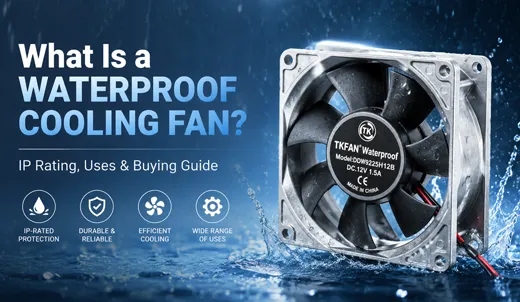
2. Why Do Standard Cooling Fans Fail in Harsh Environments?
To appreciate the engineering breakthroughs of a waterproof cooling fan, it is essential to understand why standard fans fail prematurely when exposed to moisture, airborne particulate matter, and chemical pollutants:
- Moisture-Induced Electrical Short Circuits: Rainwater, environmental humidity, and localized condensation quickly bridge the conductive traces on an unsealed printed circuit board (PCB). This leads to leakage currents, short circuits, and instantaneous driver IC failures.
- Salt Spray and Atmospheric Corrosion: In coastal, marine, or highly humid agricultural zones, air containing salt or chemicals acts as an aggressive electrolyte. It quickly corrodes exposed copper windings, metal stator laminations, and internal ball bearings, seizing the motor within weeks.
- Particulate Matter and Dust Infiltration: Fine sand, dust, pollen, and fibers bypass non-rated enclosures and enter the motor hub. They build up in the narrow gap between the rotor and stator, generating massive friction, rising operating temperatures, and eventual physical seizure.
- Oil and Chemical Mist Attack: In CNC machine shops, commercial kitchens, or chemical processing plants, vaporized hydrocarbons and cleaning agents degrade the standard wire insulation, dissolving traditional varnish and prompting winding-to-winding failures.
3. Understanding IP Ratings (IEC 60529 Standard)
Every waterproof cooling fan has its protective capability verified through the global standard IEC 60529, which defines Ingress Protection (IP) ratings. This two-digit code rates how effectively an electrical enclosure blocks solids (first digit, scale of 0–6) and liquids (second digit, scale of 0–9K).
3.1 IP55 vs. IP68: What is the Difference?
For commercial and industrial thermal design, two key levels are predominantly used:
- IP55 (Dust-Protected & Water-Jet Resistant): The first "5" indicates that dust ingress is not entirely prevented, but does not enter in quantities sufficient to interfere with safe operation. The second "5" means the fan can withstand water projected by a nozzle (6.3mm) from any direction.
IP68 (Dust-Tight & Hermetically Sealed): The first "6" guarantees complete protection against dust ingress (dust-tight). The second "8" means the device can withstand continuous immersion in water under specified conditions. For example, TKFAN IP68 cooling fans are rated to run continuously underwater at depths of up to 3 meters for 72+ hours.
3.2 Detailed Comparison: IP55 vs. IP68 Waterproof Fans
| Parameters | IP55 Waterproof Fan | IP68 Waterproof Fan |
|---|---|---|
| Sealing Method | Parylene / Conformal Nanocoating | Vacuum Epoxy Encapsulation (Solid Cast) |
| Water Protection | Resists splashes, rain, low-pressure jets | Continuous submersion, high-pressure washing |
| Primary Applications | Semi-outdoor cabinets, indoor high-humidity | Marine gear, coastal 5G stations, subsea sensors |
| Cost Metric | Highly cost-effective | Premium, heavy-duty investment |
| Performance Loss | 0% (Thin film maintains balance) | 0% (Optimized vacuum cast maintains flow) |
4. State-of-the-Art Manufacturing Processes
Industrial-grade waterproof cooling fans do not rely on simple rubber gaskets. They are built utilizing two primary advanced manufacturing technologies:
4.1 Parylene Nanocoating (Ideal for IP55 Fans)
Parylene is an aerospace-grade material applied via chemical vapor deposition (CVD) in a vacuum chamber. Polymer gas molecules polymerize directly on all surfaces, creating a pinhole-free, completely uniform nanocoating over the PCB and motor parts.
- True 360-Degree Coverage: Penetrates the tightest gaps under surface-mount components.
- Ultra-Lightweight Profile: Unlike thick silicone gels, parylene adds virtually zero mass, preserving the blade's precise dynamic balance and rotational efficiency.
4.2 Vacuum Epoxy Encapsulation (Ideal for IP68 Fans)
For deep water submersion or extreme chemical exposure, the entire motor, stator windings, and PCB are positioned inside a vacuum chamber and fully cast in liquid epoxy resin.
- Bubble-Free Isolation: The vacuum process extracts all microscopic air pockets, ensuring no pathways exist for moisture or salt vapor to seep in.
- Extreme Durability: The cured epoxy becomes a rugged, solid protective shield that reinforces the structural integrity of the fan under severe physical shock.
5. Key Engineering Selection Parameters
When selecting a waterproof fan for your next thermal management design, evaluate the following physical and electrical properties:
5.1 Size and Frame Materials
Frame dimensions typically range from compact 60mm options to heavy-duty 172mm units. Materials must be chosen based on environmental exposure:
- Aluminum Alloy Frames: Offer exceptional mechanical strength and heat dissipation. Ideal for harsh, highly corrosive coastal and marine environments when combined with anti-corrosive surface treatments.
- PBT Plastic (UL 94V-0 Rated): Highly resistant to chemical agents and lightweight. Perfect for agricultural controls and indoor humid appliances.
5.2 Electrical Voltage Configuration
Ensure your system power architecture natively supports the selected fan model:
- 12V DC: Standard for IoT sensors, compact cameras, and battery-powered field gear.
- 24V DC: Common in agricultural automation, solar inverters, and industrial control cabinets.
- 48V DC: The industry standard for telecom infrastructure (5G) and utility-scale energy storage systems (ESS).
- 220V AC/EC: Essential for heavy industrial machinery and commercial refrigeration systems.
5.3 Airflow (CFM) & Static Pressure
Airflow (measured in Cubic Feet per Minute, or CFM) determines the volume of air moved, while static pressure defines the fan’s ability to push air through dense enclosures, filters, or heat sinks. For example, high-performance models like the TKFAN DA17251HV48X deliver up to 362 CFM, overcoming heavy static pressure in tightly packed outdoor battery cabinets.
6. Global Industrial Applications
Waterproof cooling fans are essential components across a wide array of modern industries:
- Renewable Energy & ESS: Solar inverters and outdoor battery storage container modules generate high heat. They rely on high-pressure IP68 fans to prevent thermal runaway while resisting rain, wind-blown dust, and morning dew.
- Marine & Coastal Infrastructure: Offshore wind systems, shipboard navigation consoles, and coastal 5G base stations deploy specialized marine-grade fans to withstand persistent salt spray and high humidity.
- Smart Agriculture & Greenhouses: Automated watering systems and livestock ventilation controllers create wet, high-ammonia environments. Waterproof fans prevent dust buildup and chemical corrosion.
- EV Charging Stations: High-power public charging piles generate significant thermal energy. IP65 or IP68 fans maintain airflow through the charging modules in heavy rain, snow, and extreme weather.
- Food & Beverage Processing: Food production lines must undergo frequent high-pressure washdowns with hot water and chemical sanitizers. Waterproof fans rated at IP68 or IPX9K survive these sanitization cycles.
7. Technical FAQ: Expert Q&A on Waterproof Cooling Fans
Q1: What is the main structural difference between an IP55 and an IP68 fan?
An IP55 fan typically uses a thin parylene conformal coating to protect the circuitry from airborne moisture and light splashes. An IP68 fan uses a complete, vacuum-poured epoxy encapsulation process, casting all electronic elements into a solid, impenetrable resin block that permits continuous underwater operation.
Q2: Can vacuum epoxy encapsulation degrade the fan’s airflow or thermal dissipation?
No. Advanced manufacturing techniques ensure that the epoxy is poured with high-precision balance, filling empty cavities without modifying the blade profile or stator diameter. The airflow performance remains identical to non-waterproof equivalents.
Q3: How do waterproof fans resist severe coastal salt spray corrosion?
They achieve this through dual-layer protection. First, the internal windings are encapsulated in chemically inert epoxy. Second, the external metal frames (such as aluminum alloy units) are treated with specialized anti-salt-spray coatings to prevent galvanic oxidation.
Q4: Are EC (Electronically Commutated) fans available in waterproof options?
Yes, EC fans can be fully waterproofed using the same vacuum-molding procedures, combining high energy efficiency with maximum ingress protection for HVAC and industrial refrigeration.
Q5: Can I run an IP55-rated fan completely submerged underwater?
Absolutely not. IP55 is designed for water jets and rain. Submerging an IP55 fan will cause water to bypass the seal over time, resulting in immediate electrical failure. Submergible projects require an IP68-rated model.
Q6: Does a waterproof fan require special maintenance?
Because the electronics are hermetically sealed, the motor requires no internal maintenance. However, in high-dust agricultural or industrial plants, we recommend periodically rinsing the fan blades with clean water to prevent imbalance from accumulated dirt.
Q7: What type of bearing is best suited for waterproof cooling fans?
Dual ball bearings are the industry gold standard. When coupled with high-temperature, water-resistant synthetic lubricants, they withstand wide operating ranges (-40°C to +85°C) and maintain a long operating life (up to 70,000 hours).
Q8: Can waterproof fans be controlled via PWM (Pulse Width Modulation)?
Yes. Modern waterproof fans support integrated PWM speed control, tachometer frequency output (FG), and rotation detection signals (RD), all routed through heavy-duty waterproof wire harnesses.
Q9: Are custom sizes and connector pinouts available for OEM projects?
Yes. Customization is standard for commercial integrations. Manufacturers can customize lead wire lengths, harness terminals, and voltage tolerances to match your specialized hardware interface.
Q10: How do I verify if a fan's IP rating is genuine?
Always request an official, third-party test report verifying compliance with the IEC 60529 standard from an accredited laboratory (such as TUV, SGS, or UL).