

Top 5 Benefits of Using Waterproof Cooling Fans in Humid Industrial Environments
Humidity is one of the most pervasive, subtle, yet destructive threats facing modern industrial electronics, automated machinery, and thermal management systems. In environments such as processing plants, coastal manufacturing facilities, commercial agricultural operations, marine equipment bays, outdoor telecom enclosures, and EV charging stations, relative humidity (RH) frequently exceeds 80%. Under these aggressive working conditions, standard open-frame cooling fans rapidly fail. Moisture, condensation, water splashing, oil mist, and airborne salt ions penetrate unprotected axial fan housings, directly attacking exposed motor stators and printed circuit boards (PCBs).
This exposure results in catastrophic electrical short circuits, bearing corrosion, motor lockups, and unpredicted operational downtime. For plant managers, thermal design engineers, and systems integrators seeking unyielding operational continuity, waterproof DC cooling fans represent the ultimate engineering solution. TKFAN IP55 and IP68 waterproof fans utilize advanced dual-sealing technologies—including Parylene conformal vacuum coating for IP55 splash resistance and full vacuum epoxy resin potting for IP68 total submersion protection. This article offers an in-depth technical analysis of the top 5 operational benefits realized by integrating industrial-grade waterproof cooling fans into humid industrial systems, backed by empirical testing metrics, lifecycle cost evaluations, and multi-industry application data.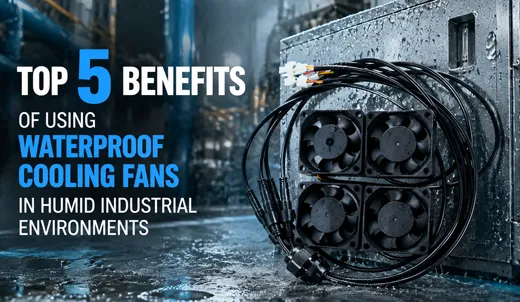
How Unprotected Standard Fans Fail in High-Humidity Industrial Zones
Before examining the direct benefits of IP-rated thermal components, it is essential to analyze the failure mechanisms of standard axial fans operating in humid environments. Standard cooling fans feature open motor cavities, unsealed PCB assemblies, minimal rubber sealing, and exposed wire entry points. When exposed to high relative humidity or ambient temperature swings, water vapor condenses inside the motor housing, causing three main mechanical and electrical failures:
- Electrical Short Circuits and Ground Faults: Moisture bridges solder pads, component leads, and copper windings on the drive board. This triggers immediate short circuits that destroy the fan's drive IC, trips system breakers, and can cause catastrophic failure in downstream controllers, power supplies, or inverter modules.
- Electrochemical Corrosion and Bearing Seizure: High humidity combined with ambient pollutants (such as airborne salt in coastal areas or sulfur in agricultural facilities) accelerates oxidation on steel shafts, ball bearings, and copper traces. Corrosion degrades grease lubrication, resulting in bearing friction, severe acoustic noise, motor lockup, and complete airflow loss within 4 to 8 weeks of continuous exposure.
- Thermal Degradation and System Overheating: As corrosion degrades motor efficiency and blade aerodynamics, total volumetric airflow drops by 40% to 70%. Power electronics, variable frequency drives (VFDs), lithium battery banks, and programmable logic controllers (PLCs) experience severe thermal throttling, accelerated component aging, and premature failure.
Field Maintenance Data: Field maintenance logs from coastal manufacturing plants reveal that standard non-waterproof fans operating in 85%+ RH environments have an average mean time between failures (MTBF) of just 3 to 6 months. Conversely, TKFAN IP68 vacuum-potted waterproof cooling fans demonstrate continuous maintenance-free operation for 3 to 5 years under identical conditions.
Benefit 1: Complete Moisture and Corrosion Protection (Extending Service Life by 300%–500%)
The primary advantage of deploying specialized industrial waterproof fans is the absolute physical isolation of sensitive electronic components from ambient water, dust, salt spray, and corrosive mists. TKFAN manufactures two primary sealing architectures to suit specific environmental severity levels:
1. IP55 Waterproof Fans: Parylene Vacuum Coating for Moderate Moisture
Designed for industrial plants requiring periodic washdowns, facilities prone to internal dew condensation, or agricultural systems exposed to light water mist. TKFAN IP55 fans utilize a vacuum-deposited Parylene vapor coating. This micron-thin, pinhole-free polymer coating uniformly covers the driver PCB, surface-mount components, and copper stator windings. Unlike traditional thick conformal spray coatings that alter blade balance or trap internal heat, Parylene adds negligible mass, preserves fan dynamic balance, and maintains maximum thermal dissipation efficiency.
2. IP68 Waterproof Fans: Vacuum Epoxy Resin Potting for Extreme Submersion
For saturated humidity environments—such as marine vessel machinery bays, submerged sensing units, outdoor EV fast chargers exposed to heavy rain, and refrigeration equipment operating above 95% RH—TKFAN IP68 waterproof DC fans employ a total vacuum encapsulation process. The motor stator, PCB assembly, and wire terminations are placed inside a vacuum chamber and fully potted with a high-density thermal conductive epoxy resin. This completely eliminates internal air pockets where condensation could form, creating a solid-state barrier. TKFAN IP68 fans pass rigorous third-party testing, achieving continuous, operational submersion at a depth of 3 meters for over 72 hours without ingress or performance drop.
| Fan Architecture Type | Average Lifespan (RH > 85%) | Corrosion Resistance Level | Primary Ingress Protection Mechanism |
|---|---|---|---|
| Standard Non-Waterproof Fan | 3 to 6 Months | Poor (Rapid Rust & Short Circuits) | None (Open Frame Structure) |
| TKFAN IP55 Waterproof Fan | 2 to 3 Years | Good (Resists Spray & Condensation) | Parylene Vapor Deposition Coating |
| TKFAN IP68 Waterproof Fan | 4 to 5+ Years | Excellent (Resists Salt Spray & Submersion) | Full Vacuum Thermal Epoxy Potting |
Benefit 2: Significant TCO Reduction and Prevention of Unplanned Downtime
While the initial purchase cost of an IP68 potted waterproof cooling fan is higher than an unprotected commodity fan, its total cost of ownership (TCO) is dramatically lower. Industrial financial analysis shows three direct cost savings:
1. Reduced Replacement Hardware Expenditures
In high-humidity facilities, replacing standard fans every 3 months results in significant recurring hardware expenses. Over a 3-year operating cycle, a system requiring 12 cooling fans may consume up to 144 standard fans due to repeated corrosion failures. Upgrading to TKFAN IP68 fans reduces that requirement to just 12 units for the entire multi-year lifecycle, saving thousands of dollars in component procurement.
2. Minimization of On-Site Emergency Service Calls
Field repair logistics for remote or critical infrastructure—such as 5G telecom towers, solar farms, or offshore wind turbines—are exceptionally expensive. Emergency dispatch labor rates range from $75 to $150 per hour, excluding travel and overtime. Replacing an failed $15 fan can easily incur a total field dispatch cost of $300 to $600. Deploying reliable IP68 sealed fans eliminates moisture-induced motor burnouts, reducing thermal-related maintenance dispatches by up to 90%.
3. Elimination of Catastrophic Production Stoppages
Fan failure leads directly to system overheating, triggering automatic thermal shutdowns or component burnout. In automated food processing facilities, chemical plants, or battery energy storage systems (BESS), an hour of unplanned downtime can result in tens of thousands of dollars in lost productivity and spoiled materials. A 2025 case study at a coastal solar inverter manufacturing site showed that switching to TKFAN IP68 fans prevented an estimated $140,000 in annual downtime losses caused by moisture-related fan trips.
Benefit 3: Uncompromised Aerodynamic Efficiency and Thermal Stability
A common misconception among systems design engineers is that adding internal waterproof sealants or heavy potting compromises fan blade clearance, reduces volumetric airflow (CFM), or increases power consumption. TKFAN’s precision engineering completely refutes this assumption:
1. Retained Aerodynamic Profile and Airflow Volume
In TKFAN IP55 models, Parylene coating thickness is measured in microns, adding virtually zero weight to rotating assemblies and maintaining original blade dynamics. For IP68 models, thermal conductive epoxy potting is strictly contained within the internal motor stator housing. The airflow channel between the impellers and outer frame remains completely unobstructed. For example, the TKFAN DDW9225HH12B (92×92×25mm IP55 12V fan) delivers 106.7 CFM at 5,500 RPM—identical to its non-waterproof counterpart. Similarly, the high-performance DA17251HV48X (172×150×51mm IP68 48V fan) outputs up to 362 CFM, supplying heavy-duty air volume for massive power storage units operating under direct moisture conditions.
2. Elimination of Thermal Spikes via Consistent RPM Output
In high-humidity environments, ambient moisture entering standard motors causes fluctuating electrical resistance, leading to erratic fan speeds and unpredictable temperature spikes within cabinet enclosures. Waterproof brushless DC motors feature electronically commutated circuits that maintain consistent, targeted RPM regardless of external humidity spikes or water exposure. Optional Pulse Width Modulation (PWM) speed control and tachometer signal output allow system controllers to precisely regulate thermal conditions, extending the operational life of sensitive IGBTs, transformers, and microprocessors.
Benefit 4: Full Compliance with International Electrical Safety Standards
Operating high-voltage or high-current equipment in humid or wet conditions poses severe electrical hazard risks. Standard fans affected by condensation can suffer tracking arc faults or current leakage, energizing conductive metal enclosures and posing lethal shock hazards to operating personnel.
- Dielectric Isolation and Leakage Prevention: TKFAN IP68 potted fans undergo rigorous dielectric withstand (Hi-Pot) testing, demonstrating zero current leakage from live motor leads to frame mounts even when operating fully submerged in conductive salt water solutions.
- Fire Hazard Mitigation: Short circuits caused by condensation on low-grade fan PCBs are a known trigger for industrial enclosure fires. Epoxy potting completely deprives electrical arcs of oxygen and combustible gas pathways, effectively eliminating fan-induced fire risks.
- Regulatory Acceptance for OEM Exports: Global industrial systems must comply with stringent international standards including IEC 60529, CE, RoHS, and OSHA workplace directives. Integrating third-party certified IP55/IP68 thermal components ensures seamless regulatory approvals and speeds up time-to-market for equipment manufacturers exporting to Europe and North America.
Benefit 5: Full OEM/ODM Customization for Multi-Industry Applications
Industrial thermal management is rarely a one-size-fits-all discipline. Humidity manifests differently across various operational sectors—ranging from fine airborne spray in agricultural greenhouses to high-pressure washdowns in meat processing plants. TKFAN provides extensive OEM/ODM customization capabilities across its entire waterproof product line:
- Custom Voltage Configurations: Available in 12V, 24V, 48V DC, and standard 110V/220V AC input configurations to integrate directly into solar arrays, battery racks, or grid power systems.
- Mechanical and Frame Adaptation: Custom lead wire lengths, specialized waterproof connectors (e.g., Amphenol, Molex, IP67 aviation plugs), customized mounting flanges, and choice of PBT plastic or die-cast aluminum frames for extreme mechanical impact resistance.
- Smart Thermal Control Integration: Built-in PWM speed control, FG tachometer speed signals, RD alarm signals, and ambient temperature sensors integrated directly into the waterproof potted assembly.
Explore the full range of customizable dimensions (from 40×40mm up to 250×250mm) on our official product catalog: TKFAN Waterproof DC Fan Series.
IP55 vs. IP68 Waterproof Fans: Technical Selection Guide
Selecting the correct ingress protection level ensures optimal cost efficiency without under- or over-specifying thermal components. The comparative matrix below provides clear engineering guidelines:
| Specification / Feature | IP55 Waterproof Fan | IP68 Waterproof Fan |
|---|---|---|
| Sealing Process | Parylene Vacuum Conformal Coating | Vacuum Thermal Epoxy Potting |
| Water Protection Level | High-pressure water jets, splashing, fine condensation | Continuous full submersion (>3m depth for 72+ hrs) |
| Dust / Solid Ingress | Dust-protected (limited ingress allowed) | Dust-tight (absolute full sealing) |
| Target Applications | Indoor humid plants, greenhouse systems, washdown zones | Marine electronics, outdoor BESS, EV chargers, coastal plants |
| Relative Cost Index | Economical / Moderate Upgrade | Premium Heavy-Duty Protection |
Top 10 Technical Q&As About Waterproof Cooling Fans
Q1: Does full epoxy resin potting in IP68 fans cause motor overheating?
No. TKFAN uses specialized thermally conductive epoxy resin for potting. Instead of trapping heat, the compound transfers heat away from the copper windings directly to the outer motor casing and airstream, maintaining low operating temperatures.
Q2: What is the main structural difference between IP55 and IP68 cooling fans?
IP55 fans use a thin micron-level Parylene conformal coating over the PCB and stator to repel moisture droplets and splash water. IP68 fans completely encapsulate the motor cavity, drive electronics, and lead solder joints in solid, void-free thermal epoxy resin.
Q3: How do TKFAN waterproof fans perform in salt spray marine environments?
TKFAN IP68 potted fans undergo rigorous ASTM B117 salt spray testing. The total encapsulation prevents salt ions from contacting copper traces, motor bearings, and drive ICs, preventing galvanic corrosion.
Q4: Can waterproof DC cooling fans support PWM intelligent speed control?
Yes. TKFAN integrates 4-wire control options (VCC, GND, Tachometer FG, PWM control) directly into both IP55 coated and IP68 potted fan assemblies without compromising sealing integrity.
Q5: What standard frame sizes are available for industrial waterproof fans?
Standard sizes include 40x40mm, 60x60mm, 80x80mm, 92x92mm, 120x120mm, 172x150mm, and up to 250mm diameter axial fans, available in 12V, 24V, and 48V DC options.
Q6: Are TKFAN IP68 fans resistant to chemical vapors or cleaning agents?
Yes. The epoxy potting compound and high-grade PBT frame material exhibit strong chemical resistance to mild acids, alkalis, industrial degreasers, and typical washdown sanitizers used in food processing.
Q7: How does high humidity affect bearing life, and how do waterproof fans solve this?
Humidity contaminates bearing lubricant, leading to friction, noise, and lockup. TKFAN waterproof fans utilize precision dual ball bearings equipped with moisture-resistant synthetic grease and double-lip rubber seals.
Q8: What is the lead time for custom OEM waterproof cooling fan samples?
TKFAN offers rapid engineering turnarounds, capable of delivering custom voltage, wire harness, and IP-rated prototype samples within 48 to 72 hours for qualification testing.
Q9: Do waterproof cooling fans carry international safety and ingress certifications?
Yes. All TKFAN waterproof series strictly comply with IEC 60529 IP55/IP68 testing standards and hold full CE, UL, RoHS, and REACH certifications for global market entry.
Q10: What is the expected payback period when replacing standard fans with IP68 fans?
In typical 85%+ RH industrial facilities, savings achieved through reduced maintenance dispatches, avoided downtime, and hardware longevity yield a complete return on investment (ROI) within 12 to 18 months.
Conclusion: Securing Industrial Thermal Performance in Humid Operations
High relative humidity and liquid exposure remain constant threats in industrial operations, but equipment degradation, frequent maintenance, and unplanned production stops are entirely preventable. Investing in engineered waterproof cooling fans secures critical thermal performance, protects capital equipment, minimizes total operating costs, and delivers dependable 24/7/365 operational safety. Whether your application requires cost-effective IP55 fans for indoor washdown zones or rugged IP68 potted fans for marine and outdoor energy systems, TKFAN delivers industry-leading waterproof thermal management solutions tailored to your technical requirements.
GET A QUOTE