

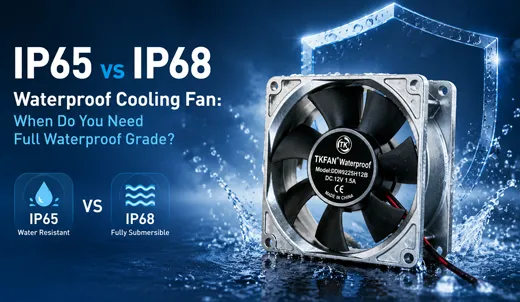
IP65 vs IP68 Waterproof Cooling Fan: When Do You Need Full Waterproof Grade?
1. Introduction: The Critical Role of IP Ratings in Thermal Management
In modern industrial thermal management, cooling fan failure is rarely caused by mechanical wear or pure over-temperature conditions alone. Instead, environmental ingress—specifically moisture, salt spray, high humidity, conductive dust, and liquid intrusion—is the leading cause of premature equipment breakdown. Standard open-frame DC cooling fans exposed to outdoor rain, heavy condensation, coastal sea air, or industrial washdowns frequently suffer from electrical short circuits, stator winding corrosion, and bearing lockups within weeks of deployment.
Selecting the correct ingress protection (IP) rating for cooling fans deployed in energy storage systems (ESS), outdoor EV charging stations, marine navigation hardware, telecom base stations, and industrial automation is crucial. Among the available protection levels, IP65 and IP68 represent the two most widely specified industrial standards. However, design engineers and procurement teams often struggle with key trade-offs: misinterpreting IP65 as water-submersible, or over-specifying IP68 for mild splash environments, which unnecessarily inflates bill-of-materials (BOM) costs.
This technical guide provides a deep-dive comparison based on the IEC 60529 international standard, dissecting testing protocols, manufacturing processes, application boundaries, and cost-to-performance metrics. All product specifications and engineering benchmarks reference TKFAN Waterproof DC Fan Engineering Catalog, encompassing 12V, 24V, 48V, and 220V axial and centrifugal fan models with full OEM/ODM customization options.
2. Deciphering IEC 60529: Solid vs. Liquid Ingress Protection Standards
To accurately evaluate an IP65 vs IP68 waterproof cooling fan, engineers must reference the IEC 60529 ingress protection framework. The "IP" code consists of two characteristic numerals that define the precise boundaries of mechanical and environmental isolation:
- First Numeral (0–6): Solid particle protection level (6 indicates complete dust-tight performance).
Second Numeral (0–9K): Liquid ingress protection level (higher numbers indicate resistance to increasing water volume, pressures, or immersion depths).
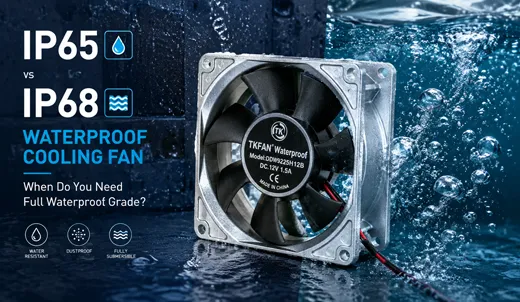
The Shared Advantage: Dust-Tight IP6X Rating
Both IP65 and IP68 cooling fans share the highest solid ingress rating: IP6X. This certifies that after an intensive 8-hour circulating talcum dust chamber test under negative pressure, zero dust particles can penetrate the motor, PCB, or bearing housing. Solid particle accumulation is the second most common cause of fan failure; IP6X eliminates particle-induced bearing abrasion and short circuits caused by conductive dust bridges.
The Crucial Separation: IPX5 (Water Jets) vs. IPX8 (Submersion)
The primary differentiation lies in the second digit—defining liquid protection:
- IPX5 (Water Jets): Protects against low-pressure water jets projected by a standard nozzle (6.3 mm) from any angle. It is rated strictly for spray, splashing, and heavy precipitation. It cannot withstand standing water or immersion.
- IPX8 (Continuous Immersion): Engineered for continuous underwater operation under specified pressures and deep water conditions. While standard IPX7 requires survival at 1-meter depth for only 30 minutes, TKFAN IP68 waterproof fans pass rigorous testing under 3 meters of static water depth for 72 continuous energized hours.
3. IP65 Waterproof Cooling Fans: Technical Specifications & Parylene Coating
An IP65-rated cooling fan offers robust protection against rain, heavy condensation, industrial washdowns, and direct splashing. It is engineered as a cost-effective, high-efficiency solution for non-submerged environments.
IP65 Compliance Testing Protocols (IEC 60529 Clause 14.2.5)
To attain genuine IP65 certification, a cooling fan must pass two mandatory testing procedures:
- Dust Chamber Test: 8 hours in a sealed, negative-pressure dust chamber with circulating fine powder.
Low-Pressure Jet Test: A 6.3 mm diameter nozzle delivers water at a rate of 12.5 liters per minute at a pressure of 30 kPa, positioned 2.5 to 3.0 meters away from the fan. Water is sprayed from all possible directions for at least 3 minutes. Post-test insulation resistance must remain intact, with no internal water buildup disrupting electrical circuits.
Core Manufacturing Technology: Advanced Parylene Vapor Deposition
TKFAN IP65 cooling fans utilize aerospace-grade Parylene (Poly-para-xylylene) chemical vapor deposition (CVD) technology. Parylene forms a pinhole-free, uniform polymer film over the entire circuit board, stator, copper windings, and electronic components.
- Zero Thermal Penalty: The coating is ultra-thin (micrometer scale), adding virtually zero mass and retaining perfect aerodynamic dynamic balance with no airflow loss.
- Chemical & Corrosion Defense: Offers superior protection against mild atmospheric salt spray, industrial humidity, airborne sulfur, and equipment condensation.
- Process Limitation: Because the coating is micro-thin, prolonged underwater hydrostatic pressure or aggressive high-pressure washdowns can breach the barrier, leading to liquid ingress over time.
4. IP68 Waterproof Cooling Fans: Vacuum Epoxy Potting Technology
For applications where cooling fans are exposed to standing water, submersion risks, high-pressure hose-downs, or extreme corrosive chemicals, upgrading to an IP68 waterproof cooling fan is mandatory.
TKFAN Extreme IP68 Testing Methodology
While basic commercial IP68 ratings are often self-certified at 1 meter for 24 hours while powered off, TKFAN subjects its full IP68 product line to a far more demanding protocol: 3 meters of static water immersion for 72 continuous hours under live electrical power. Following immersion, insulation resistance, air volume, RPM, and motor efficiency are fully audited to ensure zero degradation.
Core Manufacturing Technology: Full Vacuum Epoxy Resin Potting
The manufacturing threshold for true IP68 compliance relies on Full Vacuum Epoxy Encapsulation (Potting):
- Void-Free Encapsulation: The motor stator, copper windings, and control PCB assembly are placed inside a specialized vacuum chamber. High-density, thermally conductive epoxy resin is injected, completely purging air pockets and micro-voids.
- Complete Hermetic Isolation: Solidification turns the motor cavity into a solid, solid-state block. All live conductive parts are entirely isolated from fluids, salt ions, corrosive vapors, and fine sand.
- Enhanced Shock & Vibration Resistance: The cured epoxy resin firmly anchors internal components, significantly boosting shock resistance—an essential feature for marine propulsion and mobile off-road machinery.
5. Direct Technical Comparison: IP65 vs. IP68 Waterproof Fans
The following engineering matrix details the operational, technical, and structural differences between IP65 and IP68 cooling fans:
| Specification / Metric | IP65 Waterproof Fan | IP68 Waterproof Fan |
|---|---|---|
| Solid Dust Protection | IP6X (Complete Dust-Tight) | IP6X (Complete Dust-Tight) |
| Liquid Testing Standard | IPX5: 12.5 L/min low-pressure spray (3 mins) | IPX8: 3m deep water, 72h live power immersion |
| Primary Sealing Method | Parylene Vapor Deposition Coating | Full Vacuum Epoxy Resin Potting |
| Submersion Capability | NO (Strictly forbidden) | YES (Continuous live underwater operation) |
| High-Pressure Washdown Resistance | Moderate (Low-pressure water jets only) | Excellent (Resists high-pressure water stream) |
| Coastal Marine Lifespan | 3 to 5 years (Coating degrades over time) | 10+ years (Hermetically sealed block) |
| Manufacturing Cost Multiplier | Standard / Cost-Effective Baseline | 3x to 4x (Due to resin, vacuum cycles & testing) |
| Impact on Airflow / RPM | 0% loss (Micro-thin layer) | 0% loss (Post-potting dynamic re-balancing) |
| Primary Target Applications | Outdoor cabinets, PV inverters, LED screens | Marine systems, flooded ESS, pumps, washdowns |
6. When Is an IP65 Waterproof Fan the Optimal Choice?
Selecting an IP65 fan is the ideal engineering decision when equipment is exposed to outdoor environmental moisture, rainfall, or condensation, but has zero risk of water accumulation or immersion. It provides robust protection while maintaining lower BOM costs.
1. Renewable Energy Infrastructure (Non-Flooded Zones)
Rooftop solar photovoltaic (PV) inverters, elevated battery energy storage cabinets, and sheltered EV charging kiosks face driving rain and dew condensation. Because water drains freely from these enclosures, IP65 fans deliver perfect reliability without the cost markup of full potting.
2. Smart City & Outdoor Telecom Networks
Pole-mounted 5G telecom base stations, outdoor security camera housing, and weather-shielded LED digital billboards require dust-tight operation and resistance to heavy rain showers. IP65 fans safeguard internal electronics seamlessly.
3. Commercial & Light Industrial Systems
Indoor industrial automation panels, greenhouse climate control units, and commercial refrigeration condensers operate in high-humidity or dusty environments where occasional spray occurs, making IP65 the most economical specification.
Explore full IP65 specifications and dimension offerings (60mm to 120mm) on the TKFAN IP65 Product Selection Portal.
7. When Must You Upgrade to an IP68 Waterproof Fan?
When operational failure leads to catastrophic downtime or safety risks, and liquid accumulation or chemical washdown is present, upgrading to a full IP68 potted cooling fan is mandatory.
1. Marine, Offshore, and Naval Electronics
Shipborne radar units, oceanographic sensor payloads, offshore wind turbine control systems, and commercial aquaculture hardware operate in harsh marine environments. The continuous presence of conductive sea salt spray and saltwater spray rapidly degrades IP65 coatings within 24–36 months. Vacuum epoxy-potted IP68 fans deliver a 10+ year maintenance-free lifecycle.
2. Flood-Prone Energy Storage and Ground-Level Chargers
Ground-mounted EV superchargers, subterranean utility vaults, and outdoor containerized ESS installations deployed in low-lying urban areas face severe flash-flooding hazards. When floodwaters submerge the cabinet base, IP68 fans continue operating underwater, protecting critical thermal paths.
3. Food Processing & Agricultural Washdown Equipment
Food processing lines, meat packaging facilities, and dairy processing units undergo daily sanitation using high-pressure hot water jets mixed with harsh alkaline or acid chemical detergents. IP65 fans fail under these conditions; IP68 potted fans completely prevent liquid infiltration.
4. Underwater Machinery & Submerged Sensors
Water quality monitoring stations, underwater circulation pumps, and aquatic lighting rigs require continuous thermal dissipation while permanently submerged. IP68 fans are the only viable thermal solution.
8. Cost, Lifespan, and Thermal Performance Trade-Off Analysis
Initial BOM Cost vs. Total Cost of Ownership (TCO)
A standard IP68 potted cooling fan typically costs 3 to 4 times more than a comparable IP65 Parylene-coated fan. This price differential stems from specialized high-density epoxy resin materials, multi-stage vacuum chamber degassing cycles, extended curing times, and 100% individual hydrostatic pressure testing. However, in aggressive environments, using an IP65 fan leads to frequent component replacements, field technician calls, and costly warranty claims—making IP68 far more economical over the product lifecycle.
Aerodynamic and Thermal Efficiency
A common engineering misconception is that potting a fan's motor reduces air volume, reduces RPM, or increases acoustic noise. In reality, TKFAN Thermal Solutions performs high-precision computerized dynamic balance calibration after potting. As a result, an IP68 potted fan matches the exact CFM, static pressure, and RPM performance of an IP65 or standard IP20 model, while the solid resin matrix slightly dampens motor vibration noise.
9. Four Common Engineering Pitfalls in Waterproof Fan Selection
- Assuming IP65 Supports Temporary Submersion: IPX5 only protects against directional water sprays. Standing water creates hydrostatic pressure that forces liquid past micro-gaps, leading to motor burnout.
- Over-Specifying IP68 for Dry Enclosures: Specifying IP68 fans for indoor or elevated, sheltered cabinets needlessly inflates manufacturing costs without adding tangible operational benefits.
- Ignoring Vendor Test Discrepancies: Not all IP68 ratings are equal. Always verify whether a manufacturer tested their fan while powered off at 1 meter for 30 minutes, or continuously energized under deep water (e.g., TKFAN's 3-meter / 72-hour energized test standard).
- Confusing IP55 with IP65: IP55 allows limited dust ingress (not fully dust-tight). In heavily polluted or dusty industrial environments, IP55 fans accumulate dust internally, leading to bearing failure. Always mandate IP65 for full IP6X dust-tight compliance.
10. Technical Frequently Asked Questions (FAQ)
11. Conclusion: Selecting the Ideal Waterproof Cooling Fan
Choosing between an IP65 vs IP68 waterproof cooling fan boils down to evaluating your physical deployment environment:
- Select IP65 if your equipment experiences rain, high humidity, or light spraying, but water drains freely without pooling or submersion risk. This provides ideal protection at an optimized cost.
- Mandate IP68 if your equipment faces standing water, flood risk, continuous salt spray, high-pressure chemical washdowns, or submerged operation. The complete vacuum epoxy encapsulation guarantees maximum reliability and long-term TCO savings.
To view complete technical datasheets, download test reports, or consult with thermal application engineers, visit the TKFAN Waterproof Cooling Fan Product Center.