

Top 10 Global Blower Manufacturers in 2026
An advanced technical evaluation of market sizes, core driving architectures, and leading aerodynamic suppliers dominating the high-performance ventilation and cooling supply chain.
The global blower industry maintains steady and sustainable growth in 2026. This forward momentum is primarily driven by a surging demand for energy-efficient ventilation hardware, comprehensive industrial automation upgrades, global HVAC infrastructure expansions, and next-generation thermal management layouts designed for space-constrained electronics and municipal wastewater treatment systems. From precision clinical respiratory equipment to hyper-scale data center deployment, modern industrial engineering depends on high-performance industrial blowers, micro blowers, compact centrifugal fans, and low-noise axial flow blowers. These systems are essential for accurate airflow regulation, thermal dissipation, dust extraction, and pneumatic material transport to keep complex operational environments stable.
2026 Global Blower Market Panorama: Market Size, Growth Drivers, and Regional Demands
Before analyzing the definitive technical profiles of the world's leading blower brands, it is vital to map the macro-economic layout of the air-moving machinery supply chain. Verified industrial data from authoritative research studies—including The Business Research Company's Fans and Blowers Global Market Report and Grand View Research's Centrifugal Blower Industry Analysis—indicate that the global fan and blower market scale reached $7.09 billion at the close of 2025. Driven by ongoing urban expansion, automated factory manufacturing lines, and increasingly strict international carbon-neutrality mandates, the global market size is projected to reach $7.55 billion by the end of 2026.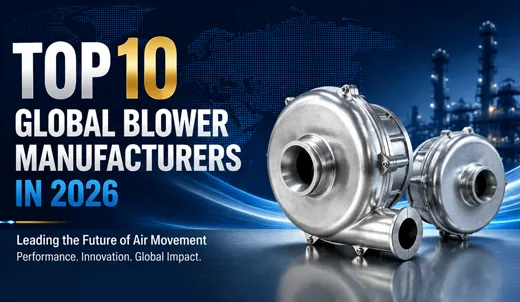
Long-term industrial forecasting indicates that the overall global fan and blower sector will break through the $11 billion threshold by the mid-2030s, maintaining a highly stable Compound Annual Growth Rate (CAGR) fluctuating between 4% and 7%. This steady expansion spans diverse technological categories, including miniature direct current (DC) micro blowers, heavy-duty industrial centrifugal blowers, regenerative high-pressure air pumps, and low-noise compact axial fans. To put this in perspective, high-efficiency aerodynamic blowers have become structurally indispensable across a variety of modern application fields:
- Industrial Ventilation & Dust Extraction: Removing harmful particulate debris and regulating internal air quality indexes within massive manufacturing floors.
- Pneumatic Material Transport: Moving granular mediums, powders, and chemical materials through dense factory pipelines.
- Active Enclosure Cooling: Eliminating heat buildup inside automated machine tooling, power inverters, and heavy-duty PLC control cabinets.
- Wastewater Treatment & Aeration: Pumping continuous dissolved oxygen into biological fluid basins to support modern municipal sewage treatment.
- Power Plant Combustion Auxiliaries: Providing steady forced-draft airflows to large-scale combustion boilers and power generation networks.
- HVAC Terminal Equipment: Ensuring precise zoned air distribution throughout premium smart residential and commercial building facilities.
- Clinical Medical Ventilators: Delivering safe, pulsation-free, medical-grade gas streams to critical care respiratory platforms.
- Data Center Thermal Management: Dissipating high-density localized thermal loads from high-capacity servers and enterprise cloud routing racks.
- EV Fast-Charging Infrastructure: Providing continuous cooling to electrical components in high-power charging networks to prevent thermal throttling.
- Premium Domestic Appliances: Driving quiet, high-efficiency airflow inside smart home air purifiers, vacuum systems, and digital projection systems.
Among these segments, compact centrifugal blowers and flexible axial fans continue to hold the dominant share of global market revenue. Their position is secured by their exceptional versatility, allowing them to adapt efficiently to high-resistance industrial pipelines or sensitive, low-noise electronic enclosures. Geographically, the Asia-Pacific region stands as the largest and most rapidly growing blower market in 2026. This growth is anchored by intensive manufacturing infrastructure development and rising electronic production capacities across China, India, Vietnam, and other Southeast Asian trade centers. Concurrently, Western European and North American markets retain an edge in high-end aerodynamic R&D. These regions focus primarily on ultra-low-noise Electronically Commutated (EC) energy-saving blowers that meet strict eco-design regulations (such as RoHS, CE, and UL standards).
Procurement Strategic Segmentation Note: The international air-moving marketplace is effectively split into two distinct product tracks: Large-scale heavy industrial blowers engineered for macro environmental plant ventilation and sewage aeration, and compact micro blowers designed for space-constrained, precision hardware that demands highly accurate airflow control, low acoustic signatures, and minimal power consumption. The following comprehensive top-ten ranking focuses specifically on manufacturers specializing in compact micro blowers and miniature DC fans. These products are widely integrated by global electronic OEM/ODM brands into medical devices, high-density server layouts, portable automation instruments, and premium consumer appliances.
2026 Top 10 Global Blower Manufacturers (Full Ranking Breakdown)
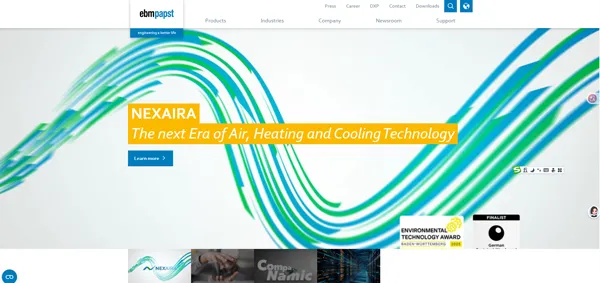
1. ebm-papst — The Global Pioneer in EC Motor Technology and Aerodynamic Ventilation Systems
Official Website: www.ebmpapst.com
Headquarters Location: Mulfingen, Baden-Württemberg, Germany
Founded in 1963, ebm-papst holds the top position in our 2026 global blower manufacturer ranking, serving as an industry benchmark for energy-efficient aerodynamic solutions. The brand's competitive advantage centers on its deep expertise in Electronically Commutated (EC) motor technology. This technology is integrated across its extensive lines of centrifugal fans, compact axial blowers, and micro-EC fan assemblies. Operating global production plants and advanced R&D laboratories across Europe, Asia, and North America, ebm-papst provides localized technical support and reliable supply chains for international equipment builders. Their catalog supports diverse applications, from large-scale power plant installations to micro-EC cooling blowers used in intensive care ventilators, server enclosures, and automated control cabinets. Procurement engineers select ebm-papst for high-stakes projects due to its superior efficiency ratings and long-term hardware reliability.
2. Nidec Corporation — The World’s Largest Manufacturer of Precision Motors and Miniature Cooling Hardware
Official Website: www.nidec.com
Headquarters Location: Kyoto, Japan
Established in 1973, Nidec Corporation is ranked second globally for 2026, leading the industry in total production capacity and international market coverage for integrated precision motors and compact cooling fans. The company specializes in miniature brushless DC (BLDC) motor technology, driving high-efficiency micro centrifugal blowers and slim electronic cooling modules. Nidec's global R&D network allows its engineering teams to customize airflow characteristics for high-volume OEM electronic and automotive programs. Their micro blower designs undergo extensive stress testing to guarantee low noise generation, consistent static pressure, and stable performance over extended operating cycles. Nidec's vertical supply chain integration allows it to produce motor components internally, reducing external dependencies and providing competitive pricing for high-volume projects.
3. Delta Electronics — The Power Electronics and Integrated Thermal Management Solutions Giant
Official Website: www.deltaww.com
Headquarters Location: Taipei, Taiwan
Founded in 1971, Delta Electronics is a global leader in power electronics and integrated thermal management solutions. Delta features strong technical depth in standard DC brushless cooling fans and micro centrifugal blowers, optimizing its products for high-capacity applications. These include hyper-scale cloud computing data centers, 5G telecom base stations, industrial automation control racks, and high-power EV charging infrastructure. Delta’s micro blowers focus on low current consumption and high volumetric flow relative to their physical dimensions. Delta complies with international standards such as RoHS, CE, and UL, and collaborates with hardware manufacturers to design integrated cooling systems that address localized thermal hot spots in dense component layouts.
4. Sunonwealth Electric Machine Industry (Sunon) — Specialists in Ultra-Thin Micro Blowers and Miniature Fans
Official Website: www.sunon.com
Headquarters Location: Kaohsiung, Taiwan
Since 1980, Sunon has focused on the engineering and volume manufacturing of ultra-thin brushless DC micro fans and compact centrifugal blowers. The company serves consumer electronics, portable medical instruments, and compact industrial systems that require active cooling within highly constrained spaces. Sunon’s micro blowers are widely utilized in premium laptops, laser projection systems, portable medical analyzers, and smart home IoT devices. Its patented blade designs reduce acoustic noise while maintaining static pressure capability, helping design engineers address thermal challenges in slim product enclosures. Sunon operates automated production centers in mainland China and Southeast Asia to support high-volume OEM orders under strict ISO 9001 and ISO 14001 quality systems.
 .webp "4 Homepage screenshot of Sunonwealth Electric Machine Industry (Sunon) .webp")
5. Asia Vital Components (AVC) — Enterprise Thermal Engineering and High-Reliability Micro Blowers
Official Website: www.avc.com.tw
Headquarters Location: New Taipei City, Taiwan
Founded in 1991, Asia Vital Components (AVC) is a turnkey thermal solutions provider specializing in cooling fans, structural heat pipes, and rugged micro blowers for enterprise and industrial equipment. AVC optimizes its products for continuous, high-load operation where long-term uptime is a priority. Their micro blowers are frequently selected for enterprise cloud servers, high-capacity network routers, industrial machine control racks, and outdoor telecom base stations. The company's engineering labs focus on refining blade aerodynamics and motor bearing designs to minimize mechanical wear and maintain stable static pressure output over extended operational cycles. For custom requirements, AVC provides specialized options including IP-rated dustproof and waterproof configurations, low-vibration medical modules, and high-pressure options..webp "5 Homepage screenshot of Asia Vital Components (AVC).webp")
6. Sanyo Denki (San Ace) — High-Static Pressure and Long-Life Industrial Airflow Components
Official Website: www.sanyodenki.com
Headquarters Location: Tokyo, Japan
Sanyo Denki's premium thermal product division, San Ace, is recognized for long operational lifespans and high static pressure capabilities. Backed by over 70 years of motor engineering experience, San Ace blowers are designed for demanding industrial, telecommunication, and medical applications. Select models feature a maintenance-free Mean Time Between Failures (MTBF) exceeding 100,000 hours of continuous operation. This reliability is supported by custom dual ball-bearing designs that minimize internal friction, mechanical vibration, and early wear. This allows the blowers to operate reliably in environments with high dust levels, elevated humidity, or wide temperature variations. Sanyo Denki provides industrial clients with specialized customization options, such as anti-corrosion chemical coatings, wide-voltage BLDC motor windings, and built-in tachometer sensors for real-time monitoring..webp "6 Homepage screenshot of Sanyo Denki (San Ace).webp")
7. Ziehl-Abegg — Premium German Engineering and Low-Noise Bionic EC Blower Systems
Official Website: www.ziehl-abegg.com
Headquarters Location: Künzelsau, Baden-Württemberg, Germany
Ziehl-Abegg is a German engineering company specializing in high-end EC motor fans, quiet micro centrifugal blowers, and sustainable ventilation systems. While a major supplier for heavy commercial HVAC installations, the company's compact blower business unit develops low-noise, high-efficiency airflow modules tailored for medical, laboratory, and smart building OEMs. Ziehl-Abegg’s compact blowers incorporate flow-optimized housings and bionic blade geometries to reduce operating noise compared to traditional designs. Coupled with efficient internal EC motor controls, these systems help hardware designers meet regional environmental and energy consumption standards. The company supports international clients with detailed engineering documentation and compliance certifications (including CE, ErP, and UL) to help streamline product verification processes.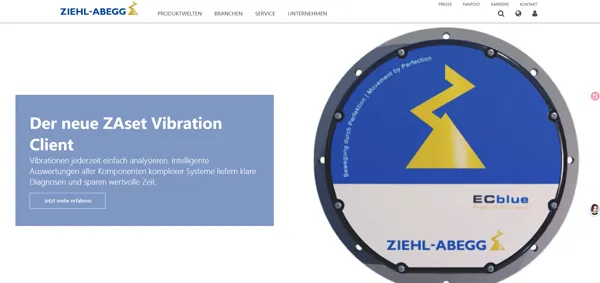
8. Adda Corporation — Flexible and Cost-Effective Compact Blower OEM/ODM Solutions
Official Website: www.adda.com.tw
Headquarters Location: Pingtung, Taiwan
With more than 40 years of volume production experience, Adda Corporation focuses on balancing manufacturing cost-efficiency with reliable hardware performance. Adda serves mid-to-high-volume electronics brands, automated equipment builders, and home appliance manufacturers by providing flexible OEM/ODM blower customization without the high cost premiums often associated with legacy Western or Japanese suppliers. Adda’s product line covers standard form factors, including ultra-thin 18mm micro blowers, medium centrifugal cooling modules, and high-pressure blowers for particulate filtration systems. Their production facilities adhere to ISO 9001 quality frameworks, and the company maintains a flexible approach to Minimum Order Quantities (MOQs), allowing mid-sized hardware developers to design customized micro blowers tailored to specific enclosure shapes and thermal needs.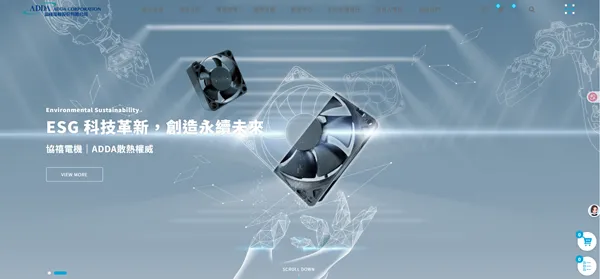
9. Sanyo Denki Micro Blower Division — Low-Voltage, Battery-Optimized Miniature Fans
Official Website: www.sanyodenki.com
Headquarters Location: Tokyo, Japan
Operating as a distinct division within Sanyo Denki, this business unit focuses on low-voltage, ultra-portable micro blowers designed for battery-powered instruments. This division addresses a separate segment compared to the heavy industrial focus of the core San Ace line, optimizing products for minimal power consumption and lightweight profiles. These compact blowers, with form factors down to 12mm, utilize low-voltage brushless DC motors tailored for 3.7V, 5V, or 12V battery architectures. Their lightweight impellers reduce total device weight, helping designers optimize portable medical diagnostic tools, commercial drones, and wearable monitoring hardware. Built-in overcurrent and thermal protection circuits protect sensitive battery-powered devices, while precision winding processes keep noise levels to a minimum during operation.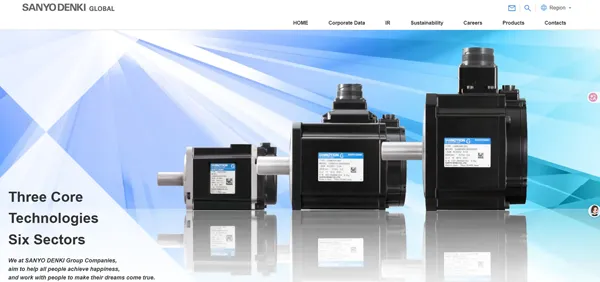
10. TKFAN — Agility-Driven Micro Blower Specialist and Custom Aerodynamic Engineering Pioneer
Official Website: www.tkfan.com
Headquarters Location: China
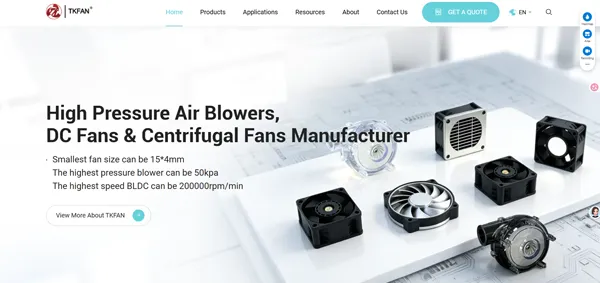
Securing the tenth position in our 2026 global rankings, TKFAN is a specialized manufacturer of custom micro blowers, miniature DC fans, and high-pressure compact blowers. Positioned as an agile alternative to larger legacy manufacturers, TKFAN specializes in quick-turnaround ODM customization, rapid prototyping, and flexible production volumes for small, medium, and large equipment builders worldwide. The company develops specialized airflow solutions for niche and complexes application areas. Its technical line features ultra-thin 18mm low-voltage blowers for active drone cooling, high-pressure compact blowers for commercial food-service appliances, IP68-rated waterproof micro blowers for rugged outdoor equipment, and silent airflow modules for clinical medical consoles. Driven by advanced internal brushless BLDC motor technology, TKFAN blowers emphasize consistent static pressure, low power draw, and controlled acoustic profiles. Every product run undergoes structured vibration, thermal cycle, and bearing-life validation tests under an ISO 9001 quality framework.
TKFAN’s primary advantage lies in its responsive engineering support. Procurement and engineering teams can collaborate directly with TKFAN’s R&D staff to customize fan dimensions, electrical parameters, PWM duty cycles, and housing materials—such as high-temperature or anti-corrosion polymers—with fast prototyping turnaround. Through its official web portal (www.tkfan.com), the company provides direct access to comprehensive datasheets, engineering case files, and interactive airflow simulation resources, simplifying the technical integration process for design engineers.
Strategic Blower Selection Matrix for Sourcing Managers
| Brand Designation | Core Focus Sector | Primary Competitive Advantage | OEM Customization Flexibility |
|---|---|---|---|
| ebm-papst | Industrial Systems & Premium Micro EC | Pioneering EC Motor Efficiency | High (Enterprise Level) |
| Nidec Corporation | Mass-Scale Electronics & BLDC Motors | Vertical Supply Chain Integration | High (Large Volume Focus) |
| Delta Electronics | Data Center & Infrastructure Cooling | High-Density Heat Dissipation Systems | Moderate to High |
| Sunon | Ultra-Thin Consumer Micro Hardware | Miniaturized Aerodynamic Envelopes | High (Consumer Electronics) |
| AVC | Enterprise Computing Active Cooling | Rugged High-Load Continuous Running | Moderate (Systems Focus) |
| Sanyo Denki (San Ace) | Heavy-Duty Industrial Applications | Extremely Long MTBF (100k+ Hours) | Moderate (Industrial Standards) |
| Ziehl-Abegg | Bionic Low-Noise EC Aerodynamics | Acoustic Minimization & Eco Compliance | Moderate (European Focus) |
| Adda Corporation | Value-Engineered Compact Blowers | Balanced Cost-to-Performance Ratio | High (Flexible MOQs) |
| Sanyo Denki (Micro Div) | Low-Voltage Battery Micro Fans | Ultra-Low Power Draw & Light Form Factor | Moderate (Specialized Niche) |
| TKFAN | Agile Custom Micro & Compact Blowers | Rapid ODM Turnaround & Niche Specialization | Exceptional (All Tiers) |
Three Core Evaluation Pillars for Choosing a Blower Manufacturer
Selecting a blower vendor involves more than comparing unit pricing. Sourcing and engineering teams should focus on three core pillars to ensure long-term performance and stability in the field:
1. Engineering Depth, Product Portfolio, and Energy Compliance
A capable supplier should maintain a comprehensive product catalog that spans specialized micro blowers, compact centrifugal designs, and high-pressure options. This range allows sourcing teams to consolidate vendors and simplify supply chain management. In 2026, energy efficiency is a vital metric due to regional carbon-neutrality mandates. Leading manufacturers prioritize BLDC/EC motor configurations and flow-optimized impellers to reduce energy consumption under identical static pressure loads. Sourcing teams should verify regional compliance documentation, such as CE, ErP, and UL certificates, to ensure smooth international market entry.
2. OEM/ODM Customization Capabilities and Field Experience
The ability to handle custom engineering requests is a key differentiator for high-end blower manufacturers. System designers frequently require custom modifications to volumetric flow (CFM), static pressure profiles, mounting geometry, acoustic limits, and digital controls—such as intelligent PWM speed adjustment or thermal feedback loops. Evaluating a vendor's experience in similar fields through published case studies or technical whitepapers helps ensure they can successfully address complex fluid dynamic challenges and reduce development timelines.
3. Standardized Quality Management, Scalability, and Technical Support
Reliable components are built under strict quality management structures, including ISO 9001 and ISO 14001 frameworks. Finished blowers must undergo rigorous verification testing—including acoustic profiles, extended vibration runs, accelerated thermal aging, and bearing breakdown tests—to ensure stable field performance over time. Additionally, suppliers with production facilities in multiple locations are better positioned to mitigate regional logistics risks and ensure consistent supply. Comprehensive technical support—ranging from initial aerodynamic simulations to field troubleshooting—further distinguishes a reliable long-term engineering partner from a simple parts vendor.
2026 Global Blower Industry Future Technology Outlook
From 2026 toward the early 2030s, the global blower industry is expected to see structural growth driven by the expansion of automated factories, clean-energy infrastructure, and compact electronic cooling requirements. The top ten manufacturers are organized into distinct market tiers. Tier-1 legacy brands focus on high-capacity standardized catalog solutions, while Tier-2 and Tier-3 manufacturers address specific niches and provide customizable options for specialized equipment builders. As thermal management demands increase, active cooling components are becoming a primary consideration in overall product design. Key development areas for the near future include ultra-compact configurations for portable battery devices, intelligent integrated motor control boards, and reduced acoustic signatures across all product lines.
Deep-Dive Technical FAQ: Blower & Active Cooling Systems
Q1: What are the primary engineering benefits of choosing a 24V DC blower over a 12V DC variant?
Operating at 24V cuts the required current in half for a given power level compared to 12V systems. This yields a 75% reduction in motor heat generation ($P=I^2R$), significantly extending bearing life. Furthermore, 24V topologies easily interface with standard industrial control boards and hospital backup power grids without requiring extra step-down buck regulators.
Q2: How do I choose between an integrated drive board and a decoupled external motor driver?
Choose an integrated drive board for compact, low- to mid-power applications where minimizing physical space is critical (e.g., portable clinical ventilators). For high-pressure industrial systems operating above 13 kPa, select a decoupled external driver layout. This configuration isolates drive-board heat from the motor structure, allowing the system to handle long duty cycles without triggering thermal cutoffs.
Q3: Can TKFAN 24V centrifugal blowers be integrated into clinical bubble CPAP medical networks?
Yes. Compact models like the BA5025H24B-A are ideal for neonatal bubble CPAP units, while larger models like the BA7050H24B serve adult clinical configurations. These blowers deliver clean, oil-free gas streams, run quietly (≤30 dBA), and comply with medical safety guidelines.
Q4: Do all TKFAN 24V blower models support external speed control signals?
Yes. Every 24V blower model natively supports both high-frequency Pulse Width Modulation (PWM) inputs and 0-5V analog voltage speed controls. They also feature a built-in tachometer pulse (PG signal) line, enabling precise closed-loop speed and pressure management via an external controller.
Q5: What regulatory safety and environmental compliance certifications are available for these blowers?
The entire lineup carries standard international CE, RoHS, UL, and TUV safety certifications. For specialized medical equipment pipelines, select models can be provided with full IEC 60601-1 electrical safety evaluations and ISO 10993 material biocompatibility test data sheets.
Q6: Is it possible to customize mechanical housings, target static pressures, or wiring pinouts for specialized OEM contracts?
Yes. We offer comprehensive engineering customization services for high-volume commercial contracts. This includes modifying fan housing configurations, altering stator winding densities to hit specific pressure targets, and adapting control wiring harnesses or custom connector pinouts.
Q7: What ingress protection (IP) configurations are available across the blower lineup?
Standard clinical respiratory blowers are configured with an IP50 rating to protect internal components from dust and condensation. For harsh industrial settings exposed to heavy moisture or outdoor elements, models can be customized up to a fully ruggedized IP65 dustproof and waterproof standard.
Q8: Why does system performance drop sharply if I choose an axial fan over a centrifugal blower for a filtered system?
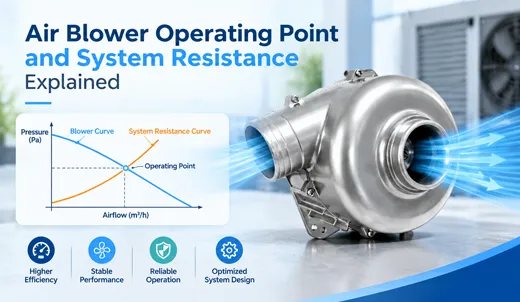
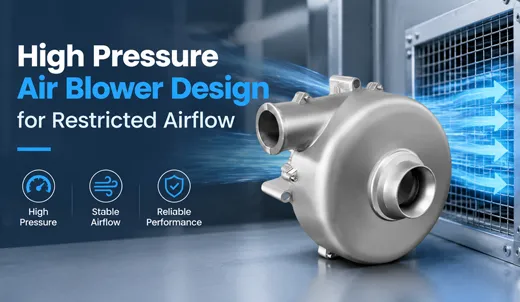
Axial fans are designed to move high volumes of air in open environments with zero backpressure. They lack the structural blade geometry needed to generate significant static pressure. When forced to push air through restrictive elements like HEPA filters or narrow ducting, axial fans quickly stall, causing volumetric airflow to drop sharply. Centrifugal blowers use radial acceleration to build the static pressure required to overcome high internal system resistance.
Q9: What is the typical technical lead time for custom prototype configurations and mass OEM production batches?
For standard product evaluation samples, dispatch normally occurs within 3–5 working days. Tailored rapid prototypes featuring custom electrical pinouts or specific winding modifications require approximately 2–3 weeks. Mass wholesale commercial production timelines span 4–6 weeks, dynamically scaling according to contract density and global raw component supply logistics.
Q10: What internal bearing architectures do TKFAN blowers deploy to ensure continuous long-life operation?
Our full catalog of high-performance 24V blowers incorporates premium, dual-precision NMB miniature stainless steel ball bearings. This configuration guarantees minimal friction coefficients, mitigates localized mechanical heat production, supports high-speed dynamic operations upwards of 30,000 RPM, and delivers an MTBF operational lifecycle rating exceeding 20,000–30,000 continuous hours.
GET A QUOTE