

Low-Pressure vs High-Pressure Blower Selection Guide: Optimizing Industrial Efficiency, Aerodynamic Stability, and Energy Consumption
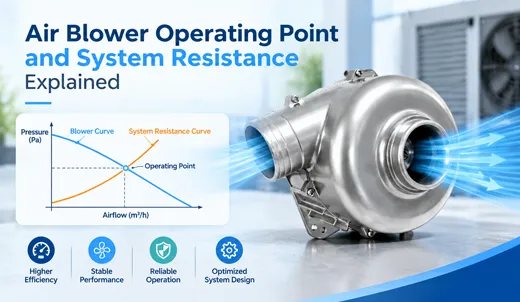
In contemporary industrial production, environmental wastewater processing, pneumatic material handling, and large-scale HVAC ventilation systems, industrial blowers function as the underlying mechanical core for continuous air and gas movement. Selecting the correct industrial blower configuration directly influences total system operating efficiency, lifetime energy costs, and mechanical reliability. Low-pressure blowers and high-pressure blowers feature fundamentally different aerodynamic profiles, mechanical seal designs, and torque curves.
Mismatches between the air blower's rated parameters and actual working conditions frequently trigger substantial energy waste, insufficient volumetric flow rate, localized system choke, and catastrophic hardware failures. This comprehensive technical guide delivers deep structural insights, mathematical selection parameters, and real-world application mapping to help engineers choose between high-pressure positive displacement systems and high-volume low-pressure industrial fans.
1. Aerodynamic Classifications of Industrial Blowers: Definitive Pressure Horizons
Accurately defining the targeted operational pressure regime is the baseline requirement for any fluid engineering workflow. Industrial standards classify blowers by their static pressure or total gauge pressure generation, rather than relying on abstract terms. This prevents dangerous sizing errors during the initial procurement phase.
1.1 Low-Pressure Blowers: High Volumetric Flow, Low Impeller Resistance
Standard engineering terminology defines a low-pressure blower or low-pressure industrial fan as an aerodynamic device generating a total gauge pressure of ≤ 1,000 Pa (0.1 kPa). In specialized heavy manufacturing fields, this spectrum is extended to incorporate pressures ≤ 3,000 Pa (3 kPa).
The core operational focus of a low-pressure air blower centers on delivering a massive volume of air across a minimal circuit resistance path. These systems are characterized by large-diameter inlets, low dynamic rotational speeds, and minimized specific power requirements. Structurally, their outer housings are frequently square or rectangular, designed to mate directly with massive cross-section HVAC ducting networks to transfer immense volumes of air with minimal backpressure friction.
- Standard Gauge Pressure Spectrum: 0.1 kPa to 3.0 kPa
Primary Aerodynamic Profile: Exceptionally high volumetric flow rates (frequently exceeding 100,000 m³/h), optimized system efficiency within low-resistance channels, reduced mechanical acoustic emissions (70-85 dB), and minimized maintenance intervals.
1.2 High-Pressure Blowers: Heavy-Duty Compression, High Backpressure Survival
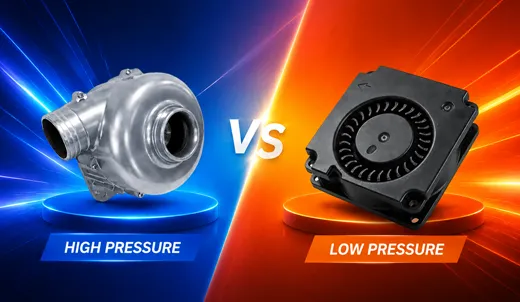
Conversely, a high-pressure blower is defined as a fluid machine engineered to generate a total system backpressure ≤ 5,000 Pa (5 kPa), with typical industrial-grade applications ranging from 30 kPa to 300 kPa. Elite, multi-stage industrial configurations can sustain pressures surpassing 350 kPa.
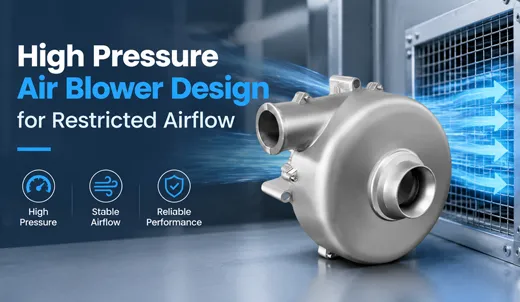
High-pressure air blowers prioritize overcoming intense external resistance over raw volumetric flow. To generate these extreme pressure differentials, the machinery employs small-diameter, hyper-velocity impellers running at high RPMs, or utilizes positive displacement multi-stage internal compression screws and lobes. The blower casing is almost universally circular or heavy scroll-shaped, manufactured from cast iron or thick reinforced alloy steels capable of withstanding severe internal stress and preventing gas leakage.
- Standard Gauge Pressure Spectrum: 30 kPa to 300 kPa
- Primary Aerodynamic Profile: Intense static pressure generation, highly stable volumetric output under shifting loads, elevated specific energy consumption, robust construction, and high resistance to system backpressure spikes.
1.3 Medium-Pressure Systems: The Transitional Bridge
Systems operating within the 3 kPa to 30 kPa boundary fall under medium-pressure configurations. While they serve as vital transitional options for specialized applications, industrial procurement strategies typically focus on low-pressure or high-pressure systems to secure optimal efficiency at the extreme ends of the performance spectrum.
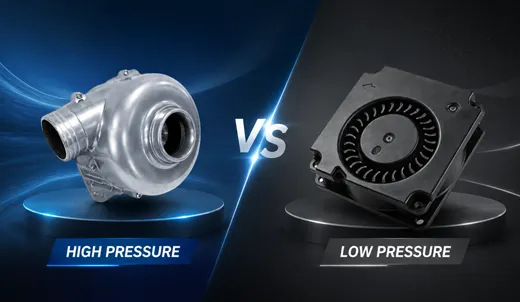
2. Granular Technical Comparisons: Low-Pressure vs. High-Pressure Air Blowers
Evaluating the appropriate blower type requires looking beyond simple catalog specifications. A proper analysis must assess how internal mechanics, structural choices, and acoustic dynamics behave under continuous factory stress.
Flow and Pressure Interdependency
Low-pressure industrial fans operate on a flow-dominant matrix. The volumetric output remains large and highly resilient against small system fluctuations, but drops sharply if downstream ducting is restricted. High-pressure blowers, especially positive displacement types, deliver a highly stable volumetric output across a broad pressure range, forcing gas downstream regardless of intense system blockages or material weight resistance.
Metallurgical and Structural Architecture
Low-pressure units feature lightweight configurations, using thin carbon steel or light aluminum housings with large-clearance impellers spinning under 1,500 RPM. High-pressure air blowers require heavy cast iron, stainless steels, or advanced polymer coatings. They feature precision-machined internal tolerances, multi-stage impeller configurations, and robust shaft seals capable of handling speeds over 3,000 RPM without mechanical distortion.
Energy Efficiency and Specific Power Metrics
Low-pressure blowers offer exceptional specific power metrics, consuming between 0.02 to 0.05 kW/(m³/min). This translates to ultra-low continuous running costs for facility ventilation. High-pressure industrial systems require significantly more input energy, demanding 6.0 to 10.0 kW/(m³/min) due to the internal thermodynamic compression work required to overcome high backpressure.
Acoustic Dynamics and Vibration Control
Low-pressure fans operate with low shear noise (70-85 dB), making them suitable for installation near personnel without massive acoustic insulation. High-pressure industrial blowers generate intense high-frequency shear and pulsation noises (75-90 dB+). They require heavy silencers, thick acoustic enclosures, and specialized vibration-damping pads to protect structural integrity.
3. Critical Engineering Calculations: Sizing Parameters and Margin Mapping
Sizing errors during selection are a primary cause of industrial system failure. Industrial buyers must use accurate calculations and include appropriate safety margins to ensure the blower operates within its optimal efficiency zone.
3.1 Volumetric Flow Rate (Q) Calculations
The required volumetric flow rate defines the total mass or volume of gas that must be shifted per unit time ($m^3/h$ or $m^3/min$). This value must match the exact needs of the target application, such as facility air exchanges or the oxygenation rate in biological processing. For example, in wastewater treatment aeration, the flow rate must be calculated based on the precise oxygen demand needed to break down specific biological oxygen demand (BOD) loads per hour.
Safety Margin Implementation: Never match the blower's rated catalog capacity exactly to the calculated minimum demand. Standard engineering practices dictate adding a 10% to 20% safety buffer. This compensates for eventual system degradation, filter loading, and internal piping friction increases over time. Low-pressure applications typically require a 15% margin to maintain high volume over wide areas, while high-pressure systems add a 10% safety index to prevent driving the motor into overload during pressure spikes.
3.2 Static and Total System Pressure (P) Engineering
The blower's generated pressure must overcome the total resistance of the entire downstream circuit. Total system backpressure is calculated using a comprehensive friction loss model:
Total System Backpressure = Linear Pipe Friction Loss + Localized Fitting Losses (bends, valves) + Process Reactor Head (liquid depth) + Filter/Diffuser Resistance
Low-pressure blowers operate safely below 3 kPa, making them perfect for short, straight runs with few fittings. High-pressure systems are required once the total resistance calculation exceeds 30 kPa, which occurs regularly in deep liquid immersion tanks, long pneumatic transport pipelines, and dense dust-collection filters.
3.3 Thermodynamic Medium and Environmental Factor Corrections
Air blower specifications are typically rated at Standard Temperature and Pressure (STP: 20°C, 101.3 kPa, 36% relative humidity, air density of 1.204 $kg/m^3$). If the actual site environment varies from these conditions, calculations must be adjusted:
- Thermal Extremes: High-temperature applications (≥ 80°C) reduce gas density, meaning the blower must move a larger volume of air to achieve the same target mass flow rate. These environments require specialized stainless steel or alloy wheels.
- Chemical Corrosiveness: Moving acidic, alkaline, or humid industrial waste gases requires upgrading to 316L stainless steel, titanium components, or specialized PTFE corrosion-resistant coatings.
Particulate Loading: High dust concentration rapidly erodes high-speed impellers. Systems handling heavy dust loads should utilize robust, lower-speed configurations like Roots or screw designs, paired with heavy-duty upstream filtration packages.
4. Industrial Application Mapping: Strategic Sizing Scenarios
Matching specific industrial applications to the correct pressure regime simplifies the procurement process and ensures optimal system performance.
4.1 Typical Low-Pressure Applications (≤ 3 kPa)
- Industrial Plant and Large Facility Ventilation: Moving immense volumes of stagnant or contaminated air out of large production spaces requires low-pressure axial or inline centrifugal fans, maintaining high turnover rates with minimal electrical draw.
- Cooling Towers and Heat Exchangers: Forcing air across fluid bundles to induce evaporative cooling demands huge volumetric flow rates across wide surface areas, with very low circuit resistance.
- Shallow Water Aquaculture Aeration: Ponds and commercial shrimp farming tanks with shallow water depths require low-pressure ring compressors or small vortex blowers to deliver continuous dissolved oxygen efficiently.
4.2 Typical High-Pressure Applications (≥ 30 kPa)
- Deep-Tank Biological Wastewater Treatment: Forcing air through fine-bubble diffusers submerged under 3 to 7 meters of water requires high static pressure (30-70 kPa) to overcome the heavy liquid head and diffuser resistance.
- Pneumatic Conveying of Dry Bulk Materials: Moving high-density powders, cement, grains, fly ash, or plastic pellets through long horizontal or vertical pipelines requires high-pressure Roots or twin-screw blowers to keep materials suspended and prevent line blockages.
- Combustion Air Supply for Furnaces and Kilns: Pushing air into high-pressure metallurgical furnaces or chemical incinerators requires stable high-pressure centrifugal or multi-stage blowers to overcome intense internal burner backpressure.
5. Comprehensive Industrial Blower Comparison Matrix
This structured matrix organizes the performance boundaries, technical efficiencies, and primary use cases of the five leading industrial blower designs.
| Blower Architecture Type | Optimal Pressure Domain | Volumetric Capacity Range | Isentropic Efficiency Index | Acoustic Base Profile | Primary Industrial Target Application |
|---|---|---|---|---|---|
| Axial Flow Fans | ≤ 1.0 kPa (Ultra-Low) | Extremely High (>100,000 m³/h) | 70% - 80% | Low (70-80 dBA) | Warehouse HVAC, Commercial Cooling Towers |
| Low-Pressure Centrifugal | 1.0 kPa - 3.0 kPa (Low) | High (500 - 50,000 m³/h) | 75% - 85% | Low-Medium | Factory Exhaust, Localized Dust Collection |
| Rotary Lobe (Roots Type) | 10 kPa - 100 kPa (Medium-High) | Medium (60 - 18,000 m³/h) | 60% - 75% | High (80-95 dBA) | Wastewater Aeration, Pneumatic Conveying |
| Twin-Screw Displacement | 50 kPa - 250 kPa (High) | Medium-High (100 - 12,000 m³/h) | 75% - 90% | Medium-Low | Chemical Gas Boosting, Energy-Saving Aeration |
| High-Pressure Centrifugal | 30 kPa - 300 kPa (High) | Medium-High (200 - 15,000 m³/h) | 80% - 85% | High Pulsation | Glass Manufacturing, Boiler Combustion Air |
6. Sizing Blunders to Avoid: Safeguarding Industrial Sourcing
Avoiding common procurement mistakes prevents long-term operational issues, unexpected maintenance costs, and system inefficiencies.
- Operating Below the Pressure Curve: Deploying a low-pressure industrial fan into a high-resistance circuit like a deep aeration tank causes immediate air stagnation. The air cannot overcome the liquid resistance, leading to motor overheating and rapid electrical breakdown.
- Over-Specifying Pressure Demands: Selecting a high-pressure blower for a low-resistance application like simple space ventilation results in massive energy waste. The machine consumes excessive electricity to perform unnecessary compression work.
- Neglecting Total Cost of Ownership (TCO): Selecting a blower based solely on a low initial purchase price often leads to higher long-term costs. Low-efficiency models consume significantly more energy over their operational lifespan, quickly eclipsing the initial savings compared to high-efficiency configurations like twin-screw or magnetic-levitation systems.
7. Step-by-Step Blower Specification Workflow
Industrial buyers should follow this structured five-step engineering workflow to ensure accurate equipment sizing:
- Analyze the Operating Environment: Define gas properties, chemical abrasiveness, ambient temperature, elevation above sea level, and expected daily duty cycles.
- Calculate Volumetric Requirements: Calculate the exact volume or mass flow rate needed for the process, then add a 10% to 20% safety margin.
- Determine Total System Backpressure: Calculate the total resistance of the entire downstream circuit, accounting for pipe friction, fitting losses, and liquid head.
- Select the Blower Architecture: Match the calculated pressure and flow requirements to the optimal blower design type using the performance matrix.
- Review Efficiency and Lifecycle Costs: Compare specific power consumption ratings across models to optimize long-term energy efficiency and minimize operational costs.
Technical FAQs: Industrial Blower Selection
Q1: How does high site elevation or altitude affect the sizing of low-pressure and high-pressure blowers?
As elevation increases, atmospheric pressure drops, resulting in less dense air. Because industrial blowers are constant-volume machines, they will move the same volume of air at altitude but a lower total mass flow rate. To deliver the correct oxygen mass or material suspension force at high altitudes, engineers must scale up the calculated volumetric flow rate ($m^3/h$) and verify that the motor has sufficient capacity to handle the altered aerodynamic load.
Q2: Why do twin-screw blowers demonstrate superior energy efficiency compared to traditional Roots rotary lobe blowers in high-pressure regimes?
Traditional Roots blowers utilize external compression, meaning the air is compressed only when it is forced into the downstream piping. This design creates significant back-flow shock and turbulence losses. Twin-screw blowers utilize internal compression, where the gas volume is progressively reduced within the screw flights before reaching the discharge port. This internal compression reduces internal turbulence and lowers specific power consumption, saving up to 20% to 30% in energy costs under high-pressure conditions.
Q3: What mechanical risks occur when an industrial blower is operated far below its native rated backpressure?
Operating a high-pressure centrifugal or positive displacement blower without sufficient system backpressure causes the machine to run toward the far right of its performance curve, significantly increasing the volumetric flow rate. This high flow volume can overload the motor driver, exceed its rated amperage, and trigger thermal trips or winding burnouts unless the intake or discharge lines are properly throttled.
Q4: How does coil inductance and internal resistance alter the performance of high-speed high-pressure turbo blowers?
Modern high-speed high-pressure turbo blowers rely on high-frequency permanent magnet motors managed by variable frequency drives (VFDs). Low internal coil resistance minimizes stator copper losses ($I^2R$), preventing thermal issues within compact housings. Optimized low inductance reduces the motor's electrical time constant, allowing the VFD to quickly adjust magnetic fields and safely stabilize the impeller during rapid system pressure changes.
GET A QUOTE