

Micro Air Blower Applications: The Definitive Engineering & Selection Guide
Executive Summary: As consumer, medical, and industrial devices undergo rapid miniaturization, thermal and pneumatic design engineers face unprecedented constraints. Compact enclosure design requires localized, high-pressure airflow to cool dense electronics and deliver precise fluidic control without draining power or exceeding strict acoustic limits. This comprehensive guide covers everything hardware engineers, product designers, and procurement teams need to know about micro air blower applications, operating principles, core technical parameters, and selection methodology.
In modern electronic hardware design, miniaturization is no longer optional—it is a baseline requirement. However, shrinking enclosure volumes creates severe thermal density challenges. Traditional axial cooling fans often fail in these environments due to their inability to overcome high system impedance (backpressure). When airflow encounters dense PCB layouts, micro-heatsinks, or air filters, axial fans suffer from aerodynamic stall, causing airflow rates to collapse.
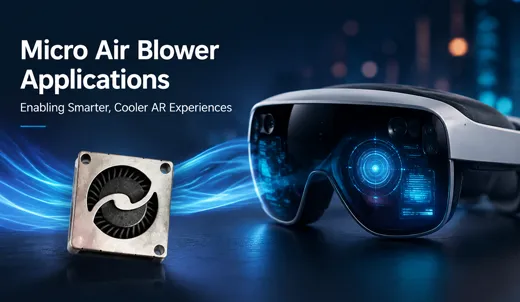
This critical engineering gap has driven the widespread adoption of the micro air blower (also referred to as a miniature air blower, small air blower, or micro centrifugal blower). Designed specifically to generate high static pressure within ultra-compact footprints, micro blowers pull air in axially and discharge it centrifugally at a 90-degree angle. Specialized manufacturers like TKFAN lead this innovation, supplying ultra-small DC micro air blowers that resolve severe thermal and pneumatic bottlenecks across portable medical devices, augmented reality (AR) smart glasses, dense single-board computers, and wearable electronics.
1. What is a Micro Air Blower? (Technical Overview & Mechanisms)
To select the correct fluid motion component, design engineers must distinguish between a miniature axial fan and a micro centrifugal air blower. While both move air, their internal fluid dynamics and pressure delivery profiles are fundamentally different.
1.1 Engineering Definition & Working Principle
A micro air blower is a compact fluid-displacement device that integrates a precision-engineered centrifugal impeller with a low-profile brushless DC (BLDC) motor. The operating mechanism follows three core stages:
- Axial Intake: Air enters axially through the central inlet aperture parallel to the motor shaft.
- Centrifugal Acceleration: High-speed forward-curved or radial impeller blades accelerate air particles outward, converting mechanical torque into kinetic energy.
- 90-Degree Radial Discharge: The internal volute housing collects the high-velocity air, converting kinetic velocity into static pressure, and vents it through a focused, directional outlet nozzle.
The product portfolio from TKFAN Micro Air Blower Solutions includes sizes ranging from the ultra-compact 18×04mm (BA1804L05X) to the high-output 40×10mm (BA4010HHV05X). These blowers support multiple operating voltages including 3.3V, 5V, 12V, and 24V DC, alongside custom 2V low-voltage configurations for single-cell lithium battery power management.
1.2 Micro Air Blower vs. Conventional Miniature Axial Fan
Understanding performance trade-offs under system load is vital for preventing field failures caused by thermal throttling or insufficient air delivery.
| Performance Metric | Micro Air Blower (Centrifugal) | Miniature Axial Fan |
|---|---|---|
| Static Pressure Capability | High (0.06 kPa to 0.23+ kPa). Overcomes severe internal airflow resistance. | Extremely Low. Suffers stall when backpressure is present. |
| Airflow Directionality | 90° focused vector outlet. Ideal for ducted, micro-fluidic, or targeted cooling. | Diffuse straight-through flow. Ineffective for focused channel routing. |
| Resistance to Impedance | Maintains continuous airflow through HEPA filters, micro-channels, and dense heatsinks. | Airflow degrades drastically under minor system backpressure. |
| Low-Voltage Efficiency | Optimized BLDC motors offer up to 30% power savings in 3.3V/5V battery circuits. | Standard motor designs consume higher energy when forced to run at elevated RPM. |
| Form Factor Integration | Flat, low-profile volute structure sits flush within slender housings (e.g., smart glass temples). | Requires open axial clearance on both sides, limiting structural integration options. |
2. Why Do Compact Devices Require Micro Air Blowers?
Every industrial, commercial, and medical micro air blower application exists to solve a specific thermal or pneumatic challenge that traditional axial fans cannot address. Below are the primary engineering motivations for selecting micro blowers.
2.1 Overcoming High System Static Pressure & Backpressure
Modern miniature devices feature densely stacked rigid-flex PCBs, integrated sensor arrays, dust filters, and narrow exhaust channels. This layout creates high fluid resistance (backpressure). When an axial fan encounters high resistance, air recirculates around the blade tips, causing flow detachment and zero effective cooling. Conversely, TKFAN centrifugal blowers—such as the BA4010HHV05X operating up to 13,500 RPM—generate up to 0.23 kPa of static pressure, forcing air through high-density heat sinks and micro-pore filters without flow decay.
2.2 Meeting Extreme Envelope and Weight Constraints
Wearables, head-mounted displays (HMDs), and handheld diagnostic meters demand minimal gram-weight impact and ultra-thin profiles. Traditional cooling modules add bulk, degrading ergonomics. Advanced micro air blowers feature frame widths down to 18mm and thickness under 5mm, reducing overall component volume by up to 75%. Weighing less than 10 grams, these units provide active airflow without compromising industrial design goals.
2.3 Energy Efficiency and Battery Life Optimization
Portable devices rely on lithium-ion or lithium-polymer battery cells. Inefficient thermal management draws extra current, shortening battery runtimes. TKFAN micro blowers incorporate multi-phase motor windings designed specifically for 3.3V and 5V power rails. Integrated Pulse Width Modulation (PWM) speed control enables dynamic adjustment based on real-time temperature sensing, cutting power consumption during idle periods and increasing system battery endurance by up to 40%.
2.4 Acoustic Comfort and Low-Vibration Engineering
High-RPM miniature components can produce irritating high-frequency noise and mechanical vibration. This is unacceptable in medical devices used during sleep (e.g., CPAP machines) or wearables worn on the face or head. Micro air blowers address this using dynamically balanced impellers, aerodynamically optimized volutes, and UL94-V0 vibration-dampening polymer frames, achieving high pressure at low sound levels.
3. Key Applications of Micro Air Blowers
The versatility of the micro air blower spans healthcare, smart consumer electronics, high-density computing, personal safety gear, and industrial diagnostic equipment. Below is a detailed breakdown of major application categories.
3.1 Portable Medical & Respiratory Devices
Medical electronics represent one of the fastest-growing sectors for micro blowers. Key performance demands include unwavering pressure delivery, minimal acoustic emission, low vibration, and biocompatible material construction.
- Wearable & Travel CPAP Machines: Micro air blowers deliver continuous positive airway pressure in compact sleep apnea therapy devices. Dynamic impeller balancing eliminates night-time vibration, while 5V/12V designs support portable battery power. The TKFAN BA3510VH05X blower provides 0.11 kPa static pressure, ideal for compact respiratory therapy.
- Air Sampling & Point-of-Care (PoC) Diagnostics: Handheld bio-hazard samplers and portable blood analyzers utilize micro blowers to pull precise air volumes across diagnostic membranes and micro-fluidic cassettes under constant flow rates.
- Portable Oxygen Concentrators (POCs): Compact blowers assist in ambient air intake and internal thermal management, maintaining stable operating temperatures across internal pressure-swing adsorption (PSA) valves.
- Biocompatible Wearable Monitors: Ultra-thin models (BA1804L05X, 18x04mm) integrate into wearable sensors to supply low-volume micro-airflow for skin-contact skin-humidity regulation and pressure-based bio-signal detection.
3.2 AR / VR / MR Headsets and Smart Glasses
Next-generation Spatial Computing headsets, Augmented Reality (AR) glasses, and Virtual Reality (VR) displays combine high-brightness optical engines (Micro-LED/OLED) with high-performance AI processors inside sealed, lightweight frames.
- VR Headset Active Cooling: Positioned inside the main housing, micro blowers direct cool air across computing chips and display panels to eliminate thermal throttling, prevent lens fogging, and reduce face-pad heat buildup.
- AR Glasses Frame Integration: Featuring a frame thickness of just 4mm to 5mm, ultra-micro blowers fit directly inside slender temples. They cool on-board AI acceleration chips during continuous object recognition or spatial rendering tasks.
- Pocket Laser Projectors: Compact blowers cool high-luminescence laser diodes within restricted optical paths where axial fans cannot overcome internal drag.
3.3 Wearable Consumer Electronics & Personal Cooling
As wearable consumer gear evolves, active cooling and localized air movement are becoming essential for user comfort and device safety.
- Smart Apparel & Climate-Controlled Vests: Miniature blowers integrated into industrial cooling vests and protective athletic wear circulate air through micro-ventilation tubes to mitigate heat stress.
- Smartwatches & Wrist Health Monitors: Custom micro air blowers provide localized surface cooling and pneumatic inflation for wrist-bound blood pressure measurement modules.
- Personal Beauty & Wellness Tools: Facial therapy devices, misting applicators, and eye cooling masks use micro blowers for consistent, whisper-quiet air distribution.
3.4 Embedded Computing, Edge AI, and Optical Transceivers
High-density electronics generate significant thermal energy within tightly constrained PCB footprints.
- Single Board Computers (SBCs) & Mini PCs: Micro blowers pull air across dense array heatsinks mounted on overclocked ARM and x86 processors, preventing thermal throttling in fanless-style chassis.
- Edge Servers & Optical Transceivers: Micro blowers direct cooling air onto high-speed OSFP and QSFP optical transceivers in compact networking nodes, preventing thermal data degradation.
- High-Fast-Charge Power Banks & Energy Modules: Integrated blowers dissipate heat during high-wattage USB-PD power conversion, mitigating thermal runaway risks without increasing device thickness.
3.5 Smart Home & Portable Appliances
Home automation devices continue to downsize while integrating advanced air filtration and thermal management functionality.
- Desktop Personal Air Purifiers: Micro blowers pull room air through multi-stage HEPA filters, using high static pressure to maintain clean air delivery rates (CADR) in compact footprints.
- Miniature Refrigeration & Portable Coolers: Blowers circulate air inside desktop cosmetic fridges and mobile automotive cooling boxes, maintaining uniform internal temperature distribution.
- Compact Venting Systems: Portable air fryers and desktop solder fume extractors rely on mini blowers to route exhaust gases through restrictive carbon filters quietly.
3.6 Industrial Gas Detection & Fuel Cell Systems
B2B industrial monitoring and clean energy equipment require continuous, reliable micro-pneumatic flow under harsh operational conditions.
- Handheld Gas Leak Detectors: Micro blowers sample surrounding ambient gas across particulate filters into sensor chambers, ensuring accurate readings even in dirty field environments.
- Micro Fuel Cell Air Supply: Portable hydrogen fuel cells require continuous, low-pressure oxygen delivery to sustain electrochemical reactions. TKFAN blowers offer the linear airflow control needed to optimize fuel cell efficiency.
Partnering with an experienced manufacturer like TKFAN provides access to standardized, high-performance micro blowers as well as tailored ODM/OEM solutions engineered for your specific design requirements. Review technical specifications, request engineering drawings, or consult with fluid dynamics specialists today to resolve your system's thermal and pneumatic challenges.
GET A QUOTE