

Industrial DC Blower Selection Guide: Engineering & Procurement Handbook
Executive Summary: Selecting the optimal industrial DC blower is critical for ensuring long-term equipment stability, maximizing thermal management performance, minimizing operational acoustic noise, and controlling total cost of ownership. This comprehensive guide covers technical specifications, structural advantages, application breakdowns (with emphasis on 24V industrial air blower models), and custom OEM/ODM solutions tailored for hardware engineers and procurement managers.
For hardware engineers, procurement heads, OEM product designers, and industrial equipment manufacturers, specifying the right industrial DC blower directly determines system reliability, thermodynamic efficiency, and end-product market competitiveness. A common mistake during procurement is focusing solely on unit price while overlooking vital engineering metrics—such as static pressure limits, volumetric airflow, brushless motor longevity, PWM control compatibility, ingress protection (IP ratings), and supply voltage tolerances. Neglecting these key technical parameters frequently leads to premature field failures, costly product recalls, and high warranty claims.
This technical guide systematically details product definitions, structural distinctions between DC and AC blowers, core engineering parameters, key industrial applications, step-by-step selection logic, and customized OEM/ODM engineering workflows. Special focus is given to the widely adopted 24V industrial air blower, which serves as the gold standard across medical ventilation, automotive ADAS sensor cleaning, industrial automation, and telecom cooling systems. TKFAN provides high-static-pressure, low-noise brushless industrial DC blower solutions capable of continuous 24/7 operation with full parameter customization. Explore our complete standard and custom lineup at the TKFAN Air Blower Product Portal. 1. What is an Industrial DC Blower?
1.1 Definition & Industrial Grade Benchmarks
An industrial DC blower (also known as a DC centrifugal blower) is a forced-convection airflow device powered by a Brushless Direct Current (BLDC) motor. Unlike traditional axial cooling fans that move air linearly parallel to the blade axis, a centrifugal industrial DC blower draws air in axially through its intake and expels it radially at a 90-degree angle. This structural orientation builds significantly higher static pressure, allowing the air stream to overcome high system impedance.
To distinguish a true heavy-duty industrial DC blower from low-grade commercial or consumer fans, the unit must meet three strict industrial standards:
- Continuous Duty Cycle (24/7 Operation): Rated for continuous full-load operation with a L10 bearing service life exceeding 60,000 to 100,000 operating hours.
- High Static Pressure Capabilities: Delivers minimum static pressure starting at 300 Pa, with specialized high-pressure models capable of generating up to 20,000 Pa to force air through dense HEPA filters, narrow ducts, and tightly packed enclosures.
- Robust Environmental Tolerance: Operates reliably across wide temperature ranges (-20°C to +70°C, with automotive-grade variants spanning -40°C to +85°C) and features optional IP54, IP67, or IP68 ingress protection against dust and moisture.
1.2 Core Components of a Heavy-Duty DC Blower
Every TKFAN industrial DC blower is built using precision-engineered industrial components:
- BLDC Brushless Motor: Eliminates physical carbon brush wear, lowers electromagnetic interference (EMI), and allows precise digital speed control. 24V variants integrate specialized 24V stator windings designed for industrial power supplies.
- Aerodynamically Balanced Impeller: Feature dynamically balanced forward-curved or backward-curved blades engineered using fluid dynamics software to minimize turbulence noise and optimize air delivery.
- Sealed Volute Housing: Molded from durable ABS, flame-retardant PC (UL94 V-0 rated), or die-cast aluminum alloys, providing smooth internal air channels and customizable duct interfaces.
- Integrated Smart PCB Assembly: Houses advanced motor driver ICs providing Pulse Width Modulation (PWM) speed regulation, Frequency Generator (FG) tachometer feedback, and Rotation Detector (RD) lock alarm outputs.
1.3 Common Industrial DC Blower Voltage Ratings
Industrial DC blowers are manufactured in several standard input voltages: ultra-low voltage (2V–5V), 12V DC, 24V DC, and 48V DC. Among these, the 24V industrial air blower accounts for over 65% of global industrial procurement orders due to its ideal balance between electrical safety, torque output, and compatibility with standard 24V DC industrial power rails, PLC systems, and medical equipment power supplies.
2. Industrial DC Blowers vs. AC Blowers: Key Differences
Selecting between a DC centrifugal air blower and an Alternating Current (AC) industrial blower is a critical architectural decision. The comparison table below highlights why modern engineering projects increasingly transition toward brushless industrial DC blower solutions, particularly 24V configurations.
| Performance Feature | Industrial DC Blower (BLDC / 24V DC) | Industrial AC Blower (110V / 220V AC) |
|---|---|---|
| Power & Electrical Safety | Low-voltage DC (12V, 24V, 48V). Extremely safe for tight electronic enclosures and medical devices. | High-voltage AC power mains (110V/220V). Requires strict high-voltage isolation and grounding. |
| Speed Control Precision | 0–100% smooth, linear speed control via PWM or 0–10V analog signals. Easily syncs with temperature sensors. | Fixed rotational speed. Requires expensive, bulky Variable Frequency Drives (VFD) for speed adjustment. |
| Energy Efficiency | High motor efficiency (75%–92%). Consumes 30%–50% less power during reduced-load operation. | Lower efficiency (55%–70%). Substantial energy waste when full airflow is not continuously required. |
| Operational Lifespan | 60,000 to 100,000 hours of continuous maintenance-free service. No mechanical brushes to wear out. | 20,000 to 35,000 hours typical. Mechanical components and brushes experience steady degradation. |
| Acoustic & Vibration Performance | Dynamically balanced impellers & precision bearings. Low-speed acoustic noise can drop below 25 dB(A). | Pronounced AC electrical hum and vibration. Difficult and expensive to damp acoustically. |
| System Monitoring Signals | Native support for FG speed tachometer output and RD rotor-lock fault alarms for automated system safety. | No native digital monitoring. Requires external sensors to detect motor stall or failure. |
| Primary Applications | Medical ventilators, CPAP devices, automotive ADAS lens cleaning, air cushion machines, telecom servers. | Large factory HVAC systems, fixed-speed industrial dryers, macro facility ventilation units. |
2.1 When Should You Specify a 24V Industrial Air Blower Over AC Options?
Engineers should explicitly choose a 24V industrial air blower over AC alternatives when:
- The host equipment runs on battery power or a low-voltage DC bus (e.g., automotive, portable medical diagnostic tools).
- Dynamic thermal control using microcontrollers, PLCs, or PID loops is required.
- Operating environments demand low noise levels (e.g., intensive care units, hospital wards, cleanroom labs).
- Equipment runs continuously 24/7, where long-term power savings offset initial hardware investment.
Internal installation volume is strictly constrained, necessitating compact blower housings with high power density.
 3. Critical Engineering & Procurement Specifications
Before issuing a Request for Quotation (RFQ) or finalize a bill of materials (BOM) for an industrial DC blower, hardware engineering teams must verify the following core parameters against technical datasheets, such as those provided on the TKFAN DC Blower Series Catalog.
3.1 Rated Operating Voltage
Voltage selection dictates electrical architecture compatibility:
- 12V DC Blowers: Ideal for small portable equipment, consumer smart appliances, and lightweight thermal modules.
- 24V Industrial Air Blowers: The dominant standard for medical respiratory gear, factory automation sensors, vehicle ADAS cleaning setups, and inflatable packaging machinery.
- 48V DC Blowers: Standard for telecommunications base stations, high-density server racks, and high-wattage industrial air pumps.
Note: TKFAN industrial DC blowers accommodate a ±10% input voltage fluctuation tolerance to protect against unstable industrial power supplies.
3.2 Rotational Speed (RPM)
Motor RPM correlates directly with volumetric airflow and static pressure capacity:
- Low Speed (3,000–8,000 RPM): Used in quiet sleep apnea (CPAP) devices and lab analyzers prioritizing sub-30 dB(A) noise targets.
- Medium Speed (10,000–25,000 RPM): Typical operational range for standard industrial cooling and 24V automotive purge systems.
- High Speed (30,000–50,000+ RPM): Engineered for high-pressure pneumatic sampling pumps, optical blow-off systems, and laser cutting equipment.
3.3 Volumetric Airflow (CFM / m³/h / LPM)
Airflow measures the volumetric volume of air delivered per unit of time:
- Micro DC Blowers: 5 to 50 Liters per Minute (LPM) for compact analytical tools.
- Standard 24V Industrial Air Blowers: 100 to 500 LPM, optimal for medical ventilation and air cushion bag inflation.
- Heavy-Duty Industrial DC Blowers: 800 to 2,000+ LPM, capable of cooling entire telecom enclosures or drying industrial parts.
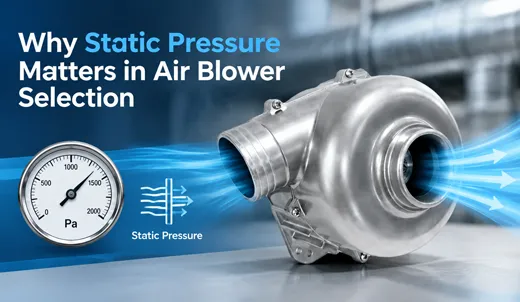
3.4 Static Pressure (Pa / mmH₂O) — The Critical Metric
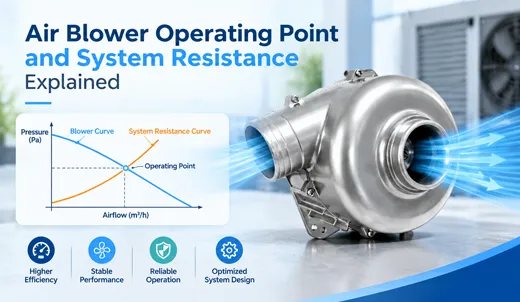
Static pressure defines a blower's capacity to force air through systemic resistance (air filters, long narrow hoses, dense heatsinks). It represents the single most important advantage of a centrifugal industrial DC blower over standard axial fans.
- Low Pressure (< 500 Pa): Suitable for open-flow, unobstructed ventilation.
- Medium Pressure (500–5,000 Pa): Standard operational envelope for medical gas delivery and ducted cooling (the core operating zone for most 24V industrial air blower models).
- High / Ultra-High Pressure (> 10,000 Pa): Required for LiDAR/camera lens purging, particulate collection, and high-resistance pneumatic transport.
3.5 Acoustic Noise Output (dB(A))
Acoustic performance must match the final operating environment:
- Ultra-Quiet (< 28 dB(A)): Essential for hospital ICUs and home sleep care environments.
- Standard Industrial (30–45 dB(A)): Suitable for factory automation panels, automotive blowers, and packaging lines.
- High-Performance Output (> 45 dB(A)): Common in high-speed industrial air knives, solder rework stations, and machinery exhaust hoods.
3.6 Bearing Systems & Service Lifespan
Bearing selection directly sets expected system longevity:
- Dual Ball Bearings: Essential for industrial procurement. Delivers 60,000 to 100,000 hours of continuous operation across wide operating temperature spans (-20°C to +70°C).
- Sleeve Bearings: Lower cost, but limited to short life expectancies (~20,000 hours) and prone to oil drying in elevated temperatures. Not recommended for industrial applications.
3.7 Smart Control & Monitoring Interfaces
Industrial DC blowers typically offer three digital control options:
- PWM Speed Control: Allows continuous, dynamic rpm adjustment based on real-time temperature feedback to optimize thermal efficiency and reduce acoustic output.
- FG Tachometer Signal: Outputs a square-wave frequency signal proportional to motor speed, enabling HMI interfaces to monitor blower health.
- RD Lock Alarm: Changes signal state if the impeller becomes mechanically blocked, enabling the system controller to initiate safety shutdowns before thermal overload occurs.
3.8 Ingress Protection (IP Ratings)
Environmental sealing ratings prevent premature failures:
- IP20: Standard indoor electrical cabinet cooling.
- IP54: Dust-protected and splash-resistant for general factory floor conditions.
- IP67 / IP68: Fully dust-tight and submersible waterproof sealing for outdoor automotive, marine, and wet washdown environments.
4. Core Industrial Application Scenarios
The versatility of the modern industrial DC blower—and particularly the 24V industrial air blower—spans several critical high-reliability industries:
4.1 Medical Respiratory Equipment
ICU ventilators, portable CPAP devices, and neonatal oxygen therapy systems rely heavily on 24V brushless industrial DC blower units. Key requirements include ultra-fast dynamic pressure response times, medical-grade bio-compatibility (materials meeting ISO 10993 standards), ultra-low operational vibration, and acoustic levels maintained below 25 dB(A).
4.2 Automotive ADAS Sensor Cleaning Systems
Autonomous driving platforms rely on camera lenses, LiDAR sensors, and radar domes remaining clear of dirt, rain, and mud. Compact, high-pressure 24V industrial air blower modules deliver targeted high-velocity air bursts to instantly clear optical surfaces. These units are built with IP67 sealed housings and wide temperature ranges (-40°C to +85°C) to withstand rugged road conditions.
4.3 Industrial Packaging: Air Cushion Machines
Inflatable packaging systems require a continuous, steady supply of pressurized air to rapidly inflate protective air pillow films. Specialized 24V industrial blowers deliver high static pressure under continuous duty cycles to maintain consistent film inflation without overheating.
4.4 Particle Counters & Environmental Monitors
Precision cleanroom particle counters draw sample air through fine HEPA filters using compact high-pressure blowers. Highly stable motor speeds and precise digital control ensure consistent intake sampling rates for sensitive laser detection systems.
4.5 Telecom Cabinets & Edge Servers
High-density computing outdoor racks utilize 48V or 24V industrial DC blowers to drive air through tightly spaced PCB cards and dense heat sinks. High motor efficiency helps reduce long-term energy consumption across large data center infrastructures.
4.6 Hot Air Rework Stations
Electronics manufacturing repair tools require focused, adjustable hot air streams to desolder surface-mount components. Medium-pressure 24V DC blowers provide smooth, controllable airflow output directly through heating elements.
5. Step-by-Step Blower Selection Workflow
Follow this 7-step engineering selection framework to identify the correct industrial DC blower model for your equipment project:
- Step 1: Determine System Power Bus Voltage
Match the blower to your available power rail (12V, 24V, or 48V DC). For general industrial equipment, specifying a 24V industrial air blower simplifies power distribution architecture. - Step 2: Estimate System Airflow Impedance & Required Static Pressure
Calculate the pressure drop across filters, ducting, and internal components. Choose a high-pressure blower (≥ 1,000 Pa) if air pathways are restricted or ducted. - Step 3: Define Necessary Airflow Volume
Calculate required heat dissipation (in Watts) or volumetric gas delivery rates to establish the target CFM or LPM specification. - Step 4: Establish Maximum Noise Limits
Determine acoustic requirements based on operating environments: select sub-30 dB(A) blowers for medical/laboratory settings, or high-output models for industrial machinery. - Step 5: Identify Signal Interface Requirements
Select appropriate leads: standard 2-wire (power/ground), 3-wire (with FG tachometer), or 4-wire (with PWM control and RD lock alarm). - Step 6: Specify Ingress Protection & Thermal Operating Limits
Choose IP54 for dusty factory floors or IP67/IP68 for outdoor automotive and wet applications. Ensure operational temperature ratings match expected environmental extremes. - Step 7: Confirm Physical Envelope & Mounting Geometry
Verify total allowable dimensions (L x W x H), inlet flange sizes, and outlet duct positions. Review technical dimensional drawings on the TKFAN Product Selection Page.
6. Custom OEM/ODM Engineering & Manufacturing Services
While standard catalog models satisfy approximately 70% of standard application needs, specialized equipment often demands tailored technical solutions. TKFAN provides end-to-end OEM and ODM customization services for all industrial DC blower platforms.
6.1 Available Customization Parameters
- Electrical Customization: Non-standard operating voltages (2V–48V), modified torque curves, specialized wire harness lengths, and custom connectors (JST, Molex, Amphenol, or terminal blocks).
- Aerodynamic Tuning: Custom impeller blade geometry to optimize static pressure, reduce noise frequency spikes, or increase airflow throughput.
- Mechanical Housings: Modified volute dimensions, custom outlet flanges, custom mounting bracket hole locations, and specialized materials (die-cast aluminum, ABS, clear PC).
- Environmental Protections: Conformal PCB coatings, IP67/IP68 silicone encapsulation, and anti-corrosion treatments for harsh chemical environments.
- Branding & Labeling: Custom laser-etched nameplates, customer-specific serial numbers, and private-label OEM packaging.
6.2 Custom Prototyping & Production Timeline
- Technical Requirement Intake: Submit working specifications (dimensions, operating voltage, airflow/pressure curve targets, noise limits, IP rating, wire pinout).
- Engineering Proposal: TKFAN engineers deliver detailed technical drawings, performance curves, and quotation within 24 to 48 hours.
- Prototyping & Sampling: Custom samples are built, dynamically balanced, and dispatched within 7 to 15 business days.
- Client Verification Testing: Prototypes undergo testing within your system for air performance, acoustic noise, thermal management, and digital control integration.
- Mass Production & Quality Control: Following sample approval, volume manufacturing begins with 100% end-of-line electrical, acoustic, and dynamic balance testing.
7. Frequently Asked Questions (Technical FAQ)
Q1: What is the fundamental difference between an industrial DC blower and an axial cooling fan?
An axial cooling fan moves air parallel to its blade axis, providing high airflow volume but very low static pressure, making it suitable only for open-air ventilation. An industrial DC blower draws air in axially and exhausts it at a 90-degree angle using a centrifugal impeller. This design generates substantially higher static pressure, allowing air to pass through high-resistance pathways such as tight channels, micro-ducts, and dense filters.
Q2: Why is the 24V industrial air blower the most popular standard in industrial equipment?
The 24V DC specification offers an ideal balance of performance, electrical safety, and system integration. It delivers sufficient torque to drive high-static-pressure impellers efficiently without generating high voltages that require specialized electrical safety isolation. Furthermore, 24V is the native control voltage across industrial PLC systems, medical equipment power buses, and mobile vehicle systems.
Q3: What are the main benefits of a Brushless DC (BLDC) blower compared to a brushed DC model?
BLDC motors replace wear-prone mechanical brushes with electronic commutation. This eliminates physical brush wear, dramatically extends operational lifespan (up to 100,000 hours vs. 10,000 hours for brushed motors), reduces electromagnetic noise (EMI), operates with higher power efficiency, and supports precise digital speed regulation via PWM.
Q4: Can an industrial DC blower dynamically adjust its airflow output?
Yes. TKFAN 4-wire industrial DC blowers integrate PWM speed control inputs. By adjusting the duty cycle of a 25kHz PWM control signal from a microcontroller or PLC, the motor speed—and consequently the airflow and static pressure—can be smoothly varied from 0% to 100% based on dynamic system thermal requirements.
Q5: What parameters should I provide when requesting a custom blower quotation?
To receive an accurate engineering proposal and quote, provide: maximum allowable physical envelope (L x W x H), target operating voltage (e.g., 24V DC), required airflow (CFM/LPM) at a specific system static pressure (Pa), maximum acceptable acoustic noise level (dB(A)), operating environment temperature and IP rating needs, and required signal interfaces (PWM, FG, RD).
Q6: Are TKFAN industrial DC blowers rated for continuous 24/7 continuous duty?
Yes. All TKFAN industrial-grade blowers configured with premium dual precision ball bearings are rated for continuous 24/7 continuous operation. They offer L10 life expectancies exceeding 60,000 to 100,000 hours when operated within rated operating temperature parameters.
Q7: How do I select the right IP rating for a blower used in outdoor or harsh factory environments?
For standard dust-protected factory cabinets, an IP54 rating is typically sufficient. For equipment exposed to outdoor rain, heavy washdown procedures, or direct exposure to splashed liquids (such as automotive ADAS sensor cleaning systems or marine electronics), specify IP67 or IP68 fully encapsulated waterproof blower models.
Q8: What is the purpose of FG and RD signals on a 4-wire industrial DC blower?
The FG (Frequency Generator) signal outputs a square wave pulse train proportional to the motor's actual rotational speed, allowing the system host to continuously monitor blower performance. The RD (Rotation Detector) signal changes its logic state if the impeller stalls or locks, providing an instant alarm to trigger emergency protective shutdowns before thermal damage occurs.
Q9: What happens if a 12V DC blower is accidentally connected to a 24V supply line?
Connecting a 12V blower to a 24V supply overvoltages the motor driver PCB and windings, which will destroy the control electronics and permanently damage the motor. Always verify that input voltage matches the rated blower nameplate voltage prior to applying power. TKFAN blowers include reverse polarity protection to prevent damage from inverted power connections.
Q10: What international safety and quality certifications do TKFAN industrial DC blowers meet?
TKFAN industrial DC blowers are manufactured under strict ISO 9001 quality management systems and comply with global safety and environmental standards, including CE, UL, RoHS, and REACH certifications. Medical-grade variants utilize raw materials compliant with ISO 10993 requirements.
8. Procurement Summary & Next Steps
When procuring an industrial DC blower or standard 24V industrial air blower, decisions should consider total performance metrics rather than initial purchase cost alone. Evaluating static pressure curves, brushless motor efficiency, smart digital monitoring capabilities, mechanical ingress protection, and custom OEM support helps ensure long-term equipment performance and minimizes maintenance costs.
TKFAN manufactures a comprehensive line of standard and custom high-pressure, low-noise industrial DC centrifugal blowers engineered for medical ventilators, autonomous vehicle cleaning setups, packaging automation, and telecom systems. Review full technical specs, download datasheets, or request custom prototyping samples directly at the TKFAN Air Blower Product Portal.
GET A QUOTE