

How Air Blower Pressure Affects Airflow in Compact Systems: Thermal Optimization Guide
Published on: Thermal Management Knowledge Center | Reading Time: 12 Minutes
Modern electronic devices are undergoing a rapid miniaturization trend. From portable medical diagnostic equipment and AR/VR smart headsets to miniature projectors and portable fuel cell modules, hardware footprints are shrinking while processing power and thermal density continue to escalate. However, thermal management engineers frequently encounter a critical bottleneck: a cooling fan specified for impressive airflow in open air fails drastically once installed inside a sealed, dense enclosure.
Inside compact enclosures, air cannot move freely. High-density printed circuit boards (PCBs), dense heatsink fin arrays, restrictive air inlets, dust-proof filter membranes, and tight 90-degree duct bends generate severe static resistance, commonly referred to as system backpressure. Under high backpressure, standard axial fans stall, causing thermal throttling and premature component degradation. Resolving this engineering challenge requires replacing traditional axial fans with an engineered Air Blower, specifically a high-static-pressure Micro blower designed for restricted spaces.
This technical guide explores how static pressure dictates real-world airflow within restricted electronics, breaks down the pressure-airflow (P-Q) curve, compares axial fans against centrifugal micro blowers, and details how the TKFAN Micro blower series solves thermal bottlenecks across low-voltage (2V–12V DC) compact hardware architectures.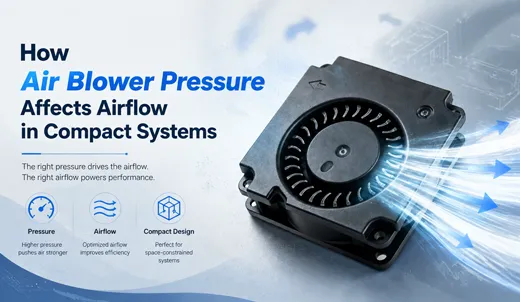
Fundamental Concepts: Static Pressure, Airflow, and System Impedance
To select the correct cooling component, thermal engineers must evaluate three fundamental aerodynamic metrics that dictate thermal dynamics inside micro-enclosures:
- Volumetric Airflow (CFM / m³/h): Measuring the volume of air delivered per unit time, free-air CFM figures listed on datasheets reflect zero-impedance environments. In real-world compact systems, free-air ratings rarely correlate with actual cooling capability.
- Static Pressure (Pa / kPa / mmH₂O): Static pressure represents the directional force exerted by an Air Blower to push air through systemic obstacles. High static pressure enables a Micro blower to drive airflow across densely packed components, micro-heatsink channels, and restrictive filters.
- System Impedance (Backpressure): The total dynamic resistance created by the hardware enclosure against moving air. As airflow attempts to pass through narrow gaps, resistance rises non-linearly, forcing the air mover to operate along its specific Pressure-Volumetric Airflow (P-Q) curve.
A fundamental physical law applies to all air movers: static pressure and volumetric airflow share an inverse relationship along the operational P-Q curve. When system backpressure escalates, usable airflow decays. If static pressure capability is insufficient, air stalls, causing heat accumulation and localized thermal runaway.
Axial Fans vs. Centrifugal Micro Blowers in Compact Architectures
Understanding the structural and aerodynamic differences between standard axial fans and specialized centrifugal micro blowers is essential for selecting the appropriate thermal subsystem.
| Parameter | Compact Axial Fan | TKFAN Micro Blower (Centrifugal) |
|---|---|---|
| Air Intake / Exhaust Vector | Parallel axial flow (in & out in same axis) | Axial intake, 90° radial centrifugal exhaust |
| Backpressure Resistance | Poor; suffers aerodynamic stall at high impedance | Exceptional; maintains high airflow at elevated pressure |
| Ideal Application Space | Unrestricted open-frame chassis ventilation | Dense PCBs, micro-ducts, sealed enclosures, filters |
| Voltage Customization | Standard 5V, 12V DC | 2V, 3.3V, 5V, 12V DC battery-optimized variants |
| Dimensions Range | Typically limited under 25mm footprint | Ultra-thin profiles: 18x18x4mm up to 40x40x10mm+ |
Table 1: Structural and aerodynamic comparison between standard axial fans and TKFAN Micro blower centrifugal systems.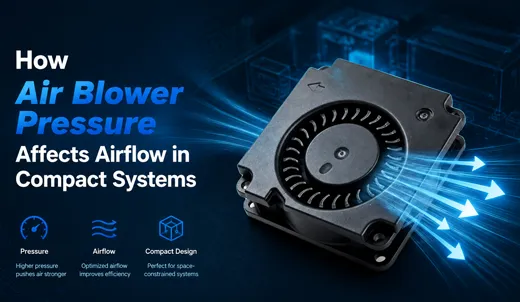
Why Compact Systems Generate Extreme System Backpressure
As mechanical design trends move toward smaller, sleeker form factors, internal airflow paths shrink. Four main engineering factors compound to create severe system impedance inside compact devices:
1. High-Density PCB Component Stacking
Modern electronic devices feature multi-layer PCBs crowded with SOCs, PMICs, memory modules, RF shielding, and battery packs. This density leaves sub-millimeter clearances for air clearance. When air travels past sharp component edges and dense arrays, friction and turbulence create severe static resistance. Standard axial fans lose velocity instantly, whereas a TKFAN Micro blower delivers the static pressure required to force cool air through narrow board gaps.
2. Micro-Fin Heatsink Assemblies
To maximize heat dissipation within tiny footprints, engineers utilize ultra-dense fin pitch heatsinks. While tight fin spacing increases surface area, it drastically increases aerodynamic resistance. If an Air Blower lacks adequate static pressure, air bypasses the fin array entirely, causing localized thermal spikes on critical silicon dies.
3. Restrictive Ingress/Egress Ports and Tight Ducts
Industrial design, ingress protection (IP ratings), and cosmetic constraints often limit air vent dimensions. Air forced through micro-perforated grills or forced around sharp 90-degree internal ducts undergoes static pressure loss. A specialized Micro blower converts rotational energy into directional pressure, maintaining high throughput despite restrictive venting.
4. Particulate and Protection Filters
Portable medical analyzers, wearable clean-air devices, and outdoor sensors require dust filters, HEPA membranes, or moisture barriers. Protective membranes impose heavy pressure loads on the cooling subsystem. While axial fan airflow collapses under filter resistance, an optimized Air Blower overcomes filter drag to deliver reliable operational flow.
How Micro Blower Engineering Preserves Airflow Under Load
Centrifugal micro blowers operate on radial dynamic acceleration. Air enters axially at the impeller center, accelerates radially through centrifugal force, and exits at a 90-degree angle through a volute housing. This structural configuration inherently generates higher static pressure than axial designs.
The TKFAN Micro blower portfolio leverages three core engineering advancements to sustain pressure performance in high-impedance environments:
- Aerodynamically Optimized Impellers: Precision-molded impeller geometry converts kinetic rotational energy directly into static pressure head. Models such as the 18x18x4mm (BA1804), 20x26x8mm (BA2008), and 35x35x10mm (BA3510) deliver consistent static pressure even when overall height is restricted to a few millimeters.
- High-Efficiency Brushless DC (BLDC) Motors: TKFAN integrates multi-phase BLDC motors engineered for maximum torque density and low power consumption. This allows low-voltage (2V–5V DC) battery-operated devices to achieve high rotational speeds and pressure output without draining battery life. Integrated PWM speed control enables closed-loop thermal regulation based on real-time board temperatures.
- Precision Volute Housing Tight Tolerances: Air leakage between the impeller tips and internal housing degrades static pressure capacity. TKFAN housings are molded from UL94V-0 flame-retardant engineering plastics with tight manufacturing tolerances, preventing internal pressure losses across thousands of operating hours.
Real-World Case Studies: Solving High-Impedance Thermal Challenges
Portable Medical Diagnostic Devices & CPAP Accessories
Handheld blood analyzers, personal air samplers, and portable CPAP accessories feature narrow tubing, internal filtration, and dense control electronics. Operating an axial fan leads to air stagnation, sensor drift, and thermal shut-offs. Installing a medical-grade TKFAN Micro blower supplies high static pressure to drive stable airflow across filters and micro-channels, ensuring accurate fluidic readings and reliable operation under low-voltage battery power.
AR/VR Smart Glasses and Headsets
Next-generation augmented and virtual reality headsets integrate high-power processors, display drivers, and batteries within tight head-mounted frames. The internal chassis leaves minimal ventilation space. Compact 18mm and 20mm Micro blower models fit within temple arms or optics modules, pushing cooling air through micro-ducts to prevent SOC throttling without adding noticeable weight or operational noise.
Miniature Laser Projectors & Smart Home Hardware
Pocket-sized laser projectors generate concentrated thermal loads within tiny enclosures. Cooling air must pass through ultra-fine copper fins and narrow exhaust ports. Replacing axial fans with the TKFAN BA4010 series (40x40x10mm, 5V DC) delivers up to 0.23 kPa of static pressure, maintaining stable airflow, reducing chip temperatures, and extending light engine lifespan.
Micro Fuel Cell Systems
Portable fuel cell stacks require forced-air oxygen feed delivered directly into small flow channels under pressure. Low-pressure axial fans fail to push reactants through the stack membrane. A specialized Air Blower provides continuous pressure, ensuring consistent electrochemical reaction rates and stable output wattage.
Common Thermal Engineering Pitfalls & System Optimization
To avoid thermal performance failures in product development, design teams should watch for four frequent selection errors:
- Relying Exclusively on Free-Air CFM: Datasheet open-air CFM numbers do not reflect high-impedance operation. Always evaluate airflow at your system's estimated operating static pressure point on the P-Q curve.
- Omitting System Resistance Calculations: Failing to model the pressure drop caused by heatsinks, air bends, and filters leads to undersized fan selection. Early physical prototype pressure testing is strongly recommended.
- Directly Comparing Axial Fan and Micro Blower Specs: Axial fans and centrifugal blowers feature fundamentally different P-Q curve slopes. A micro blower with lower open-air CFM will outperform a higher-CFM axial fan under backpressure.
- Ignoring Power-to-Pressure Efficiency: Generating high static pressure increases electrical draw. Selecting custom low-voltage, high-efficiency BLDC drivers ensures long battery runtimes in mobile devices.
Best Practices for Integration
- Align the Air Blower exhaust port directly with heatsink channels to eliminate turbulence losses.
- Use 4-wire PWM-controlled TKFAN Micro blower units for dynamic closed-loop temperature control, reducing acoustic noise during low-load operation.
- Minimize abrupt 90-degree duct turns immediately upstream of the air intake.
Technical FAQ: Air Blowers in Compact Systems
Q1: When should I choose a Micro Blower over a mini axial fan for a compact device?
Select a Micro blower whenever the airflow path faces high physical resistance—such as dense heatsink fins, dust filters, micro-ducts, or densely packed PCBs. Axial fans are best suited for open, unhindered ventilation, whereas centrifugal blowers are built to overcome backpressure.
Q2: How does static pressure affect actual airflow inside a restricted enclosure?
Static pressure is the driving force that pushes air through system resistance. Higher static pressure capability prevents airflow collapse, ensuring air passes through narrow gaps and dissipates heat effectively under load.
Q3: Can low-voltage (2V–5V DC) micro blowers deliver high static pressure?
Yes. Customized TKFAN Micro blower solutions incorporate high-torque BLDC motors and aerodynamically tuned impellers, enabling substantial static pressure delivery under low-voltage battery power.
Q4: How do I read an Air Blower P-Q performance curve?
The horizontal axis represents volumetric airflow (CFM), and the vertical axis represents static pressure. Identify your system’s estimated resistance on the vertical axis, then read across to determine the true delivered airflow along the curve.
Q5: Why do axial fans stall in high-impedance applications?
Axial fan blades rely on lift mechanics that lose effectiveness when downstream backpressure equals or exceeds the fan's maximum pressure rating. Air recirculates around the blade tips, causing aerodynamic stall and flow reduction.
Q6: How does pulse-width modulation (PWM) benefit micro blower operation?
PWM allows dynamic speed adjustment based on real-time temperature feedback. At lower thermal loads, blower speed decreases to save power and minimize acoustic noise; at peak loads, speed ramps up to provide full pressure and airflow.
Q7: What customization options are available for TKFAN Micro Blower products?
TKFAN offers OEM/ODM customization covering operating voltage (2V–12V DC), lead wire lengths, connector types, bearing assemblies (sleeve/ball), PWM/FG signal outputs, and custom mounting flanges.
Q8: How does housing precision affect Air Blower efficiency?
Tight tolerances between the housing volute and impeller blades prevent high-pressure air from slipping back to the low-pressure intake, preserving overall static pressure output and mechanical efficiency.
Q9: Are TKFAN Micro blowers suitable for medical-grade devices?
Yes. TKFAN products utilize UL94V-0 compliant materials, offer stable flow performance for micro-fluidics and sampling, and integrate FG tachometer feedback for closed-loop safety monitoring required in medical designs.
Q10: Is higher static pressure always better for thermal cooling?
Not necessarily. Static pressure capability should match system resistance with a reasonable margin. Excessively high static pressure increases power consumption and acoustic output without providing additional cooling benefits.
Conclusion: Pressure Defines Real-World Cooling Performance
In modern miniaturized electronics, open-air CFM numbers are purely theoretical. A cooling system’s actual performance depends on its static pressure capability—the ability of an Air Blower to drive airflow through narrow, high-resistance internal geometries.
By replacing traditional axial fans with an engineered TKFAN Micro blower, thermal engineers can overcome backpressure bottlenecks, avoid thermal throttling, and maintain reliable performance across wearable devices, portable medical hardware, AR/VR displays, and micro fuel cells.
GET A QUOTE