

AC 220V vs DC 24V Blower: What Are The Real Differences?
When design engineers, procurement directors, and Original Equipment Manufacturer (OEM) system designers specify a centrifugal blower for forced thermal management, toxic exhaust extraction, industrial drying processes, or sealed enclosure ventilation, one of the earliest infrastructure choices revolves around operating supply voltage: selecting a 220V AC blower or a 24V DC blower. At first glance, a novice buyer might assume the fundamental difference is limited purely to the electrical input standard. However, looking under the hood reveals deep structural contrasts across motor topology, auxiliary power conversion hardware, static pressure curves, dynamic speed regulation, total cost of ownership (TCO), and thermal endurance.
Too often, engineering teams default to selecting air movers based on legacy Bill-of-Materials (BOM) patterns rather than conducting a full system-level electrical and aerodynamic analysis. This design shortcut frequently leads to costly engineering oversights: insufficient static pressure under heavy filtration loads, premature thermal degradation of auxiliary power components, inflated hardware procurement costs, or inadequate airflow deliverability when overcoming real-world duct resistance. This comprehensive engineering guide breaks down the true functional and operational differences between high-performance 220V AC blowers and compact 24V DC blowers, assisting equipment builders in choosing the optimal air-moving solution for demanding applications.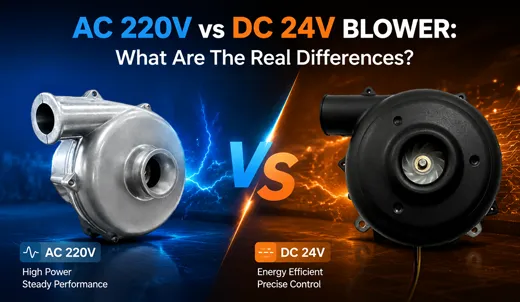
Fundamental Definitions: What Are 220V AC and 24V DC Blowers?
Understanding the 220V AC Blower
A 220V Air Blower is a heavy-duty air-moving machine designed to plug directly into standard single-phase 220V-240V AC municipal or industrial power grids worldwide. Traditional AC blowers historically relied on legacy AC induction motors. However, modern high-efficiency units—exemplified by the premium TKFAN 220V Blower line—utilize advanced AC-input Brushless DC (BLDC) motor technology featuring integrated or external high-voltage drive electronics. This configuration allows direct 220V AC grid connectivity without requiring an intermediate low-voltage DC power supply transformer.
Engineered primarily for heavy industrial duty cycles, high-voltage 220V Blower units excel in overcoming steep system impedance created by multi-stage HEPA filters, dense heat exchangers, complex duct networks, and hermetically sealed enclosures.
Understanding the 24V DC Blower
Conversely, a 24V Air Blower operates strictly on a 24-Volt Direct Current electrical supply. Virtually all modern 24V air blowers employ Brushless DC (BLDC) motor architecture, which cannot interface directly with high-voltage AC wall sockets. To operate a 24V Blower within a grid-powered piece of machinery, electrical designers must install an auxiliary AC-to-DC switching power supply (SMPS) module to step down and rectify 220V AC utility power to a regulated 24V DC rail.
Deploying a TKFAN 24V Air Blower is standard across automated control panels, portable medical equipment, precision laboratory analytical instruments, and battery-powered vehicle systems. Their core advantages center around low-voltage human touch safety, compact form factors, and fine-grained PWM control. However, in high-power industrial installations, low operating voltages impose severe electrical current limitations that cap achievable static pressure and airflow scalability.
Direct Comparison Matrix: 220V AC Blower vs. 24V DC Blower
The table below provides a detailed side-by-side engineering evaluation of performance parameters, system overhead, and operational constraints between modern high-voltage AC-input BLDC blowers and low-voltage DC blowers:
| Comparison Dimension | 220V AC Blower (TKFAN AC-Input Brushless) | 24V DC Blower (Brushless BLDC) |
|---|---|---|
| Power Input Source | Direct 220V AC mains utility supply; zero external power supply required. | Requires external AC-to-DC switching power supply (220V AC to 24V DC). |
| Motor Architecture | High-voltage AC-input BLDC with integrated/external PCB drive. | Low-voltage DC brushless motor driven by internal micro-controller chip. |
| Peak Static Pressure Capability | Extreme High Pressure; TKFAN 220V Blower models reach up to 18 kPa. | Low to Moderate; high static pressure demands excessive DC current draw. |
| Speed Control & Feedback | PWM / 0-10V Analog Speed Control + FG Tachometer Feedback signal. | PWM / 0-10V Analog Speed Control + FG Tachometer Feedback signal. |
| Motor System Efficiency | High efficiency, up to 85% motor conversion rating. | Typical range 75% – 82% (excluding AC-DC conversion losses). |
| BOM & Integration Cost | Low total system cost; eliminates secondary power supply hardware. | Higher BOM cost; requires heavy-duty rated 24V DC power modules. |
| Electrical Safety Classification | High voltage (220V); mandates insulation, grounding, and creepage standards. | SELV (Safety Extra Low Voltage); negligible shock risk to operators. |
| Continuous Heavy-Duty Operation | Designed for 24/7 continuous industrial operation under max load. | Supports continuous running; power supply unit (PSU) often becomes thermal bottleneck. |
| Form Factor & Size Range | Extensive size range, from medium OEM models to large industrial housings. | Predominantly compact, small-to-medium footprint designs. |
| Typical Application Scenarios | Industrial dust extraction, Fume removal, Air knife drying, HEPA filtration. | PLC enclosure cooling, portable medical devices, automotive, 3D printing. |
Key Integration Takeaway: Performance gaps extend beyond raw motor specifications. The choice between an AC or DC blower dictates auxiliary power supply sizing, thermal management inside control cabinets, and structural BOM costs—factors frequently overlooked during preliminary component selection.
Deep Dive Analysis: Critical Operational Differences
1. Power Supply Architecture and System Integration Overhead
The operational gap between a 220V Air Blower and a 24V Blower stems primarily from overall system complexity and electrical infrastructure setup.
A high-grade TKFAN 220V Blower plugs directly into standard single-phase AC utility grids. By removing the need for intermediate AC-DC converter modules, system architects eliminate an extra procurement line item, streamline physical component layout, reduce cabinet assembly labor, and eradicate a primary electrical failure point. For large-scale industrial machinery operating on standard grid power, high-voltage AC units deliver a true "plug-and-play" installation experience.
Conversely, installing a high-wattage 24V Air Blower in an AC-powered system requires sizing and mounting a dedicated AC-DC industrial switching power supply. Operating multiple high-output 24V DC blowers simultaneously demands sizable current draw. This necessitates larger power supply units (PSUs), which generate internal cabinet heat, add chassis weight, consume valuable rail space, and require additional electrical safety certifications (such as UL, CE, and CB). If an AC-DC converter degrades or overheats over time, forced ventilation fails entirely—even if the blower motor itself remains in perfect working order.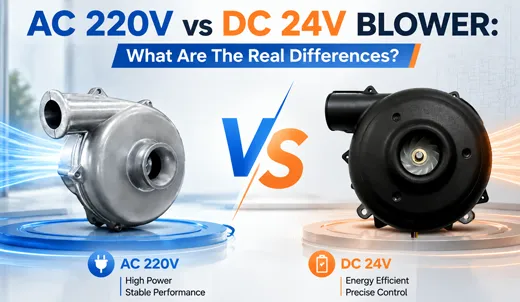
2. Static Pressure Performance, Airflow Volume, and Aerodynamic Load
When air must be forced through dense particulate HEPA filters, long ductwork, tight bends, or pressurized cooling jackets, static pressure performance determines whether a blower can deliver its target volumetric airflow rate.
Modern high-voltage AC-input brushless blowers, such as the TKFAN 220V Blower series (e.g., model BA8060H02B), deliver static pressures up to 18 kPa alongside airflow volumes reaching 33 CFM. Operating at high voltage allows these motors to draw smaller line currents while delivering massive mechanical work. Generating equivalent static pressure with a low-voltage 24V system would require drawing massive amperage. High current draw forces engineers to specify thick copper wire gauges, heavy-duty connectors, and larger heat sinks to handle resistive copper losses ($I^2R$ heat losses).
As a result, high-impedance applications—such as industrial fume extraction, laser cutter ventilation, process air drying, and multi-stage air purification—greatly benefit from the aerodynamic power density offered by a heavy-duty 220V Blower.
3. Speed Regulation, Signal Control, and Industrial Automation
Modern automated machinery dynamically adjusts fan speeds based on real-time temperature telemetry, pressure sensor readings, or filter clog states.
A historical complaint against traditional AC induction blowers was their fixed operational speed tied directly to grid frequency (50/60 Hz). However, modern AC-input brushless blowers, including the 220V Air Blower family from TKFAN, feature advanced onboard drive electronics that support PWM speed adjustment, 0-10V analog voltage control inputs, and Frequency Generator (FG) tachometer speed feedback output signals. These features enable direct closed-loop control via Programmable Logic Controllers (PLCs) and industrial IoT gateways, matching the advanced control capabilities typically associated with DC blowers.
Selecting a 24V Blower offers straightforward signal line integration because control signal grounds share a common DC bus with host PLC logic. Integrating a high-voltage 220V AC blower requires proper galvanic isolation between the low-voltage control interface and high-voltage power lines to prevent ground loop noise—a straightforward engineering step easily handled during initial control PCB layout.
4. Energy Efficiency, Thermal Output, and Service Life
Legacy single-phase AC induction blowers operated with poor electrical efficiency, typically between 30% and 45%, converting excess input energy into waste heat that shortened motor bearing life. Modern high-voltage brushless AC blowers have eliminated this efficiency gap.
The modern TKFAN 220V Blower achieves system energy efficiency ratings up to 85%, reducing electrical power consumption by up to 60% compared to legacy induction motors. Equipped with dual-precision ball bearings and advanced thermal protection, these units offer an operating lifespan reaching up to 70,000 hours under rated operating conditions.
While a TKFAN 24V Air Blower delivers excellent efficiency under light-to-moderate aerodynamic loads, pushing low-voltage motors to high pressure limits increases electrical current draw. This elevated amperage leads to resistive heat buildup in motor windings and PCB components. Additionally, system designers must account for efficiency losses inside the AC-DC switching power supply (typically 10%–15% power loss), which lowers total wall-to-shaft energy efficiency across 24V power setups.
Strategic Selection Framework: Which Blower Fits Your Project?
Choose a 220V AC Blower If Your Project Requires:
- Direct integration with standard 220V-240V single-phase grid power without adding auxiliary AC-DC power supplies.
- High static pressure performance (up to 18 kPa) to overcome significant system resistance from HEPA filters, dense heat exchangers, or extended ducting.
- Continuous 24/7 heavy-duty operation in demanding industrial environments such as dust collection, fume extraction, or air knife drying systems.
- Minimized overall Bill-of-Materials (BOM) hardware costs, reduced panel space usage, and simplified cabinet thermal management.
- Maximum airflow delivery from a single compact blower assembly without requiring multiple parallel low-voltage fans.
Choose a 24V DC Blower If Your Project Requires:
- Compatibility with existing low-voltage 24V DC control buses, mobile battery systems, or solar-powered installations.
- Compliance with strict Safety Extra Low Voltage (SELV) human touch requirements for accessible commercial or consumer devices.
- Installation in applications with short air paths, low static resistance, and unrestricted airflow, such as server racks or small control cabinets.
- Integration into ultra-compact, portable medical instruments, mobile diagnostic equipment, or desktop 3D printers.
Frequently Asked Questions (FAQ) - Technical Selection
Q1: Can a 24V DC blower achieve the same high static pressure as a 220V AC blower?
While theoretically possible, achieving high static pressure (e.g., above 10 kPa) with a 24V DC blower requires extremely high current draw. This excessive amperage demands heavy-gauge wiring, larger power supply units, and advanced heat sinking, significantly increasing thermal stress and overall system cost. For high static pressure industrial applications, a high-voltage 220V Blower offers a much more efficient and cost-effective design choice.
Q2: Do modern 220V AC blowers support variable PWM speed control?
Yes. Legacy AC induction blowers operated at fixed speeds tied to line frequency. However, modern AC-input brushless models, such as the TKFAN 220V Blower series, feature integrated driver boards that fully support PWM speed control, 0-10V analog voltage modulation, and FG tachometer feedback signals for seamless integration into PLC-driven automated systems.
Q3: Is a 24V DC blower inherently safer than a 220V AC blower?
A 24V DC system operates within Safety Extra Low Voltage (SELV) limits, minimizing electrical shock hazards in exposed or consumer-facing environments. However, when properly installed, grounded, and insulated to standard industrial codes, a 220V Air Blower is fully safe for long-term commercial and industrial operation.
Q4: How does an AC-DC power supply impact total 24V DC blower system efficiency?
Auxiliary AC-to-DC switching power supplies typically operate at 85% to 92% electrical efficiency. This conversion loss drops the overall wall-to-shaft efficiency of a 24V blower setup. In contrast, an AC-input brushless 220V Blower connects directly to AC mains power, eliminating secondary power supply conversion losses.
Q5: What is the expected service life comparison between 220V AC and 24V DC blowers?
Both product lines from premium manufacturers like TKFAN feature high-precision dual ball bearings, achieving up to 50,000 to 70,000 hours of continuous operation under normal working temperatures. However, high-amperage 24V setups can experience thermal stress at peak loads, making power supply quality a key factor in long-term system reliability.
Q6: Can I replace an existing 24V DC blower with a 220V AC blower?
Yes, provided your machinery has direct access to a 220V AC power line and sufficient internal space for high-voltage wiring and proper grounding. Upgrading to a TKFAN 220V Blower can significantly boost available static pressure while freeing up internal cabinet space by removing the 24V power supply.
Q7: How do ingress protection (IP) ratings compare between AC and DC blowers?
Both 220V AC and 24V DC blowers can be customized with advanced conformal coatings or complete potting encapsulation to meet IP55, IP67, or IP68 environmental standards. This ensures reliable operation in high-dust, humid, or corrosive industrial settings.
Q8: Which blower type offers lower noise output?
Acoustic noise is primarily determined by airflow velocity, impeller geometry, operating RPM, and motor commutation tuning rather than operating voltage. Both TKFAN 24V Air Blower models and 220V brushless versions utilize optimized dynamic balancing to minimize operational vibration and acoustic noise.
Q9: Why are 220V AC blowers preferred for long duct networks?
Long duct networks create high friction and system resistance (backpressure). A high-performance 220V Air Blower generates the high static head pressure required to overcome this resistance and maintain steady airflow along extended duct runs.
Q10: Can TKFAN customize blowers for OEM equipment applications?
Yes. TKFAN provides full OEM/ODM engineering support across both 220V AC and 24V DC product lines. Custom options include tailored voltage ranges, customized mounting flanges, modified PWM duty cycles, specialized wiring harnesses, and application-specific IP protection levels.
Summary & Engineering Recommendation
Selecting between a 220V Air Blower and a 24V Blower involves evaluating system-level trade-offs beyond simple unit pricing. While a 24V Air Blower is ideal for low-voltage safety requirements, compact instruments, and pre-existing 24V DC control buses, high-voltage 220V brushless blowers offer significant performance advantages for demanding industrial applications requiring high static pressure, simplified wiring, and maximum energy efficiency.
Explore the complete engineering specifications, dimensions, and P-Q performance curves on the official TKFAN 220V Blower product page, or consult our engineering team to select the ideal air-moving solution for your application requirements.
GET A QUOTE