

High-Performance 24V Brushless DC Blower Fans: The Definitive Guide for Medical, Automation, and Industrial Applications
Discover how premium 24V BLDC blowers optimize fluid dynamics, thermal management, and reliability across mission-critical equipment ecosystems.
1. Introduction: Why 24V BLDC Blower Fans Dominate Global Markets
In precision manufacturing, medical diagnostics, and Industry 4.0 automated production lines, the 24V brushless DC (BLDC) blower fan has become the preferred fluid control component for engineers and OEMs worldwide. While 12V configurations are common in consumer electronics and 48V units serve heavy-duty infrastructure, the 24V air blower offers the perfect equilibrium of voltage stability, space efficiency, and wide-range adaptability.
According to recent industry data, global demand for certified 24V BLDC centrifugal blowers has risen by 18.7% year-over-year. Within this landscape, medical-grade high-pressure blowers represent 42% of total exports, automation cabinet cooling units command 35%, and industrial process air systems account for the remaining 23%.
"Premium 24V blowers leverage brushless motor architecture to eliminate carbon brush wear, yielding operational lifespans ranging from 80,000 to 120,000 hours under continuous duty cycles."
2. Core Technical Advantages of Premium 24V Blowers
2.1 Standardized 24V DC Input & Integrated Intelligent Circuitry
A nominal DC 24V (±10%) input natively aligns with global industrial DC power grids and medical-grade switching power supplies. This standard compatibility allows seamless integration into portable battery-powered devices and industrial PLC buses without requiring costly transformers. High-quality 24V centrifugal fans feature onboard driver chipsets that provide comprehensive protections: over-voltage, under-voltage lockout, over-current shutdown, locked-rotor protection, and thermal rollback.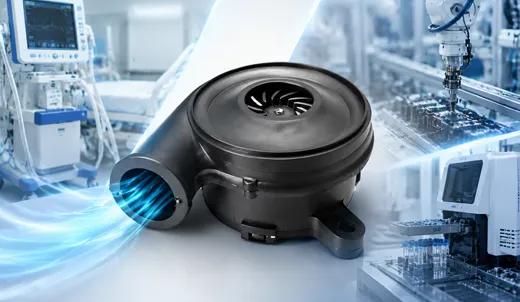
2.2 Precision Flow and Pressure Modulation
Advanced 24V blowers utilize backward-curved impellers and dynamic balancing techniques to ensure performance tolerances stay within ±2%. System designers can dynamically adjust motor speeds from 10% to 100% of nominal ratings using 0-5V analog signals or PWM duty cycles. This eliminates the inefficiencies of traditional fixed-speed legacy fans, reducing overall system power consumption by 22% to 38%.
| Blower Class | Static Pressure Range | Airflow Capacity | Acoustic Threshold |
|---|---|---|---|
| Low-Pressure Quiet | 2 kPa to 6 kPa | 8 CFM to 65 CFM | ≤32 dB(A) |
| Medium-Pressure Universal | 7 kPa to 22 kPa | 40 CFM to 130 CFM | 35 to 48 dB(A) |
| High-Pressure Heavy Duty | 23 kPa to 55 kPa | 15 CFM to 90 CFM | 45 to 60 dB(A) |
2.3 Low Vibration & Medical Materials Compliance
Medical environments demand rigorous control over acoustic signatures and structural vibration. Modern medical 24V fans feature precision dual-ball bearings and specialized housing geometries to minimize turbulence. For biological and clinical devices, housings are manufactured using FDA-compliant engineering plastics that resist outgassing and withstand repeated chemical disinfection without structural breakdown.
3. Deep-Dive Industry Applications
3.1 Medical Devices & Life Support Systems
Medical-grade 24V DC blowers serve as critical sub-components across five primary clinical vectors:
- Respiratory Therapeutics: Continuous Positive Airway Pressure (CPAP) systems, BiPAP machines, and critical care ventilators rely on low-inertia 24V fans to modulate airway pressure in real-time based on patient breathing profiles.
- In-Vitro Diagnostics (IVD) & Laboratory Analyzers: Real-time PCR thermal cyclers and biochemical analyzers use compact blowers to achieve strict internal temperature uniformity and negative-pressure containment.
- Dental & Optical Equipment: High-speed dental air systems and non-invasive ophthalmic diagnostic instruments integrate quiet 24V micro-blowers for precise air delivery.
- Advanced Medical Imaging: Large CT scanners, digital radiography (DR) suites, and ultrasound arrays employ 24V blowers to protect multi-layered PCB arrays from thermal drift.
- Cleanroom HEPA Filtration: Modular positive/negative air pressure isolate facilities utilize mid-pressure fans to drive air through high-efficiency particulate air (HEPA) matrices.
3.2 Industrial Automation & Industry 4.0
As automated assembly cells, robotic gantries, and PLC systems grow denser, dedicated 24V cooling fans provide essential thermal management:
- Enclosure & Servo Drive Thermal Management: High-output CNC control boxes and robotic electrical enclosures deploy 97x33mm or 76x20mm blowers to evacuate heat generated by servo amplifiers.
- Automated Electronics Rework and Soldering Systems: Multi-layer PCB assembly lines use high-pressure hot air blowers to apply uniform heat arrays during component alignment.
- Inline Air Knife Stripping Units: Industrial sorting and packaging lines use high-velocity blowers to drive air knives that clear surface dust, debris, and fluid residue.
- Industrial Additive Manufacturing: Large-scale FDM 3D printers rely on speed-controlled 24V fans to regulate layer-by-layer cooling and capture particulate emissions.
3.3 General Industrial Processes
From energy conversion to environmental controls, heavy-duty 24V fans provide reliable auxiliary air sources for hydrogen fuel cell test stations, localized laser fume extractors, and industrial environmental test chambers.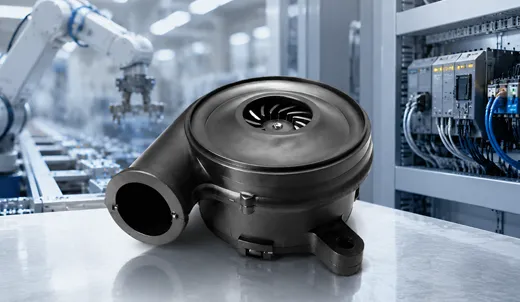
4. Engineering Selection Framework for 24V Blowers
To achieve maximum reliability, engineering teams should follow this step-by-step selection framework:
- Calculate Total System Impedance: Quantify the volumetric flow rate (CFM) and static pressure (kPa or inHg) requirements under worst-case operational loads. Incorporate a 15% to 20% safety margin to accommodate filter loading over time.
- Select the Correct Ingress Protection (IP) Rating:
- Indoor Automation Cabinets: IP44 to IP54 ratings provide adequate dust protection.
- Chemical Processing Plants: Upgrade to IP55 or IP67 sealed configurations.
- Corrosive or High-Humidity Environments: Specify aluminum die-cast housings or specialized anti-corrosion coatings.
- Define Control Interfaces: Match the system architecture with the correct blower control configuration, whether using fixed-frequency, 0-5V analog, or standard PWM speed modulation.
Technical Frequently Asked Questions (FAQ)
Q1: What distinguishes a medical-grade 24V blower from a standard industrial model?
A1: Medical-grade blowers comply with regulatory standards like ISO 13485 and use FDA-approved biocompatible materials. They are engineered for ultra-low structural vibration and low acoustic signatures, and often feature redundant protection circuitry. Industrial blowers prioritize raw static pressure, high IP ratings, and cost efficiency for non-clinical applications.
Q2: Are 24V BLDC blowers rated for continuous 24/7/365 operations?
A2: Yes. Premium 24V brushless DC blowers equipped with high-precision dual-ball bearings or fluid dynamic bearings are rated for 80,000 to 120,000 hours of continuous runtime. Routine maintenance is limited to keeping the air intakes free of debris and dust buildup.
Q3: How does intake restriction or static pressure affect blower power consumption?
A3: Centrifugal blowers feature unique load curves. When the air intake or exhaust faces high restriction (such as a blocked filter or closed valve), airflow drops, which reduces the load on the impeller. This causes the current draw and power consumption (Watts) to decrease, contrasting with axial fans which can stall or draw more power under high static pressure.
Q4: What parameters are customizable for non-standard 24V blower projects?
A4: Original equipment manufacturers can request custom discharge orientations, alternate housing materials (such as anti-static or aluminum), custom PWM performance profiles, specialized lead wire lengths, and application-specific IP ratings.
6. Summary and Future Industry Trends
High-performance 24V brushless DC blower fans remain vital components across the medical, automation, and industrial sectors. As downstream systems become smaller, smarter, and more energy-efficient, the demand for specialized blowers will continue to grow. Future innovations will focus on higher motor efficiency, embedded telemetry for predictive maintenance, and high-pressure micro-blowers designed for compact, portable devices.