

12V vs. 24V Blowers: Complete Technical Comparison and Selection Guide
An in-depth technical analysis of DC brushless centrifugal blower fans, electrical parameters, working principles, and industrial application scenarios.
In the fields of industrial thermal management, medical devices, precision electronics cooling, and localized ventilation systems, 12V blowers and 24V blowers represent the two most widely deployed categories of DC brushless centrifugal blower fans. Serving as the mechanical core of forced-air cooling systems, both variants utilize an advanced BLDC brushless motor architecture and a classic scroll-case centrifugal design. The primary differentiation lies within their rated DC input voltage. This single electrical variation fundamentally alters their internal circuit design, compatible power supply specifications, cabling dynamics, and operational efficiencies.
Design engineers, procurement managers, and system maintenance technicians frequently evaluate the distinct performance profiles of 12V and 24V cooling systems. Selecting an incorrect system voltage can lead to systemic failures, including insufficient airflow, high static pressure drop, motor overheating, or catastrophic control board burnout. Understanding the nuanced differences between a standard axial flow fan and a high-pressure DC centrifugal cooling blower is critical for optimal equipment integration.
1. What is a 12V Blower Fan?
1.1 Definition and Electrical Characteristics
A 12V blower is a localized centrifugal forced-air mover engineered to operate at a nominal input voltage of 12 Volts Direct Current (DC), driven by an integrated brushless DC motor. This 12V rating is the factory-designed baseline for the internal copper stator windings, the control PCB, and the driver chipsets. To achieve the manufacturer's rated RPM, maximum volumetric airflow, and static pressure, the fan must receive a stable 12V DC input. Most commercial-grade 12V blowers feature a wide voltage tolerance range (typically 10.8V to 13.2V) to accommodate voltage ripples from unregulated lithium battery packs or switching power supplies.
1.2 Power Supply Integration and Compatibility
The primary advantage of the 12V architecture is its native compatibility with consumer-grade low-voltage power infrastructure. A 12V DC bus is standard across automotive electrical architectures, desktop PC power supplies (ATX systems), consumer lithium-ion battery modules, LED drivers, and open-source development platforms like Raspberry Pi and Arduino. Integrating a 12V blower eliminates the need for auxiliary step-up or step-down DC-DC voltage regulators, which optimizes PCB layout space, reduces components, and shortens engineering design cycles.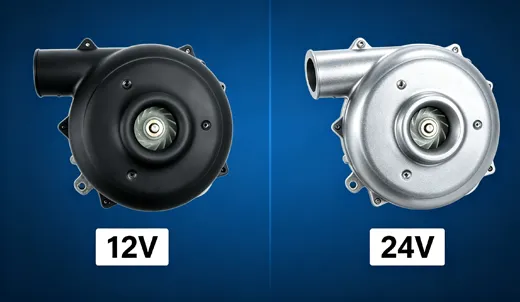
1.3 Primary Applications
12V blowers are ideal for space-constrained, portable, or consumer-oriented thermal applications including:
- Medical Devices: Portable CPAP machines, desktop diagnostic analyzers, and thermostatic medical warming blankets.
- Consumer Electronics: Desktop FDM 3D printers (part cooling nozzles), micro-air purifiers, and localized AV equipment enclosures.
- Automotive & HVAC: Specialized car seat ventilation modules, compact 12V portable refrigerators, and small-scale off-grid power inverters.
2. What is a 24V Blower Fan?
2.1 Technical Specifications and Electrical Efficiency
A 24V blower is a heavy-duty air-moving assembly engineered to operate optimally at a nominal 24 Volts DC supply. Its internal motor windings, commutation logic arrays, and Hall-effect sensing pathways are built to meet 24V electrical standards. While it shares the same physical scroll casing and centrifugal aerodynamic properties as its 12V counterpart, its electronic components feature a much higher dielectric voltage breakdown threshold. Commercial 24V blowers typically support an operational envelope of 21.6V to 26.4V to tolerate industrial power grid fluctuations.
From an electrical engineering perspective, applying Ohm's Law and the power formula demonstrates that at an equivalent wattage ($P = I \times V$), a 24V blower draws exactly half the nominal current ($I$) required by a 12V model. This reduction in current draw minimizes resistive $I^2R$ copper losses along the supply lines, resulting in lower thermal dissipation from the wiring harnesses. This characteristic is crucial for distributed multi-fan arrays or applications requiring long electrical cable runs.
2.2 Industrial Automation and Power Infrastructure
The 24V DC specification serves as the global standard for industrial automation control topologies. Programable Logic Controller (PLC) cabinets, industrial fieldbus networks, servo drive systems, and robotic assembly corridors rely on a centralized 24V DC power distribution bus. Selecting a 24V blower allows system designers to connect the cooling hardware directly to the existing control power rails. This eliminates line-voltage conversion hardware, prevents parasitic energy loss from step-down processes, and reduces the component point-of-failure count within critical control panels.
2.3 Typical Deployment Environments
24V blowers excel in ruggedized, high-duty-cycle industrial environments, including:
- Industrial Automation: Heavy-duty electrical switchgear enclosures, CNC machine control centers, and factory automation drive bays.
- Large-Scale Thermal Equipment: High-capacity commercial lab dehydrators, industrial dehumidification stations, and precision fiber laser cutting power modules.
- Infrastructure Systems: Outdoor telecom basestation bays, smart environmental monitoring arrays, and mass transit ventilation subsystems.
3. Unified Working Principles of DC Brushless Centrifugal Blowers
Despite their different voltage ratings, 12V and 24V DC centrifugal cooling blowers share identical aerodynamic and electro-mechanical operating mechanics. Below is the technical breakdown of their shared architecture.
3.1 Mechanical and Structural Components
| Component | Technical Function |
|---|---|
| BLDC Brushless Motor | Provides electronic commutation to eliminate mechanical brush wear, maximizing operational lifespan. |
| Control PCB Array | Regulates voltage input, manages step-phase transitions, and decodes PWM speed signals. |
| Hall-Effect Sensor | Tracks real-time rotor position to ensure precise electronic timing and phase synchronization. |
| Centrifugal Impeller | Features forward-curved or backward-curved radial fins to impart kinetic energy into the air. |
| Scroll Volute Casing | Converts high-velocity kinetic airflow into static air pressure using a expanding aerodynamic path. |
3.2 Aerodynamic Pressure Generation
When current passes into the stator assembly, the resulting magnetic force causes the centrifugal impeller to spin at high speeds. Air is drawn axially into the center of the intake hub, where the rotating blades accelerate the air molecules outward toward the inner wall of the scroll volute casing. As the cross-sectional area of the scroll casing expands, it slows down the air velocity and converts kinetic energy into static pressure. This high-pressure airstream is then directed out of the rectangular exhaust nozzle. This high-pressure output enables blowers to push air through restrictive paths like dense HEPA filters, liquid cooling radiators, and narrow ventilation ducts where conventional axial fans would stall.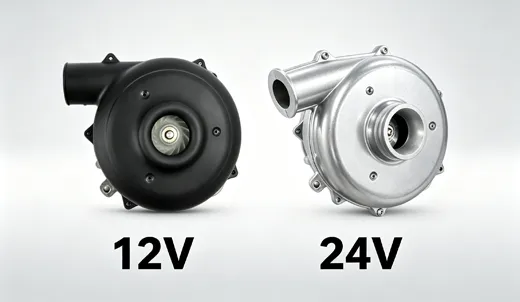
3.3 Electronic Commutation and Control Circuits
Both voltage variants utilize identical electronic commutation logic. An onboard microcontroller or driver IC switches power across the stator phases based on real-time feedback from the Hall-effect sensor. This creates a rotating magnetic field that drives the permanent-magnet rotor. Because this design eliminates mechanical carbon brushes, it prevents friction wear and arcing issues, delivering a reliable lifespan ($L_{10}$) often exceeding 50,000 to 70,000 continuous hours under nominal conditions. Additionally, both 12V and 24V systems can feature a dedicated 4-wire PWM (Pulse Width Modulation) control loop. This allows the host controller to adjust the fan's RPM on demand based on system temperatures, which helps optimize energy use and reduce acoustic noise levels.
4. System Selection Matrix: 12V vs. 24V
When designing a system, selecting between a 12V and a 24V blower depends on the power infrastructure and environmental conditions of your application.
Choose a 12V Blower Fan when:
- The system runs on native low-voltage DC power sources like single-stage lithium batteries, 12V vehicle electrical buses, or typical 12V AC-DC consumer adapters.
- Developing portable or handheld consumer hardware where weight, battery integration space, and localized electronics cost are primary design limits.
- The distance between the power source and the blower motor is less than one meter, making line voltage drop negligible.
Choose a 24V Blower Fan when:
- The blower integrates into a factory automation grid, PLC control cabinet, or heavy industrial machinery utilizing a standard 24V DC bus.
- The application requires long wiring harnesses or multiple fans wired in parallel. The lower current draw of 24V systems minimizes resistive losses and prevents voltage drops across the harness.
- The system operates continuously in heavy industrial environments where reduced component operating temperatures and high reliability are essential.
Technical FAQ
Q1: Can I connect a 12V blower to a 24V power supply, or vice versa?
Connecting a 12V blower to a 24V supply causes immediate over-voltage damage to the internal PCB components, potentially causing stator burnout or component failure. Conversely, running a 24V blower on a 12V supply will usually under-volt the internal driver IC, preventing it from starting or causing it to run at a significantly lower speed, which will not meet the rated airflow or static pressure requirements.
Q2: Does a 24V blower deliver more airflow and pressure than a 12V blower?
If both fans share identical physical housing, impeller geometries, and motor wattages, their volumetric airflow (CFM) and static pressure outputs will be nearly identical. The 24V model does not inherently deliver higher aerodynamic performance; instead, it offers greater electrical efficiency by achieving that performance with half the nominal current draw of the 12V model.
Q3: How do I control the speed of 12V and 24V DC brushless centrifugal blowers?
The most reliable method is using a 4-wire configuration with a Pulse Width Modulation (PWM) signal. The host system sends a high-frequency logic signal (typically 25kHz) to the fan's internal controller, adjusting the speed by varying the signal's duty cycle. For 2-wire or 3-wire models that lack a dedicated PWM pin, speed can be adjusted by varying the DC supply voltage within the fan's safe operational tolerance window.
Q4: Why does a centrifugal cooling blower generate higher static pressure than an axial fan?
Axial fans move air parallel to the blades, which makes them susceptible to backpressure stalls. Centrifugal blowers use a high-speed impeller to accelerate air radially outward, using centrifugal force to compress the air against the expanding inner wall of the scroll volute casing. This mechanical compression converts kinetic energy into high static pressure, allowing the blower to push air efficiently through restrictive paths.