

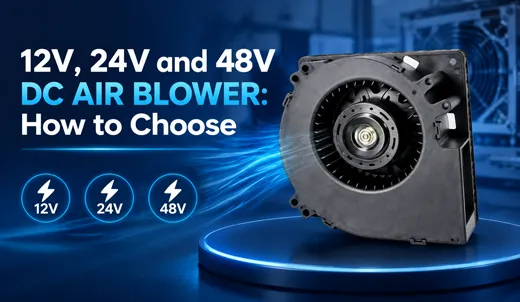
12V, 24V, and 48V DC Air Blower Selection Guide for OEM Engineers
Selecting the optimal operating voltage is one of the most critical thermal management decisions OEM engineers face when integrating high-static pressure fans into modern equipment. Unlike conventional low-pressure axial fans, a DC air blower (brushless centrifugal blower) is specifically engineered to force air through high-resistance pathways by redirecting airflow at a 90-degree angle. This mechanism builds substantial static pressure necessary to overcome dense HEPA filters, intricate ducting, and tightly packed electronic enclosures.
Choosing between a 12V DC air blower, a 24V DC air blower, and a 48V DC air blower involves much more than simply matching an available power supply. It dictates motor torque efficiency, operating current levels, wire harness thermal losses, acoustic noise signatures, voltage spike tolerance, and overall system longevity. You can explore the complete range of industrial and medical grade blowers directly on the TKFAN DC Air Blower Product Catalog.
1. Fundamental Electrical Physics Behind DC Air Blower Selection
To understand why voltage selection dictates thermal performance, OEM design engineers must evaluate two fundamental electrical formulas governing brushless DC (BLDC) motor operations:
- Electric Power Equation: \( P = U \times I \) (Power = Voltage × Current)
- Joule's First Law (Thermal Line Loss): \( P_{loss} = I^2 \times R \) (Power Loss = Current Squared × Resistance)
Under a constant wattage output requirement (for instance, a 48W high-pressure blower system), doubling the system voltage cuts the drawn current directly in half. Consequently, according to Joule's law, halving the current reduces thermal line losses within the wiring harness and motor windings by an extraordinary 75%.
Key Engineering Rule: Quadrupling system voltage from 12V to 48V reduces $I^2R$ electrical heat dissipation by approximately 93.7%. This drastic reduction in line loss makes 48V DC air blowers the undisputed benchmark for high-power, long-distance, and 24/7 continuous industrial deployments.
Consequences of Voltage Mismatches & Spikes
Improper voltage sizing introduces operational risks that can jeopardize system reliability:
- Over-voltage Conditions (e.g., supplying 24V to a 12V DC air blower): Causes severe current overload, rapidly overheating the internal BLDC motor windings and destroying sensitive PCB drive electronics within minutes.
- Under-voltage Conditions (e.g., supplying 12V to a 24V DC air blower): Leads to inadequate magnetic torque. When facing high air resistance from dirty filters or long ducts, the blower will suffer severe RPM degradation or complete motor stall.
- Voltage Transient Spikes: Common in automotive alternators and battery-backed power grids. High-grade blowers must integrate transient voltage suppression (TVS) diodes and wide voltage tolerance windows.
To mitigate grid instabilities, TKFAN DC Blowers feature customized wide-input voltage windows: 12V models operate reliably from 10.5V to 13.8V, 24V models handle 20V to 30V, and 48V models accept 36V to 56V inputs without thermal breakdown.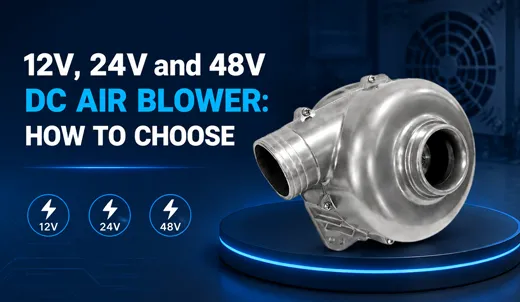
2. When to Choose a 12V DC Air Blower
The 12V DC air blower remains the most widely adopted low-voltage centrifugal blower across consumer, automotive, and portable electronic sectors. It is the default choice when equipment relies on native 12V DC bus architectures, battery packs, or automotive auxiliary power outlets without requiring additional DC-DC step-down converters. Discover all technical specs on the TKFAN 12V DC Air Blower Series Page.
Primary Application Scenarios for 12V DC Blowers
- Automotive Electronics & Autonomous Driving Systems: Vehicle power grids run natively on 12V battery buses. High-pressure 12V blowers are integrated into automotive seating ventilation, LED headlight active cooling, and autonomous sensor cleaning systems. Models like the TKFAN BA5025H12B-A and BA8050H12B-A generate up to 10.5 kPa of static pressure to purge water droplets, mud, and dust from external LiDAR and camera lenses.
- Portable & Compact Medical Devices: Battery-powered devices demand ultra-compact cooling. Ultra-thin 12V blowers (such as 30x10mm and 40x10mm formats) power portable sleep apnea devices, medical nebulizers, portable solder fume extractors, and desktop 3D printer hot-end cooling units.
- Micro-Lab Instruments & Compact IT: Low-flow air sampling particle counters, compact 5G routers, desktop laser engravers, and home networking hubs leverage 12V blowers for localized heat dissipation.
Advantages of 12V DC Air Blowers
- Universal Component Availability: 12V power supplies, AC adapters, lithium battery protection boards, and automotive connectors are mass-produced and cost-effective.
- Ultra-Miniature Form Factors: Physical limitations prevent high-voltage (48V) motor windings from fitting into micro-enclosures. 12V BLDC motors can be manufactured in micro-thin profiles down to 30mm x 10mm.
- SELV Safety Compliance: Operating well below the Safety Extra Low Voltage (SELV) limit of 36V DC simplifies safety certifications (UL, CE, IEC) without requiring high-voltage isolation barriers.
Key Limitations of 12V DC Air Blowers
Cable runs exceeding 5 meters experience pronounced voltage drop and thermal line losses. Furthermore, 12V models are less suited for multi-blower parallel configurations or continuous 24/7 industrial heavy-duty usage due to connector degradation from high sustained currents.
3. When to Choose a 24V DC Air Blower
Positioned as the standard for industrial automation and medical technology, the 24V DC air blower seamlessly bridges the gap between low-cost 12V portable blowers and heavy-duty 48V infrastructure blowers. It delivers reduced operating currents while staying safely within the SELV threshold. Browse options on the TKFAN 24V DC Air Blower Series Page.
Primary Application Scenarios for 24V DC Blowers
- Medical Ventilators & Respiratory Equipment: Clinical ICU mechanical ventilators, Continuous Positive Airway Pressure (CPAP) devices, and High-Flow Nasal Cannula (HFNC) machines universally specify 24V DC air blowers. They generate up to 24 kPa of static pressure to overcome thick medical-grade HEPA filters while keeping surface temperatures low and acoustic output under 20 dB(A). TKFAN BA8060H24B-E-25KPA models comply with ISO 10993 biocompatibility requirements for direct integration.
- Factory Automation & Machinery: Industrial PLC control cabinets, CNC machine tool cooling, air-cushion packaging machines, and industrial dust sampling aerosol monitors utilize 24V blowers. Wire runs of 5 to 20 meters experience minimal voltage degradation.
- Renewable Energy & Laboratory Systems: Hydrogen fuel cell stack ventilation, desktop aerosol samplers, and commercial laser cutters utilize standard 24V DC power rails for balanced efficiency and electrical safety.
Advantages of 24V DC Air Blowers
- 75% Reduction in Line Heat Losses: Compared to a 12V system of equivalent power, a 24V blower drastically reduces thermal stress on internal PCB components and wiring.
- SELV Certified: Fully compliant with touch-safe standards (< 36V DC), making it ideal for human-contact medical equipment and open office devices.
- Flexible Driver Configurations: Available with either internal integrated drivers or external PCB controllers, allowing flexible thermal management inside tight chassis.
4. When to Choose a 48V DC Air Blower
Engineered for mission-critical, continuous-duty industrial applications, the 48V DC air blower is designed for high-power demands, extreme static pressure maintenance, and long cable runs. It is the standard thermal solution for telecom cabinets, data centers, and commercial energy storage facilities. View the full catalog at the TKFAN 48V DC Air Blower Series Page.
Primary Application Scenarios for 48V DC Blowers
- Telecom Infrastructure & Data Centers: 5G outdoor base stations, telecom rectifier cabinets, server rack enclosures, and grid-scale battery energy storage systems (BESS) operate on 48V DC bus architectures. The TKFAN BA12032HV48X blower maintains stable air volume through dense dust filters over cable distances exceeding 20 meters.
- Heavy Industrial Air Filtration: Commercial fuel cell stacks, industrial air purifiers, factory air knife blowers, and continuous particulate monitoring networks utilize 48V blowers for maximum electrical efficiency and resistance to system pressure drops.
- Off-Grid Solar Energy Storage Systems: Commercial solar battery banks utilize 48V native architectures. Connecting a 48V blower directly eliminates DC-DC voltage conversion losses and reduces overall system complexity.
Advantages of 48V DC Air Blowers
- Maximum Electrical Efficiency: Cuts thermal line loss ($I^2R$) by ~93.7% compared to 12V equivalents, preserving energy in large-scale deployments.
- Reduced Copper Wiring Costs: Operating at lower currents allows the use of thinner gauge wire harnesses, reducing material expenses in large installations.
- Unmatched Pressure Maintenance: High-torque 48V BLDC motors maintain rated RPM and airflow even against high system impedance, multi-stage HEPA filters, and complex ducting.
Limitations of 48V DC Air Blowers
Operating above the 36V SELV threshold requires reinforced electrical insulation and touch-proof protective enclosures. Additionally, 48V blowers are generally unavailable in ultra-miniature sizes, typically starting at 120mm frame dimensions.
5. Detailed 12V vs 24V vs 48V Performance Comparison
The comparative matrix below outlines key engineering metrics across TKFAN's DC air blower catalog:
| Performance Parameter | 12V DC Air Blower | 24V DC Air Blower | 48V DC Air Blower |
|---|---|---|---|
| Operating Voltage Range | 10.5V – 13.8V DC | 20.0V – 30.0V DC | 36.0V – 56.0V DC |
| Relative Current (Equal Power) | 100% (Baseline) | 50% of 12V | 25% of 12V |
| Thermal Line Loss ($I^2R$) | 100% (Baseline) | 25% of 12V | 6.25% of 12V |
| Recommended Max Cable Distance | < 5 meters | 5 – 20 meters | > 20 meters |
| Typical Airflow Range | 2.5 CFM – 65.3 CFM | 6.0 CFM – 72.4 CFM | 34.8 CFM – 66.0 CFM |
| Maximum Static Pressure | Up to 12.5 kPa | Up to 24.0 kPa | Up to 10.0 kPa (Steady State) |
| SELV Safety Compliance (<36V) | Yes (Touch-Safe) | Yes (Touch-Safe) | No (Requires Isolation) |
| Micro Form Factor Availability | Yes (3010, 4010 Ultra-thin) | Medium (From 5025 size) | Large (From 12032 size) |
| 24/7 Continuous Heavy-Duty Rating | Moderate | Excellent | Optimal |
| Signal Control (PWM/FG/RD) | Fully Supported | Fully Supported | Fully Supported |
| Driver Integration Architecture | On-board Integrated PCB | Integrated / External Option | External Driver Controller |
6. Step-by-Step Voltage Selection Matrix for OEM Engineers
Follow this decision framework to identify the correct voltage spec for your application:
Step 1: Identify Native Equipment Power Bus
Always align the blower voltage with your main power bus (e.g., 12V automotive battery, 24V industrial supply, or 48V telecom bus). Introducing DC-DC converters adds PCB cost, increases space requirements, and introduces conversion energy losses.
Step 2: Evaluate Cable Harness Length
For wiring distances under 5m, 12V is suitable for low-power devices. For 5m–20m runs, choose 24V to prevent voltage drop. For cable runs exceeding 20m, select 48V to protect against airflow drop-off and motor stalling.
Step 3: Measure System Static Impedance
If your system forces air through dense multi-stage HEPA filters or complex ducting, select a 24V or 48V blower capable of maintaining high static pressure under load.
Step 4: Review Duty Cycle & Safety Norms
For medical devices or consumer electronics with accessible enclosures, stick to SELV-compliant 12V or 24V systems. For enclosed, professionally serviced 24/7 industrial cabinets, 48V provides the best long-term electrical reliability.
7. Frequently Asked Questions (Technical FAQ)
Q1: Can I replace a 12V DC air blower with a 24V version using a step-up DC-DC converter?
Yes, technically feasible, but adding a DC-DC converter increases component BOM cost, consumes PCB layout area, and introduces 5%–10% energy conversion losses. However, if your cable harness length exceeds 5 meters, the line efficiency gained by moving to 24V often offsets the converter loss. For short-distance portable devices, retaining native 12V is generally recommended.
Q2: What is the optimal DC air blower voltage for medical CPAP and ventilator systems?
The medical industry overwhelmingly specifies 24V DC air blowers. They comply with SELV touch-safety standards, easily overcome high HEPA filter impedance, and produce lower electrical noise and motor heat than 12V units. Check the TKFAN 24V Medical Blower Page for ISO 10993 compliant models.
Q3: Is a 48V DC air blower safe for equipment that operators can physically touch?
48V DC exceeds the 36V SELV safety threshold. While not inherently dangerous under normal conditions, wire damage or moisture ingress can pose electrical safety hazards. If a 48V blower is used in accessible equipment, double insulation, sealed connectors, and compliance with IEC 60204 electrical safety standards are required.
Q4: Do all TKFAN 12V, 24V, and 48V blowers support PWM speed control and tachometer feedback?
Yes. The entire TKFAN DC air blower portfolio supports 4-wire speed control features, including PWM pulse-width modulation, FG (Frequency Generator/Tachometer) speed output, and RD (Rotation Detector) alarm signals. Large 48V models typically utilize external driver boards, while compact 12V/24V units integrate driving circuits directly onto the internal motor PCB.
Q5: How much power efficiency can be gained by upgrading an industrial machine from 12V to 24V?
Under identical airflow and static pressure conditions, upgrading to a 24V system cuts electrical line and motor winding losses by 75%. In continuous 24/7 industrial deployments, overall system power consumption can drop by 15% to 25%, while extending bearing and connector lifespans.
Q6: Are dual-voltage (12V/24V auto-sensing) DC air blowers available?
Dual-voltage operation requires complex internal step-up/down circuitry, which increases unit cost, generates additional heat, and slightly reduces aerodynamic efficiency. TKFAN manufactures dedicated 12V, 24V, and 48V motor windings to ensure optimal aerodynamic and thermal performance for each voltage rating.
Q7: Which voltage rating performs best in harsh, dusty, or humid environments?
Voltage rating alone does not determine environmental protection. Ingress Protection ratings (IP55, IP67, IP68) are achieved via conformal coatings and potted motor enclosures, available across 12V, 24V, and 48V options. However, 24V and 48V blowers operate at lower currents, reducing connector heating and lowering the risk of pin oxidation in humid environments.
Q8: What is the Minimum Order Quantity (MOQ) for customized voltage blowers from TKFAN?
TKFAN provides engineering prototypes with no minimum order quantity for design verification. Mass production OEM orders feature tiered volume pricing, with custom winding configurations, specialized wiring harnesses, and custom connector options available within a 3- to 4-week lead time.
Q9: How does system voltage affect the acoustic noise of a centrifugal air blower?
Acoustic noise is primarily driven by impeller aerodynamics and RPM. However, lower voltage (12V) high-power blowers draw higher current, which can produce subtle electromagnetic hums. 24V medical-grade blowers feature optimized winding geometry to eliminate electromagnetic noise, while 48V blower noise is dominated by high-velocity airflow rather than motor acoustics.
Q10: How does voltage choice impact the operational lifespan (L10 rating) of a DC air blower?
Higher operating voltages reduce current density and thermal stress on motor brushes, drive electronics, and wiring connectors. Under 40°C ambient operating conditions, high-quality precision ball-bearing 24V and 48V blowers routinely achieve L10 life ratings exceeding 70,000 hours, whereas high-current 12V units typically average around 60,000 hours due to accelerated thermal connector stress.