

The Critical Role of Blower Sealing Performance in PAPR, Particle Counter, and CPAP Medical Systems
When design engineers evaluate miniature brushless DC (BLDC) centrifugal blowers for specialized industrial and medical equipment, evaluation matrices typically focus on primary metrics: maximum static pressure, free-air volume (CFM), speed-torque curves, PWM speed regulation, FG tachometer feedback, bearing endurance, and operational acoustic noise. Blower sealing performance, however, is frequently treated as a secondary hardware specification or deferred to late-stage enclosure packaging.
In standard electronics cooling fans, minor air recirculation or trace dust ingress rarely degrades overall system function. But in safety-critical, high-precision applications—such as Powered Air-Purifying Respirators (PAPR), optical aerosol particle counters, and Continuous Positive Airway Pressure (CPAP) sleep therapy devices—internal pneumatic leakage or external environmental seal failure introduces severe operational risks. Microscopic seal gaps lead to systematic failures that software algorithms cannot compensate for or repair.
Relevant product series: PAPR fan, blower for particle counter, cpap blower.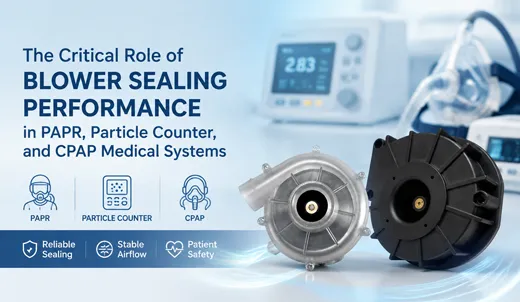
1. Defining the Two Core Technical Dimensions of Blower Sealing
To accurately evaluate blower sealing performance in critical systems, engineering teams must differentiate between two distinct technical dimensions:
- Internal Pneumatic Air-Tightness (Internal Pressure Separation): This mechanism isolates high-pressure airflow within the blower scroll housing (volute) from low-pressure regions. Inadequate internal sealing allows pressurized air to leak directly from the outlet back into the intake, causing internal air short-circuiting. This internal bypass degrades delivered static pressure and effective volumetric flow to downstream components, such as HEPA filters, particle sampling chambers, or patient airways.
- External Environmental Ingress Protection (IP Rating Sealing): This dimension protects internal rotating assemblies, double ball bearings, and driving PCB electronics against environmental contaminants. Ingress protection shields sensitive components from sub-micron dust particles, fluid splashes, corrosive chemical vapors, and condensing moisture. High environmental sealing prevents electrical short-circuits, bearing race abrasion, and structural corrosion.
Unnoticed micro-leaks cause progressive performance decay over thousands of operating hours. Whether deployed in explosive ATEX-certified industrial zones, ISO-certified cleanroom environmental monitoring, or long-term clinical patient care, blower sealing integrity directly impacts human safety, analytical precision, and medical efficacy.
2. Fundamental Mechanical Failure Modes Driven by Inadequate Blower Sealing
A comprehensive engineering review reveals four primary failure pathways stemming from compromised blower seals in medical and industrial fluidic systems:
2.1 Internal Air Short-Circuiting and Volute Bypass Leakage
Imperfections on scroll housing mating surfaces, improper clearance tolerances near the impeller inlet, or gasket creep cause internal air bypass. High-pressure air generated at the scroll exit recirculates back to the suction inlet without passing through the external fluid loop (such as HEPA filtration media or patient breathing tubes).
Although tachometer signals confirm the motor is operating at target RPM, actual delivered static pressure and effective airflow drop significantly. System controllers attempting to compensate via PWM speed control ramp motor RPM higher. This reaction triggers secondary engineering penalties: accelerated battery drain, heightened acoustic noise, increased thermal dissipation, and shortened bearing lifespan.
2.2 Moisture, Fine Dust, and Chemical Vapor Ingress
Without sufficient IP ratings (e.g., IP54 to IP67), airborne contaminants penetrate the motor chamber. Sub-micron dust particles mix with synthetic greases inside double ball bearings, turning lubricants into abrasive pastes that score raceways, induce rotor unbalance, and generate audible bearing chatter.
In humid or chemically aggressive environments, moisture condensation and corrosive vapors settle on driving inverter circuits, triggering random PWM signal interference, localized dielectric breakdown, short-circuits, or motor burnout. In explosion-proof PAPR units, volatile chemical vapors reaching internal electronics create spark ignition hazards, instantly invalidating ATEX/IECEx safety compliance.
2.3 Material Outgassing and Volatile Organic Compound (VOC) Secondary Contamination
Industrial-grade seals, low-cost room-temperature vulcanizing (RTV) silicones, or unrated adhesives continuously exposed to high motor temperatures release volatile organic compounds (VOCs). In medical CPAP devices, outgassed chemicals enter the patient breathing circuit, directly violating ISO 10993 medical biocompatibility standards.
In high-sensitivity aerosol particle counters, micro-fragmented rubber debris or outgassed volatile vapors migrate into optical detection cavities. These contaminants trigger false-positive particle counts, compromising cleanroom environmental monitoring data.
2.4 Thermal Cycling and Gasket Creep Degradation
PAPR units, particle counters, and CPAP machines undergo repetitive thermal expansion and contraction. Portable PAPR blowers transition between refrigerated cleanrooms and hot industrial shop floors; CPAP blowers run adjacent to heated humidification chambers; online particle counters run continuously in climate-controlled facilities. Mismatched thermal expansion coefficients between plastic housings and elastomeric seals induce mechanical stress relaxation and seal creep over time, escalating micro-leakage after several thousand operating hours.
3. Sector-Specific Deep Dives: Impact of Blower Sealing Integrity
| Application Sector | Primary Sealing Challenge | System Risk of Failure | Required Engineering Standard |
|---|---|---|---|
| PAPR Systems | Volute air leakage & toxic vapor ingress into motor | Loss of positive hood pressure; inhalation of hazardous toxins; explosion risk | ATEX / IECEx Intrinsically Safe, IP54–IP67, High Static Pressure |
| Particle Counters | Internal bypass leakage & optical cavity contamination | Distorted volumetric flow rate; erroneous aerosol concentration metrics | Zero outgassing materials, pulse-free laminar air-tightness |
| CPAP Devices | Humid condensate ingress & seal material VOC outgassing | Therapeutic pressure drops; airway irritation; elevated operating noise | ISO 10993 Biocompatibility, ISO 80601-2-70, Ultra-quiet seal design |
3.1 PAPR Systems: The Primary Defense Barrier in Hazardous Environments
Product reference: PAPR fan high‑static‑pressure centrifugal blowers
Powered Air-Purifying Respirators rely on compact, high-static-pressure centrifugal blowers to force contaminated ambient air through multi-stage particulate (HEPA) and organic vapor cartridges, delivering clean, breathable air to a loose-fitting hood or tight-mask facepiece under positive pressure.
If internal volute leakage occurs inside a PAPR blower, delivered pressure at the facepiece declines. Even if the motor operates at full speed, positive pressure inside the hood collapses during rapid inhalation. Ambient airborne contaminants enter through hood neck-dam margins, exposing workers to toxic chemicals or infectious aerosols. Field diagnostic data reveals that internal blower short-circuiting is frequently misdiagnosed as clogged HEPA filter media, leading to unnecessary filter replacements without addressing the underlying mechanical leak.
In ATEX/IECEx intrinsically safe PAPR applications, external seal failure allows flammable gases to reach internal motor electronics. A single micro-spark from a switching circuit can trigger catastrophic ignition. High-performance PAPR blowers utilize fully encapsulated motor stator windings, precision elastomer gaskets, and potting compounds to meet IP67 and explosion-proof safety requirements.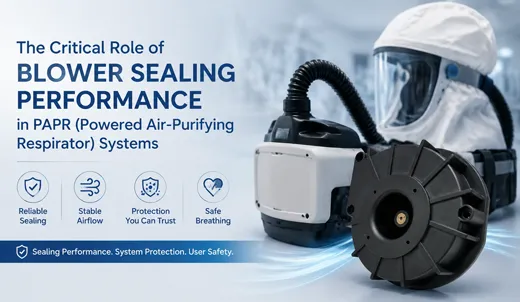
3.2 Optical Particle Counters: Guaranteeing Aerosol Sampling Accuracy
Product reference: blower for particle counter & aerosol‑sampler blowers
Laser particle counters and bio-aerosol samplers depend on micro centrifugal blowers to pull precise, non-pulsating volumetric air samples through laser-scattering optical detection chambers. Standard volumetric flow sampling rates (such as 28.3 L/min or 2.83 L/min) must remain constant to convert light-scattering counts into precise particle concentrations per cubic meter.
When internal air leakage occurs inside a particle counter blower, tachometer signals report correct fan speeds, but actual flow through the optical sensing nozzle decreases. This volumetric discrepancy corrupts aerosol concentration calculations, yielding falsely low particle readings that allow contaminated cleanroom environments to go undetected.
Furthermore, fine dust penetrating unsealed motor bearing cavities induces rotor imbalance and mechanical micro-vibrations. These vibrations travel to the optical bench, misaligning laser optics and introducing stray light noise. High-grade particle counter blowers employ precision injection-molded scroll housing mating joints and double-sealed ball bearing cartridges to eliminate fluidic bypass and structural vibration.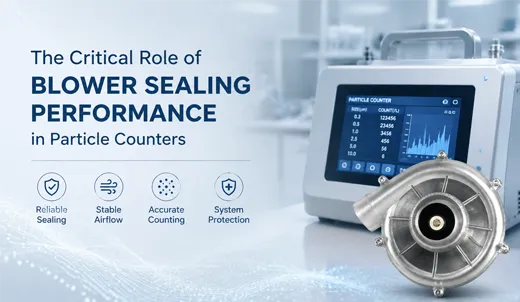
3.3 CPAP Medical Devices: Preserving Clinical Efficacy and Patient Comfort
Product reference: cpap blower for home sleep‑apnea ventilators
In CPAP, BiPAP, and APAP sleep apnea therapy machines, the BLDC blower serves as the fluidic engine. It must supply dynamically regulated, continuous positive pressure (ranging from 4 cmH₂O to over 20 cmH₂O) across varying breathing cycles, heated humidifier chambers, and flexible air delivery tubing.
Internal pressure leakage within a CPAP blower volute destabilizes target therapeutic pressures. Pressure drops caused by internal air short-circuiting allow upper airway collapses during sleep, raising the patient's Apnea-Hypopnea Index (AHI). To compensate for pressure loss, control algorithms increase motor speeds, raising acoustic noise above acceptable night-time thresholds and disturbing sleep quality.
Integrated humidification systems also present moisture risks. Condense-laden backflow entering an unsealed blower chamber degrades bearing lubricants and causes PCB corrosion. All air-contact seal materials in medical CPAP blowers must use medical-grade, non-outgassing elastomers complying with ISO 10993-5 (cytotoxicity) and ISO 10993-10 (irritation and sensitization) standards to prevent toxic gas emissions into the patient's airflow.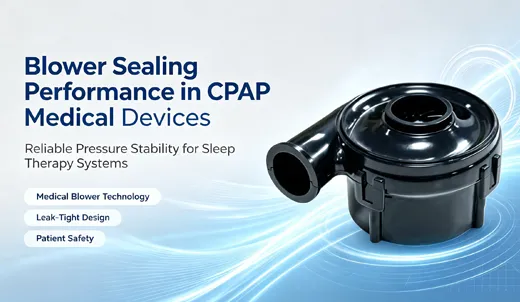
4. Product Selection Guidance & Internal Resource Links
When you are sourcing blowers for PAPR respirator systems, particle‑sampling instruments or sleep‑therapy ventilators, sealing capability should be weighted equally with CFM, static‑pressure and lifespan parameters.
For Powered Air‑Purifying Respirator and explosion‑proof blower projects: Explore PAPR fan high‑static‑pressure centrifugal blowers. The series offers configurable IP54‑IP67 ingress protection, dual‑ball‑bearing construction, ATEX‑ready intrinsically‑safe variants, and full OEM mechanical‑and‑electrical customization for respirator‑system integration.
For aerosol‑sampling and particle‑monitoring instrument development: Review blower for particle counter precision DC blowers. Optimized sealing minimizes internal bypass leakage, preserving stable pulse‑free sampling flow for optical particle‑counting equipment in cleanroom and environmental‑monitoring deployments.
For home‑medical sleep‑apnea ventilator hardware development: Refer to cpap blower medical‑grade miniature blowers. Air‑path sealing adopts biocompatible materials, resisting humid‑condensate ingress while maintaining stable therapeutic pressure under real‑world breathing‑circuit load conditions.
5. Engineering Assessment Criteria for OEM Blower Selection
When specifying BLDC micro centrifugal blowers for safety-critical OEM projects, engineering teams should evaluate key sealing parameters alongside pressure and flow curves:
- Independent Verification of Internal Air-Tightness vs. IP Rating: Ensure the supplier provides separate validation data for internal volute pneumatic tightness and external IP dust/water protection. High external IP protection does not automatically guarantee zero internal air recirculation.
- Application-Specific Elastomeric Material Compatibility: Match gasket materials directly to the operational environment. Specify fluorocarbon elastomers (FKM) or medical-grade silicone for chemical exposure, low-outgassing EPDM for cleanrooms, and ISO 10993 certified materials for medical breathing circuits.
- Thermal Cycling Stress Verification: Request supplier test reports demonstrating low seal creep and stable leak-rate metrics across extended thermal shock profiles (-40°C to +85°C).
- Quantitative Volute Leak Rate Benchmarking: Require quantitative housing leak tests (such as helium mass spectrometry or differential pressure decay testing) rather than basic visual inspection.
Customization and Potting Capabilities: Partner with manufacturers capable of delivering customized potting, specialized gaskets, over-molded housings, and modified wiring harnesses for specific OEM integration needs.
If you require technical datasheets, prototype samples or customized sealing‑solution evaluation for your next‑generation equipment project, please visit corresponding product pages:
👉 PAPR fan
10 Technical Questions & Answers: Micro Blower Sealing Performance
Q1: Can firmware PWM speed adjustments fully compensate for internal blower air leaks?
No. While increasing PWM speed offsets external filter resistance, it cannot correct internal air bypass. Recirculating high-pressure air within the volute increases thermal dissipation, power draw, and noise without restoring effective downstream pressure or volumetric flow rate. The leak must be resolved mechanically.
Q2: Does an IP67 protection rating guarantee zero internal air leakage inside the blower?
No. An IP67 rating verifies that the motor electronics and bearings are protected against dust and water immersion. It does not measure internal air short-circuiting between the high-pressure outlet and suction inlet within the scroll volute. Both metrics require separate engineering verification.
Q3: What specific sealing modifications are required for ATEX-certified PAPR blowers?
ATEX-compliant PAPR blowers require complete epoxy potting of the drive PCB, non-sparking casing materials, static-dissipative housing plastics, and chemically resistant elastomers (such as FKM) that prevent flammable gas ingress into electrical components.
Q4: How does moisture from CPAP humidifiers degrade unsealed blower assemblies?
Humid backflow entering an unsealed motor housing condenses on cool bearing raceways, flushing away synthetic lubricants and causing corrosion. Moisture on drive circuitry causes current leakage, intermittent PWM signal errors, and premature motor failure.
Q5: How does internal blower leakage distort cleanroom optical particle counter data?
Internal bypass leakage reduces the actual air volume drawn through the optical sampling chamber despite correct motor RPM feedback. This volumetric imbalance yields falsely low particle concentration readings, masking contamination issues in cleanrooms.
Q6: What biocompatibility standards apply to seal materials used in medical CPAP blowers?
All air-contact elastomeric seals, adhesives, and housing materials in CPAP blowers must comply with ISO 10993-1, ISO 10993-5 (Cytotoxicity), ISO 10993-10 (Irritation and Sensitization), and ISO 18562 for volatile organic compound (VOC) emissions in breathing gas pathways.
Q7: Why do industrial blowers suffer increased air leakage over long-term operation?
Long-term leakage stems primarily from gasket material stress relaxation (creep), thermal degradation under high motor temperatures, structural deformation caused by continuous pressure differentials, and chemical degradation from exposure to cleaning agents or ambient solvents.
Q8: How does bearing dust contamination lead to optical component errors in particle counters?
Dust entering unsealed ball bearings causes surface pitting on rolling elements, inducing micro-vibrations during high-speed rotation. These vibrations transmit through the chassis to the optical sensor assembly, misaligning lasers and introducing light-scattering noise.
Q9: What testing methodologies are used to quantify micro-leakage in medical-grade blowers?
Manufacturers use differential pressure decay testing, mass flow leak detection, and helium mass spectrometry to measure minute leakage rates across scroll mating seams and shaft seal interfaces.
Q10: What custom OEM sealing options exist for compact centrifugal blowers?
Custom engineering options include liquid silicone rubber (LSR) overmolding directly onto housing halves, full PCB conformal coating or potting, custom-molded elastomeric gaskets, ultrasonic housing welding, and static-dissipative material formulations.
GET A QUOTE