

What Key Capability Metrics Are Used to Evaluate DC Centrifugal Fan Manufacturers?
Choosing a DC fan manufacturer is not a matter of comparing the largest CFM number on a catalog page. A qualified DC fan supplier must prove aerodynamic performance, electrical robustness, acoustic behavior, bearing life, environmental protection, material compliance and repeatable production quality. This guide turns those requirements into a practical evaluation framework, and shows how the engineering discipline behind the TKFAN 24V DC fan platform supports OEM projects in industrial control, electronics, automotive and medical equipment.
The Short Answer: 12 Capability Metrics That Separate a Real Manufacturer from a Trading Middleman
A professional DC fan supplier should be measured against twelve linked capabilities: (1) complete airflow-pressure curves, (2) efficiency grade and power draw, (3) noise and vibration data, (4) bearing life methodology, (5) motor and driver protection, (6) IP rating and material durability, (7) regulatory compliance, (8) application engineering support, (9) tooling and customization depth, (10) production capacity, (11) quality traceability and (12) after-sales technical response. Any supplier that quotes only a unit price and a single CFM value has not yet demonstrated manufacturer-level capability.
The distinction matters because a DC centrifugal fan manufacturer works with a different physics problem than an axial fan maker. A centrifugal impeller accelerates air radially and converts velocity into static pressure through a scroll housing. That makes the system resistance curve—filters, ducting, heat sinks, grilles and bends—just as important as the fan itself. The best TKFAN DC fan manufacturer evaluation therefore starts with the installed application, not with the catalog.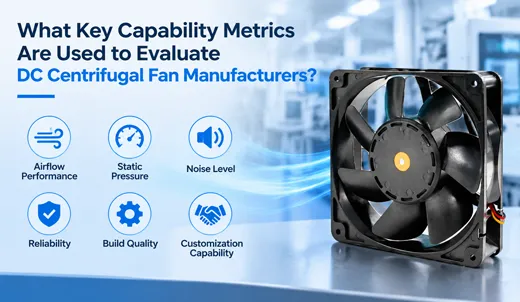
1. Aerodynamic Performance: Demand a Curve, Not a Single CFM Number
Free-air CFM is useful only as an upper theoretical reference. In a real enclosure, the fan operates where its pressure-versus-flow curve intersects the system resistance curve. A buyer should ask every DC fan manufacturer for airflow at several static pressure points, the shutoff pressure, the recommended operating zone and the tolerance band. Without those data, two fans with identical advertised CFM can behave very differently after installation.
Recognized test methods make comparison possible. The ISO 5801:2017 standard, “Fans — Performance testing using standardized airways”, specifies procedures for determining fan performance and provides estimates of measurement uncertainty. The AMCA introduction to the Certified Ratings Program explains that certified products are tested in AMCA or accredited laboratories, have their published catalog data reviewed and remain subject to periodic and challenge testing. The same document identifies ISO 5801 and ANSI/AMCA 210 as approved standards for centrifugal fan air performance.
Installation quality is part of measured capability. In its technical article “Mitigating System Effect to Optimize Fan Performance and Efficiency”, AMCA International warns that poor inlet and outlet conditions create turbulence, swirl and losses that a laboratory curve does not show. The article gives a concrete warning: just a 10 percent increase in fan speed causes about a 33 percent increase in energy consumption. A strong DC fan supplier should therefore review duct geometry and inlet clearance before finalizing a model.
Practical check: ask for a P-Q curve tested under ISO 5801 or ANSI/AMCA 210, then ask the supplier to mark the expected operating point of your actual system. If the supplier cannot discuss system resistance, it is selling components rather than engineering airflow.
2. Efficiency and Speed Control: Look Beyond the Nameplate Wattage
Fan efficiency determines heat load, battery runtime and total cost of ownership. AMCA's article “Dawn of a New Era: The Regulation of Commercial and Industrial Fans and Blowers” explains that the Fan Efficiency Grade was formalized in ANSI/AMCA 205 and that a minimum FEG 67 was established in ASHRAE 90.1 because it approximated a 65 percent minimum efficiency. The article also notes a 15-percentage-point sizing window from peak total efficiency, designed to discourage selecting an unnecessarily small fan merely because it sits in the same efficiency band.
For battery-powered and thermally constrained products, speed control is equally important. A brushless DC fan with PWM input can modulate airflow instead of cycling on and off, while an FG tachometer output allows the host controller to verify actual speed. The TKFAN 24V DC fan range is described with 4-wire PWM control and FG speed feedback options, allowing PLCs and embedded controllers to reduce noise at partial load and ramp up only when sensor data demand cooling.
Voltage architecture also affects efficiency. For the same power, a 24V system draws roughly half the current of a 12V system, which reduces I²R heating in wires and connectors. That is why a TKFAN DC fan supplier focused on industrial automation emphasizes 24V models with an operating window of 14.0V to 27.6V DC, rather than narrow consumer-grade 12V designs.
3. Noise and Vibration: Measured Data and Balanced Rotors
Noise is not a cosmetic specification. In medical devices, office equipment, vehicles and control rooms, acoustic behavior directly affects user acceptance. Buyers should distinguish sound pressure measured at a defined distance from sound power measured under standardized laboratory conditions. The ISO/TC 117 catalogue lists the ISO 13347 series for determining fan sound power levels, while AMCA Publication 311 governs sound performance certification.
Mechanical balance is the other half of the problem. An unbalanced impeller creates vibration that accelerates bearing wear, loosens fasteners and produces tonal noise. Ask whether every rotor receives two-plane dynamic balancing and whether vibration limits are recorded on the production traveler. TKFAN states that it operates a 16 dB silent laboratory, which is the kind of infrastructure expected from a serious DC centrifugal fan manufacturer rather than a simple assembly shop.
4. Bearing Life and Reliability: Understand L10 Before Comparing Hours
“50,000 hours” means little without a definition. NSK's technical resource “Dynamic Load Ratings and Fatigue Life” defines basic rating life L10 as the life that identical bearings can achieve under the same conditions before flaking occurs in 10 percent of the group—in other words, a statistical reliability of 90 percent. NSK also gives the ball-bearing relationship L10 = (C/P)³, showing why a small increase in load can dramatically shorten life.
When reviewing a DC fan manufacturer, ask for the bearing type, grease specification, rated ambient temperature, mounting orientation and calculation basis. The TKFAN 24V DC fan series states that precision dual ball bearings with high-temperature synthetic lubricant support more than 50,000 continuous hours at 40°C in horizontal, vertical or angled mounting. That claim is far more useful because it includes temperature and orientation rather than presenting a naked hour figure.
5. Electrical Protection and Control Intelligence
Industrial power rails are noisy. Voltage surges, inductive drops, reverse polarity and EMI can destroy an unprotected fan driver. A capable DC fan supplier should document over-voltage, over-current and reverse-polarity protection, plus EMI suppression and lock-rotor alarm behavior. Lock-rotor output is especially valuable: if debris stops the impeller, the host controller receives an alert before the motor overheats.
Safety certification is a separate question. UL Solutions' electric fan product information identifies specific certification categories such as GPRT, GPWV and GPWX. Buyers should verify the exact file number and category in UL Product iQ rather than accepting a generic “UL-like” claim. TKFAN's company milestone record states that UL safety certification was attained in 2018 and ISO9001 certification in 2017, providing traceable claims that procurement teams can audit.
6. Environmental Protection: IP Rating, Materials and Chemical Compliance
The IEC ingress protection guide based on IEC 60529 explains that the first IP digit covers solid-object protection from 0 to 6, while the second covers liquid protection from 0 to 9. A dust-tight IP6x design is appropriate for particulate-heavy environments; IPx5 indicates protection against water jets; IPx7 and IPx8 refer to temporary and continuous immersion under defined conditions. Always request the test report, because a conformal coating alone does not create a certified IP rating.
Material compliance is equally non-negotiable for global OEM programs. The European Commission document “REACH and Directive 2011/65/EU (RoHS): A Common Understanding” states that RoHS entered into force on 21 July 2011 and that member states were obliged to implement national measures by 2 January 2013. A reliable TKFAN DC fan manufacturer should supply material declarations, UL94V-0 flame-retardant housing and impeller data, and current RoHS and REACH statements for every production lot.
7. Manufacturing Capability and Quality System
A datasheet describes a design; a factory determines whether that design can be repeated ten thousand times. Evaluate line capacity, in-house tooling, motor winding capability, automated balancing, final electrical testing and lot traceability. TKFAN's official company profile states 15+ years of R&D experience, a 5,000 m² production base, 5 million units of annual capacity and 380+ successful projects. It also states that samples can be produced within 48 hours and that CFD and electromagnetic simulation reports are available to customers.
Those numbers matter to a DC fan supplier evaluation because they indicate engineering depth and surge capacity. A buyer should still request evidence: calibration records, incoming material inspection, statistical process control charts, burn-in reports and corrective-action procedure. ISO 9001 certification is a foundation, not a finish line. ISO's ISO 9001 explained guide notes that the standard covers customer focus, process approach, risk-based thinking, documented information, monitoring and continual improvement.
8. Customization Depth: From Mechanical Fit to Control Logic
Standard fans rarely fit perfectly. A mature DC fan manufacturer should support changes to voltage, frame depth, impeller geometry, bearing type, lead wire, connector, labeling, waterproof coating and control interface. TKFAN's company introduction states that its products cover miniature, silent, waterproof and high-power fans, with sizes as small as 15 × 15 × 4 mm, and that waterproof capability spans IP55 to IP68.
The link between customization and validation is simulation. CFD can predict recirculation and dead zones before tooling, while electromagnetic simulation can reduce driver noise and thermal stress. When a TKFAN DC fan supplier supports both, OEM engineers shorten the design loop and avoid expensive late-stage enclosure changes.
Mechanical customization
Frame size, mounting holes, inlet bell mouth, outlet adapter, wire length and connector housing can be matched to the existing assembly.
Electrical customization
5V, 12V, 24V and 48V platforms, PWM, FG, NTC thermistor control, lock-rotor alarm and custom harnesses support system-level integration.
Environmental customization
Conformal coating, vacuum encapsulation and sealed constructions target dust, humidity, salt mist and washdown environments.
Documentation customization
Drawings, P-Q curves, material declarations, inspection plans and application notes should be supplied in the customer's required format.
9. Supply Chain, Samples and Commercial Transparency
Procurement risk is a capability metric. Ask about minimum order quantity, sample lead time, tooling ownership, capacity reservation, Incoterms and the availability of local technical support. A DC fan supplier that cannot explain its sample-to-mass-production gate is likely to struggle when a project scales.
The 24V DC fan catalog illustrates how a broad product matrix reduces sourcing risk. Available models include compact 40 × 40 × 28 mm high-speed fans and larger 172 × 51 mm high-airflow designs. Engineers can shortlist an existing platform before requesting a custom tool, which lowers both cost and validation time.
| 24V DC Fan Model | Size (mm) | Speed (RPM) | Airflow (CFM) | Max Pressure (kPa) |
|---|---|---|---|---|
| DA4028VH24B-D230202 | 40 × 40 × 28 | 32,000 | 38.5 | 1.6 |
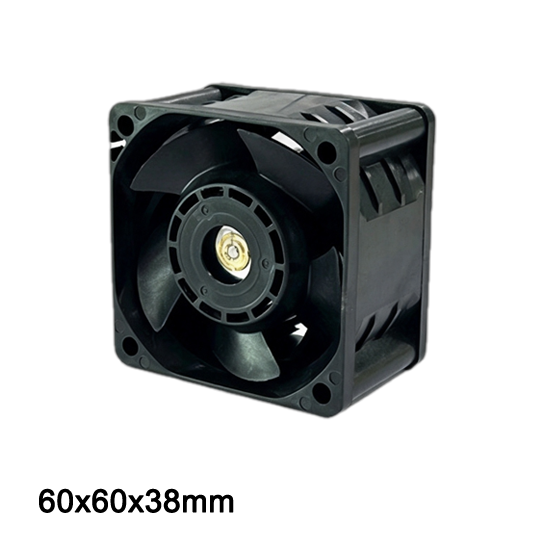
| DA6038VH24B-B | 60 × 60 × 38 | 21,700 | 66.4 | 1.7 |
| DA14038HV24B-D | 140 × 140 × 38 | 6,000 | 378.6 | 0.51 |
| DA17251HV24B-B250722 | 172 × 51 | 9,500 | 603.2 | 1.58 |
| DA25489H24B | 254 × 89 | 2,500 | 742.8 | 0.19 |
Technical data source: TKFAN 24V DC fan selection guide, accessed 26 November 2026. Values are model-specific and should be confirmed against the latest official drawing before volume production.
10. A 100-Point Supplier Scorecard You Can Actually Use
To turn this guide into a decision, score each category from 0 to the maximum value and require a documented evidence file for every score above 5:
| Evaluation Category | Weight | Evidence to Request |
|---|---|---|
| Aerodynamic performance | 20 | ISO 5801 or AMCA 210 P-Q curve, operating point, tolerance |
| Efficiency and control | 15 | Power curve, FEG/FEI data, PWM and FG interface description |
| Noise and vibration | 10 | Sound power report, dynamic balance record, vibration limit |
| Reliability and life | 15 | L10 calculation, bearing specification, burn-in and HTOL data |
| Compliance and safety | 15 | CE/UKCA/UL files, RoHS, REACH, material declarations |
| Customization and engineering | 10 | Drawings, CFD report, connector and coating options |
| Manufacturing and quality | 10 | Capacity, ISO 9001 certificate, SPC and traceability records |
| Commercial transparency | 5 | Sample lead time, MOQ, tooling ownership, warranty terms |
Procurement warning: a supplier that scores highly on price but cannot produce a test curve, certificate file and traceability record should not be treated as a manufacturer. For regulated OEM projects, documentation is part of the product.
Why TKFAN Is a Practical Benchmark for DC Fan Manufacturer Evaluation
TKFAN illustrates the difference between a component reseller and an engineering manufacturer. The brand belongs to Shenzhen Tengkai Group and states more than 15 years of brushless fan development, 5,000 m² of production space, 5 million units of annual capacity and 380+ completed projects. Its product range reaches from 15 mm miniature fans to high-power industrial blowers, and its documented milestones include ISO9001 certification, UL safety certification, IP55–IP68 waterproof mass production and advanced sensor-cleaning blower programs.
Most importantly for this topic, the same engineering rules apply across the portfolio. Whether the buyer is selecting a DC centrifugal fan for a ventilator or a 24V axial fan for a control cabinet, the TKFAN DC fan manufacturer process starts with system resistance, electrical environment, acoustic target and required life. Engineers can then use the official 24V DC fan catalog to select a platform before requesting customization. Explore the 24V DC fan range
Frequently Asked Questions — 10 Technical Answers
Summary for sourcing, engineering and quality teams: the right DC fan manufacturer is proven by data, not adjectives. Require a standardized performance curve, clearly defined efficiency and speed-control behavior, traceable bearing life, verified IP and safety documentation, and evidence of repeatable production. A qualified TKFAN DC fan supplier should be able to discuss all of these issues in technical detail before a prototype is approved.