


How to Choose a Reliable DC Fan Manufacturer for OEM Projects?
Choosing the right DC fan manufacturer is one of the most important decisions for OEM equipment developers, industrial engineers, electronics manufacturers, and product sourcing managers. A cooling fan may be a relatively small component, but its performance directly affects equipment temperature, operating stability, noise levels, energy consumption, and product service life.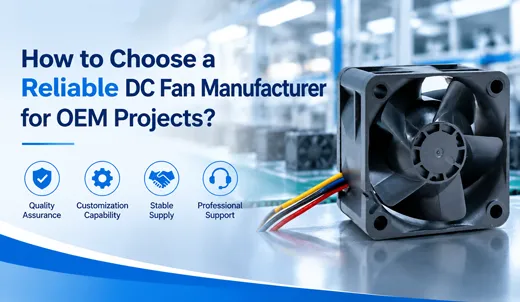
For OEM projects, selecting a supplier based only on unit price or catalog specifications can create unexpected engineering and production risks. The ideal OEM fan manufacturer should offer more than standard products. It should provide engineering support, reliable performance testing, flexible customization, consistent manufacturing quality, and long-term supply capabilities.
This guide explains how to evaluate a DC fan supplier from an engineering and procurement perspective, including airflow performance, motor technology, bearing selection, quality certifications, OEM customization, production capacity, and total cost of ownership.
Quick Answer: What Makes a Reliable DC Fan Manufacturer?
A reliable DC fan manufacturer should demonstrate measurable airflow and static pressure performance, provide product-specific test reports, maintain a documented quality management system, support mechanical and electrical customization, and demonstrate consistent mass-production capabilities.
OEM buyers should evaluate five essential factors: engineering expertise, product quality, customization flexibility, manufacturing capacity, and technical support throughout the product lifecycle.
5V–48V DC Fan Voltage Platforms
15×15×4 Compact Fan Size (mm)
5M Reported Annual Production Capacity
48H TKFAN Reported Rapid Prototyping Service
1. Why Choosing the Right DC Fan Manufacturer Matters for OEM Projects
Modern electronic equipment is becoming increasingly compact and powerful. Industrial controllers, communication devices, medical equipment, automotive electronics, energy storage systems, and computer servers all generate heat during operation.
When heat cannot be removed efficiently, component temperatures may exceed their recommended operating limits. This can lead to reduced electronic component life, thermal protection shutdowns, unstable performance, and increased maintenance requirements.
A qualified DC fan manufacturer understands that cooling performance depends on the entire thermal system rather than the fan alone. Fan selection must consider heat generation, enclosure dimensions, airflow paths, pressure losses, ambient temperature, and operating conditions.
According to the Uptime Institute Annual Outage Analysis 2024, 13% of impactful data center outages reported in the study were attributed to cooling-related issues. The report also highlights the significant financial consequences associated with critical infrastructure outages.
Although this figure relates to data center operations rather than DC fan failure rates, it illustrates why thermal management deserves serious attention during equipment development.
For an OEM project, a dependable supplier can help prevent these risks by providing suitable fan specifications, engineering recommendations, sample validation, and stable production quality.
What Should OEM Buyers Expect from a Professional Supplier?
Engineering Capability
Professional airflow analysis, motor design, thermal optimization, acoustic testing, and technical problem-solving.
Consistent Quality
Standardized manufacturing procedures, incoming material inspection, production testing, and traceable quality records.
OEM Customization
Flexible frame dimensions, mounting structures, wire configurations, connectors, speed settings, and control functions.
Supply Reliability
Production planning, capacity management, component sourcing, delivery coordination, and long-term technical support.
2. Understand Different DC Fan Types Before Selecting a Supplier
Before contacting a DC fan manufacturer, OEM engineers should understand the different cooling fan structures available. Selecting the wrong airflow architecture may result in insufficient cooling even when the fan has a high advertised airflow rating.
DC Axial Fans: High Airflow for General Equipment Cooling
A DC axial fan draws air through the inlet parallel to the motor shaft and discharges it in approximately the same direction. Its simple structure makes it suitable for applications requiring high volumetric airflow and relatively low to moderate system resistance.
Typical applications include:
- Industrial control cabinets and electrical enclosures.
- Computer servers and network communication equipment.
- Power supplies, charging equipment, and electronic devices.
- Automotive electronic control units.
- Industrial automation equipment and motor controllers.
Centrifugal Fans: Higher Pressure for Restricted Airflow Paths
A centrifugal fan draws air into the impeller axially and discharges it radially, typically through a side outlet. This design can generate higher static pressure than many conventional axial fan configurations.
It is particularly suitable for systems containing narrow ducts, filters, heat exchangers, or other components that create considerable airflow resistance.
Micro DC Fans: Compact Cooling for Space-Limited Devices
Micro DC fans are designed for applications where installation space is extremely limited. They are commonly used in portable electronics, compact instruments, mini projectors, wearable equipment, and small embedded systems.
TKFAN's DC fan product range includes compact models with dimensions down to 15 × 15 × 4 mm, alongside larger industrial cooling fan configurations.
Engineering Recommendation:
Do not select a fan using free-air airflow alone. Always evaluate the fan's pressure-flow characteristics against the actual resistance of the equipment enclosure, filter, grille, and internal airflow channel.
3. Evaluate Airflow, Static Pressure, and Performance Testing
One of the most important differences between a genuine DC fan manufacturer and a supplier that simply resells standard products is its ability to provide verifiable performance data.
OEM buyers should request a complete pressure-flow curve, commonly known as a P-Q curve, rather than relying on a single maximum airflow figure.
Why Is the P-Q Curve Important?
The P-Q curve describes the relationship between airflow and static pressure. At zero external static pressure, a fan may achieve its maximum free-air airflow. As system resistance increases, the available airflow decreases.
The actual operating point is determined by the intersection between the fan performance curve and the system resistance curve.
This is particularly important for industrial equipment because real installations rarely operate under unrestricted airflow conditions.
Important Performance Parameters to Request
| Parameter | What It Measures | Why It Matters |
|---|---|---|
| Airflow (CFM / m³/h) | Volume of air delivered per unit of time. | Determines the fan's ventilation capability. |
| Static Pressure (Pa) | Pressure available to overcome airflow resistance. | Important for restricted cooling channels. |
| Rated Voltage (V) | Specified operating supply voltage. | Ensures electrical compatibility. |
| Current (A) | Electrical current consumption. | Determines power supply requirements. |
| Power (W) | Electrical power consumption. | Helps evaluate energy efficiency. |
| Speed (RPM) | Fan rotational speed. | Affects airflow, pressure, and noise. |
| Noise (dB(A)) | Sound level under specified conditions. | Important for noise-sensitive equipment. |
| Operating Temperature | Permitted environmental temperature range. | Determines suitability for actual working conditions. |
Which International Testing Standards Should You Check?
The ANSI/AMCA 210-16: Laboratory Methods of Testing Fans for Certified Aerodynamic Performance Rating establishes standardized laboratory methods for determining fan airflow, developed pressure, power consumption, air density, rotational speed, and efficiency.
AMCA International also explains its independent testing and certification procedures through its Certified Ratings Program. Its program uses independent accredited laboratories and periodic product checks to support the accuracy of certified performance claims.
These references provide useful evaluation criteria for OEM buyers. However, buyers should distinguish between a fan tested according to a standard and a product formally certified under a certification program. They are not automatically the same.
When evaluating a DC fan manufacturer, ask for:
- Performance curves at the specified rated voltage.
- Airflow and static pressure test results.
- Power consumption and operating current.
- Noise measurements with clearly stated test conditions.
- Test equipment information and applicable test methods.
4. Check Motor Technology and Bearing Reliability
The motor and bearing assembly are critical components affecting fan reliability. A professional OEM fan manufacturer should be able to explain its motor architecture, bearing options, operating temperature limits, and expected service life.
Brushless DC Motor Technology
Brushless DC motors use electronic commutation instead of mechanical brushes. This eliminates brush-related friction and wear, making BLDC motors suitable for compact equipment and continuous-duty cooling applications.
Depending on the motor design and control electronics, BLDC fans can offer stable speed regulation, reduced maintenance requirements, and flexible control functions.
Comparing Common Fan Bearing Types
| Bearing Type | Advantages | Considerations | Typical Applications |
|---|---|---|---|
| Sleeve Bearing | Economical and often quiet when new. | Temperature and mounting orientation can affect service life. | Cost-sensitive equipment. |
| Dual Ball Bearing | Good orientation flexibility and durability. | Can have higher initial noise and cost. | Industrial and continuous-duty equipment. |
| Fluid Dynamic Bearing | Potentially low noise and long operating life. | Performance depends on bearing design and operating conditions. | Noise-sensitive electronic equipment. |
Some industry technical references report approximate bearing life figures of 30,000–60,000 hours for sleeve bearings and 50,000–100,000 hours for ball-bearing designs. These figures are illustrative industry ranges, not guaranteed values for every product.
For a better understanding of fan life calculations, consult the technical article How to Evaluate Fan Life – Electronics Cooling.
L10 Life, MTTF, and MTBF: What Should OEM Buyers Know?
Fan life specifications should always include reference conditions. L10 life describes the operating time at which 10% of a tested population is expected to have failed under the specified statistical model and conditions.
MTTF refers to Mean Time to Failure, while MTBF refers to Mean Time Between Failures and is generally used for repairable systems. These terms should not be treated as interchangeable.
When comparing suppliers, request the rated ambient temperature, bearing temperature, sample size, failure definition, and testing methodology. A life rating without these conditions is difficult to compare meaningfully.
5. Verify Quality Management and Product Compliance
A reliable DC fan manufacturer should have a documented quality management system and be able to provide relevant product compliance documentation for the target market.
ISO 9001 Quality Management
ISO 9001 provides a framework for quality management systems, including process control, customer requirements, continuous improvement, and documented operational procedures.
According to the ISO 9001:2015 official standard page, the standard specifies requirements for organizations seeking to demonstrate their ability to consistently provide products and services that meet customer and applicable regulatory requirements.
TKFAN reports that it achieved ISO 9001 certification in 2017. OEM buyers should request the current certificate and verify its validity, issuing organization, and certification scope.
UL, RoHS, and REACH Documentation
Depending on the target market and application, a DC fan may require different safety and material compliance documentation.
- UL: Relevant product safety recognition for applicable North American markets. Always verify the exact model and certification file.
- RoHS: Addresses restrictions on certain hazardous substances in electrical and electronic equipment under applicable EU requirements.
- REACH: Covers chemical registration, evaluation, authorization, and restriction obligations within the EU framework.
Official regulatory references include the EU RoHS Directive 2011/65/EU and the European Chemicals Agency REACH legislation.
IP Protection for Outdoor and Harsh Environments
If your equipment operates outdoors or in humid, dusty, or wet environments, an appropriate IP-rated DC fan may be necessary.
The IEC 60529 standard defines the Ingress Protection classification system for electrical enclosures. The first digit indicates protection against solid objects and dust, while the second digit indicates protection against water ingress.
| IP Rating | Dust Protection | Water Protection | Typical Consideration |
|---|---|---|---|
| IP54 | Dust-protected | Water splashing | General protected environments. |
| IP55 | Dust-protected | Water jets | Outdoor equipment with suitable installation protection. |
| IP65 | Dust-tight | Water jets | Dusty industrial environments. |
| IP67 | Dust-tight | Temporary immersion | Equipment exposed to temporary immersion. |
| IP68 | Dust-tight | Continuous immersion under specified conditions | Specialized waterproof applications. |
Refer to the IEC 60529 official publication for the classification framework.
Important:
IP ratings should never be accepted based only on a product photograph or marketing description. Request the applicable test report and confirm the tested configuration, cable entry, connector, mounting conditions, and immersion requirements.
6. Evaluate OEM Customization and Engineering Capabilities
Standard catalog products cannot always meet the mechanical, electrical, and thermal requirements of an OEM project. This is where the engineering capability of an OEM fan manufacturer becomes especially important.
A capable supplier should be able to modify existing designs or develop new configurations based on the customer's technical requirements.
Mechanical Customization
- Fan frame dimensions and thickness.
- Mounting hole positions and installation structures.
- Blade geometry and impeller design.
- Housing materials and structural reinforcement.
- Air inlet and outlet configurations.
Electrical and Control Customization
- Rated voltage options such as 5V, 12V, 24V, and 48V.
- Operating speed and customized RPM requirements.
- Wire length, wire color, and connector configuration.
- PWM speed control.
- FG tachometer feedback.
- RD rotor lock detection.
- Customized driver electronics and protection functions.
Why Engineering Simulation Matters
Computational Fluid Dynamics (CFD) can help engineers evaluate airflow distribution, pressure losses, recirculation zones, and potential turbulence before production tooling is finalized.
Electromagnetic simulation can also support motor design optimization, helping engineers evaluate magnetic performance, torque characteristics, and electrical operating conditions.
TKFAN reports offering CFD and electromagnetic simulation support for OEM projects. Its manufacturing capabilities also include impeller dynamic balancing and acoustic testing.
For OEM buyers, these capabilities can reduce repeated sample modifications and improve the likelihood that the selected fan will meet the final equipment requirements.
7. Prototype Development and Mass Production Consistency
A successful prototype does not automatically guarantee successful mass production. OEM projects require repeatable manufacturing processes that ensure production units maintain the same performance and specifications as the approved samples.
A professional DC fan manufacturer should have a clear development process covering initial requirements, engineering evaluation, sample production, performance verification, approval, and mass production.
Recommended OEM Development Process
Step 1: Requirement Analysis
Review voltage, dimensions, airflow, pressure, noise, operating temperature, installation conditions, and annual demand.
Step 2: Engineering Design
Select the motor, bearing, blade structure, housing, and control functions according to the application.
Step 3: Prototype Testing
Verify airflow, static pressure, current, speed, noise, vibration, and installation compatibility.
Step 4: Sample Approval
Confirm the approved specification, sample identification, inspection criteria, and change-control requirements.
Step 5: Pilot Production
Evaluate manufacturing consistency, assembly quality, process stability, and product traceability.
Step 6: Mass Production
Implement standardized production inspection, final testing, packaging, and delivery management.
TKFAN reports a 48-hour rapid prototyping service for applicable projects. Actual development time depends on design complexity, material availability, tooling requirements, and sample validation.
Another important consideration is the approved golden sample. The supplier should retain the approved product specification and inspection records to ensure that subsequent production batches remain consistent.
8. Manufacturing Capacity and Long-Term Supply Reliability
For OEM buyers, production capacity is just as important as product performance. A supplier may develop an excellent fan sample but still struggle to support a long-term project if its manufacturing resources are insufficient.
Before choosing an OEM fan manufacturer, investigate the following:
- Factory location and actual manufacturing capabilities.
- Monthly and annual production capacity.
- Availability of motor assembly and fan testing equipment.
- Component sourcing and supplier management procedures.
- Production lead times and delivery planning.
- Quality traceability and corrective action procedures.
- Engineering change notification and product lifecycle management.
TKFAN Manufacturing Background
TKFAN is a Shenzhen-based manufacturer specializing in DC cooling fans, centrifugal fans, air blowers, brushless DC motors, and related thermal management products.
According to its published company information, TKFAN was founded in 2012 and operates a production base of approximately 5,000 square meters, with a reported annual production capacity of 5 million units.
The company also reports more than 15 years of R&D experience and over 380 completed projects. Its product development history includes waterproof motor technologies, compact micro fans, medical airflow solutions, and automotive sensor cleaning applications.
You can review its background and manufacturing information through the TKFAN company profile.
These company-reported figures provide useful sourcing information. OEM procurement teams should still confirm current production capacity, product-specific qualifications, and delivery commitments during supplier evaluation.
9. Consider Total Cost of Ownership Instead of Unit Price
The lowest purchase price does not necessarily represent the lowest long-term cost. A DC fan that consumes more power, produces excessive noise, requires frequent replacement, or causes equipment downtime may create significantly higher operating expenses.
OEM engineers should therefore compare the total cost of ownership (TCO), including:
- Initial purchase price.
- Electrical energy consumption.
- Maintenance and replacement costs.
- Warranty and after-sales expenses.
- Production downtime caused by cooling failures.
- Engineering changes and redesign expenses.
How Fan Speed Affects Power Consumption
Under comparable operating conditions, the fan affinity laws describe the relationship between rotational speed and aerodynamic performance.
Airflow: Q₂ / Q₁ ≈ N₂ / N₁
Pressure: P₂ / P₁ ≈ (N₂ / N₁)²
Power: W₂ / W₁ ≈ (N₂ / N₁)³
Q represents airflow, P represents pressure, W represents power, and N represents rotational speed. These relationships are approximate and assume comparable aerodynamic conditions.
For example, if a fan operates at 80% of its reference rotational speed, its theoretical aerodynamic power requirement under the affinity-law assumptions is approximately:
0.8 × 0.8 × 0.8 = 0.512, or 51.2% of the reference power.
Actual electrical input power may differ because of motor and controller efficiency, minimum operating speed, and system characteristics.
PWM Control for Intelligent Thermal Management
Pulse Width Modulation (PWM) allows a host system to regulate fan speed according to thermal demand. Instead of operating continuously at maximum speed, the system can increase or decrease fan speed as equipment temperature changes.
The Intel fan control technical documentation and the Intel 4-Wire PWM Controlled Fans Specification Rev. 1.3 provide useful references for understanding common four-wire fan control arrangements.
OEM engineers should confirm PWM input voltage levels, frequency, polarity, minimum operating speed, tachometer output, and controller compatibility for the exact fan model.
10. Red Flags When Selecting an OEM Fan Manufacturer
Not every supplier advertising itself as a DC fan manufacturer has the engineering and manufacturing resources required for a long-term OEM partnership.
The following warning signs should be considered during supplier qualification.
- No detailed performance data: The supplier provides only a maximum CFM value without a pressure-flow curve.
- Unverified lifetime claims: Operating life is quoted without temperature, bearing information, or failure criteria.
- Unclear certification scope: The supplier displays certification logos but cannot provide current documentation.
- No engineering support: Technical questions about airflow, motor design, or customization receive vague answers.
- Unstable sample quality: Prototype performance differs significantly from later production batches.
- Limited production transparency: Factory resources, manufacturing processes, and capacity cannot be verified.
- No change-control system: Components or specifications may be changed without customer approval.
A trustworthy OEM fan manufacturer should be willing to discuss these issues openly and provide supporting technical documents.
11. How to Prepare an RFQ for a DC Fan Manufacturer
Providing complete technical requirements helps manufacturers select an existing model or develop a customized solution more efficiently.
When contacting a DC fan manufacturer, OEM buyers should prepare the following information:
| RFQ Requirement | Information to Provide |
|---|---|
| Application | Equipment type and cooling purpose. |
| Dimensions | Fan frame size, thickness, and mounting dimensions. |
| Voltage | 5V, 12V, 24V, 48V, or other required input voltage. |
| Airflow | Required airflow in CFM or m³/h. |
| Static Pressure | Required operating pressure in Pa. |
| Noise | Maximum permitted noise level and measurement conditions. |
| Bearing | Sleeve, dual ball, FDB, or recommended option. |
| Control | Standard, PWM, FG, RD, or customized control. |
| Protection | Required IP rating and environmental conditions. |
| Connection | Wire length, wire specification, and connector model. |
| Operating Environment | Ambient temperature, humidity, vibration, and duty cycle. |
| Purchasing Volume | Sample quantity, initial order, and annual forecast. |
The more accurately these requirements are defined, the easier it becomes for the supplier to evaluate technical feasibility, recommend the correct product, and prepare a realistic quotation.
12. Why Choose TKFAN as Your DC Fan Manufacturer?
For companies looking for a long-term cooling solution partner, TKFAN provides a range of DC fan products and OEM engineering services designed for industrial, electronic, automotive, medical, and other equipment applications.
As a TKFAN DC fan manufacturer, the company focuses on product development, brushless motor technology, airflow optimization, and customized thermal management solutions.
Comprehensive DC Fan Product Range
TKFAN offers multiple DC fan configurations to meet different voltage, airflow, size, and application requirements.
5V and Micro DC Fans
Compact cooling solutions for portable electronics, embedded devices, small instruments, and space-limited equipment.
12V DC Fans
Suitable for electronic equipment, computer systems, automotive electronics, and compact cooling applications.
24V DC Fans
Designed for industrial automation, electrical cabinets, control systems, and other equipment requiring continuous operation.
48V DC Fans
Suitable for telecom equipment, server racks, and high-density industrial cooling applications.
OEM and ODM Engineering Support
TKFAN supports customization of mechanical dimensions, mounting structures, fan performance, motor specifications, wire configurations, connectors, and electronic control functions.
Its reported engineering capabilities include CFD simulation, electromagnetic simulation, dynamic balancing, acoustic testing, and rapid prototyping support.
Applications Across Multiple Industries
TKFAN DC fans can be selected for a wide range of equipment applications, including:
- Industrial automation and control cabinets.
- Communication equipment and server cooling.
- Medical instruments and electronic equipment.
- Automotive electronics and vehicle control systems.
- Energy storage systems and power conversion equipment.
- Home appliances and smart electronic products.
- Charging equipment and industrial power supplies.
Explore TKFAN DC Cooling Fan Products
Discover TKFAN's DC brushless cooling fan solutions, including 5V, 12V, 24V, and 48V models, micro fans, high-speed fans, waterproof fans, and customized OEM cooling solutions.
Whether you need a standard DC axial fan or a customized cooling solution, TKFAN can help evaluate the technical requirements of your application.
Explore TKFAN DC Fan Products →If your existing equipment requires a special fan size, customized connector, different operating voltage, or a specific airflow and pressure target, contact the TKFAN engineering team with your technical requirements.
13. Conclusion: Select a Manufacturer That Can Support Your Entire OEM Project
Choosing a reliable DC fan manufacturer requires more than comparing catalog specifications and purchase prices. OEM buyers should evaluate engineering experience, airflow performance, motor reliability, quality management, customization capability, and manufacturing consistency.
A qualified OEM fan manufacturer should be able to demonstrate its technical capabilities through measurable test results, documented manufacturing procedures, and clear communication throughout the product development process.
TKFAN combines DC fan product development, brushless motor technology, engineering customization, and manufacturing resources to support different industrial and electronic cooling applications.
Whether you are developing a new electronic product, upgrading an existing cooling system, or sourcing DC fans for long-term mass production, selecting the right manufacturing partner can help reduce technical risks and improve overall product reliability.
Contact TKFAN to discuss your project requirements and explore a suitable DC fan solution.
14. Frequently Asked Questions About DC Fan Manufacturers
Q1. How do I choose a reliable DC fan manufacturer?
Evaluate the manufacturer's engineering capabilities, product quality, performance testing, customization services, certifications, and manufacturing capacity. Request a complete datasheet, P-Q curve, sample, and relevant quality documents before approving a supplier for mass production.
Q2. What is the difference between a DC fan manufacturer and an OEM fan manufacturer?
A DC fan manufacturer produces DC cooling fans, while an OEM fan manufacturer additionally supports customized products based on customer specifications. OEM services may include customized dimensions, mounting structures, motors, bearings, connectors, wiring, and electronic control functions.
Q3. What information should I provide when requesting an OEM DC fan quotation?
Provide the application, frame dimensions, rated voltage, required airflow, static pressure, maximum noise, operating temperature, bearing preference, IP rating, control functions, connector details, and expected annual purchasing volume. Drawings and photographs of the installation space are also helpful.
Q4. What is the difference between a DC axial fan and a centrifugal blower?
A DC axial fan moves air parallel to the motor shaft and is generally suitable for high-airflow ventilation. A centrifugal blower draws air axially and discharges it radially, making it more suitable for applications requiring higher static pressure and restricted airflow channels.
Q5. How can I verify the airflow performance of a DC cooling fan?
Request a pressure-flow curve, rated voltage, current consumption, and test conditions. Standards such as ANSI/AMCA 210 provide standardized aerodynamic performance testing methods. It is also important to validate the fan inside the actual equipment enclosure.
Q6. Which bearing type is best for continuous 24/7 operation?
Dual ball bearings are frequently considered for continuous-duty applications because of their mounting flexibility and durability. However, the best option depends on operating temperature, noise requirements, orientation, cost, and the manufacturer's verified life data.
Q7. Can TKFAN customize DC fans for OEM projects?
Yes. TKFAN reports supporting OEM customization involving fan dimensions, mounting structures, voltage, airflow, motor specifications, bearing options, cable length, connectors, PWM speed control, FG feedback, and other electrical requirements. Final customization feasibility depends on the project specifications.
Q8. What is the difference between PWM, FG, and RD signals?
PWM is used to control fan speed through a pulse-width modulation signal. FG provides rotational speed feedback through pulses, allowing a controller to monitor RPM. RD is a rotor detection or lock alarm output used to indicate abnormal rotor operation. Their electrical interfaces should be confirmed with the fan datasheet.
Q9. Are 12V, 24V, and 48V DC fans interchangeable?
Not necessarily. The fan must operate within its specified input voltage range. Supplying a 12V-only fan with 24V may damage the motor electronics or reduce service life. Always select a model compatible with the actual power supply and system requirements.
Q10. Why should OEM buyers work directly with a DC fan manufacturer?
Working directly with a manufacturer can provide better access to engineering resources, product customization, technical documentation, sample development, manufacturing information, and production planning. It also makes communication and engineering change management easier throughout the product lifecycle.
15. Technical References and Industry Resources
The following technical standards and industry publications provide additional information for engineers and OEM procurement teams evaluating DC cooling fan performance, reliability, and compliance.
- ANSI / AMCA 210-16 – Laboratory Methods of Testing Fans for Certified Aerodynamic Performance Rating. Read the standard information.
- AMCA International – Certified Ratings Program and independent fan performance testing. Visit AMCA.
- ISO 9001:2015 – Quality Management Systems: Requirements. Read the ISO standard information.
- IEC 60529 – Degrees of Protection Provided by Enclosures (IP Code). Visit IEC Webstore.
- Electronics Cooling – How to Evaluate Fan Life. Read the technical article.
- European Commission / EUR-Lex – RoHS Directive 2011/65/EU. Read the regulation.
- European Chemicals Agency (ECHA) – REACH Legislation. Read the regulatory information.
- Uptime Institute – Annual Outage Analysis 2024. Read the report.
- TKFAN – DC Fan Product Range. Explore DC Fan Products.
- TKFAN – Company Profile and Manufacturing Information. Learn About TKFAN.
Technical note: Performance figures, operating life, certifications, and production capacity should always be verified against the latest product-specific documentation. Industry standards and regulatory requirements may be updated over time.
GET A QUOTE
Table of Contents
Latest Post
Custom Centrifugal Fans: What Requirements Should OEM Buyers Clarify Before Ordering?
19 November, 2026
DC Fan Bulk Purchasing Guide: What Specifications, Samples and Quality Inspections Should You Check?
16 November, 2026

12V vs 24V DC Fans: Which One Should Industrial Equipment Choose?
12 November, 2026