

Waterproof High Pressure High Speed Blowers: Engineering Guide for Stable High Airflow in Harsh Environments
Every year, industrial equipment and outdoor electronic hardware suffer millions of dollars in unplanned downtime. The vast majority of these thermal failures stem not from conventional mechanical wear-and-tear, but from moisture condensation, liquid splashing, salt spray corrosion, and fine particulate ingress into standard cooling fans and blowers. For engineering teams deploying hardware in outdoor enclosures, marine vessels, food processing washdown lines, or high-humidity agricultural facilities, conventional open-frame air-moving devices simply cannot survive the stress of real-world operating environments. This is precisely where high-performance waterproof blowers deliver immense value: supplying high static pressure, rapid RPM capability, and continuous, stable airflow while completely isolating sensitive internal electronics from water, dust, and corrosive airborne contaminants.
A premium waterproof high-pressure high-speed air blower is purpose-engineered for thermal management and targeted directional airflow under extreme industrial conditions. Unlike standard axial cooling fans whose airflow drops precipitously when encountering filter resistance or system backpressure, a centrifugal waterproof blower compresses air dynamically. This yields intense static pressure capable of driving air through clogged dust screens, long ducts, and dense internal component layouts. For thermal system designers, procurement managers, and field reliability engineers, understanding the core structural technology, Ingress Protection (IP) standards, aerodynamic parameters, and OEM customization capabilities of waterproof blowers is key to slashing field failure rates, reducing warranty claims, and extending total system service life. Full product specifications and CAD drawings are accessible via our official product directory: TKFAN Waterproof Blower Series.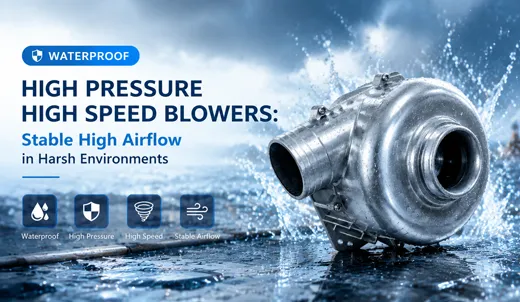
Why Standard Air Blowers Fail in Humid and Corrosive Operating Conditions
The vast majority of commercial, off-the-shelf air blowers rely on open-motor architecture. The internal Printed Circuit Board (PCB), copper stator windings, and bearing raceways are directly exposed to ambient air drawn through the housing. While this cost-effective configuration operates reliably in climate-controlled indoor spaces, deploying it in humid, outdoor, or liquid-splashed environments triggers catastrophic failure modes—often within months or weeks of operation.
Key Engineering Insight: Dust and water ingress are rarely separate issues. Moisture mixes with airborne particulates to create abrasive slurries, while temperature fluctuations draw humid air directly into motor cavities via thermal cycling.
The first major failure pathway is dew-point condensation leading to dielectric breakdown. Operating equipment undergoes continuous thermal cycling. When ambient temperatures drop, humid air trapped within sealed control cabinets or blower housings cools rapidly. Moisture condenses into micro-droplets on the cold surfaces of the internal drive circuit. This moisture creates conductive bridges across PCB traces, leading to over-current tripping, electrochemical migration, trace corrosion, and eventual catastrophic short circuits. Field data indicates that even without direct exposure to liquid rain, standard blowers operating in 85%+ relative humidity environments exhibit high premature failure rates.
The second failure mechanism involves bearing degradation caused by contaminant ingress. Ambient air in marine or industrial zones carries fine salt spray, chemical vapors, and abrasive mineral dust. Standard dust shields on inexpensive bearings fail to block microscopic particulates. Once airborne contaminants mix with the internal lubricating grease, the lubricant breaks down. The blower experiences elevated acoustic noise, increased rotational friction, dynamic balance shifts, and eventual bearing seizure. In coastal or marine environments, salt crystallization accelerates this abrasive wear exponential times over.
The third critical pain point is aerodynamic stall under high system backpressure. When air intake filters accumulate moisture, dust, or grease, duct resistance spikes sharply. Standard axial fans suffer aerodynamic stall in these conditions: the motor continues turning, but volumetric airflow collapses toward zero. The underlying electronic system rapidly overheats without triggering a fan-fail alarm, presenting a subtle yet severe risk to mission-critical hardware.
These failure modes have forced global OEMs to adopt fully sealed waterproof blowers. An industrial-grade waterproof blower is not merely a standard blower fitted with an external rubber gasket. It represents a ground-up engineering redesign of the motor, impeller, and driver assembly using vacuum encapsulation, labyrinth sealing, and specialized alloys to completely isolate energizing components from external atmosphere.
Core Architectural Technologies Powering IP68 Waterproof Blowers
To simultaneously deliver extreme rotational speeds (often exceeding 40,000 RPM) and total environmental isolation, premium waterproof blowers rely on four foundational engineering pillars:
1. Vacuum Epoxy Potting (Complete Stator & Circuit Encapsulation)
The defining line between consumer-grade splash-resistant fans and true IP68 industrial waterproof blowers is the potting process. Advanced manufacturing utilizes specialized thermosetting epoxy resin applied under a vacuum chamber. This process extracts all micro-bubbles and completely encapsulates the copper stator windings, drive electronics, IC chips, and solder joints in a solid, impermeable polymer matrix.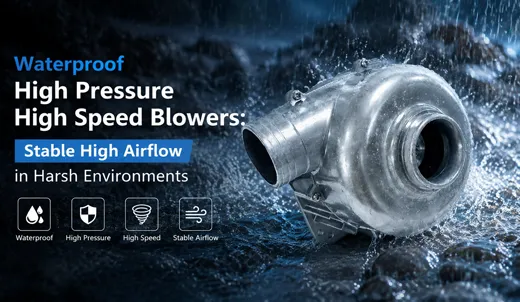
Engineers often express concern that thick epoxy potting will trap internal heat, degrading motor efficiency. High-performance blowers resolve this using specialized resin formulations infused with high thermal-conductivity ceramic micro-fillers. Thermal energy generated by high-speed operation conducts through the epoxy resin directly to the external metal or specialized plastic housing. Empirical thermal imaging proves that 24/7 continuous full-load operation maintains stator winding temperatures well within safe insulation limits, eliminating thermal derating or premature insulation breakdown.
While surface conformal coatings (such as Parylene or acrylic films) provide basic IP54–IP55 splash protection, thin films develop microscopic pinholes over time under vibration, thermal expansion, and particle abrasion. For long-term submersion, high-pressure washdown, or multi-year outdoor deployments, vacuum epoxy potting remains the industry gold standard.
2. Precision Dual Ball Bearings with Labyrinth Mechanical Seals
High-pressure blowers run at elevated velocities to generate static head. TKFAN waterproof blowers operate across typical speeds of 36,000 RPM to 48,000 RPM. Sleeve bearings cannot sustain these speeds or handle humid ambient conditions. Heavy-duty dual ball bearings paired with rubber labyrinth shaft seals form the core mechanical interface. The labyrinth path creates a mechanical barrier against liquid droplets and salt crystals, preventing grease migration and keeping raceways clean.
Under nominal operating conditions, industrial waterproof blowers achieve an L10 bearing life expectation of up to 70,000 hours—translating to nearly 8 years of continuous 24/7 operation without maintenance.
3. Aerodynamically Optimized Centrifugal Impellers
The centrifugal impeller configuration gives waterproof blowers a major edge over axial fans in high-impedance airflow pathways. Air is drawn in axially through the center inlet and accelerated radially outward through curved blades. This centrifugal compression generates high static pressure, forcing air through dense heat sinks, wet dust filters, and long, narrow ducting without encountering aerodynamic stall.
Industrial Waterproof Blower Performance Matrix
Below are representative engineering specifications for standard mass-production waterproof blower models:
| Model Number | Dimensions (mm) | IP Rating | Max Speed (RPM) | Max Airflow (CFM) | Max Static Pressure | Nominal Voltage |
|---|---|---|---|---|---|---|
| BA7050H24B-B | 70 × 70 × 50 | IP68 | 36,700 RPM | 17.9 CFM | 8.6 kPa (877 mmH₂O) | 24V DC |
| BA7060H24B-K | 70 × 70 × 60 | IP68 | 36,000 RPM | 16.2 CFM | 7.4 kPa (754 mmH₂O) | 24V DC |
| BA9080H24B-A-Integrated | 90 × 90 × 80 | IP68 | 48,000 RPM | 72.0 CFM | 18.0 kPa (1,835 mmH₂O) | 24V DC |
The heavy-duty BA9080H24B-A features an integrated high-power driver generating up to 18 kPa of static head pressure—ideal for extreme impedance applications like air knife drying systems and medical positive-pressure ventilation units.
4. Onboard MCU Protections and Intelligent Speed Control
Modern industrial blowers incorporate onboard microcontrollers (MCUs) to manage motor commutation and system protection functions. Built-in protection routines include:
- Locked-Rotor Protection: Automatically cuts drive current if foreign debris jams the impeller, auto-restarting once cleared.
- Reverse Polarity Protection: Prevents driver circuitry damage if wiring leads are mistakenly swapped during installation.
- Over-Voltage & Over-Current Cutoff: Protects internal electronics from unstable industrial power grids.
Blowers support standard speed control interfaces, including **Pulse Width Modulation (PWM)** signals and **0–10V analog voltage inputs** from PLCs or temperature controllers. The **Frequency Generator (FG)** tachometer output pin feeds real-time speed data back to the host system for closed-loop thermal monitoring.
Decoding Ingress Protection (IP) Ratings for Blower Selection
Selecting the correct IP rating prevents under-engineering (leading to field failure) or over-engineering (unnecessarily inflating unit costs). The two digits following "IP" define dust and water resistance limits:
- IP54 (Dust Protected / Splash Proof): Protection against limited dust ingress and water sprayed from any direction. Suitable for sheltered indoor enclosures; unsuitable for direct rain or high-pressure spray.
- IP67 (Dust-Tight / Temporary Immersion): 100% dust intrusion protection and immersion in up to 1 meter of static water for 30 minutes. Ideal for equipment exposed to temporary flooding or heavy storms.
- IP68 (Dust-Tight / Continuous Submersion): The benchmark for TKFAN industrial waterproof blowers. Complete dust seal and continuous submersion capability under specified pressure conditions. Perfect for outdoor marine, agricultural, and unshielded industrial hardware.
- IP69K (High-Pressure, High-Temperature Washdown): Protection against intense 100-bar water jets at 80°C. Mandatory for food processing lines subjected to daily chemical sanitization.
Primary Industry Applications for High-Pressure Waterproof Blowers
1. Outdoor Telecom Infrastructure & EV Charging Stations
5G remote radio units (RRUs), outdoor power cabinets, and commercial DC fast chargers run continuously outdoors exposed to rain, snow, sandstorms, and solar radiation. Internal power modules generate substantial heat that must be rejected. IP68 waterproof blowers push air through restrictive dust filters, maintaining low thermal resistance within sealed enclosures while using PWM control to lower fan speeds during cooler nighttime hours.
2. Marine Electronics, Offshore Wind, and Naval Systems
Ocean air carries high concentrations of corrosive sodium chloride. Navigation displays, maritime radar power supplies, and offshore wind turbine control panels require sealed thermal management solutions. Anti-salt-spray waterproof blowers combine IP68 vacuum potting with PBT polymer housings, stainless steel hardware, and specialized shaft coatings to resist salt crusting and galvanic corrosion.
3. Food Processing & Automated Washdown Facilities
Food processing facilities enforce strict hygiene regulations requiring daily washdowns with hot water and chemical sanitizers. Open fans short-circuit almost instantly in these conditions. IP68 and IP69K blowers withstand direct high-pressure spray, providing reliable cooling for conveying gearboxes, inspection systems, and packaging lines.
4. Smart Agriculture, Greenhouses, and Livestock Facilities
Commercial greenhouses and indoor farming facilities maintain high humidity levels alongside airborne fertilizer vapors and corrosive ammonia gases. Industrial waterproof blowers withstand constant condensation and chemical exposure, ensuring consistent air circulation and equipment cooling year-round.
OEM & ODM Customization Capabilities
Integrating a high-speed blower into an existing enclosure often requires custom physical or electrical modifications. TKFAN offers comprehensive OEM/ODM engineering services, including:
- Custom Harness & Connectors: Integration of IP-rated waterproof connectors (e.g., Deutsch, Amphenol, Molex).
- Aerodynamic Curve Tuning: Custom impeller blade modifications to shift P-Q curves for specific pressure/flow balance requirements.
- Material Upgrades: Highly chemical-resistant plastics or anodized aluminum housings for aggressive acid/alkali environments.
- Marine Anti-Corrosion Treatment: Advanced salt spray plating and specialized shaft seals for marine and offshore deployments.
Frequently Asked Technical Questions (FAQ)
Engineering Summary: Maximizing Value with Industrial Waterproof Blowers
Underestimating environmental stress during the design phase is one of the leading causes of premature equipment failure. Deploying standard commercial fans in humid, liquid-splashed, or salt-laden environments leads to unexpected field downtime, high warranty repair expenses, and damaged brand reputation. Integrating high-performance IP68 waterproof high-pressure blowers ensures reliable, long-term thermal performance even under the most demanding conditions.
To evaluate detailed technical datasheets, CAD models, or consult with our thermal engineering team regarding custom configurations, visit our official product hub at TKFAN Waterproof Blower Solutions.