

What Are the Benefits of Using a CPAP Blower? Key Advantages of High-Performance Medical Motors
Discover how medical-grade CPAP blowers dictate the therapeutic efficacy, quiet operational acoustic profiles, and long-term compliance rates of modern sleep apnea ventilation systems.
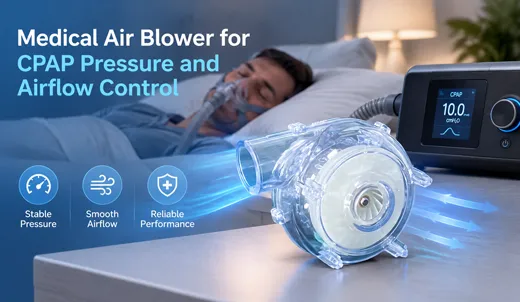
For millions of individuals worldwide diagnosed with Obstructive Sleep Apnea (OSA), Continuous Positive Airway Pressure (CPAP) therapy serves as the non-invasive gold standard treatment. By delivering a continuous stream of pressurized air, these devices prevent upper airway collapse, eliminate snoring, and mitigate the long-term systemic risks of chronic daytime fatigue and cardiovascular strain. However, the ultimate efficacy of any CPAP, BiPAP (Bilevel Positive Airway Pressure), or APAP (Automatic Positive Airway Pressure) machine relies entirely on a single critical internal component: the CPAP blower.
Often designated as the "heart" of the medical ventilator, a precision-engineered CPAP blower motor directly governs every critical performance metric of the device—ranging from operational noise emissions and dynamic pressure stability to rapid airflow response times, biometric safety, and overall service life. While substandard or generic industrial fans lead to frequent sleep disruptions, erratic therapeutic pressure drops, and early system failures, premium medical CPAP blowers unlock immense clinical and operational advantages. This comprehensive analysis evaluates the technical benefits of integrating advanced medical-grade blowers, utilizing performance baselines established by TKFAN’s specialized respiratory micro-turbines (Explore the Full Product Line).
1. Ultra-Low Vibration and Silent Operation: The Core Acoustic Advantage
The primary barrier to patient compliance during early-stage CPAP therapy is machine noise. Low-cost, generic blowers typically utilize single-plane dynamic balancing, an economy design choice that leaves residual rotational unbalance inside the motor rotor. At high speeds, this imbalance creates continuous micro-vibrations that resonate through the machine casing, producing an intolerable acoustic disturbance for patients and their bed partners.
In contrast, specialized medical CPAP blowers implement industry-leading dual-shaft, two-plane dynamic balancing systems. TKFAN’s entire catalog of 24V DC brushless CPAP blowers—ranging from ultra-compact 40mm units to high-flow 70mm systems—leverages this high-precision balancing process to neutralize kinetic oscillations before they turn into noise.
How Two-Plane Balancing Redefines Sleep Acoustics
By extending the rotor shaft of the brushless DC motor, a primary aerodynamic impeller is installed on the front end, while a precision-machined brass counterweight is anchored to the rear. Automated high-speed balancing equipment mill away minuscule weight deviations across both geometric planes simultaneously. This achieves near-zero rotor eccentricity.
Under standard clinical testing parameters (10 cmH₂O pressure load equipped with a 4mm restrictive orifice), a premium system like the flagship BA7060H24B-K CPAP blower generates an operational noise level of just 26.5 dB(A). This sits comfortably below the 30 dB(A) "library quiet" threshold, outperforming generic industrial fans and entry-level medical blowers from legacy manufacturers. Minimizing vibration yields clear patient benefits:
- Undisturbed REM Cycles: The elimination of low-frequency mechanical humming prevents micro-arousals, allowing users to enter and maintain deep, restorative REM sleep stages.
- Elimination of Secondary Resonance: Unbalanced motors transfer vibration into the internal humidification water chamber and the flexible breathing circuit, turning the entire device into an acoustic amplifier. Precision balancing halts this resonance at the source.
For portable travel CPAP devices where internal space is at a premium, micro-blowers like the BA4028H24B (measuring a mere 40×28mm and spinning at up to 48,000 RPM) cannot afford the weight of thick acoustic insulation foam. Thanks to its low-vibration architecture, this compact CPAP motor achieves silent operation natively, enabling lightweight, ultra-portable device enclosures without sacrificing acoustic comfort.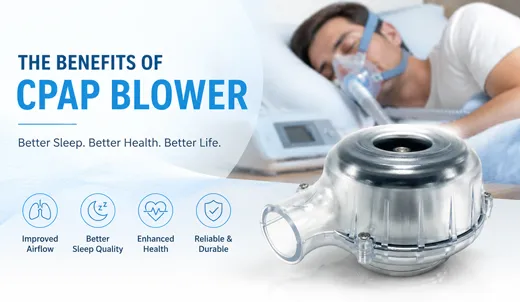
2. Dynamic Millisecond Pressure Response for Adaptive Ventilation Modes
The primary clinical benchmark for any sleep apnea blower is its capability to modulate airflow and therapeutic pressure instantly in lockstep with human respiratory cycles. When an OSA patient shifts from inhalation to exhalation, they must push against the incoming air column. If the internal blower cannot decelerate rapidly enough to lower the backpressure, the user experiences a distressing sensation of suffocation or "fighting the machine." This expiratory resistance is one of the most common reasons patients abandon their therapy.
High-performance brushless DC (BLDC) CPAP blowers overcome this through ultra-low inertia impellers paired with highly responsive sensored or sensorless electronic motor commutation control. This architecture permits millisecond-level transitions between pressure settings, perfectly matching the demands of fixed CPAP, auto-adjusting APAP, and bilevel BiPAP systems.
Engineered Aerodynamic Parameters
Advanced medical blowers maintain highly linear performance curves across varying structural resistances:
- Exceptional Static Pressures: Models such as the BA5060H24B-A deliver peak pressures of up to 8.4 kPa (over 80 cmH₂O), providing immense headroom to support high-pressure clinical prescriptions effortlessly within standard 4 to 25 cmH₂O therapy windows.
- High Volumetric Flow Rates: Reaching up to 440 L/min (or 18.8 CFM on the BA7060H24B-C model), these blowers supply sufficient air volume even for patients suffering from complex comorbidities like COPD or overlapping restriction issues.
- Linear Current Stability: Current draw remains perfectly proportional, scaling from a minimal 0.05 A under light loads up to just 0.56 A under max pressure. This allows the host microcontroller to calculate rapid motor speed adjustments smoothly.
By leveraging standard pulse-width modulation (PWM) or 0–5V analog speed control, device engineers can design advanced algorithms that distinguish between Inspiratory Positive Airway Pressure (IPAP) and Expiratory Positive Airway Pressure (EPAP). When the APAP machine detects a sudden hypopnea or snoring event mid-sleep, the responsive CPAP blower motor ramps up to the required therapeutic pressure instantly, resolving the airway obstruction before the patient wakes up.
3. Certified Medical-Grade Biocompatibility for Airway Safety
The most dangerous operational difference between generic industrial cooling fans and certified medical-grade CPAP blowers lies in material biocompatibility. A CPAP machine pumps high-velocity air directly into a patient’s respiratory tract for 7 to 10 hours every single night. Standard commercial fans frequently use low-cost plastics, volatile chemical lubricants, unrated industrial adhesives, and anti-flammable coatings that outgas volatile organic compounds (VOCs) when exposed to internal motor heat.
Over time, inhaling these trace chemical toxins can cause acute airway hypersensitivity, trigger chronic sinusitis, and pose systemic health hazards to the patient. Dedicated CPAP blowers eliminate this risk entirely by adhering to stringent ISO 10993 biocompatibility standards.
Every internal structural component along the airflow path—including the scroll housing and the centrifugal impeller—is injection-molded from specialized, medical-grade engineering plastics. No solvent-based glues or industrial bonding agents are used in the automated assembly lines. Consequently, even when operating at full velocity (ranging from 30,500 to 48,000 RPM) where internal friction warms the assembly, the airstream remains completely free of particulate matter and chemical odors. This material security provides distinct health advantages:
- Prevents localized airway inflammation, dry throats, and nasal passages commonly caused by low-grade aftermarket replacement blowers.
- Withstands continuous exposure to warm, humidified environments without undergoing polymer degradation or micro-plastic shedding.
- Minimizes systemic allergenic or asthmatic risks for pediatric, geriatric, or immunocompromised patients utilizing residential ventilation.
For medical device original equipment manufacturers (OEMs) seeking global regulatory approvals such as FDA clearance or CE marking, using an independently pre-certified ISO 10993 blower accelerates compliance pipelines. Eliminating the need to perform separate toxicology screening on the blower assembly saves substantial capital and shortens time-to-market schedules.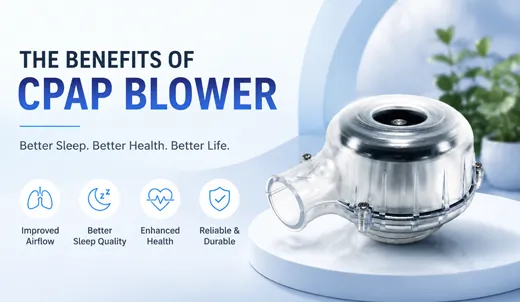
4. Extended Operational Longevity: Reducing Lifecycle Maintenance Costs
A CPAP machine is categorized as long-term durable medical equipment (DME). Therefore, the durability of its internal motor assembly dictates the product's overall warranty footprint and reliability reputation. Substandard blowers utilizing low-tier commercial ball bearings often present mechanical wear or bearing failure after 12,000 to 20,000 operational hours, forcing consumers into expensive machine overhauls or premature replacements.
Premium medical blowers integrate premium Japanese NMB dual-ball bearing assemblies as standard equipment. Engineered specifically to withstand high-velocity rotational forces, these bearings are paired with optimized thermal dissipation channels that quickly draw heat away from friction-prone zones.
As a result, professional-grade CPAP blowers achieve an impressive L10 service life rating of 50,000 to 70,000 hours. Calculated under standard load conditions, this translates to over 17 years of continuous nightly 8-hour therapy. This longevity represents a 30% to 40% upgrade over general-purpose industrial blowers, providing massive cost benefits to individual users, medical equipment rental fleets, and sleep clinics alike.
5. Robust Anti-Backpressure Aerodynamics Against Circuit Restrictions
A common vulnerability seen in standard commercial centrifugal fans is performance stalling under backpressure. In modern CPAP setups, the air pathway is heavily restricted by integrated humidification chambers, ultra-fine particulate filters, extended heated breathing tubes, and the exhalation ports of nasal or full-face masks. These elements generate significant pneumatic resistance.
If a blower lacks specialized anti-backpressure aerodynamic profiling, its air delivery curve drops off sharply when encountering these real-world obstacles. The medical device is then forced to over-rev the motor to compensate, which generates excessive noise, accelerates bearing degradation, and produces erratic pressure spikes.
Specialized CPAP blowers maintain linear current consumption and reliable volumetric flow even when operating behind a high-resistance 4mm restriction orifice at maximum pressure. The air delivery remains uncompromised, allowing integrated humidification and heated-tube systems to distribute moisture evenly without experiencing air stagnation or condensation issues along the circuit.
6. Ultra-Low Power Consumption for Extended Off-Grid Therapy
With the growing popularity of compact travel CPAP machines, the power efficiency of the internal blower motor has become a paramount design metric. Patients frequently require therapy when away from the power grid—such as during outdoor camping, long-haul flights, or unexpected residential power outages—relying entirely on external lithium-ion battery packs.
Advanced brushless DC CPAP blowers maximize electrical-to-pneumatic conversion efficiency. By drawing as little as 0.05 A at low-flow standby modes and averaging a mere 0.175 A during typical 10 cmH₂O therapeutic pressures, these blowers compress power consumption significantly. This ultra-low current draw enables standard portable battery systems to power a complete night of therapy easily, freeing users from the need to transport heavy, high-capacity backup batteries.
Technical Q&A: Frequently Asked Questions
Q1: Why is two-plane balancing critical for a CPAP blower compared to standard single-plane balancing?
A1: Single-plane balancing only corrects static imbalance on one geometric axis, which still allows dynamic coupling unbalance to cause axial twisting and high-frequency micro-vibrations at high RPMs. Two-plane balancing calibrates both ends of the rotor shaft simultaneously, completely neutralizing rotational eccentricity. This lowers noise levels down to <26.5 dB(A) and protects internal components from premature mechanical wear.
Q2: What specific ISO certifications should a high-quality CPAP motor possess?
A2: A premium medical-grade CPAP motor should comply fully with ISO 10993 (Biocompatibility Evaluation of Medical Devices) to guarantee that all materials in the air path are non-toxic and free from harmful outgassing. Additionally, manufacturing facilities should maintain ISO 13485 quality management certification specifically for medical device components.
Q3: How does the blower handle the rapid pressure shifts between inhalation and exhalation in BiPAP mode?
A3: The blower relies on an ultra-low inertia centrifugal impeller coupled to a responsive brushless DC motor controller. When receiving speed-change commands via PWM or a 0-5V analog interface, the motor adjusts its speed within milliseconds. This allows it to drop from a high inhalation pressure (IPAP) to a lower exhalation pressure (EPAP) smoothly, aligning with the patient's natural breathing frequency.
Q4: Can a standard industrial fan be used as a budget replacement inside a sleep apnea machine?
A4: No. Standard industrial fans lack certified bio-safe materials, cannot handle high pneumatic backpressure without stalling, lack the dynamic speed modulation needed for auto-adjusting algorithms, and emit loud acoustic profiles. Using them presents severe medical, therapeutic, and operational risks.
Q5: What is the average expected service life of a premium CPAP blower motor assembly?
A5: High-tier blowers configured with premium dual-ball bearing assemblies from specialized suppliers (like NMB) achieve an L10 operating lifetime rating of 50,000 to 70,000 hours. If used for standard 8-hour nightly therapy, this translates to more than 17 years of reliable operation.
Q6: How does backpressure from a humidification water chamber affect blower performance?
A6: Humidifiers and bacterial air filters introduce high pneumatic resistance. Specialized medical CPAP blowers feature highly efficient aerodynamic scroll profiles designed to counteract this resistance, maintaining highly linear pressure and flow delivery curves without overloading the motor.
Q7: What voltage setups are typical for these types of micro-turbines?
A7: The vast majority of medical CPAP blowers operate on a standardized 24V DC input, which balances optimal torque delivery and rapid acceleration with safe, manageable low-voltage power supply designs. Custom 12V configurations are also engineered for specialized mobile or military transport applications.
Q8: How does a low-power blower design affect travel-centric portable CPAP devices?
A8: Highly optimized motor windings and low-friction bearings reduce electrical waste. By running at lower currents (e.g., ~0.175 A under normal loads), portable CPAP machines can operate through an entire night on smaller, lightweight external battery packs, making travel much more convenient.
Q9: What options exist for customizing standard blowers for unique medical device footprints?
A9: Experienced OEMs can customize a variety of parameters through collaborative engineering, including modified mounting flange configurations, unique impeller aerodynamic blade angles, specific wire harness lengths, customized connector types, or integrated onboard driver electronics.
Q10: Why does premium automated assembly matter for the end supply chain?
A10: Utilizing fully automated assembly floors featuring integrated machine-vision inspection and digital MES tracking minimizes human assembly error. This guarantees strict batch-to-batch consistency, maintains a very low product defect rate, and reduces manufacturing costs—allowing medical device brands to acquire premium components at competitive price points.