

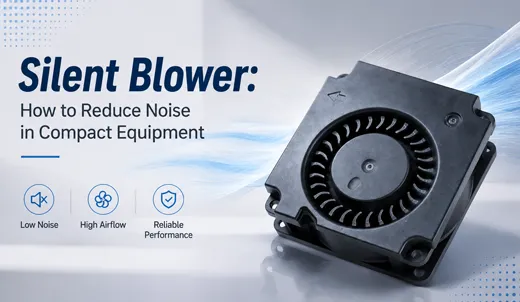
Silent Blower: How to Reduce Noise in Compact Equipment
Engineering compact electronic devices presents a persistent challenge: balancing powerful thermal management with acceptable acoustic performance. While miniature centrifugal blowers provide superior static pressure for cooling dense electronics, poorly optimized units generate annoying hums, high-pitched whistles, and intense air turbulence. For hardware design teams selecting a silent blower, low noise blower, low noise air blower, or silent blower fan, understanding acoustic roots, component-level limitations, and system-level integration is critical.
This guide breaks down blower noise generation, acoustic mitigation techniques, selection methodologies, and practical application scenarios. To evaluate ready-to-use miniature hardware options, explore the TKFAN micro blower product series.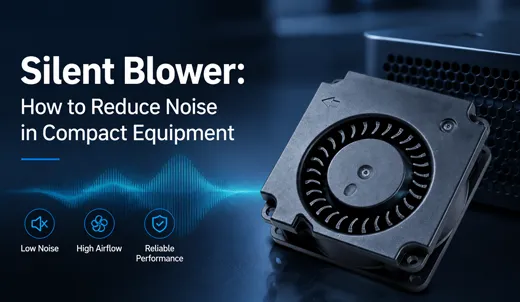
Why Blower Noise Matters in Compact Equipment
Miniaturization forces high-density components into increasingly cramped enclosures. Wearables, portable medical devices, compact lab analyzers, and office equipment all rely on forced-convection cooling. Standard axial fans fail under high backpressure caused by narrow air ducts, stacked PCBs, and dense heatsinks, prompting engineers to choose centrifugal blowers. However, acoustic noise remains a unyielding constraint.
Excessive noise poses severe product quality risks:
- Medical Devices: Blower noise near patients disrupts sleep and impacts clinical usability.
- Consumer & Wearable Tech: Whistling blowers make VR/AR headsets and desktop devices feel low-quality, leading to bad reviews.
- Precision Instrumentation: Mechanical vibrations cause optical components and sensor sub-systems to drift.
Compact enclosures amplify blower noise through cabinet resonance and forced fluid turns. A blower rated at 32 dBA in a lab can easily reach 42 dBA when installed inside an enclosure. Effective low-noise thermal management requires selecting a silent blower fan that balances static pressure, power, footprint, and acoustics from the earliest design stages.
Understanding the Sources of Air Blower Noise
An air blower's overall acoustic output is an aggregation of multiple distinct noise mechanisms. In most centrifugal units, aerodynamic noise accounts for 60% to 70% of total sound pressure.
| Noise Category | Primary Cause | Acoustic Characteristic |
|---|---|---|
| Aerodynamic | Blade passing frequency (BPF), vortex shedding, turbulent inlet air. | Broadband rushing noise, high-pitched tonal whistles. |
| Mechanical | Imbalanced impellers, shaft misalignment, bearing friction. | Rattling, persistent low-frequency hums. |
| Electromagnetic | Stator-rotor magnetic interaction, PWM switching frequencies. | Sharp, high-frequency electrical squeal. |
| Structural Resonance | Blower vibration matching chassis natural frequency. | Amplified buzzing sound across the casing. |
1. Aerodynamic Noise
Aerodynamic noise stems from air interacting with moving components. Blade Passing Frequency (BPF) noise occurs as impellers sweep past the scroll cut-off tongue, creating periodic pressure pulses. Restricted inlet pathways in compact equipment force impellers to pull air through narrow gaps, significantly increasing broadband turbulence.
2. Mechanical Noise
Mechanical noise originates from physical friction and rotational imbalance. At high operational speeds (10,000–13,500 RPM), minute mass offsets create strong vibrational forces. Choosing fluid dynamic bearings (FDB) over cheap sleeve bearings ensures low friction and long acoustic stability.
3. Electromagnetic & Resonance Noise
Brushless DC (BLDC) motors generate electromagnetic noise through magnetic flux variations and PWM switching pulses. If the motor's operational frequency matches the natural resonance of the plastic casing, structural resonance amplifies the sound level significantly.
How Motor Design Impacts Silent Blower Performance
The motor architecture drives mechanical stability and electromagnetic noise control. Multi-phase BLDC motors have replaced brushed motors in modern low noise blower designs. Removing physical brushes eliminates friction wear and prevents acoustic degradation over time.
Integrated Pulse Width Modulation (PWM) speed control is one of the most effective ways to lower real-world acoustics. Blower noise scales exponentially with rotational speed. Supporting 4-wire PWM control allows system microcontrollers to scale fan speeds down during low thermal loads, keeping noise at minimal levels.
Optimizing Impeller and Air Duct Architecture
While motors control mechanical vibration, optimized impellers and housing designs reduce aerodynamic sound. True low noise air blower units utilize engineered blade geometries to maintain pressure without excessive speed.
- Backward-Curved Blades: Reduce tip vortex shedding and spread tonal peak energy.
- Optimized Volute Cut-off: Smoothing the clearance between the tongue and impeller reduces BPF pressure pulses.
- CFD-Designed Flow Paths: Computational Fluid Dynamics (CFD) optimizes air transition, eliminating sharp corners that trigger turbulence. All TKFAN micro blowers integrate CFD-guided volute geometries.
Step-by-Step Guide to Selecting a Low Noise Blower
- Define Airflow & Static Pressure Requirements: Ensure the unit meets target CFM at required system backpressure without forcing maximum RPM.
- Set Real-World Noise Targets: Account for an added +5 to 8 dBA margin to offset enclosure reflection and turbulence.
- Specify Bearing Type & Dynamic Balancing: Choose FDB or dual ball bearings balanced to ISO 1940 G2.5 standards.
- Incorporate Anti-Vibration Mounts: Use silicone grommets or flexible isolation mounts to decouple vibration from the chassis.
Conduct Full Prototype Testing: Perform acoustic sweep tests across the entire PWM range to identify resonance zones.
Applications Requiring Silent Blower Design
Demand for silent forced-air cooling spans across multiple industries:
- Portable Medical Equipment: CPAP machines, portable oxygen concentrators, and diagnostic devices require whisper-quiet operation near patient beds.
- Laboratory Analyzers: Precision air delivery units require zero mechanical vibration to maintain sensor calibration.
- AR/VR Headsets & Wearables: Head-mounted electronics demand light weight, low power, and silent heat extraction.
- Compact Office Electronics: Mini PCs, smart projectors, and desktop edge devices.
Technical FAQ: Silent Blower Noise Control
Achieving optimal acoustics in compact equipment requires an integrated approach covering aerodynamic selection, motor mechanics, and sound isolation. For engineering support and sample testing, explore TKFAN micro blower solutions to streamline your thermal design.