

High-Speed Centrifugal Fan: The Ultimate Synergy of Large Airflow and High Static Pressure
Introduction: The Modern Engineering Bottleneck
In contemporary hardware design, thermal management and fluid dynamics dictates product reliability. As microelectronics, medical devices, and industrial equipment continue to shrink in footprint while ramping up thermal output, design engineers encounter a persistent fluid mechanics bottleneck: system impedance. Compact enclosures demand dense component placement, tortuous air channels, fine-pitch heat sinks, and multi-stage particulate filters (such as HEPA filtration). These components inevitably introduce severe pneumatic resistance.
When selecting thermal management components, engineers traditionally had to choose between two conflicting characteristics:
- Axial Cooling Fans: Capable of delivering vast volumetric airflow (CFM) under zero-resistance (free-air) conditions, but experiencing rapid aerodynamic stall and severe flow rate drop-offs when subjected to moderate backpressure.
- Conventional Blower Fans: Capable of generating static pressure to push air through tight spaces, but requiring large physical dimensions and slow rotational speeds, yielding insufficient airflow in micro-enclosures.
Enter the modern high-speed centrifugal fan (also known as a high-speed micro DC blower). By pairing ultra-high rotational speeds—ranging from 30,000 RPM to over 100,000 RPM—with highly optimized radial impellers and specialized volute geometries, high-speed centrifugal fans successfully unite high volumetric airflow with high static pressure capabilities within a remarkably compact envelope.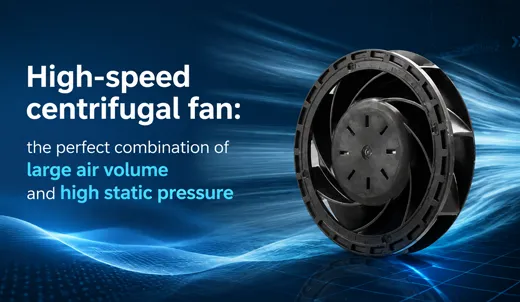
Pneumatic Principles: Axial vs. Centrifugal Mechanics
Understanding why a high-speed centrifugal blower excels in high-impedance environments requires examining its underlying fluid dynamics. The fundamental distinction between axial fans and centrifugal blowers lies in the direction of fluid passage and energy conversion mechanisms.
Axial Fan Aerodynamics
Axial fans move air parallel to the axis of rotation. The blades act like rotating wings, creating a pressure differential that lifts and propels air forward. While highly efficient for open-air ventilation, axial fan blades are vulnerable to aerodynamic boundary layer separation when pressure builds up downstream. When exposed to system impedance (such as a dust-laden HEPA filter), the air slips backward over the blade tips, inducing stall and reducing delivered air volume toward zero.
High-Speed Centrifugal Fan Mechanics
In contrast, a high-speed centrifugal blower draws air in axially through the center inlet and turns it 90 degrees, accelerating it radially outward through a spinning impeller. The centrifugal force generated by high rotational velocity imparts kinetic energy to the air molecules. As air leaves the tip of the impeller blades, it enters the volute casing—a expanding spiral channel. The volute acts as a diffuser, converting high kinetic energy (velocity) into potential energy (static pressure). This 90-degree energy conversion allows centrifugal fans to maintain powerful air movement even against dense system backpressure.
| Performance Metric | Standard Axial Fan | Conventional DC Blower | High-Speed Centrifugal Fan |
|---|---|---|---|
| Rotational Speed Range | 2,000 – 8,000 RPM | 2,000 – 6,000 RPM | 30,000 – 100,000+ RPM |
| Free-Air Flow (CFM) | High | Low to Moderate | High to Very High |
| Max Static Pressure (kPa) | Low (< 0.1 kPa) | Moderate (0.1 – 0.3 kPa) | Extremely High (0.4 – 10+ kPa) |
| High-Impedance Tolerance | Poor (Prone to stall) | Moderate | Exceptional |
| Transient Response Speed | Slow | Moderate | Ultra-Fast (Milliseconds) |
| Footprint Density | Standard | Bulky for high pressure | Ultra-Compact Envelope |
Engineering Breakthroughs Enabling High-Speed Performance
Simply spinning an impeller faster is not enough to create a reliable high-speed centrifugal fan. Uncontrolled high speeds induce massive mechanical stresses, severe thermal dissipation issues, acoustic noise, and premature bearing destruction. Premium manufacturers like TKFAN implement several engineering innovations to resolve these hurdles.
1. Low-Inertia, Dynamically Balanced Impellers
At rotational speeds exceeding 50,000 RPM, the mass of the spinning rotor dictates pneumatic responsiveness and structural integrity. High-performance centrifugal blowers utilize ultra-lightweight, high-strength polymer impellers (such as medical-grade PBT or reinforced polycarbonate). Minimizing rotational inertia enables dynamic speed adjustments within milliseconds—a mandatory feature for medical ventilators following human respiratory patterns. Furthermore, each impeller undergoes fully automated two-plane dynamic balancing to reduce residual unbalance down to microgram-millimeter levels, suppressing high-frequency vibration and structural resonance.
2. Slotless Brushless DC (BLDC) Motor Architecture
Traditional brushed motors cannot survive high RPM applications due to rapid brush wear and electrical arcing. High-speed centrifugal fans rely on advanced Brushless DC (BLDC) motors, frequently featuring slotless stator windings. Slotless designs eliminate cogging torque, ensure smooth rotation, minimize iron losses, and drastically reduce heat buildup within the motor core. This high electrical efficiency extends battery life in portable medical and industrial devices.
3. Precision Aerodynamic Volute and Housing Design
The internal geometry of the volute housing directly dictates pneumatic efficiency. Through Computational Fluid Dynamics (CFD) modeling, the scroll curvature, tongue angle, and discharge nozzle are optimized to minimize turbulent recirculating flow. This ensures maximum kinetic-to-pressure conversion with minimal acoustic emissions.
4. Advanced Bearing Technologies
Bearings represent the primary point of wear in any rotating machine. High-speed centrifugal blowers implement high-precision dual ball bearings pre-loaded with synthetic high-temperature lubricants. For ultra-demanding or continuous 24/7 applications, advanced ceramic ball bearings or fluid dynamic bearings (FDB) are integrated to withstand high thermal loads and prevent lubrication breakdown.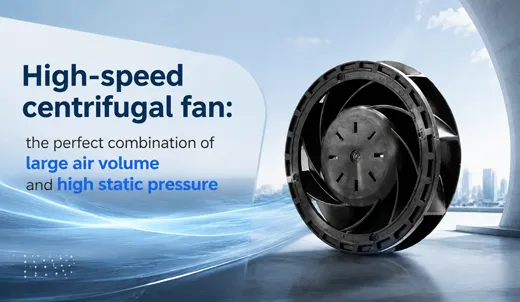
Key Application Scenarios
The ability to deliver uncompromised air volume under substantial backpressure makes high-speed centrifugal fans indispensable across numerous technical sectors.
Medical Ventilators and ICU Support Systems
Life-support ventilators require precision air delivery that instantly adapts to a patient's breathing cycles. The blower must overcome the resistance of internal bacteria filters, humidifiers, and narrow patient tubing while generating precise flow profiles. High-speed centrifugal fans provide the ultra-fast millisecond pressure response needed to supply instantaneous tidal volumes without lag.
CPAP and BiPAP Sleep Apnea Devices
Continuous Positive Airway Pressure (CPAP) therapy devices must maintain constant, prescribed pressure levels through fine intake filters and long flexible hoses. Because these machines sit on bedside tables, high-speed centrifugal fans in CPAP units are engineered with specialized acoustic dampening chambers and ultra-balanced rotors to operate virtually silently while sustaining high static pressure.
Powered Air-Purifying Respirators (PAPR)
PAPR systems protect industrial personnel and healthcare workers by pulling contaminated air through dense HEPA filters and supplying clean air to a hood or facepiece. As particulate matter accumulates on the filter, system impedance increases dramatically. A high-speed centrifugal fan maintains constant airflow despite dirty filters, ensuring user safety and extending battery runtimes.
High-Speed FDM 3D Printers
Modern high-speed 3D printers print at speeds upwards of 500 mm/s. To prevent print deformation, newly deposited filament must be cooled instantly. High-speed centrifugal blowers force cold air through tight print-head ducts directly onto the nozzle tip, delivering focused, high-pressure cooling air without adding excess mass to the toolhead.
High-Density Server Racks and Computing Workstations
Dense 1U/2U server chassis packing high-TDP CPUs and GPUs leave minimal space for air passages. Air must be driven through tightly spaced aluminum heat pipes and dense cable bundles. High-speed centrifugal blowers pull heat directly away from hot spots and push it out through restrictive rear grilles efficiently.
Selection & Engineering Checklist
Selecting the optimal high-speed centrifugal fan requires examining critical engineering factors beyond simple peak specification metrics:
- Analyze the Operating Point on the P-Q Curve: Never base selection on maximum flow (free air) or maximum static pressure alone. Evaluate the exact point where your system resistance curve intersects the fan's Pressure-Volume (P-Q) performance curve.
- Operating Voltage and Control Signals: Determine whether 10.8V, 12V, 24V, or 48V DC power fits your system architecture. Verify compatibility with PWM (Pulse Width Modulation) speed control and FG (Tachometer) feedback signals for closed-loop thermal management.
- Acoustic and Vibration Constraints: Evaluate system noise thresholds. Check if dynamic balancing standards, soft-mounting dampeners, or acoustic inlet mufflers are required for noise-sensitive environments.
- Material Compatibility and Standards: For medical or cleanroom equipment, specify biocompatible, low-outgassing polymers (such as RoHS, REACH, and ISO 10993 compliant materials).