

How to Choose the Right Air Blower: The Complete Industrial & OEM Engineering Guide
Selecting the optimal air blower fan for specialized equipment is a critical engineering decision. Whether you are designing high-precision medical ventilators, automated driver-assistance systems (ADAS) sensor cleaners, dust particle counters, or heavy-duty packaging machinery, choosing the incorrect blower fan can lead to thermal throttling, air volume insufficiency, excessive noise levels, and premature system failure. This technical engineering guide covers everything you need to know about how to choose the right air blower, examining working principles, key operational metrics, performance curve interpretations, and customized OEM integration strategies.
1. What is an Air Blower Fan and How Does It Work?
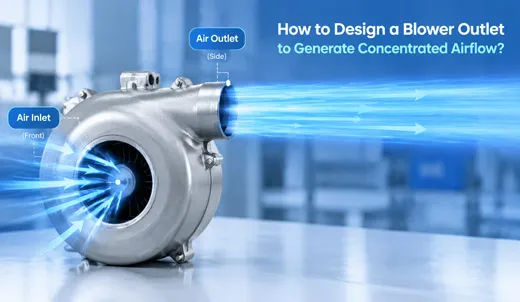
An air blower fan (frequently referred to as a centrifugal blower, high-pressure blower, or radial fan) is an air-moving device designed to draw air in axially along the center axis and expel it radially at a 90-degree angle. This structural orientation accelerates air through internal impellers inside a specialized housing (volute), converting kinetic energy into static pressure.
Understanding the fundamental distinction between an air blower and a standard axial cooling fan is essential for proper mechanical selection:
- Axial Fans: Intake air and discharge air parallel to the rotation shaft. They deliver high airflow (CFM) under minimal backpressure conditions but stall quickly when encountering restricted airflow channels.
- Centrifugal Air Blowers: Draw air axially and discharge it perpendicularly at 90 degrees. They are specifically engineered to build up substantial static pressure (Pa or mmAq), enabling air to overcome significant resistance inside tight enclosures, narrow ducts, multi-layer HEPA filter arrays, and sealed equipment chassis.
2. TKFAN Air Blower Product Categories and Technical Overview
To meet diverse OEM engineering requirements, TKFAN manufactures a comprehensive portfolio of high-efficiency blowers categorized by dimensions, voltage supply, static pressure capacity, and industrial environmental resistance:
- Micro Air Blowers (Ultra-Compact Series): Standard sizes down to 30×30×7mm and 40×40×10mm. Designed specifically for space-constrained applications like wearable medical monitors, portable diagnostic kits, and compact sensor modules.
- Low-Voltage DC Air Blowers (2V / 5V): Ultra-low startup voltages engineered for battery-powered, highly mobile medical and consumer electronics.
- Standard DC Air Blowers (12V, 24V, 48V): The core workhorses for industrial automation, automotive electronics, server racks, cleanroom particle counters, and CPAP sleep apnea therapy machines.
- High-Pressure Centrifugal Blowers: Advanced centrifugal fans offering elevated static pressure output tailored for heavy filtration networks (HEPA), medical ventilation, and automotive ADAS optical lens cleaning systems.
- AC 220V Industrial Blowers: Heavy-duty, continuous-operation blowers built for factory ventilation, hot air soldering stations, and air-pillow packaging machinery.
- Waterproof & Dustproof IP-Rated Blowers: Fully encapsulated blowers rated up to IP54/IP67, protected against severe outdoor humidity, water jets, and harsh chemical dust exposure.
3. Key Parameters for Air Blower Selection
To accurately select the right air blower for your equipment, engineering teams must evaluate seven core technical parameters:
3.1 Required Airflow Volume (CFM / m³/h)
Airflow volume measures the total volumetric displacement of air over time, expressed in Cubic Feet per Minute (CFM) or Cubic Meters per Hour (m³/h). Airflow requirement is dictated by thermal dissipation calculations or necessary volumetric exchange rates:
- Portable & Wearable Medical Devices: 0.5 – 5 CFM (Micro Blowers)
- Medical CPAP & Ventilation Therapy: 5 – 30 CFM (High-Pressure Micro Blowers)
- Automotive ADAS & Camera Cleaning: 10 – 40 CFM (Compact 12V/24V Blowers)
- Telecommunications & Server Cabinets: 30 – 100 CFM (48V Industrial Blowers)
- Industrial Air Cushion Packaging Systems: 80 – 200 CFM (High-Speed 24V/220V Blowers)
3.2 Static Pressure (Pa / mmAq / inH2O)
Static pressure defines the force an air blower generates to push air through system resistance (filters, narrow heat sinks, acute duct bends, or micro-nozzles). Static pressure is the ultimate differentiating factor when specifying a high-pressure blower. Always verify that the blower's maximum static pressure rating comfortably exceeds your system's total flow resistance at the desired operating airflow rate.
3.3 Physical Dimensions and Mechanical Fitting
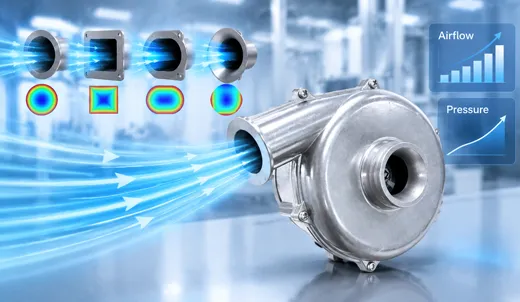
Mechanical constraints dictate outer shell boundaries. Critical dimension checks include overall length, width, and thickness, mounting hole spacing and screw thread specifications, air inlet diameter, and air outlet geometry (rectangular vs. circular, side-flange vs. tangential housing output).
3.4 Noise Emission Limits (dB(A))
Acoustic performance is critical in healthcare, office, and home environments. Acoustic noise in air blowers is minimized by dynamic blade balancing, optimized volute aerodynamics, and precision motor control:
| Application Environment | Target Noise Level | Recommended Air Blower Solution |
|---|---|---|
| Medical Respiratory & Sleep CPAP | ≤ 20 – 25 dB(A) | Ultra-quiet Brushless DC High-Pressure Blower |
| Smart Home & Consumer Electronics | 25 – 35 dB(A) | Low-Noise Micro Centrifugal Fan |
| Automotive & General Electronics | 35 – 50 dB(A) | Standard 12V / 24V Brushless DC Blower |
| Industrial Machinery & Packaging | 50 – 70 dB(A) | High-Speed AC/DC Heavy-Duty Industrial Blower |
3.5 Bearing System and Operational Lifespan
Continuous reliability depends directly on internal motor bearing design:
- Sleeve Bearings: Lower initial cost; typical lifespan of 10,000 to 20,000 hours. Best suited for non-critical, intermittent-use consumer goods.
- Dual Ball Bearings: Standard industrial choice; 50,000 to 70,000 hours lifespan under continuous operation at 40°C. Ideal for mission-critical medical, automotive, and telecom equipment.
- Fluid Dynamic / Magnetic Levitation Bearings: Extended lifespan exceeding 100,000 hours with minimal acoustic noise, suitable for premium medical and laboratory equipment.
3.6 Environmental Ingress Protection (IP Rating)
Dust, moisture, and chemical exposure can damage electrical windings. Unprotected standard fans suit dry indoor environments, whereas sealed IP54 to IP67 blowers are essential for outdoor automotive sensors, industrial cleaning machinery, and high-humidity processing plants.
3.7 Smart Motor Control and Feedback Options
Modern OEM architectures require real-time speed control and system diagnostic capabilities. TKFAN BLDC blowers support customizable control interface options including PWM (Pulse Width Modulation) for dynamic speed control, FG (Frequency Generator) for real-time tachometer output, and RD (Rotation Detector) alarm signals to trigger automated system alerts if a fan lockup occurs.
4. Decoding the P-Q Performance Curve for Precise Matching
A common mistake when selecting an air blower fan is reviewing only free-air delivery (maximum CFM) or shut-off static pressure (maximum Pa). In actual operation, an air blower works at an intersection point where the system impedance curve crosses the fan's P-Q (Pressure vs. Volume) curve.
To ensure optimal system performance:
- Calculate or measure system flow resistance under maximum load conditions (e.g., dirty filter state).
- Plot the system resistance curve on the manufacturer's P-Q graph.
- Identify the operating intersection point. Ensure this point lies within the stable, high-efficiency middle region of the blower curve, avoiding the unstable aerodynamic stall region near the maximum pressure cutoff.
- Apply a 15% to 20% performance safety margin on both airflow and static pressure to account for long-term filter dust loading, motor aging, and ambient air density fluctuations.
5. Brushless DC (BLDC) vs. Brushed Motors in Air Blowers
TKFAN equips all premium air blowers with advanced Brushless DC (BLDC) motors. Compared to legacy brushed motors, BLDC blowers offer distinct performance advantages:
| Performance Metric | Brushless DC (BLDC) Blower | Brushed DC Blower |
|---|---|---|
| Operating Lifespan | 50,000 – 100,000 Hours | 5,000 – 15,000 Hours (limited by brush wear) |
| Energy Efficiency | High (85% – 92%) | Moderate (60% – 70%) |
| Acoustic & Vibration | Very low; smooth electronic commutation | Higher mechanical friction and brush chatter |
| Control Capabilities | Integrated PWM, FG, RD smart control | Voltage scaling only; no digital feedback |
| Electromagnetic Interference | Minimal EMI signature | High EMI caused by mechanical arcing |
6. Key Application Scenarios for OEM Air Blowers
6.1 Medical Equipment & Respiratory Healthcare
High-pressure micro blowers serve as the central driver for CPAP machines, portable ventilators, and anesthesia units. These systems require rapid acceleration, high peak pressures, biological compatibility, extremely stable air delivery, and low acoustic noise output (≤20 dB(A)).
6.2 Automotive Electronics & ADAS Sensor Cleaning
Autonomous driving camera lenses, LiDAR sensors, and night-vision modules require rapid debris removal. High-pressure 12V/24V blowers deliver concentrated air bursts to clean optical surfaces under extreme temperature fluctuations ranging from -40°C to +85°C.
6.3 Environmental Sensing & Cleanroom Equipment
Optical dust particle counters require precise volumetric sampling airflow to draw air through tight interior filter membranes. High-accuracy 24V brushless blowers guarantee consistent airflow rates, directly protecting measurement precision.
6.4 Industrial Automation & Packaging Machinery
Automated air-pillow packaging devices, hot-air desoldering stations, and vacuum pick-and-place lines require heavy-duty continuous industrial blowers with high pressure capabilities and thermal endurance.
7. OEM Custom Air Blower Engineering Services
When off-the-shelf standard blowers fall short of specialized project parameters, working with a custom blower manufacturer provides tailored engineering solutions. TKFAN provides complete OEM/ODM engineering customization options, including:
- Custom volute casing molds, customized mounting flanges, and specialized intake/outlet angles.
- Motor winding adjustments to match non-standard input voltages (e.g., 6V, 36V, 72V).
- Acoustic tuning to achieve ultra-quiet thresholds for medical equipment.
- Custom cable lengths, automotive-grade connectors, and modified PWM response curves.
- Conformal coating and full epoxy encapsulation for IP67 waterproof and anti-corrosion protection.