

How to Choose a Blower Fan: The Ultimate Industrial & Medical Engineering Selection Guide
An in-depth technical analysis on selecting high-performance 24V DC brushless centrifugal blowers for medical ventilators, laboratory instruments, and heavy-duty industrial applications.
1. Introduction: Why Correct Blower Fan Selection Dictates System Lifecycle and Performance
A centrifugal blower fan serves as the foundational pneumatic prime mover, thermal management driver, and respiratory airflow source across countless critical applications. Whether you are developing clinical medical ventilators, automated industrial dust extraction systems, new energy thermal dissipation architectures, laboratory dust particle counters, or high-throughput commercial appliances, an incorrect blower selection introduces irreversible design deficiencies throughout your product's operational lifecycle.
Many original equipment manufacturer (OEM) procurement professionals and hardware design engineers frequently commit the error of focusing exclusively on unit cost, physical dimensions, or open-air flow rates when researching how to choose a blower fan. Consequently, they neglect vital technical dependencies such as static pressure reserves, motor thermodynamic efficiency, voltage fluctuation tolerances, ingress protection (IP) ratings, biomedical compatibility, and international safety compliance certifications.
- Severe airflow degradation under pneumatic resistance from dense air filters or narrow piping.
- Excessive acoustic noise exceeding 30 dBA, disrupting clinical hospital wards or strict workspace environments.
- Premature bearing failure leading to high field-maintenance overhead and frequent warranty claims.
- Low-efficiency motor topologies generating extreme parasitic heat, triggering electronic circuit over-temperature trips.
- Material composition lacking certified regulatory clearances, completely halting global market distribution.
Within the modern direct current (DC) fan landscape, the 24V brushless DC (BLDC) centrifugal blower fan has emerged as the global benchmark for high-performance medical and industrial instrumentation. By delivering lower current consumption, higher mechanical power density, and a broader tolerance for supply voltage fluctuations, these blowers overcome the performance ceilings that constrain legacy 12V or alternating current (AC) variants.
2. Step 1: Accurately Mapping Your Operational Environment and Application Context
The foundational rule of learning how to choose a blower is to thoroughly define the application ecosystem before cross-referencing datasheet specifications. Different operational environments impose distinct mandatory parameters on structural engineering, aerodynamic profiles, protection metrics, and compliance frameworks. We categorize the core application spectrum into five primary engineering scenarios:
Scenario A: Clinical Medical Respiratory Equipment (Ventilators, Sleep Apnea CPAP, Bubble CPAP)
Medical-grade pneumatic delivery mandates ultra-clean, oil-free gas streams paired with dynamic pressure control loops. The blower must operate at near-silent acoustic thresholds (≤30 dBA) to prevent sleep disruption or ICU ambient fatigue, while maintaining static pressure capacities ranging between 2.0 kPa to 8.0 kPa. Material selection must comply with strict biocompatibility mandates, ensuring no toxic off-gassing occurs within the patient gas path.
Furthermore, internal electronics must feature IP50 or superior moisture-resistant coatings to prevent failure from humidified gas condensation. Regulatory frameworks require comprehensive CE, RoHS, and IEC 60601-1 certifications, alongside continuous operational lifespans exceeding 20,000 hours. High-speed 24V BLDC centrifugal blowers represent the only viable technology for this niche; generic commercial air pumps or industrial fans cannot match their response times or contamination-free architectures.
Scenario B: Industrial Automation and New Energy Infrastructure
Industrial deployment demands blowers capable of developing extreme static pressures (up to 24 kPa) and moving robust air volumes through dense particulate filters or extensive ducting. These blowers must endure volatile temperature ranges from -25°C up to +85°C and carry robust IP65 dustproof and waterproof ratings to survive harsh shop floors or outdoor enclosures.
Engineered with dynamic balanced rotors to cancel out operational vibration, these heavy-duty blowers support continuous 24/7 duty cycles. Typical industrial applications include manufacturing line debris clear-away, air-liquid mixing interfaces, hydrogen fuel cell oxidation gas delivery, and high-power electric vehicle (EV) charging station thermal management loops.
Scenario C: Precision Laboratory & Metrology Instrumentation
Analytical systems require highly laminar, pulsation-free volumetric airflow to avoid disrupting sensitive sensor arrays. Precision control requires highly accurate Pulse Width Modulation (PWM) speed regulation paired with clean tachometer (PG) pulse feedback. These applications utilize mid-range static pressures housed within extremely compact fan configurations that radiate negligible electromagnetic interference (EMI).
Typical instruments include airborne optical particle counters, ambient air quality monitors, and gas chromatography sampling modules. The TKFAN BA8050H24B 24V blower model is an industry-standard configuration engineered precisely for these high-accuracy metrology requirements.
Scenario D: High-Density Electronics and Semiconductor Thermal Management
Modern telecommunications rack arrays, server enclosures, solid-state laser modules, and industrial power inverters generate dense localized thermal footprints. Blowers deployed here require small physical form factors featuring integrated internal drive electronics to minimize system integration volume.
Key requirements include low parasitic power consumption, wide voltage tolerance inputs (20V to 30V DC), minimal structural vibration, and built-in protection architectures (over-current, locked-rotor, and thermal shutdown). Micro-centrifugal models like the TKFAN BA5025H24B-A and BA5030H24B-A are tailor-made to provide targeted localized cooling in confined space envelopes.
Scenario E: Commercial Systems and High-End Household Appliances
Commercial packaging machinery, high-volume refrigeration units, and premium household air filtration arrays balance structural performance with commercial cost efficiency. These environments require low to mid-range static pressures combined with high volumetric air displacement and moderate acoustic footprints.
Compliance criteria focus primarily on standard RoHS and basic IP4X ingress prevention. Accurately determining your exact application scenario early prevents over-engineering, minimizing developmental cost overruns and maximizing performance matching.
3. Step 2: Differentiating Major Blower Topologies and Architectural Categories
Four primary aerodynamic fan architectures dominate the global market. Understanding their structural mechanics, operational strengths, and performance boundaries is critical when evaluating how to choose a blower:
| Blower Topology | Aerodynamic Mechanics | Key Engineering Benefits | Primary Limitations |
|---|---|---|---|
| Centrifugal BLDC Blower | Air enters axially, accelerates via centrifugal force, and exits radially through a scrolled housing. | High static pressure, rapid PWM speed response, oil-free long-life ball bearings, low noise. | Higher initial unit cost compared to basic axial fans. |
| Axial Flow Fan | Airflow passes directly through the fan blade plane, parallel to the rotational axis. | Exceptional volumetric flow rate under zero-resistance conditions, low cost, simple integration. | Extremely poor static pressure; stalls easily under system restriction. |
| Cross-Flow (Tangential) Fan | Air enters and exits transversely through a long, cylindrical multi-blade rotor assembly. | Ultra-wide, uniform planar air distribution, low profile, minimal localized vibration. | Low static pressure threshold; restricted flow rate scaling. |
| Diaphragm Positive Displacement Pump | Mechanical reciprocating diaphragm actuation produces alternating positive displacement. | Low unit cost for basic pressure generation at low flow volumes. | Severe flow pulsation, heavy mechanical vibration, brief service life, loud acoustics. |
For applications integrating air filters, narrow transport tubing, or complex internal routing, Centrifugal BLDC Blowers represent the ideal engineering solution. Axial fans fail under minimal pressure drops, cross-flow units lack the static pressure to drive deep air columns, and diaphragm pumps introduce disruptive pressure pulsations that degrade sensor accuracy and pose safety risks in respiratory environments. The TKFAN 24V Centrifugal Blower Portfolio is engineered specifically around this premium, high-efficiency centrifugal architecture.
4. Step 3: Deconstructing Critical Technical Specifications and Mathematical Margins
Accurate parameter matching forms the core of successful blower integration. Over 80% of system operational anomalies stem from inadequate volumetric flow rates or insufficient static pressure margins. Below, we break down the vital parameters required to systematically choose a blower fan:
4.1 Volumetric Flow Rate (CFM) and the 20% Safety Buffer Design Margin
Volumetric flow rate represents the gross volume of air displaced by the blower per unit of time, typically quantified in Cubic Feet per Minute (CFM) or Liters per Minute (L/min), where:
1 CFM ≈ 28.316 L/min
When selecting a blower, always employ the standard engineering safety buffer formula:
Required Systematic Airflow × 1.2 = Target Minimum Blower Specification
Integrating a mandatory 20% safety margin ensures the system compensates for particulate build-up on air filters over time, sharp plumbing bends, chassis leakage, and internal surface friction losses across extended deployment cycles.
- Micro-Electronics Dissipation (5–10 CFM Target): Highly suited for the TKFAN BA5030H24B-A rated at 6.0 CFM.
- Clinical Respiratory Ventilators (12–18 CFM Target): Typically pairs with the BA7050H24B or BA7060H24B platforms.
- Industrial Extraction & Analytical Samplers (25–33 CFM Target): Optimally serviced by the BA8050H24B-A or BA8060H24B-B models.
4.2 Static Pressure (kPa): The Crucial Metric for Real-World Fluid Resistance
Static pressure measures the blower's ability to drive air through restrictive pathways like HEPA filters, active humidifiers, narrow respiratory masks, long flexible hoses, and tight internal ductwork. While a blower might offer a high open-air volumetric flow rate on paper, insufficient static pressure cause actual output to drop sharply under load.
Recommended peak static pressure benchmarks for 24V blowers across standard applications include:
- Micro-Chassis & Mobile Electronics: Peak Static Pressure ≥ 2.9 kPa (e.g., TKFAN BA5030H24B-A)
- Standard Medical CPAP Devices: Peak Static Pressure 4.8 kPa – 7.9 kPa (e.g., TKFAN BA5025H24B-A / BA7050H24B)
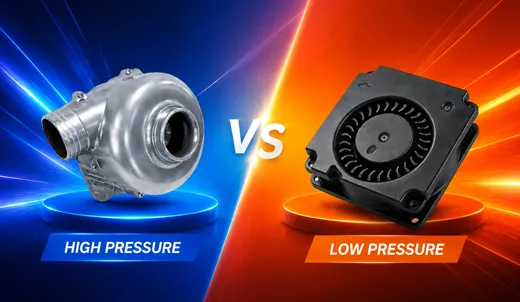
- Bi-Level PAP Ventilators & Light Industrial Scrapers: Peak Static Pressure 13 kPa – 18 kPa (e.g., TKFAN BA8050H24B-A / BA8060H24B-E)
- Ultra-High Pressure Pneumatics & Fuel Cells: Maximum Pressure up to 24 kPa (e.g., TKFAN Flagship BA8060H24B-E-25KPA)
4.3 Operating Voltage: Why 24V BLDC Systems Outperform 12V and AC Configurations
Choosing the correct electrical architecture is critical when specifying a blower fan. Compared to standard 12V DC variants, a 24V blower fan provides clear advantages for medical and industrial applications:
75% Reduction in Parasitic Heat Loss: At equivalent mechanical power outputs, doubling the operating voltage reduces current draw by 50%. Based on Joule's Law ($P = I^2R$), cutting the current in half reduces thermal losses by 75%, lowering motor temperatures and extending bearing life.
Broad Voltage Instability Tolerance: Premium 24V BLDC blowers support an operational input window from 20V to 30V DC, ensuring stable performance despite fluctuations from industrial power grids or mobile battery arrays.
Superior Peak Performance Ceilings: Heavy-duty 24V brushless motor topologies support drive ratings up to 367.2W. This allows them to generate extreme pressures up to 24 kPa—a threshold that 12V architectures cannot safely reach without overheating.
Simplified System Architecture: Modern industrial control networks, hospital backup arrays, and heavy-duty battery packs are natively standardized around 24V DC lines. Utilizing a 24V blower fan eliminates the need for extra step-down regulators, reducing component count and potential failure points.
4.4 Motor Control Layouts: Internal Drive Boards vs. External Independent Drivers
To accommodate diverse physical layouts and thermal profiles, modern 24V blowers are engineered with two distinct motor drive architectures:
- Integrated Drive Topology (Built-In Driver): The entire electronic control and commutation board is enclosed within the physical blower casing. This layout provides a highly compact footprint and simplifies wiring, making it ideal for space-constrained medical equipment and mobile electronics (e.g., TKFAN BA5025H24B-A, BA7060H24B, BA8050H24B-A).
- Decoupled Drive Topology (External Driver): The commutation driver board is completely separated from the mechanical blower body. This architecture isolates drive-board heat from the motor windings, allowing the system to run cool during continuous high-load operations. This configuration is used primarily for high-power industrial systems operating above 18 kPa (e.g., TKFAN BA8060H24B-E, BA8060H24B-E-25KPA).
4.5 Precision Speed Modulation: Dynamic Closed-Loop Integration
Industrial automation networks and medical ventilators require real-time, dynamic airflow adjustment. High-quality 24V blowers incorporate dual-signal control compatibility: Pulse Width Modulation (PWM) inputs and 0–5V analog voltage adjustment lines. Operating alongside a dedicated Frequency Tachometer Output (PG Signal), this setup enables the host microcontroller to run highly precise closed-loop control routines. This capability allows medical ventilators to sync perfectly with a patient's breathing cycle and lets industrial extraction arrays modulate speed based on changing filter resistance.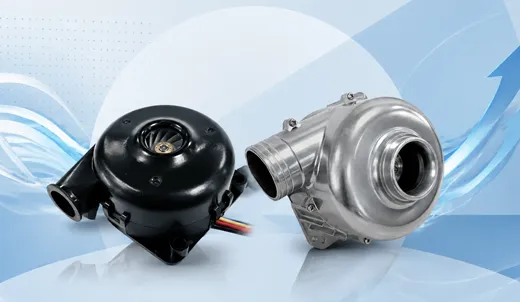
5. Step 4: The 6-Step Standardized Blower Selection Workflow for Design Engineers
To avoid performance deficits or costly over-engineering, system designers should follow this structured process when evaluating how to choose a blower fan:
- Isolate the Primary Operational Application: Define whether the design centers on medical respiratory support, analytical metrology, or heavy industrial sweeping to establish the target static pressure envelope.
- Calculate Net Volumetric Airflow Requirements: Identify your system's operational airflow needs and multiply by 1.2 to integrate the mandatory 20% safety margin.
- Map Physical Space Restrictions: Measure the exact spatial constraints within your product chassis to filter out models that exceed available footprint boundaries.
- Select the Optimal Drive Configuration: Choose an integrated drive board for tight spaces or an external driver layout for high-load, continuous industrial operations.
- Verify Control Logic Compatibility: Confirm that your central microcontroller interface supports PWM or 0–5V control signals and can read incoming PG tachometer frequency pulses.
- Audit Mandatory Safety and Regulatory Certifications: Verify standard CE, RoHS, and UL listings for industrial environments, and ensure IEC 60601-1 electrical safety and ISO 10993 biocompatibility compliance for medical devices.
6. Deep Technical Specification Matrix: Comprehensive 24V Brushless Centrifugal Blower Lineup
The TKFAN 24V brushless DC centrifugal blower family covers the entire performance spectrum, from low-power medical devices to ultra-high pressure industrial equipment. This portfolio consists of nine core models designed to satisfy rigorous engineering standards. All models utilize standard 24V DC input lines, support dual PWM/0-5V speed regulation, and comply with international safety frameworks.
| Model Designation | Dimensions (mm) | Voltage | Power (W) | Max Airflow (CFM) | Max Pressure (kPa) | Drive Electronics Type |
|---|---|---|---|---|---|---|
| BA5025H24B-A | 54.5 × 51 × 25 | 24V DC | 28.8 | 11.1 | 4.81 | Integrated (Built-In) |
| BA5030H24B-A | 58 × 50 × 28 | 24V DC | 10.8 | 6.0 | 2.90 | Integrated (Built-In) |
| BA7050H24B | 70 × 66 × 45 | 24V DC | 67.2 | 17.8 | 7.89 | Integrated (Built-In) |
| BA7060H24B | 70 × 70 × 60 | 24V DC | 52.8 | 16.2 | 7.40 | Integrated (Built-In) |
| BA8050H24B-A | 80 × 50 | 24V DC | 158.4 | 25.9 | 13.40 | Integrated (Built-In) |
| BA8060H24B-E | 86 × 82 × 60 | 24V DC | 216.0 | 25.1 | 18.20 | Decoupled (External) |
| BA8060H24B-E-25KPA | 86 × 82 × 60 | 24V DC | 280.8 | 28.0 | 24.00 | Decoupled (External) |
| BA8060H24B-B | 96.8 × 93.6 × 72.2 | 24V DC | 184.8 | 33.8 | 18.60 | Decoupled (External) |
| BA9080H24B-A | 103 × 86 × 76 | 24V DC | 367.2 | 72.4 | 18.40 | Integrated (Built-In) |
7. Step 5: Environmental Adaptation and Mechanical Integration Criteria
After finalizing your airflow performance specifications, you must verify the blower's environmental adaptation capabilities to ensure long-term durability in the field:
- Condensation and Moisture Management: Medical ventilators generate high humidity via active inline humidifiers. To prevent component corrosion, specify blowers with at least an IP50 rating featuring fully sealed motor windings.
- Particulate and Chemical Resistance: Industrial shop floors often contain airborne metallic dust or corrosive chemical gases. For these environments, specify customized blowers featuring IP65 enclosures and specialized anti-corrosion outer shell coatings.
- Thermal Threshold Margins: While climate-controlled clinical wards remain stable around 22°C, outdoor charging enclosures or automotive engine compartments experience extreme temperatures. For these scenarios, specify heavy-duty industrial blowers engineered to operate reliably from -25°C up to +85°C.
- Dynamic Rotor Balance Calibration: High-precision laboratory systems and neonatal medical equipment cannot tolerate rotational vibration. Premium blowers undergo strict dynamic balancing tests to minimize structural vibration, ensuring stable sensor readings and quiet operation.
8. Key Technical Frequently Asked Questions (FAQ)
Conclusion: Using a Standardized Selection Process to Guarantee Long-Term System Stability
Effectively choosing a blower fan requires a systematic analysis across six core engineering metrics: operational context, volumetric airflow requirements, static pressure resistance, operating voltage, motor drive layout, and international regulatory compliance. For modern clinical medical devices, precision laboratory instruments, and demanding industrial automation equipment, the 24V brushless DC centrifugal blower fan delivers the optimal combination of efficiency, reliability, and service life.
Following a structured engineering workflow ensures your system maintains adequate performance margins, lowers field warranty claims, and accelerates regulatory approval pipelines. For complete data curves, technical step files, or volume production quotes, please click the link below to connect directly with our engineering team.